Is It Too Late to Change Your Life? (The Ownership Test)
~19 min | August 3, 2026
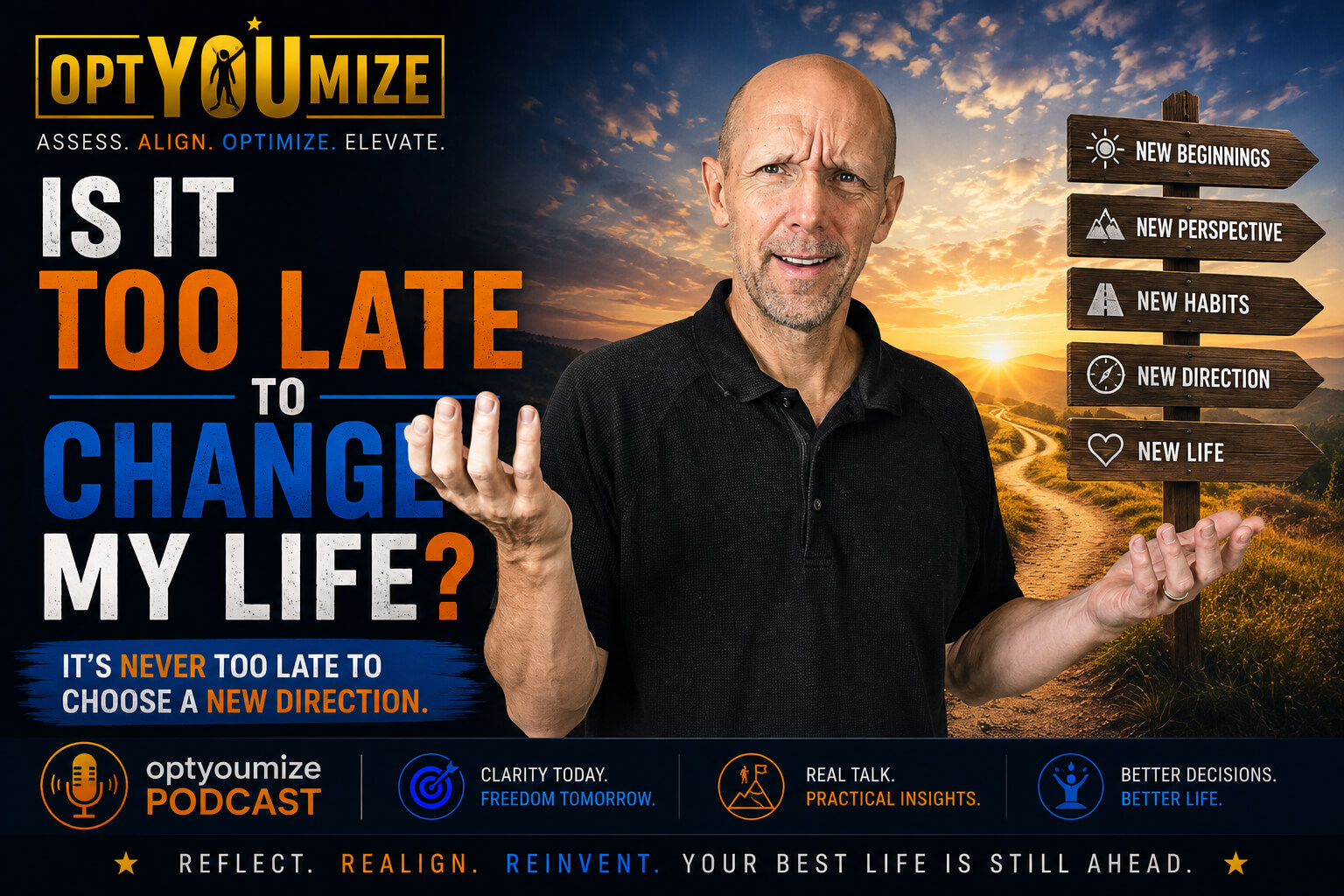
"It's too late" is a feeling, not a fact, and most of the deadlines we're measuring ourselves against were never ours to begin with. In this episode, Brett breaks down why the voice telling you your window has closed is working from bad information, and gives you a three-question "ownership test" for telling a real constraint from an inherited story, so you can find out whether the change you keep circling is actually worth making.
What You'll Learn in This Episode
- Why the feeling that it's too late is not evidence that it's too late — and the specific blind spot in how our minds predict our own future selves
- The 2013 "End of History Illusion" study and what it reveals about why every age group believes they're basically done changing
- The difference between a real constraint and a borrowed deadline you absorbed from comparison, family expectation, or culture — and never agreed to
- Why "is it too late?" is actually two different questions wearing the same coat, and why only one of them deserves a factual answer
- The Ownership Test: three questions to separate a change that's genuinely yours from one that's just an escape
- Why the regret of the untried tends to outlast the regret of things that didn't work out
- The smallest honest step you can take this month to turn "too late" from a story you obey into a fact you check
Episode Timestamps
[0:00]Introduction — the version of your life you keep circling[2:00]Why "too late" feels so convincing, even when it's wrong[4:00]The End of History Illusion — the 2013 study on how badly we predict our own change[7:00]Borrowed deadlines — where your "too late" clock actually comes from[8:00]Julia Child and the myth of the linear timeline[10:00]Separating real constraints from inherited stories[11:00]Moving toward vs. running from — why the same decision can mean two different things[13:00]The Ownership Test — three questions to run any change through[16:00]Why the regret of the untried outlasts the regret of trying[17:00]This week's smallest honest step
Episode Summary
There's a version of your life you keep circling back to. Different work, a creative thing you set down years ago, a move, a different way of being in your own days. And every time it comes close, a quiet voice forecloses it: "Nice idea, but that ship's already sailed." Brett opens this episode by taking that voice seriously instead of arguing with it — and then taking it apart.
The central claim of the episode is simple and, once you hear it, hard to unhear: "The feeling that it's too late is not evidence that it's too late." Those are two different things, and we habitually treat them as one. To back this up, Brett walks through a 2013 study published in Science by psychologists Jordi Quoidbach, Daniel Gilbert, and Timothy Wilson, called "The End of History Illusion." Researchers surveyed more than 19,000 people ages 18 to 68 and asked how much they'd changed over the past decade versus how much they expected to change over the next one. At every single age, people readily admitted they'd changed a lot in the past — and then predicted they'd barely change going forward. In other words, no matter how old you are, there's a persistent illusion that right now is the moment you've finally become who you're going to be. If that's true at every age, the person telling you "it's too late for me to become someone different" is very likely making the exact predictable error the whole species makes.
That's the first thing "too late" gets wrong: it assumes you're finished. The second thing is about the clock itself. Most of the deadlines we carry — established in your 20s, settled by your 30s, peaked in your 40s — aren't real deadlines. They're borrowed ones, absorbed from peer comparison, family expectation, and culture, never consciously chosen. Brett illustrates this with Julia Child, who didn't cook seriously until her late 30s, trained in France at 36, and published the cookbook that made her a household name at 49. Measured against the timeline most of us carry, she'd have been called finished. It would have been wrong.
Here's where the episode does its most useful work. Brett argues that "is it too late?" isn't one question — it's two, wearing the same coat, and they need different answers. The first is the constraint question: is this change actually still possible, physically and practically? That deserves a clear-eyed factual answer, not a feeling. The second is the ownership question, and it's the one almost nobody asks: is this change mine? Are you moving toward something that genuinely fits who you're becoming, or just trying to escape something that hurts right now? Two motivations that feel identical in the moment but lead to completely different places — because a change built only on escape tends to rebuild the same problem somewhere new.
From there, Brett offers what he calls the ownership test: three questions to run any change you're circling through. The constraint question (what specifically is in the way, and have you actually inspected the wall or just assumed it's there?), the ownership question (finish the sentence "I want this change because ___" and notice whether you're moving toward something or away from something), and the cost-of-not question (what does it quietly cost you in five years if you never touch this at all?). The point isn't to talk you into changing — it's to make the choice yours instead of the fear's. And the research on regret backs this up: people tend to make peace with things they tried that didn't work out. What sits heaviest years later is the door they never walked up to at all.
This idea sits at the center of what optYOUmize means by growth — not a checklist of habits or a race against a timeline, but the slower, more honest work of closing the gap between how your life looks and how it actually fits. If this episode resonated, that's the deeper territory to explore next.
The takeaway Brett leaves you with: this week, do exactly one honest thing with the change you keep circling. Not the leap — just the inspection. Walk up and touch the wall you've been describing from across the room.
Resources Mentioned
- "The End of History Illusion" — Jordi Quoidbach, Daniel T. Gilbert, and Timothy D. Wilson, Science, Vol. 339, Jan. 4, 2013 — DOI: 10.1126/science.1229294
- Julia Child — chef and author who didn't train professionally until her late 30s — en.wikipedia.org/wiki/Julia_Child
- The Shawshank Redemption — referenced for the line "Get busy living, or get busy dying"
Frequently Asked Questions
Is it actually too late to change your life? Usually not — but the honest answer depends on separating two different questions. Whether a specific change is still physically or practically possible deserves a factual answer, not a feeling. Whether the change is genuinely yours to make (versus an inherited deadline you never agreed to) is the question most people never actually ask.
What is the "End of History Illusion"? It's a finding from a 2013 study in Science (Quoidbach, Gilbert, and Wilson) showing that people at every age readily admit they've changed a lot in the past decade, but consistently predict they'll barely change in the next one. The researchers concluded people tend to treat the present as a kind of finish line for who they'll become — a belief the data shows is reliably wrong at every age.
How do I know if a deadline I'm holding myself to is real or just something I absorbed? Ask where it actually came from. Most "too late" deadlines trace back to peer comparison, family expectation, or a cultural script (established in your 20s, settled by your 30s) rather than any genuine constraint. A real constraint is something you can name specifically — a dollar amount, a skill gap, an obligation to a real person. If you can't name the specific obstacle, it's likely a borrowed story rather than a wall.
What is the "ownership test" from this episode? It's a three-question framework for deciding whether a change you're circling is genuinely yours to make: the constraint question (what's factually in the way, and have you actually inspected it?), the ownership question (are you moving toward something or escaping something?), and the cost-of-not question (what does staying the same quietly cost you in five years?).
What's the difference between making a change to move toward something versus to escape something? Both can look identical from the outside — quitting a job, for example — but internally one is a compass and the other is a fire alarm. A change built primarily on escaping discomfort tends to recreate the same problem in a new location, because part of what you didn't like was inside the situation and part was inside you. A change built on moving toward something specific tends to be more durable.
Do people regret the changes they tried that didn't work out? Research on regret suggests people tend to make peace with things they tried, even when they didn't land the way they'd hoped. What tends to weigh heaviest years later is the door someone never walked up to check at all — the regret of the untried, which is a distinct and more durable kind of regret.
What's the smallest step I can take if I'm not ready to make a big change? Brett's advice is to skip the leap and start with the inspection. Take the change you keep circling and do one honest, small thing to test it this month — a class, a conversation, one experiment — small enough that "too late" becomes a fact you check instead of a story you obey.
Keep Exploring
If this episode resonated, these are worth your time:
- Growth & Self-Becoming — The optYOUmize pillar page on growing in the direction of your own values instead of a borrowed timeline → https://optimizeyoumize.com/growth-self-becoming/
Enjoyed This Episode?
The best way to support optYOUmize is to subscribe and leave a review — it takes about two minutes and makes a real difference in helping more people find the show.
Apple Podcasts · Spotify · Amazon Music · YouTube