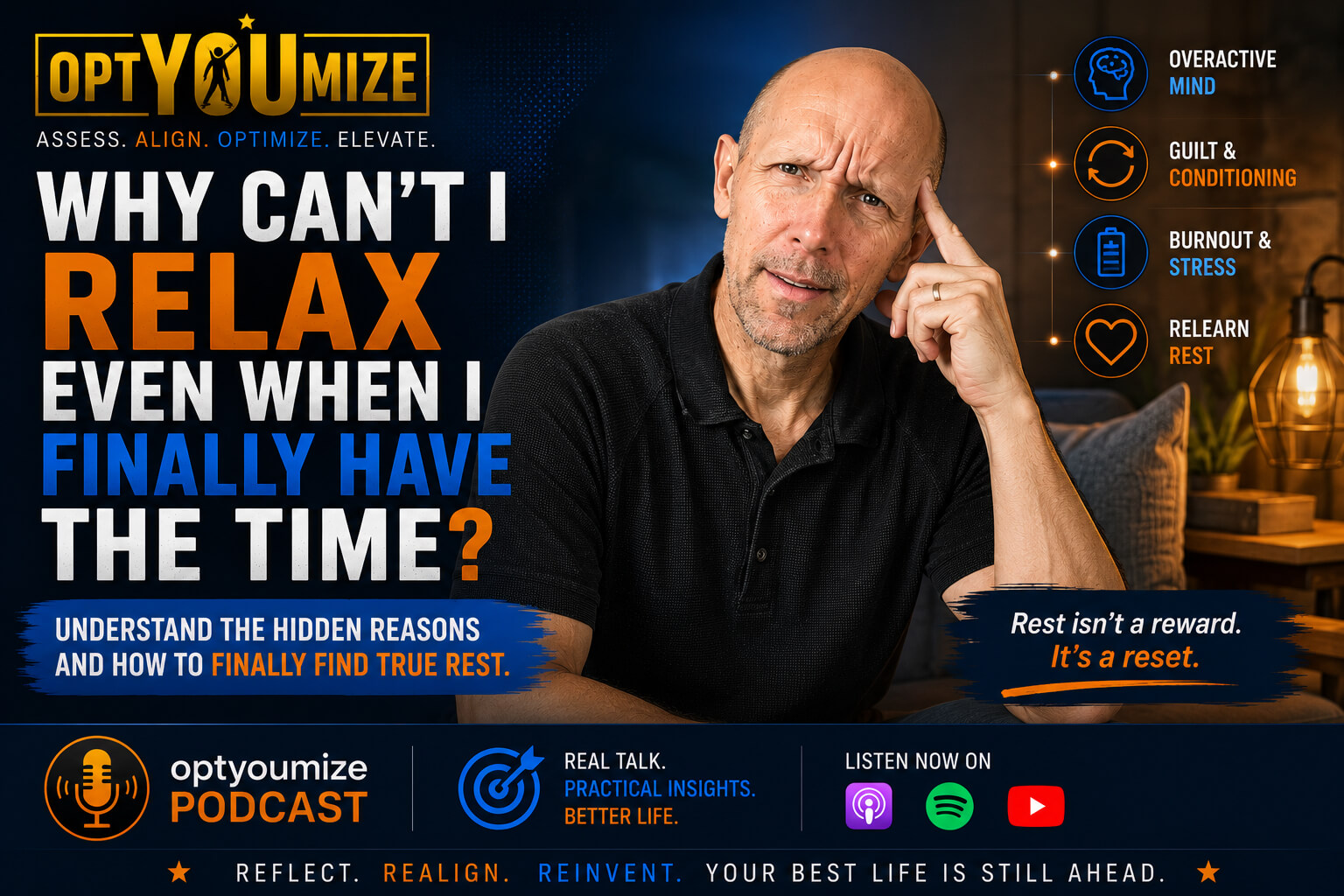
Why Can't I Relax Even When I Finally Have the Time?
~20 min | August 6, 2026
You can't relax on a free evening because rest isn't the default state you fall back into once demands stop — it's an active shift your nervous system has to make, and years of staying switched on can wear down your ability to make it. Add a quiet belief that rest has to be earned, and even the time you do have starts to feel like something you need to justify. In this episode, Brett Ingram breaks down why your body treats "on" as its baseline, walks through two studies on just how uncomfortable stillness really is for most people, and gives you a single 60-second practice for rebuilding the capacity to come down.
What You'll Learn in This Episode
- Why rest isn't the default you return to when demands stop — it's an active nervous system shift, and shifts are skills that can go rusty
- How years of staying "switched on" trains your body to treat activation, not calm, as its resting baseline
- The quiet belief — rest has to be earned — that turns downtime into something you feel guilty taking
- What the University of Virginia "shock" study reveals about how uncomfortable most people find sitting alone with their own thoughts
- Why people who believe leisure is wasteful enjoy it less, even while they're doing it
- Three honest questions to ask yourself the moment you notice you can't settle
- The 60-second daily practice for rebuilding your capacity to rest — no meditation app required
Episode Timestamps
[00:00]Cold open — the free evening you can't relax into[01:00]Introduction — what optYOUmize means by real optimization[02:00]Naming the pattern — why this isn't a willpower problem[04:00]The two nervous system modes: activation and recovery[06:00]The belief that rest has to be earned[09:00]Study one — the electric shock experiment[11:00]Study two — why "wasteful" leisure doesn't land[13:00]Three questions to ask when you can't settle[17:00]The 60-second practice[18:00]Closing reflection and the Ferris Bueller line
Episode Summary
Most advice about rest starts from the wrong assumption: that if you clear your calendar, calm will fill the space automatically. Brett Ingram spends this episode dismantling that assumption, starting with a scene a lot of listeners will recognize — a cleared evening, nothing owed to anyone, and a low hum of restlessness that shows up anyway.
The episode opens by ruling out the obvious explanation. This isn't a willpower problem, and telling someone to "try harder to relax" is a contradiction most people have already tested and failed on a vacation somewhere. The real explanation, Brett argues, is that rest is not the resting state you assume it is. It's an active shift the nervous system has to make between two modes: an activated mode that gets you through deadlines and demands, and a restorative mode that actually repairs and recovers. A healthy life moves between them — [the rhythm between activation and recovery] — but years spent mostly in the activated mode teach your body to treat "on" as the default, not the exception. When the demands finally stop, the system doesn't glide down. It idles high, because high is the only setting it remembers well.
That's the physical layer. The second layer is the story people carry about what rest means. Brett names a quiet equation most of us absorbed without ever agreeing to it: rest is what you get after — after the list is done, after you've earned it. "Rest is not a reward for completion," he says, "and in modern life, completion never actually arrives." The list refills. The inbox regenerates overnight. If rest has to be earned first, it never comes, and any rest taken early starts to feel like something stolen.
Two pieces of research anchor the episode and take it well past personal anecdote. The first comes from a set of studies led by psychologist Timothy Wilson at the University of Virginia, published in Science in 2014. Participants were left alone in a plain room for six to fifteen minutes with nothing to do but think — no phone, no task. Given the option to press a button that delivered a mild electric shock they'd already said they'd pay to avoid, about two-thirds of men and a quarter of women pressed it anyway rather than sit with their own thoughts. One man pressed it 190 times. The takeaway isn't that something is wrong with you if reaching for your phone in the first ninety seconds of quiet feels compulsive — it's one of the more universal human reflexes there is.
The second study, led by Gabriela Tonietto and Selin Malkoc and published in the Journal of Experimental Social Psychology in 2021, found that people who believe leisure is fundamentally wasteful enjoy their leisure less — even while they're doing it — and that the same belief correlates with lower reported happiness and higher stress, anxiety, and depression. Put the two studies together and the picture sharpens: a nervous system trained to stay up, a mind that finds stillness genuinely uncomfortable, and a belief that rest isn't worth taking even when it's available.
Brett's answer isn't another system to optimize. It's three questions to run when you notice you can't settle — am I resting or just less stimulated, what kind of tired am I, and what's the smallest amount of nothing I can tolerate — followed by a practice deliberately built to be too small to fail: once a day, take sixty seconds of time you'd normally fill and simply don't fill it. Not thirty minutes. Sixty seconds. The goal, as he puts it, "is not to be excellent at resting. The goal is to let some of your life be unoptimized on purpose."
Resources Mentioned
- "Just Think: The Challenges of the Disengaged Mind" — Timothy Wilson et al., Science, 2014 — the study on people choosing electric shocks over sitting alone with their thoughts — Read the study
- "Viewing Leisure as Wasteful Undermines Enjoyment" — Gabriela Tonietto, Selin A. Malkoc, Rebecca Walker Reczek, and Michael I. Norton, Journal of Experimental Social Psychology, 2021 — Read the study
- Ferris Bueller's Day Off (1986) — Referenced for the closing line: "Life moves pretty fast. If you don't stop and look around once in a while, you could miss it."
Frequently Asked Questions
Why can't I relax even when I finally have free time? Because rest isn't the default state your body returns to when demands stop — it's an active shift the nervous system has to make, and that shift is a skill. If you've spent years mostly in an activated, switched-on mode, your body starts treating that as baseline, so when the pressure lifts, your system keeps idling high instead of settling down.
Is feeling restless during downtime a sign of anxiety? Not necessarily. Low-level restlessness when demands stop is a common, well-documented pattern, not a diagnosis. If the inability to switch off is constant, heavy, or accompanied by dread, that's worth discussing with a professional — but for most people it's simply a nervous system and belief system that adapted to years of low-grade activation.
Why do I feel guilty when I'm not being productive? Many people absorb an unspoken rule that rest has to be earned — through completing tasks, being useful, or "deserving" a break. Because that list never actually finishes, rest taken before it's "earned" can feel like theft, which shows up as guilt on an otherwise free evening.
What's the difference between resting and just being less stimulated? Scrolling, half-watching a show, or refreshing the news lowers stimulation but doesn't shift your body into genuine recovery — it just distracts. Brett's test: after the activity, do you feel more like yourself, or just less wound up? Genuine rest passes that test; numbing doesn't.
What was the study about people choosing electric shocks over sitting quietly? In a set of 2014 studies led by psychologist Timothy Wilson at the University of Virginia, participants left alone with nothing to do for six to fifteen minutes were given the option to shock themselves. About two-thirds of men and a quarter of women chose the shock rather than sit with their own thoughts — evidence of just how uncomfortable undirected stillness is for most people.
How do I actually start practicing rest if it feels uncomfortable? Start absurdly small. Once a day, take sixty seconds of time you'd normally fill — the wait for coffee, the first minute in the car — and simply don't fill it. The discomfort in that first minute isn't a sign it's not working; it's the sensation of a rusty capacity being used again.
Keep Exploring
If this episode resonated, these are worth your time:
- Time Rhythm & Rest Pillar — A full guide to building a sustainable rhythm between effort and recovery → [INSERT PILLAR URL]
- Why We Sleep Wrong — And What It's Costing You Beyond Tiredness — Goes deeper on the biology of recovery and why cutting it short costs more than tiredness → [INSERT LINK]
- The Optimization Paradox: Why More Doesn't Mean Better — Explores why turning every part of life into something to improve can backfire — including rest itself → [INSERT LINK]
Enjoyed This Episode?
The best way to support optYOUmize is to subscribe and leave a review — it takes about two minutes and makes a real difference in helping more people find the show.
Apple Podcasts · Spotify · Amazon Music · YouTube