
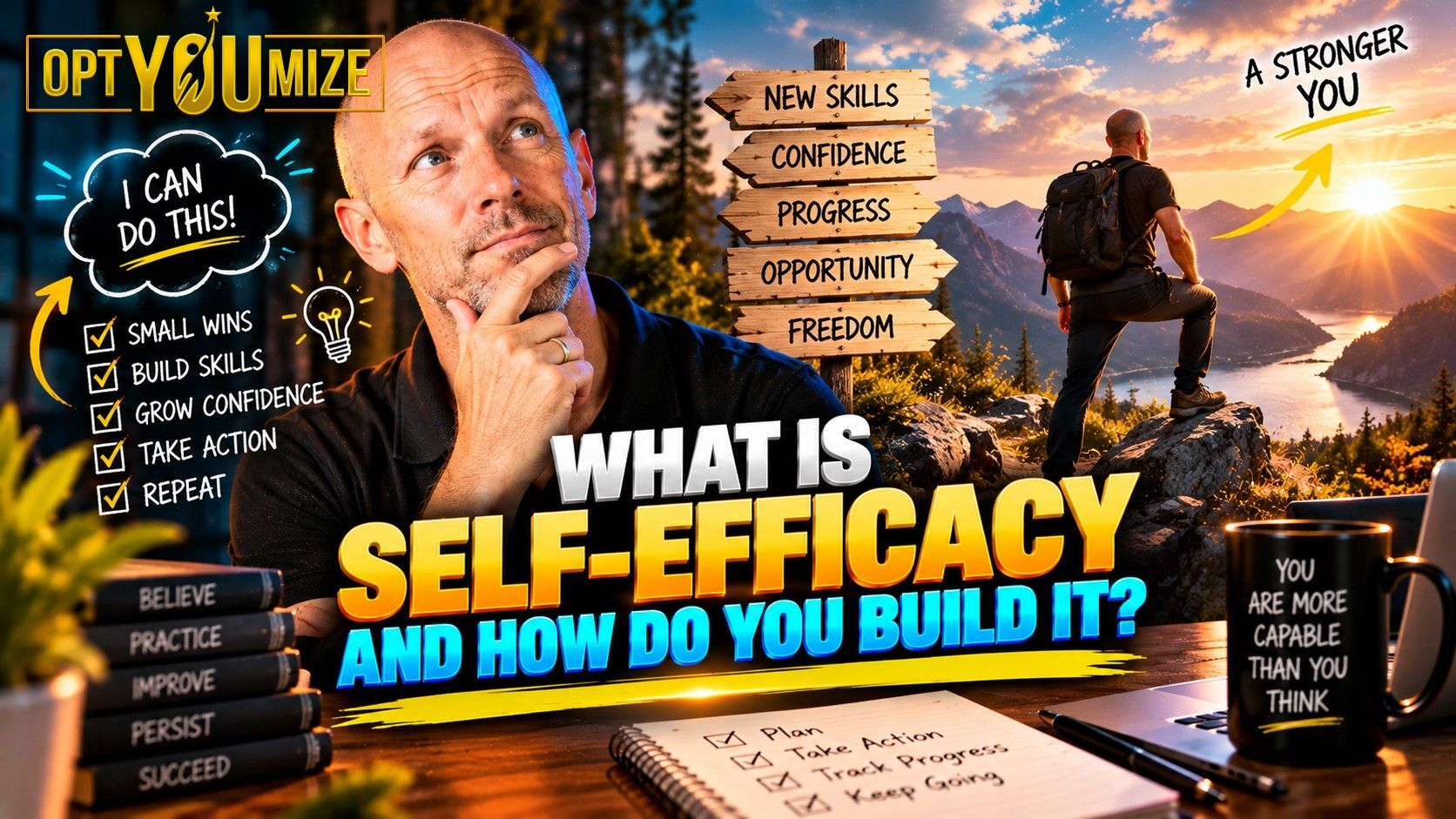
What Is Self-Efficacy and How Do You Build It?
By Brett Ingram | Last updated October 29, 2026 | 6 minute read
Self-efficacy is your belief that you can do a specific task or reach a specific goal. It isn't general confidence, and it isn't self-esteem. Psychologist Albert Bandura proposed that it's built from four sources: doing the thing and succeeding (even in small ways), watching someone like you do it, hearing credible encouragement, and how your body feels as you try. The practical takeaway is encouraging: you build it by collecting evidence, not by pep-talking yourself.
The Simple Answer
Self-efficacy is "I can do this particular thing." Not "I'm a great person" and not "I feel good about myself." The Stanford Center on Longevity summarizes it as a person's own beliefs about their ability to do a task or activity, and notes those beliefs may not match actual ability. That gap is the interesting part. Some people underrate themselves and never start. Others overrate themselves and skip the practice. The sweet spot is a belief that's earned and roughly accurate.
Where Does the Idea Come From?
Albert Bandura spent nearly 60 years at Stanford. Stanford's obituary describes self-efficacy as a person's belief in their ability to succeed and how that belief shapes their thinking, actions, and feelings. The Association for Psychological Science called him one of the most influential psychological scientists in the world and noted he received the National Medal of Science in 2016. His former student and colleague Elizabeth Ozer said he "lived his theory of self-efficacy - instilling confidence for successful experiences." And his assistant recalled his favorite sign-off: "Onward and upward and let the efficacy force be with you." A psychologist with a Star Wars-adjacent catchphrase. I'd have liked to take his class.
What Are the Four Sources of Self-Efficacy?
In his 1977 paper, Bandura said expectations of personal efficacy come from four principal sources of information. Here they are in plain English, with my own examples:
| Source (Bandura's term) | What it means | Everyday example |
|---|---|---|
| Performance accomplishments | You try it and it works, even a little | You finish one 10-minute run and realize you didn't die |
| Vicarious experience | You watch someone relatable succeed | A coworker with your background gets the promotion |
| Verbal persuasion | Someone credible tells you that you can | A mentor says "you're ready, I've seen your work" |
| Physiological states | How you read your body's signals | Racing heart before a talk: fear, or just energy? |
Examples are mine, for illustration; the four category names come from Bandura's 1977 paper as summarized by Stanford.
What Happened in the Snake Study?
This is my favorite part. In one of the studies summarized by Stanford, people with snake phobias were split into groups. One group did progressively more threatening interactions with a boa constrictor themselves. Another watched a therapist do the same tasks. A third got no treatment. The people who did the tasks themselves ended up with higher self-efficacy at follow-up, and the belief carried over to other snakes and to situations not covered in therapy. Doing beat watching.
Please do not take this as a prompt to adopt a boa. The point is the structure: small, graded steps, each one a bit scarier than the last, with the person doing the actual doing.
How Is Self-Efficacy Different From Self-Esteem or a Growth Mindset?
Self-esteem is how you feel about yourself overall. Self-efficacy is task-specific. You can have high self-esteem and low self-efficacy for public speaking, or the reverse. If you've read our piece on what a growth mindset is and where it goes wrong, you'll see the connection: believing you can improve is one thing, but having evidence you can do this specific thing is what makes you actually start.
How Do You Build Self-Efficacy on Purpose?
These steps are my practical take on Bandura's four sources, not a clinical protocol.
- Shrink the goal until it's almost silly. Not "get fit." One ten-minute walk. Wax on, wax off: the boring reps are the point.
- Write down the result. One line in a notes app. Your brain is bad at remembering wins and great at remembering stumbles. This is evidence storage.
- Find a relatable example. Someone a few steps ahead of you, ideally with a similar starting point. Superstars don't count; they feel like a different species.
- Ask one credible person for an honest read. Not a cheerleader. Someone who has seen your work.
- Reinterpret the jitters. A racing heart can mean "I'm in danger" or "I care about this." Try naming it the second one. (This is my suggestion; Bandura treated physiological states as an input, not a trick.)
- Raise the bar slightly and repeat. Twelve minutes. Then fifteen.
If this sounds like habit-building, it overlaps. Our post on how long it really takes to form a habit pairs well with it. And if a little voice says you'll be found out, imposter syndrome often shows up exactly when self-efficacy is lagging behind your real skills.
Is It Ever Too Late to Build It?
I don't think so, and nothing in Bandura's framework says otherwise: the sources are experiences, and you can keep having experiences. If you're starting something at 45 or 60, you can still collect small wins. We dig into that in is it too late to learn something new as an adult.
One note: if low confidence feels heavy or constant, or is tied to depression or anxiety, a mental health professional can help. This post is general information, not medical or psychological advice.
Frequently Asked Questions
What is self-efficacy in simple terms?
It's your belief that you can do a specific task or reach a specific goal. It's task-specific, so you can have strong self-efficacy for cooking and weak self-efficacy for public speaking.
What is the difference between self-efficacy and self-esteem?
Self-esteem is your overall feeling about yourself. Self-efficacy is your belief in your ability to do a particular thing. They can move independently.
What are the four sources of self-efficacy?
According to Bandura's 1977 paper: performance accomplishments, vicarious experience, verbal persuasion, and physiological states. In plain terms, doing it, watching someone like you do it, credible encouragement, and how your body feels.
How can I build self-efficacy quickly?
There's no fast shortcut, but small, achievable steps that you complete and record tend to be the most direct route, because doing the task yourself gave the strongest results in the Stanford-summarized snake study. Start tiny and raise the bar gradually.
Where This Leaves You
You don't need to become a more confident person first. You need one small thing you can do this week, and a way to notice that you did it. Stack a few of those and the belief starts to follow. For more on becoming who you're aiming to be, explore our Growth & Self-Becoming pillar.