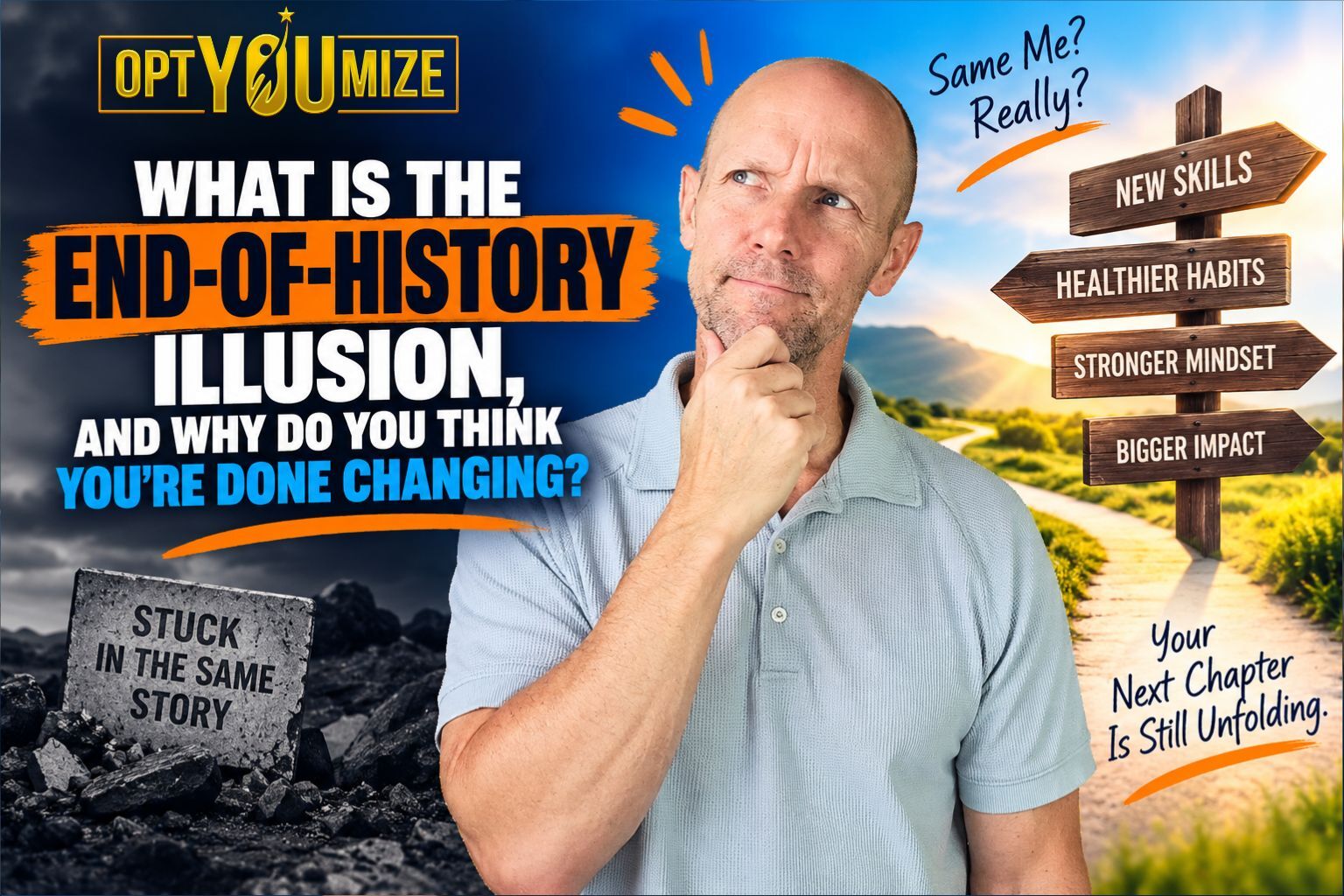
What Is the End-of-History Illusion, and Why Do You Think You're Done Changing?
By Brett Ingram | Last updated September 15, 2026 | 8-9 minute read
Short answer: the end-of-history illusion is a well-documented psychological pattern where people accurately recognize how much they've changed in the past, but consistently underestimate how much they'll change in the future - at every age, from eighteen to sixty-eight. A landmark study of more than 19,000 people found that no matter how old someone was, they tended to believe their personality, values, and preferences had basically finished forming and would stay roughly put from here on out. They were wrong, on average, every single time. You are, in all likelihood, still under construction - and believing otherwise can quietly cost you more than you'd think, including actual money.
The Simple Answer
The end-of-history illusion is the tendency to treat the present moment as the point where your personal development effectively wraps up. You'll acknowledge - readily, even proudly - that the person you were at twenty was pretty different from who you are now. Different taste in music, different values, maybe a different sense of what a good life even looks like. But ask that same person whether they expect to change much between now and ten years from now, and most people shrug and say no, not really. They feel done. History, as far as their own personality is concerned, has basically ended. It hasn't.
The Deeper Answer: What 19,000 People Actually Revealed
Psychologists Jordi Quoidbach, Daniel Gilbert, and Timothy Wilson ran a set of studies, published in the journal Science, that tested this directly. In their research, involving more than 19,000 participants ranging from age 18 to 68, they split people into two groups. "Reporters" looked backward - rating how much their personality, values, and preferences had changed over the past decade. "Predictors" looked forward - rating how much they expected those same things to change over the next decade.
If people accurately understood how much they change, the two groups' answers should have roughly matched - what an 18-year-old predicts for their next ten years should look similar to what a 28-year-old reports having just gone through. Instead, predictors at every age consistently lowballed the amount of change ahead of them compared to what people who'd already lived through that same decade reported. Teenagers did it. People in their thirties did it. People in their sixties did it. The gap didn't close with age or life experience - it just kept showing up, decade after decade, in a slightly different costume.
| What Was Tested | What Participants Did | What Researchers Found |
|---|---|---|
| Personality traits | Rated their own personality now, then either recalled it from 10 years ago or predicted it 10 years ahead | People believe their personality has settled more than it actually has |
| Core values | Ranked the importance of basic values like achievement, security, and connection | Same underestimation pattern held for what people believe matters most to them |
| Preferences | Named favorite foods, music, hobbies, and vacations | People expected today's favorites to stay favorites; reporters showed those tastes had, in fact, moved |
The researchers' own explanation is almost funny once you sit with it: people seem to walk through life regarding right now as the moment they finally became who they are - and then keep doing that, at every single "right now," for their entire lives.
The Concert Ticket That Proves the Point
Here's where it stops being just an interesting fact about memory and starts costing people real money. In one experiment, the researchers asked one group of participants to name their current favorite musical artist and say how much they'd pay to see that artist perform ten years from now. They asked a second group - people ten years older - to name their favorite artist from a decade ago and say how much they'd pay to see that former favorite perform this week.
| Group | Question Asked | Average Willingness to Pay |
|---|---|---|
| Predictors | "How much to see your current favorite artist perform 10 years from now?" | $129 |
| Reporters | "How much to see your favorite artist from 10 years ago perform this week?" | $80 |
People predicting their own future preferences were willing to pay roughly 61 percent more, on average, to lock in a preference they assumed would still hold in a decade. It rarely does, at least not with the same intensity. The researchers called this what it is: a real, quantifiable overpay, built entirely on a mistaken belief that your current tastes are your permanent ones. Nobody thinks they're doing this in the moment. Everybody, apparently, is doing it anyway.
Why Does This Happen?
None of this is really about vanity or self-delusion. It seems to be a basic feature of how memory and imagination work differently. Remembering how you've changed is a straightforward retrieval task - the evidence already exists, in old photos, old journal entries, old decisions you can look back on and wince at. Imagining how you'll change is a construction task, and a much harder one. Your brain has to build a plausible future self from scratch, with almost no material to work with, so it defaults to the simplest available model: more of the person standing here right now.
There's also a stability that change itself creates. Personal growth rarely announces itself. It happens through hundreds of small, forgettable Tuesdays rather than one dramatic Wednesday, which means the "you" of right now feels stable and finished in a way that's more a trick of the lighting than a fact about who you actually are. We've written before about a related version of this blind spot - how easy it is to mistake motion for growth, or stillness for having arrived - and the end-of-history illusion is really that same idea, pointed forward instead of backward.
Why This Actually Matters for the Decisions You're Making Right Now
This isn't just a fun cocktail-party fact about your old haircut and questionable music taste. Believing your current self is your final self quietly shapes real decisions:
You make identity-based decisions that assume permanence. "I'm just not a person who exercises." "I'll never enjoy that kind of work." "I'm not the type to move to a new city." Every one of those statements treats a current preference as a fixed trait, when the research says it's much more likely a snapshot.
You underinvest in your own future self. Separate research on what psychologists call "future self-continuity" - how connected you feel to the person you'll be years from now - found that people who feel more psychologically connected to their future self actually accumulate significantly more financial assets over their lifetime, even after accounting for age and education. If the end-of-history illusion makes your future self feel like a stranger you don't need to plan for, that's a costly habit of mind, not just an amusing one - and it's part of why the difference between healing and growth matters: healing often looks backward, but growth requires actually believing there's someone ahead of you worth building toward.
You overpay - literally and figuratively - to lock in the present. The concert study is the clean example, but the same logic shows up in the job you take because it fits who you are "right now," the house you buy assuming your needs are set, or the relationship pattern you assume you'll always want, exactly as it looks today.
So... Are You Actually Done Changing?
The simple answer: almost certainly not, no matter your age or how settled you feel. That's not a flaw to fix. It's just accurate information the illusion tends to hide from you.
The deeper answer: this is genuinely good news, not a threat. If you're currently unhappy with some part of who you are, the research says that part is less permanent than it feels. And if you're happy with who you are right now, that's worth enjoying without mistaking it for a finish line - because ten years from now, there's a good chance you'll look back at today the same way you look back at twenty-two: recognizably you, and also someone that person hadn't quite become yet. This is really the optimistic core of what we mean by a growth mindset, done right - not endless self-improvement pressure, just an honest acknowledgment that you're not finished, and don't need to pretend you are.
How to Use This (Instead of Just Finding It Interesting)
Loosen your grip on identity statements. Notice when you say "I'm just not someone who..." and treat it as a current data point, not a permanent fact. It may be true today and false in three years.
Make one decision this month as if your future self is a real person you're planning for. A savings transfer, a boundary, a healthy habit you start before you feel ready - small acts of taking your future self seriously, rather than treating them as someone else's problem.
Revisit an old "I'll never" and check if it's still true. A food you swore off, a hobby you dismissed, a version of work you ruled out. Not everything needs revisiting. But a few of those closed doors are probably closed by habit, not by an accurate read on who you actually are now.
Hold your current certainty a little more loosely. This isn't an argument for chasing every impulse or abandoning your values on a whim - it's an argument for humility about how fixed they really are, which tends to make people easier to live with, including themselves.
Frequently Asked Questions
What is the end-of-history illusion?
It's a documented psychological pattern where people accurately recall how much they've changed in the past but consistently underestimate how much they'll change in the future, believing their current personality, values, and preferences are close to their final form.
Who discovered the end-of-history illusion?
Psychologists Jordi Quoidbach, Daniel Gilbert, and Timothy Wilson documented it in a 2013 study published in the journal Science, based on data from more than 19,000 participants between the ages of 18 and 68.
Does the end-of-history illusion get weaker as people get older?
No. The research found the pattern held at every age tested, from teenagers to people in their sixties. Older participants reported less total change than younger ones, which makes sense, but they still underestimated their own future change by a similar margin.
How does the end-of-history illusion affect real decisions?
It shows up in identity-based choices ("I'm just not that kind of person"), underinvestment in long-term goals like saving, and a documented willingness to overpay for experiences built around current preferences - like the study's concert-ticket experiment, where people paid about 61 percent more to lock in a favorite they assumed would still be their favorite a decade later.
What can I actually do differently, knowing this?
Treat strong "I'll never" or "I'm just not" statements as current data rather than permanent facts, make at least one decision that takes your future self seriously (saving, health, boundaries), and stay open to revisiting a few things you ruled out a while ago.
Where This Leaves You
You are not finished. Almost certainly, no matter how settled today feels, there's more revision coming - in what you value, what you enjoy, and who you're becoming. That's the entire premise behind the Growth & Self-Becoming pillar here: not a pressure to constantly reinvent yourself, but an honest, research-backed permission slip to keep being a work in progress. History isn't ending. It's just quiet today.