Why Do We Enjoy Being Scared? What It Does for Your Mind
By Brett Ingram | Last updated October 31, 2026 | 6 minute read
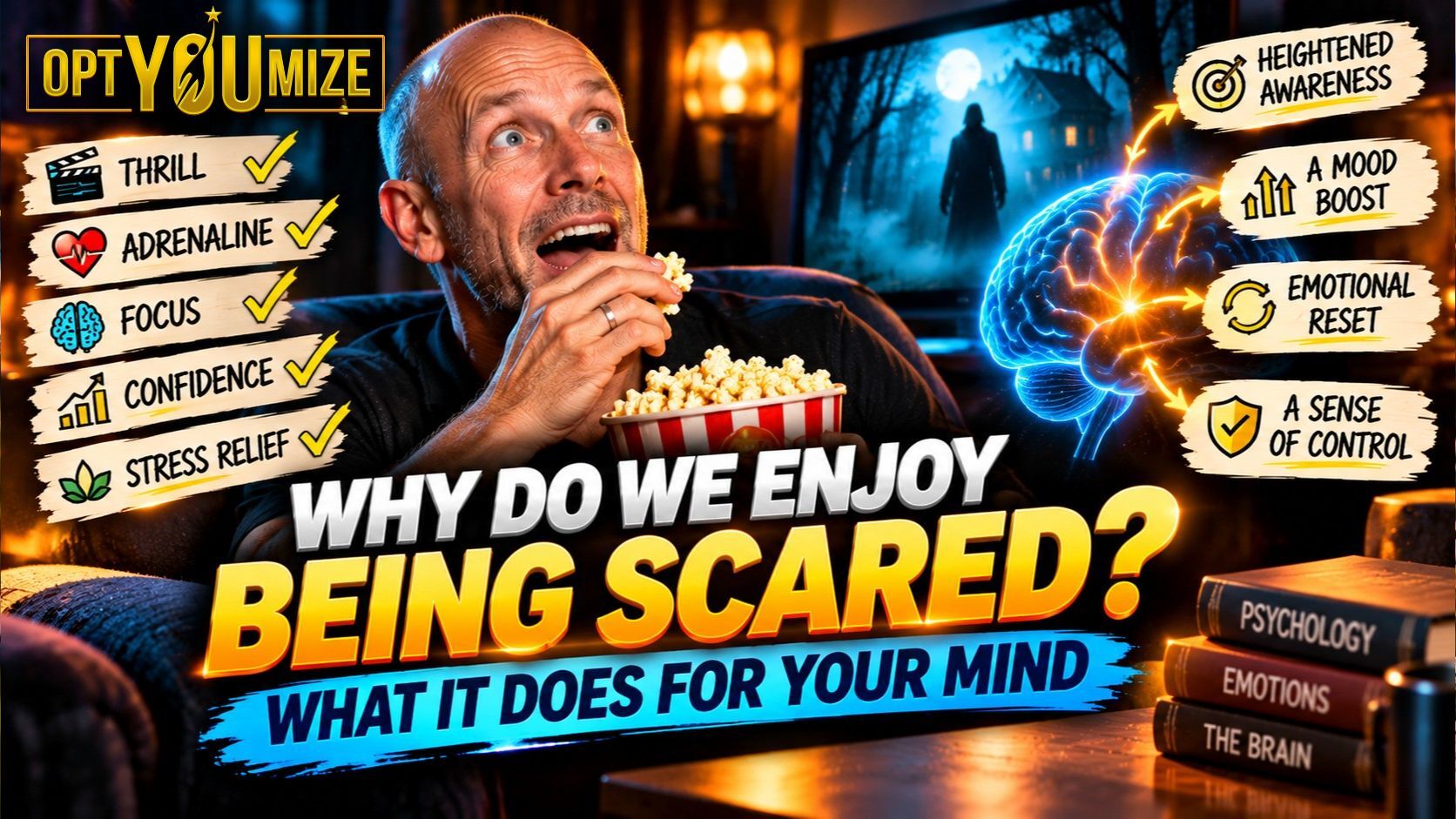
We enjoy being scared, in the right dose, because the fear is real but the danger isn't. Researchers call this recreational fear. Your body gets the racing heart and the jolt of adrenaline, while your thinking brain stays in the loop and knows you're safe on the couch. Some researchers believe that combination gives us a low-stakes way to practice feeling afraid and getting through it. It only works inside a sweet spot, though. Too tame is boring, and too intense is just miserable.
The Simple Answer
Recreational fear is the enjoyment of feeling frightened in a context you know is safe: horror movies, haunted houses, roller coasters, true crime podcasts. People enjoy it when the fear is strong enough to be exciting but not so strong that it overwhelms them. Researchers also suggest it can work like practice, a way to rehearse emotion regulation with the training wheels on.
What Did the Haunted House Studies Find?
Here's the part I love: scientists really did put heart rate monitors on people and send them through a haunted house. Researchers at Aarhus University in Denmark, home of the Recreational Fear Lab, did a field study at a haunt. According to lab director Mathias Clasen's write-up, "The New Science of Recreational Fear", they set up cameras at the scariest spots, strapped on the monitors and collected survey data.
What they found was an "inverted U-shaped relationship." If an experience isn't scary enough, people are bored. If it's too scary, they get overwhelmed and the pleasure drops off. In between is what Clasen calls the "sweet spot of fear," and it varies from person to person. That's the study published in Psychological Science in 2020 by Andersen and colleagues.
Sweet spot Bored Overwhelmed How frightening the experience is → Enjoyment → Conceptual sketch of the inverted-U pattern, not plotted from the study's data.
Are There Different Kinds of Horror Fans?
Yes, and this is where it gets personal. A later study led by behavioral scientist Coltan Scrivner and colleagues (Scrivner, Andersen, Schjødt and Clasen, 2022) described three types of haunted-house visitors, as summarized by Clasen:
- Adrenaline junkies report a mood boost from horror entertainment.
- White-knucklers feel they learn something important about themselves.
- Dark copers seem to get the benefits of both, but many use horror as a kind of self-medication for difficult feelings.
On a Scientific American podcast, Scrivner describes the white-knucklers as people who were really afraid during the haunted house and still came away thinking, in effect, "I really enjoyed feeling like I could get through this." There's a good chunk of the horror audience in that second group. Scrivner also said on an American Psychological Association podcast that thrill-seekers are only a small portion of the horror fan base, and that the rest genuinely feel scared.
So the guy next to you at the movie who is clenching the armrest is not broken. He may be getting exactly what he came for.
Is Watching Horror Good for You?
The honest answer is: possibly, in some ways, and nobody has proven it.
Clasen says horror lets people practice and improve their emotion regulation skills, which he calls "a kind of fear inoculation." Scrivner makes a similar point in the Scientific American episode: scary play lets you practice feeling afraid, practice feeling anxious, and practice regulating those feelings. His point on the APA podcast is that if you've never felt fear or anxiety in a safe setting, you may feel really unprepared when it shows up for real.
There's also a small piece of pandemic-era evidence. In a 2021 survey study during the first COVID lockdown, Scrivner and colleagues found that horror fans and morbidly curious people reported better psychological resilience. Clasen is careful to note that a survey like this cannot prove causation. Maybe horror builds resilience. Maybe resilient people are just more drawn to horror. Probably some of both, and we don't know.
What Makes the Difference Between Fun Fear and Just Fear?
Clasen's phrase here is "psychological distance." As long as we know there's no real danger, he writes, we can enjoy the emotional and physical stimulation. When that distance collapses, it stops being entertainment. That's why a haunted house is delightful and being followed in a parking garage is not, even if your heart rate looks identical.
It also explains something else: the sweet spot differs for everyone. Clasen notes that one person might be pushed past their limit by slasher films but love roller coasters or true crime podcasts. Scrivner says some people simply have a higher threshold for fear than others. Neither is a character flaw. It's like spice tolerance.
As a quick movie nod, the 1996 film Scream opens with the question, "Do you like scary movies?" Researchers would say the real answer is "depends on the dose."
How Can You Find Your Own Sweet Spot?
This is my own practical take, not a clinical recommendation:
- Start small if you're new to it. Scrivner suggests easing in with campy horror films. Fake blood and bad acting keep the psychological distance high.
- Notice your pattern. After a scary movie, do you feel energized, proud, or rattled for days? That tells you which side of the curve you landed on.
- Ask what you're using it for. If a scary movie is a fun night in, great. If you're using it to numb or avoid something hard, that's worth noticing, and a little self-compassion is a better first move than a body count.
- Practice the recovery, not just the fear. After the credits, try slow breathing. Our piece on cyclic sighing is a good place to start.
- Balance the dark with the wondrous. If you like big feelings, you might also like awe. Same intensity, much friendlier lighting.
- Skip it when it's too much. If scary content makes you feel truly distressed rather than thrilled, you don't owe anyone a horror marathon.
This post is general information, not medical or mental health advice. If fear or anxiety is getting in the way of your daily life, a qualified professional can help.
Frequently Asked Questions
Why do some people love horror while others hate it?
Researchers say the sweet spot of fear varies from person to person. Some people have a higher fear threshold, and different types of scary content hit different people differently. One person may avoid slasher films yet enjoy roller coasters.
Is enjoying scary movies a sign of something wrong with you?
No. Scrivner has said on the APA podcast that horror fans don't differ in empathy in a worrying way and that morbid curiosity is common and not a clinical measure. Some people do use horror to cope with hard feelings, so it's worth noticing why you're watching.
Can watching horror movies build resilience?
Possibly. Researchers suggest it offers practice at regulating fear in a safe setting, and a 2021 survey study found horror fans reported better resilience during lockdown. That study can't prove cause and effect, so treat the idea as promising, not proven.
What is recreational fear?
Recreational fear is deliberately seeking out frightening experiences you know are safe, like haunted houses, horror films, and roller coasters. The fear is real, but the danger isn't.
Where This Leaves You
Being drawn to a little fear, or staying far away from it, is just information about how your mind works. Notice what leaves you energized and what leaves you rattled, and design your evenings accordingly. For more on understanding and working with your own inner life, explore our Mind & Inner Life pillar. Happy Halloween.