
The difference between a business that performs and one that just survives isn't luck or personality — it's strategy. Here's how to engineer a business that creates real financial freedom.
Introduction To Financial Performance
Most people start a business to gain freedom — freedom of time, money, and choice. What they often build instead is a job with more risk and less predictability than the one they left. The business depends entirely on them. Revenue fluctuates with their effort. Taking a vacation means the revenue stops. And financial freedom, the original goal, stays perpetually somewhere in the future.
This is not a character flaw. It's an architectural problem.
High-performing businesses — the ones that generate real revenue, grow without depending entirely on the owner's daily effort, and produce lasting financial freedom — are designed that way. The owners have learned to think like architects and strategists, not just workers. They've built systems, refined their positioning, and created revenue structures that function beyond their personal labor.
This guide is the strategic framework for getting there. It covers how to build a business that performs: clear positioning, multiple revenue streams, operational systems, financial foundations, and the wealth-building principles that convert business income into lasting wealth. Not theory — executable thinking for ambitious builders.
What Business Performance Actually Means
Business performance is not vanity metrics — it's not follower counts, launch excitement, or how many hours you're working. It's the degree to which your business generates consistent, growing revenue while requiring less of your personal time and energy over time.
A useful framework: **the four performance indicators of a healthy business:**
1. **Revenue reliability** — Does the business generate consistent, predictable income, or does revenue spike and crash based on your personal effort?
2. **Margin quality** — Is the revenue you generate actually profitable after accounting for all costs, your own time included?
3. **Scalability** — Can the business grow without requiring a proportional increase in your personal hours?
4. **Owner independence** — Would the business continue to function if you were unavailable for two weeks?
Self-Employment vs. Business: The Four Performance Indicators
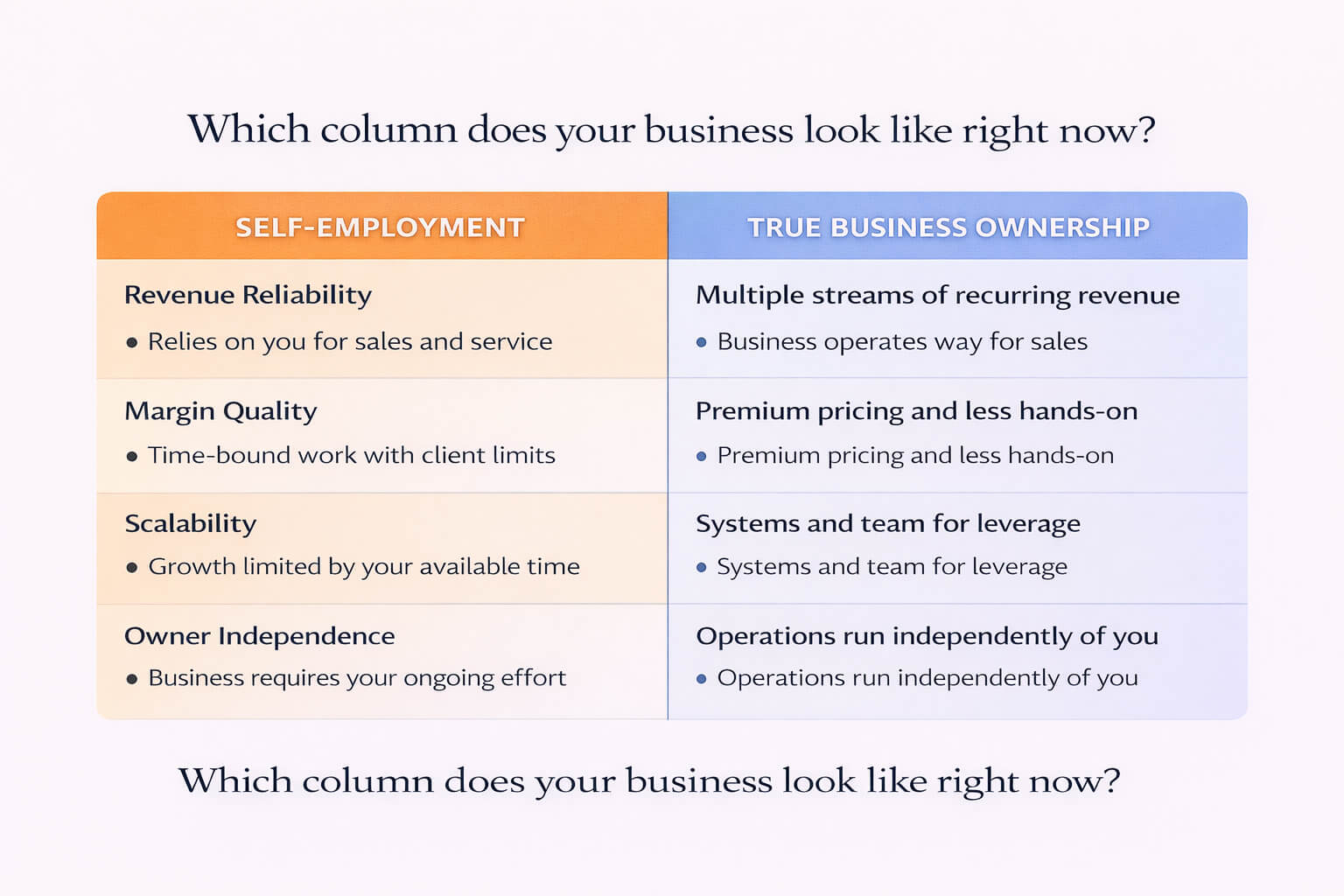
Most early-stage businesses score poorly on all four. That's normal. The goal is to design deliberately toward all four — and understand which one is currently the most critical constraint.
> **CALLOUT BOX:** A business that can't function without you isn't really a business yet. It's a self-employment arrangement. The transition from self-employment to business ownership is the most important strategic shift an entrepreneur can make.
The Foundation — Positioning and Offer Clarity
Before systems, before marketing, before revenue models — you need absolute clarity on two things: who you're for and what you sell.
Positioning is the strategic decision about where you compete and for whom. It answers: what do you do, who specifically do you do it for, and why should they choose you over every alternative? Vague positioning — "I help businesses grow" — is the root cause of most marketing problems, pricing problems, and growth plateaus.
**The positioning clarity test:** Can you complete this sentence with no weasel words? "I help [specific audience] achieve [specific outcome] through [specific method]."
If you can't, stop. Get clear here before investing in anything else.
**Offer clarity:** Your offer is the specific package of value you exchange for money. Strong offers are specific, valuable, and easy to say yes to. Alex Hormozi's framework from *$100M Offers* is useful here: a great offer stacks value (outcomes, speed, certainty, and reduced effort/risk) until the perceived value dramatically exceeds the price. [External link: Hormozi, A. *$100M Offers.* Acquisition.com, 2021.]
Weak offers are vague ("consulting services"), undifferentiated, and force the prospect to do the mental work of imagining what they're buying. Strong offers make the outcome explicit, the process clear, and the risk low.
**Video Placeholder 1:**
- Placement: After Section 2 (Positioning and Offer Clarity)
- Suggested Topic: "How to Write Your Positioning Statement: Live Example and Critique"
- Caption: "Watch: Finding your positioning clarity in real time"
**The niche paradox:** The narrower your audience definition, the easier it is to find them, speak to them, and convert them. "Entrepreneurs" is not a target audience. "First-time founders of service businesses with $0–$500K in annual revenue who want to get to seven figures" is.
Revenue Architecture — Building Income That Doesn't Depend Entirely on You
The goal of revenue architecture is to build a system where income is generated — at least partially — without requiring your direct, real-time effort every time.
The four revenue model types every entrepreneur should understand:
**1. Time-for-money (services/consulting):** High per-hour value, but fundamentally constrained by your time. Essential for cash flow in early stages. Becomes a ceiling without leverage.
**2. Productized services:** Service delivery packaged as a consistent, repeatable offering with a fixed scope and price. Easier to sell, deliver, and delegate than bespoke services. The step between freelancing and a real business.
**3. Products (digital or physical):** Create once, sell repeatedly. Digital products (courses, templates, tools, software) have the highest leverage because they have near-zero marginal cost. The challenge: they require upfront creation and significant marketing to reach profitability.
**4. Recurring revenue (subscriptions, memberships, retainers):** The holy grail of revenue architecture. Predictable, compounding, and foundational to business valuation. Any business that can move even a portion of its revenue to a recurring model gains dramatically in stability and financial planning ability.
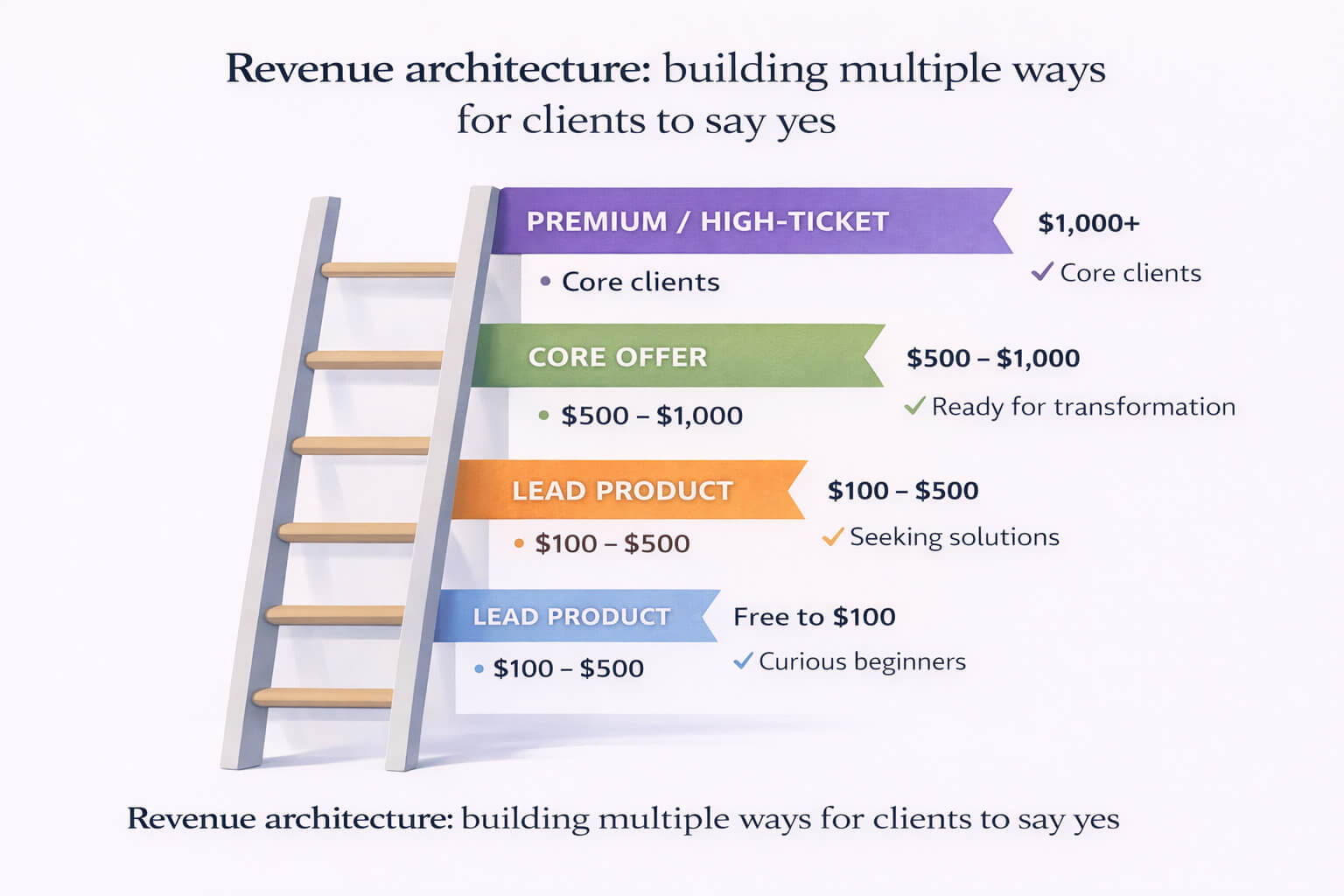
**The Ladder Strategy:** Most high-performing entrepreneurs build a revenue ladder — a range of offerings at different price points that serve the same audience at different stages. A low-cost lead product brings people in; a core offer captures the majority of revenue; a high-ticket or premium tier serves the most invested clients at the highest margin.
The Revenue Ladder: How High-Performance Businesses Stack Income
[Internal link → /habits-and-systems: "The operational habits and systems that make businesses run"]
"The business model is the strategy. Everything else is execution."
Business Systems — Turning Your Work Into a Machine
Michael Gerber's core insight in *The E-Myth* remains the most useful single idea for entrepreneurs: most people who start businesses are technicians — they're good at the work — but they build a business that depends on them doing all the work rather than building a system that does the work and simply requires them to manage it. [External link: Gerber, M. *The E-Myth Revisited.* HarperCollins, 1995.]
The shift from technician to system architect is the growth unlock.
The core systems every business needs:
**1. Sales system:** A repeatable, documented process for converting interested prospects into paying clients. Not dependent on your personal charisma or available hours. Includes lead qualification, initial conversation structure, proposal/offer presentation, and follow-up sequence.
**2. Delivery system:** A documented, consistent process for delivering your product or service. Can be taught, delegated, and improved. The test: could someone else deliver this with your documentation?
**3. Marketing system:** A reliable mechanism for generating new awareness and interest — that operates on a schedule, not on inspiration. This might be a content calendar, an email list growth process, a referral program, or paid acquisition.
**4. Operations system:** How the business is administered — finances, communications, project management, client relationships. Uses tools and processes to handle recurring tasks without requiring constant attention.
**5. Measurement system:** The metrics you track weekly and monthly that tell you whether the business is healthy or deteriorating before the problem becomes a crisis. At minimum: revenue, pipeline, margins, and customer satisfaction.
**Video Placeholder 2:**
- Placement: After Section 4 (Business Systems)
- Suggested Topic: "The Five Business Systems Every Owner Needs: A Walkthrough"
- Caption: "Watch: Building the systems that free you from your business"
> **CALLOUT BOX — THE DOCUMENTATION TEST:** Write down every repeatable task in your business. If you can't document it, you can't delegate it. If you can't delegate it, it owns you. Documentation is not bureaucracy — it's the path to freedom.
Financial Performance — From Revenue to Real Wealth
Revenue is not wealth. This is one of the most common cognitive errors among entrepreneurs — conflating income with financial security. You can generate significant revenue and build zero lasting wealth if you have no system for converting revenue into assets.
The financial performance fundamentals:
**Know your numbers:** Monthly revenue, expenses, gross margin, net profit, and cash flow are the minimum metrics every business owner must understand. If you don't know your current margins, you cannot make intelligent pricing or investment decisions.
**Separate personal and business finances — completely:** Mixing personal and business finances is one of the most common early-stage financial mistakes. It obscures your true profitability, creates tax risk, and makes growth decisions based on inaccurate data. Separate accounts, separate cards, clean accounting from day one.
**Pay yourself a market salary:** Many entrepreneurs underpay themselves and then feel their business is more profitable than it is. If you replaced yourself with a hired employee for your role, what would that cost? That is your operating cost. Not accounting for owner compensation creates misleading financial pictures.
**The profit-first principle:** Based on Mike Michalowicz's *Profit First* framework — allocate profit, taxes, and owner compensation before paying operating expenses, rather than after. [External link: Michalowicz, M. *Profit First.* Portfolio/Penguin, 2017.] This reverses the behavioral trap of spending whatever revenue comes in and hoping profit is left over, which it rarely is.
The Wealth-Building Stack for Entrepreneurs
Building a successful business is the engine. Wealth is what you do with the engine's output. Most entrepreneurs build the engine and never build the wealth.
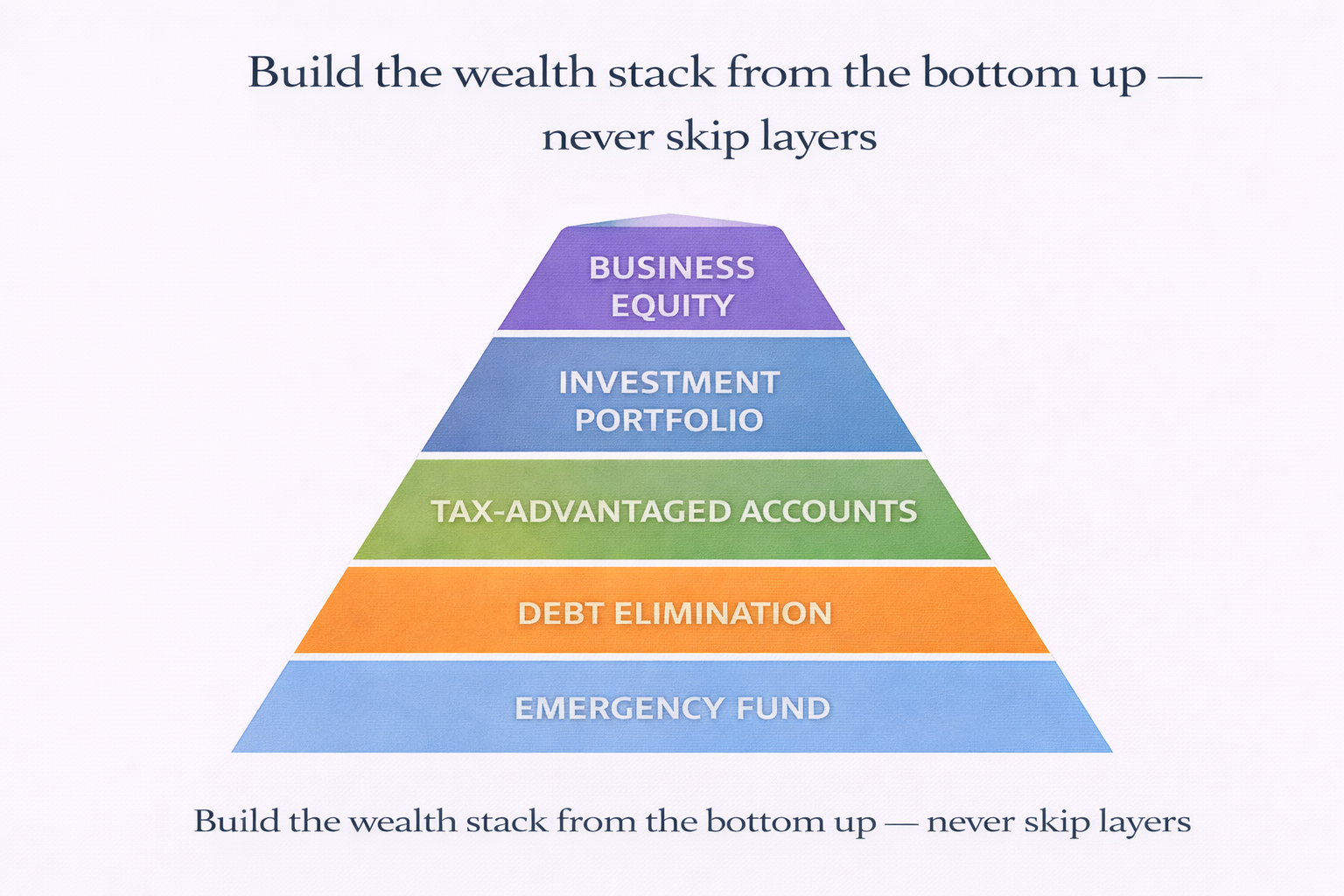
The five-layer wealth-building stack:
**Layer 1: Emergency fund.** 6–12 months of personal expenses in a liquid, accessible account. This is non-negotiable for entrepreneurs, whose income is inherently variable. Without this, every business downturn becomes a personal financial crisis that produces bad decisions.
**Layer 2: Debt elimination.** High-interest personal debt is a guaranteed negative return. Eliminating it before investing elsewhere is almost always the highest-return action available.
**Layer 3: Tax-advantaged retirement accounts.** For self-employed individuals, Solo 401(k) and SEP-IRA accounts allow significantly higher contribution limits than standard employment accounts. Maximizing these is one of the highest-leverage wealth actions available to entrepreneurs.
**Layer 4: Diversified investment portfolio.** Low-cost, broadly diversified index funds (total market or S&P 500 equivalents) have outperformed most actively managed strategies over long time periods. For most entrepreneurs, keeping the investment strategy simple and automatic allows energy to stay focused on the business where returns are potentially higher.
**Layer 5: Business equity (your business as an asset).** The business itself may be your most valuable asset — if it's built to be sold or generates significant passive cash flow. Building toward this requires thinking about business value from the beginning: systems, recurring revenue, documented processes, and financials that would survive due diligence.
The Entrepreneur's 5-Layer Wealth Stack
[Internal link → /life-architecture: "Aligning your business with the life you're actually designing"]
*Note: This is general financial education, not financial advice. Consult a qualified financial advisor before making investment decisions.*
Marketing and Growth That Compounds
The businesses that grow sustainably build marketing systems that compound — where each piece of content, each relationship, each referral generates future returns beyond its immediate impact.
The compounding marketing assets:
**Content:** Long-form content (articles, podcasts, video) that ranks in search, builds authority, and attracts the right audience generates value for years. A pillar article written today may generate discovery, leads, and referrals for a decade.
**Email list:** An owned audience that you can reach directly — without algorithm dependency or platform risk — is one of the most valuable business assets. Growing an email list of engaged subscribers who want what you offer is the closest thing to a durable marketing advantage for small businesses.
**Referral systems:** Building a deliberate referral mechanism — not just hoping clients mention you, but giving them a structured, easy way to refer and potentially rewarding them for doing so — is among the highest-ROI marketing investments for service businesses.
**Positioning that earns attention:** When your positioning is genuinely specific and valuable — when you solve a real problem for a clearly defined audience better than anyone else — word spreads without paid amplification. The best marketing is being so clearly the right answer for someone that it's impossible not to share.
Common Business Performance Killers
**Premature scaling:** Hiring, expanding, and spending before the core business model is proven profitable. Growth before product-market fit is expensive and often fatal.**Underpricing:** Chronically pricing services and products below their value, usually out of fear of rejection. Underpricing attracts difficult clients, creates resentment, and prevents the profit that funds growth.
**The owner bottleneck:** Every task that only the owner can do is a growth constraint. If every decision, delivery, and client relationship requires the founder, the business cannot scale.
**Revenue concentration risk:** Having 50%+ of revenue from a single client or source creates extreme fragility. Lose that client and the business may not survive.
**No financial dashboard:** Operating without knowing current cash flow, margins, and pipeline is flying blind. The businesses that perform are the ones whose owners can answer financial questions without calling their accountant first.
[Internal link → /mental-performance: "The mental performance edge that separates high-performing entrepreneurs"]
Frequently Asked Questions (FAQ)
**What does business performance mean?**Business performance refers to how effectively a business generates consistent, profitable revenue, operates efficiently with systems and processes, and creates lasting financial value for its owner — ideally with decreasing dependence on the owner's direct, daily effort over time.
**How do I build a business that doesn't depend entirely on me?**
The process has three phases: document every core process so it can be delegated, build systems for sales, delivery, and operations that work without your constant involvement, and gradually hire or outsource roles that don't require your unique expertise. This takes time — most owners start this process too late and in crisis. Start documenting and systematizing before it feels necessary.
**What's the fastest way to increase business revenue?**
Usually, the fastest lever is pricing optimization — specifically, raising prices for existing services. Most early-stage businesses are significantly underpriced. The second fastest is improved follow-up on existing leads and warmer outreach to past clients. New audience acquisition is important but usually slower than converting existing warm relationships.
**What are the best revenue models for financial freedom?**
Recurring revenue models (subscriptions, memberships, retainers) provide the most reliable path to financial stability because income is predictable. Combined with a productized or digital offering that doesn't require your time-for-each-sale, recurring revenue creates the conditions for true financial freedom. Pure time-for-money service models are necessary early on but create an income ceiling.
**How much should I pay myself as a business owner?**
At minimum, pay yourself a market salary for your role — what you'd pay an employee to do what you do. Early-stage businesses often make this impossible, but as a target, it clarifies true profitability. Beyond salary, profit distributions are the return on your ownership risk. If you can't pay yourself a fair market salary and be profitable, the business model needs redesign.
**What financial accounts should every entrepreneur have?**
Separate business checking and savings accounts, a dedicated business credit card, a business emergency fund (3–6 months of operating expenses), and a retirement account (Solo 401(k) or SEP-IRA) at minimum. Personal finances should be completely separate from the first day.
Key Takeaways About Business and Financial Performance
Building a business that performs — one that generates reliable revenue, runs with efficient systems, and builds real wealth over time — is an engineering challenge, not a personality achievement. It rewards clear thinking, strategic design, and consistent execution far more than it rewards raw hustle.
The frameworks in this guide are a foundation, not a complete blueprint. Your specific business, market, and strengths will determine the right execution. But the principles — clarity of positioning, revenue architecture, operational systems, financial discipline, and compounding marketing — apply across every type of business and every level of scale.
Build the engine. Protect the margins. Convert income to wealth. Design a business that serves your life, not the other way around.
**CTA:** Business performance is one pillar in a larger architecture. The most important question is whether you're building a business that fits the life you actually want. [Read: Life Architecture — How to Design a Life Worth Optimizing →](/life-architecture)