
Your brain is the most powerful tool you own — and most people never learn how to use it properly. Here's the complete guide to upgrading your cognitive performance.
Introduction To Mental Performance
There's a version of you that thinks more clearly, decides faster, focuses deeper, and stays composed when everything around you is on fire. That version isn't fictional. It's not a personality type you either have or you don't. It's the product of specific choices, inputs, and practices — a trained state, not a fixed trait.
Mental performance is the discipline of optimizing how your brain operates: how you think under pressure, how long you sustain focus, how clearly you reason, how well you regulate your emotions, and how quickly you recover from cognitive fatigue. For entrepreneurs, creators, and ambitious professionals, it's not a soft skill. It's the primary business tool.
The challenge is that most conversations about mental performance either collapse into vague mindset advice ("think positive, stay grateful") or drown in neuroscience jargon that never lands in your actual life. This guide is neither. It's a practical operating manual for your most important hardware — with frameworks you can implement, science that actually supports them, and a clear picture of what "performing well mentally" looks like in practice.
What Mental Performance Actually Means (and What It Doesn't)
Mental performance is not the same as intelligence. IQ is relatively fixed; mental performance is highly variable and trainable. Two people with identical raw cognitive ability can produce radically different results depending on how well they manage their attention, regulate their emotions, and structure their thinking environment.
A clean definition: mental performance is your ability to think clearly, decide well, focus deeply, and regulate your internal state — particularly when conditions are difficult.
What it includes:
- Cognitive clarity — thinking without fog, confusion, or mental noise
- Sustained attention — maintaining focused effort on one thing for extended periods
- Decision quality — making sound judgments under ambiguity and pressure
- Emotional regulation — managing feelings without being hijacked by them
- Mental recovery — restoring cognitive capacity after depletion
What it is not:
- Generic "positivity" or motivational thinking
- Intelligence or IQ
- Simply "working harder" or "trying more"
- A personality trait you either have or you don't
Mental performance is trainable, not fixed. Research consistently shows that attention, focus, and emotional regulation are skills that improve with deliberate practice — not personality traits you're stuck with.
The 4 Core Pillars of Cognitive Performance
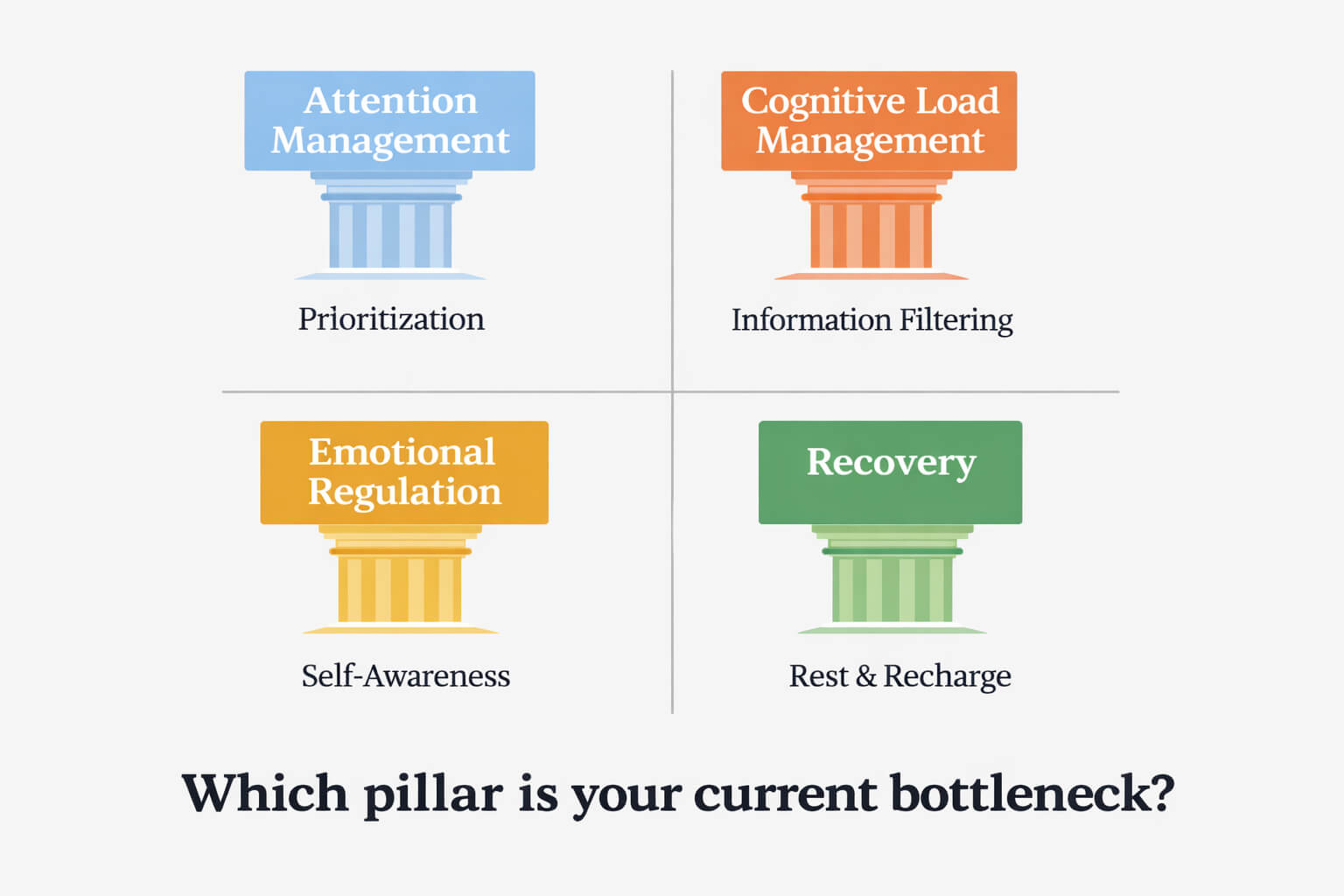
Every mental performance framework worth using is built on four foundations. Get all four working and the results compound. Neglect one and the others degrade.
Pillar 1: Attention Management Your attention is your most valuable cognitive resource. The ability to direct and hold it intentionally — rather than have it pulled by notifications, noise, and anxiety — is the foundation of everything else. [Internal link → /habits-and-systems: "Building attention management into your daily system"]
Pillar 2: Cognitive Load Management Your brain has a finite working memory capacity. When it's overloaded — too many open loops, too many decisions, too much context-switching — performance degrades fast. High performers learn to protect cognitive bandwidth by externalizing decisions, simplifying their environment, and batching cognitively demanding work.
Pillar 3: Emotional Regulation Emotions are not separate from cognition — they are cognition. Stress, anxiety, and frustration actively impair the prefrontal cortex, the part of your brain responsible for reasoning, planning, and impulse control. Emotional regulation isn't about suppressing feelings; it's about processing them quickly enough that they don't hijack your thinking.
Pillar 4: Recovery and Restoration Mental performance follows the same logic as physical performance: you don't build capacity during work; you build it during recovery. Sleep, strategic rest, and mental downtime are not indulgences — they're the mechanism by which cognitive gains are consolidated.
The Mental Performance Matrix: 4 Pillars of Cognitive Output
Focus — How to Build Deep Concentration in a Distracted World
Focus is arguably the most economically valuable cognitive skill in the modern economy. The ability to give sustained, deep attention to a single problem or task — without distraction — produces disproportionate output.
Cal Newport's concept of "deep work" is useful here: cognitively demanding tasks that push your skills to their limit produce output that is hard to replicate and highly valuable. Shallow work (emails, meetings, quick tasks) can fill a day completely while producing almost nothing of lasting worth. [External link: Newport, C. Deep Work. Grand Central Publishing.]
The Practical Focus Framework:
1. Design your focus environment before you try to focus. Environment is upstream of willpower. Remove friction for the behavior you want (focused work) and add friction for behaviors you don't (distraction). This means phone in another room, browser extensions that block social media, a dedicated work space, and a predetermined start time.
2. Work in time blocks, not time spans. Open-ended "work time" produces unfocused drift. Time-blocked sessions — 90 minutes of deep work, followed by a genuine break — align with the brain's natural ultradian rhythm. Research suggests peak cognitive performance occurs in 90-minute cycles, after which a 15–20 minute rest significantly restores capacity. [External link: Kleitman's ultradian rhythm research, referenced in Huberman Lab work]
3. Start with the hardest thing. Decision fatigue is real. Your prefrontal cortex is freshest in the early hours. Schedule your most cognitively demanding work before checking email, messages, or any input that generates cognitive load.
4. Train your attention like a muscle. Meditation — even 10–15 minutes of focused-attention practice — is one of the most consistently researched interventions for improving sustained attention. It doesn't require a spiritual practice; it requires treating attention as a trainable skill. [External link: Jha, A.P. et al. "Mindfulness training modifies subsystems of attention." Cognitive, Affective, & Behavioral Neuroscience.]
PULL QUOTE: "You can't think deeply in a shallow environment. Design comes first, discipline comes second."
- VIDEO:
- Suggested Topic: "How to Build a Deep Work Session: A 90-Minute Focus Protocol Walkthrough"
- Caption: "Watch: How to structure a genuine deep work session"
Decision-Making Under Pressure
High performers make a lot of decisions — often under time pressure, incomplete information, and emotional stress. Decision quality over time is a primary driver of outcomes in business and in life.
The two biggest cognitive traps that degrade decision quality:
Cognitive biases — systematic errors in thinking that affect everyone regardless of intelligence. The most relevant for high performers: confirmation bias (seeking information that confirms what you already believe), sunk cost fallacy (letting past investment distort current choices), and availability heuristic (overweighting vivid or recent information).
Decision fatigue — as you make more decisions throughout the day, the quality of later decisions degrades measurably. This is why high performers systematize and eliminate as many routine decisions as possible (diet, wardrobe, scheduling) to preserve cognitive bandwidth for decisions that actually matter.
The WRAP Decision Framework (adapted from Chip Heath and Dan Heath's Decisive):
- W — Widen your options. Don't frame decisions as binary. Force yourself to generate at least three options.
- R — Reality-test your assumptions. Actively seek disconfirming evidence before deciding.
- A — Attain distance before deciding. When emotionally charged, the 10/10/10 question: How will I feel about this in 10 minutes, 10 months, 10 years?
- P — Prepare to be wrong. Set a tripwire — a predetermined condition that will cause you to revisit the decision.
[Internal link → /life-architecture: "How to build a decision-making process into your life architecture"]
Emotional Regulation
This is the mental performance topic that most high achievers avoid until a crisis forces them to pay attention. And it's the one that most consistently determines whether someone performs well under pressure or falls apart.
The neuroscience is clear: the amygdala (your brain's threat-detection system) and the prefrontal cortex (responsible for rational thinking) are in active competition. When stress or threat is perceived — including psychological threats like criticism, financial pressure, or uncertainty — the amygdala fires and prefrontal cortex function degrades. You literally become less smart under stress unless you have trained mechanisms for regulating your state.
Three evidence-backed regulation tools:
1. Physiological sigh. A double inhale through the nose followed by a long exhale through the mouth activates the parasympathetic nervous system in seconds. This is one of the fastest, most evidence-supported self-regulation techniques available. [External link: Huberman Lab on physiological sigh research]
2. Labeling emotions. Psychologist Matthew Lieberman's research shows that simply naming an emotion — "I notice I feel anxious" — reduces amygdala activation. This isn't journaling; it's a 3-second cognitive intervention that creates distance between stimulus and response.
3. Reappraisal. Changing the interpretation of a situation, rather than suppressing your reaction to it. Instead of "this is a disaster," asking "what's the opportunity in this problem?" This is not toxic positivity — it's a cognitively superior strategy that reduces emotional reactivity without suppressing awareness. [External link: Gross, J.J. "Emotion regulation: Conceptual and empirical foundations." Handbook of Emotion Regulation.]
CALLOUT BOX — PERFORMANCE INSIGHT: The goal of emotional regulation is not to feel nothing. It's to process emotions quickly enough that they don't impair your decision-making. High performers feel everything — they've just built better processing speed.
- VIDEO:
- Suggested Topic: "The Physiological Sigh and 3 Other Instant Regulation Tools"
- Caption: "Watch: Real-time demonstration of emotional regulation techniques"
Recovery and Mental Restoration
Here's the uncomfortable truth about mental performance: you cannot sustain it by working harder. You sustain it by recovering better.
The brain consolidates learning, clears metabolic waste, and regenerates cognitive capacity during rest — specifically during sleep. The glymphatic system, which clears neurotoxic waste products from the brain, operates almost exclusively during sleep. Cut sleep and you are, literally, accumulating cognitive debris. [External link: Xie, L. et al. "Sleep drives metabolite clearance from the adult brain." Science, 2013.]
The Mental Recovery Protocol:
- Sleep as a non-negotiable. 7–9 hours for most adults. Prioritize consistency of timing over total hours where possible. The brain's circadian clock is highly sensitive to regular sleep/wake times.
- Strategic naps. A 20-minute nap (before reaching deep sleep stages) measurably improves alertness, mood, and cognitive performance for 3–4 hours afterward.
- Deliberate non-stimulation. Time spent with no input — no podcast, no phone, no content — allows the default mode network to process and integrate. This is not wasted time; it's consolidation time.
- Physical movement. Even a 10-minute walk increases BDNF (brain-derived neurotrophic factor) — a protein that supports neuroplasticity and cognitive function. [Internal link → /physical-performance: "The physical inputs that directly support cognitive performance"]
The Daily Mental Performance Stack
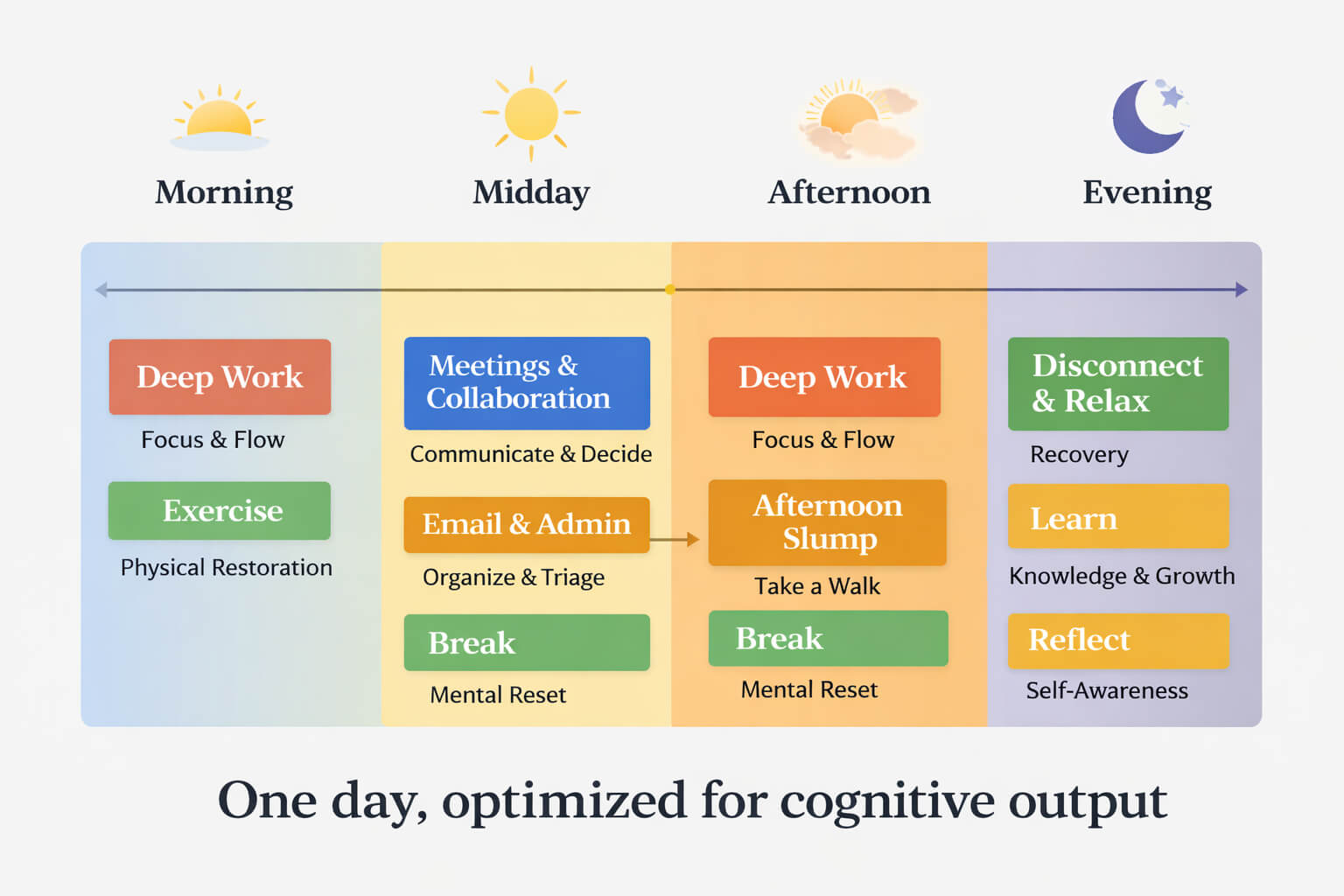
A practical, repeatable daily architecture that protects and enhances cognitive performance:
Morning (protect the first 90 minutes):
- No phone for the first 30 minutes after waking — let your nervous system calibrate before inputs arrive
- Physical movement or sunlight exposure to anchor your circadian rhythm
- Define your 1–3 most important cognitive tasks for the day before opening email
- Deep work block: 90 minutes on your most demanding work
Midday (manage the energy dip):
- Strategic nutrition that doesn't spike and crash blood sugar
- 20-minute nap or 15-minute non-stimulation break if needed
- Walk, even brief — movement resets attentional capacity
Afternoon (tactical and communicative work):
- Lower-stakes decisions and communications
- Meetings, if necessary
- No major decisions after 4 PM if avoidable
Evening (recovery investment):
- Wind-down buffer: 60 minutes of dimmer light, no intense cognitive activity before sleep
- Consistent sleep time — the single most powerful lever for cognitive restoration
- Reflect briefly: what went well cognitively today? What created friction?
The Optimal Mental Performance Day: A Time-Blocked Architecture
Common Mental Performance Killers
Chronic sleep deprivation — the most underestimated performance drag. Operating on 6 hours feels manageable; cognitively, it mirrors mild impairment.
Constant context-switching — checking messages, notifications, or email between focused work sessions fragments attention and adds 15–20 minutes of recovery time to refocus. Multiply this across a workday and you've lost hours.
Decision overload without systems — making too many small decisions (what to eat, what to work on, what to respond to) drains the prefrontal cortex faster than large decisions. Systematize the small decisions.
Isolation and lack of genuine recovery — high performers often confuse grinding with performing. Sustained output without genuine cognitive recovery creates a slow accumulation of deficit that eventually manifests as burnout, poor judgment, or both.
Information overconsumption — filling every spare moment with content (podcasts, social media, news) prevents the consolidation and creative synthesis that happens during mental downtime.
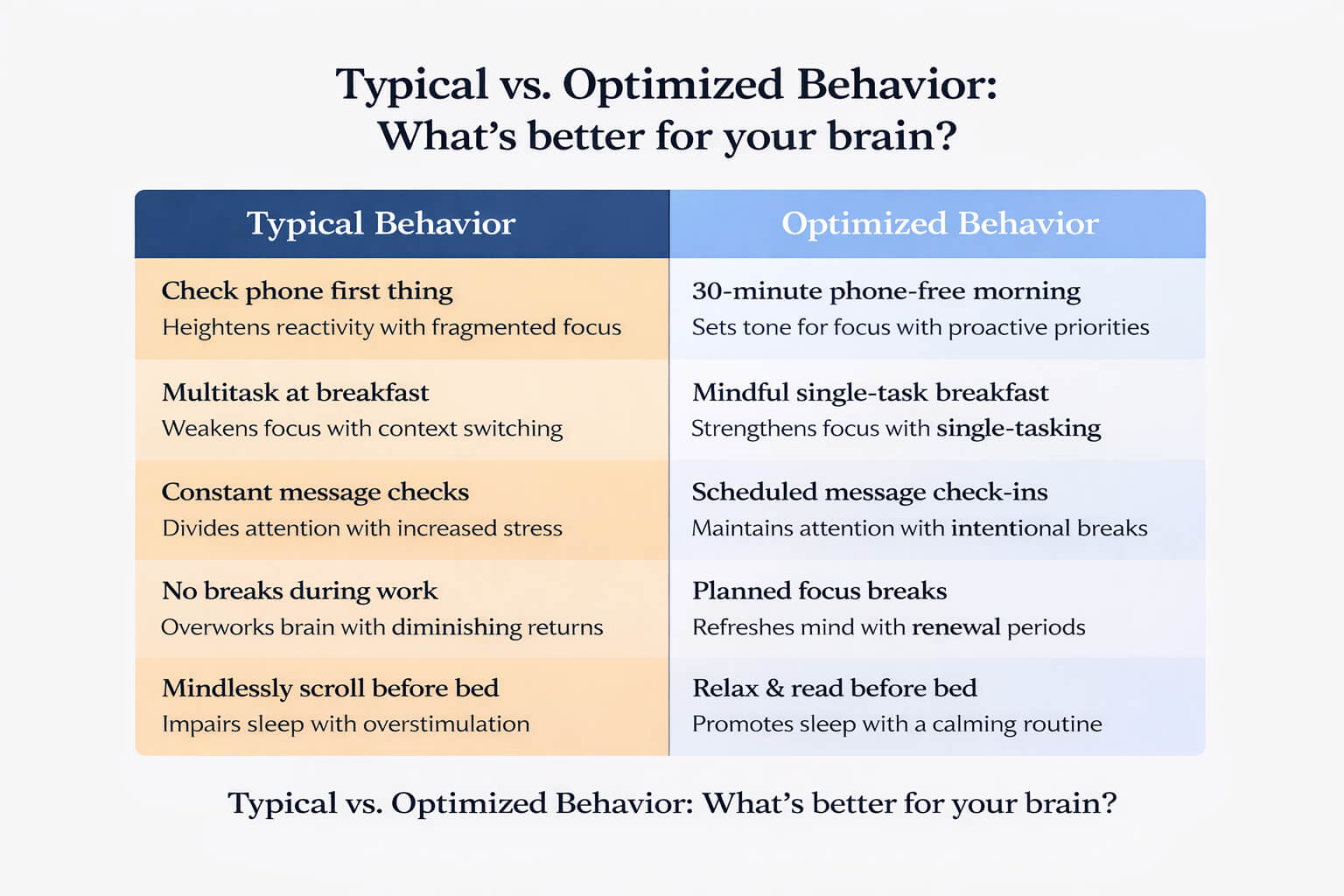
Common Habits vs. High-Performance Alternatives
Frequently Asked Questions (FAQ)
What is mental performance? Mental performance refers to your ability to think clearly, focus deeply, make good decisions, and regulate your emotions — especially under pressure. Unlike raw intelligence, mental performance is highly trainable and responds to specific habits, environmental inputs, and recovery practices.
How can I improve my mental focus quickly? The fastest lever is environmental design: remove digital distractions before starting deep work, set a timer for 90-minute focused blocks, and don't check messages until the block is complete. Combined with adequate sleep, this alone produces noticeable improvement within days.
How does stress affect mental performance? Acute stress activates the amygdala and suppresses prefrontal cortex function — meaning stress literally impairs your ability to think, reason, and make good decisions. Chronic stress compounds this effect. Learning emotional regulation techniques (labeling, physiological sigh, reappraisal) directly counters this by restoring prefrontal function under pressure.
What's the difference between mindset and mental performance? Mindset generally refers to beliefs and attitudes (growth vs. fixed mindset). Mental performance is broader — it encompasses the physiological, behavioral, and psychological inputs that determine cognitive output. Mental performance work is more operational: sleep, attention management, decision frameworks, emotional regulation, and recovery.
How much does sleep actually affect cognitive performance? Significantly. Research shows that 17–19 hours of continuous wakefulness produces cognitive impairment equivalent to a blood alcohol level of 0.05%. Chronic sleep deprivation (6 hours per night for two weeks) produces deficits equivalent to two nights of total sleep deprivation — yet people adapt to feeling "fine" while being measurably impaired.
Can meditation really improve focus? Yes — it is one of the most consistently researched interventions for improving sustained attention, working memory, and cognitive flexibility. Even 10–15 minutes of focused-attention meditation (returning attention to a breath after it wanders) produces measurable improvements in attention control.
What's the fastest way to recover mental energy during the day? A 20-minute nap, a short walk, or 10–15 minutes of deliberate non-stimulation (no phone, no content) all measurably restore alertness and cognitive capacity. The physiological sigh (double inhale through nose, long exhale through mouth) activates the parasympathetic nervous system within seconds and can help with acute stress.
Key Takeaways About Mental Performance
Mental performance is not a personality trait, a luxury, or a soft topic. It's the infrastructure underneath everything else you're trying to build. Your business, your relationships, your creative work, your decisions — all of it runs on the quality of your thinking.
The good news is that it's trainable. Focus can be improved. Decision quality can be systematized. Emotional regulation can be learned. Recovery can be engineered. None of this requires a radical life overhaul — it requires understanding the system and making consistent, intelligent adjustments to the inputs.
If you're serious about building a high-performance life, your mental performance stack is the foundation. Everything else — habits, physical conditioning, business strategy, life design — amplifies what you're building here.
The next layer of your performance stack is in your daily habits and systems. Read: How to Build Habit Systems That Actually Work →