
The Body as Foundation, Not Project
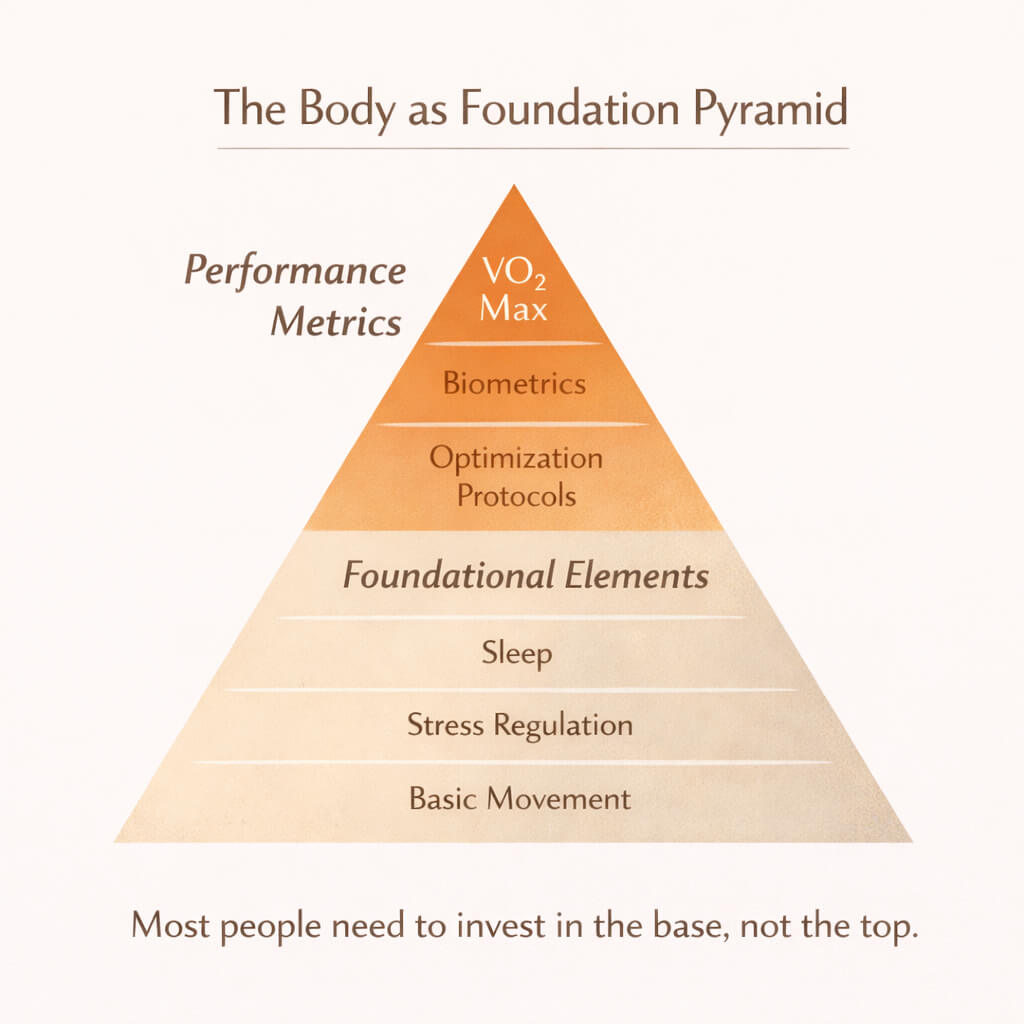
The performance model of physical health asks: how can I get my body to do more? How can I optimize my sleep score, improve my VO2 max, reduce my biological age, or increase my output capacity?
These are not inherently bad questions. But they are the wrong starting questions for most people — because they treat the body as a means to external ends rather than as the medium through which you experience being alive.
When your body is depleted, everything is harder. Not just physical things. Everything. Thinking is slower, emotions are less regulated, patience is thinner, meaning is harder to access, creativity narrows, relationships suffer. A life lived in a depleted body is a diminished life — not because the person is weak, but because the body is the instrument through which we do all of it.
The foundational question, then, is not “how do I optimize my body?” It is “how do I care for it well enough that it can support the life I actually want to live?”
That reframe matters. It shifts physical health from a project with metrics to a practice with values. And it makes the conversation significantly more sustainable — because people can sustain a practice. Very few people can sustain a project, long-term, without it eating them.
What physical health actually enables
When physical health is genuinely solid — not perfect, not elite, but solid — it enables:
Cognitive clarity. The capacity to think well, make good decisions, and access nuanced emotion requires a brain that is rested, oxygenated, adequately nourished, and not drowning in cortisol.
Emotional resilience. Physical depletion is one of the most powerful emotional dysregulators there is. When you are chronically tired and chronically stressed, your window of emotional tolerance narrows. Everything becomes harder to bear.
Presence. The ability to be fully in your life — not watching it happen while your mind is somewhere else — is partly a physiological phenomenon. A regulated, rested body creates space for presence that a depleted one cannot.
Longevity and capacity. The choices you make about your body in your 30s and 40s profoundly shape the physical capacity you have in your 60s and 70s. This is a long-game domain, and the long game is significantly more forgiving than the short game — if you start from the right premise.
If there is a single domain in which most people are quietly paying a massive tax without realizing it, sleep is it.
The science on sleep has become significantly clearer and more alarming over the last two decades. Sleep researcher Matthew Walker, in work summarized in “Why We Sleep,” calls sleep “the single most effective thing we can do to reset our brain and body health each day.” That is not hyperbole. The research supporting it is extensive.
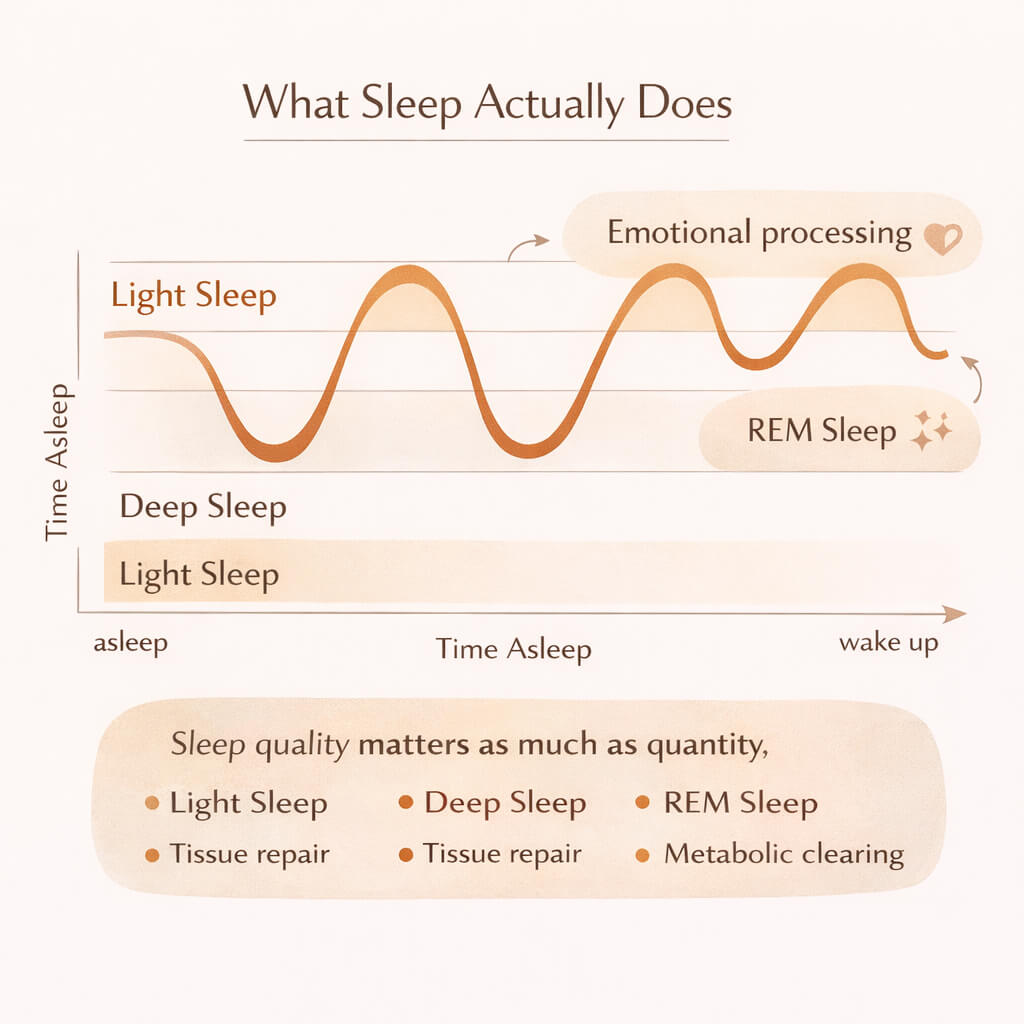
Sleep is not a passive state where the body goes offline. It is an active process in which the brain consolidates memory, clears metabolic waste products (including proteins associated with Alzheimer’s disease), regulates hormones, repairs tissue, processes emotional experience, and restores the cognitive function required for the next day. Every system in the body is affected by the quality of your sleep.
What sleep deprivation actually costs
Short of a full night of missed sleep — which most people recognize as impairment — the subtler and more common cost is chronic mild sleep deprivation. Routinely sleeping six hours when your body needs eight does not feel like a crisis. But the compounding effects are real:
Cognitive performance degrades. The ability to think flexibly, regulate emotion, make nuanced decisions, and access creativity all suffer under even moderate sleep debt — often more than the person realizes, because sleep deprivation also impairs your ability to accurately assess your own impairment.
Emotional regulation erodes. The amygdala — the brain’s threat-detection center — becomes significantly more reactive under sleep deprivation, and the prefrontal cortex’s ability to modulate it weakens. The result is a more reactive, less patient, more emotionally volatile version of yourself that people around you notice before you do.
Physical health compounds over time. Chronic sleep insufficiency is associated with elevated blood pressure, impaired immune function, metabolic dysregulation, increased cortisol, and a higher risk of serious illness over a lifetime.
Sleep quality matters as much as sleep quantity
Eight hours of fragmented, shallow sleep is not the same as seven and a half hours of solid, consolidated sleep. The quality of your sleep — how deeply you cycle through the sleep stages, how much restorative slow-wave and REM sleep you get — matters as much as the duration.
This is why many people who think they are sleeping enough are still chronically tired. The hours are there, but the quality is compromised by stress, alcohol (a significant disruptor of sleep architecture), inconsistent timing, environmental factors, or underlying conditions.
Practical sleep foundations worth building
The foundational sleep practices that consistently appear in the research are not complicated: consistent sleep and wake times (even on weekends), a cool and dark sleeping environment, limiting bright light exposure in the hour before bed, avoiding alcohol near bedtime, and creating genuine wind-down time between the end of your day and the beginning of sleep. None of these is exotic. Together, they make a significant difference for most people who apply them consistently.
Movement: What Your Body Actually Needs
The fitness industry has done something quietly counterproductive: it has made movement feel like either a major athletic commitment or something you don’t really count. Between the marathon training plan and the full gym cancellation, there is not much represented.
But the research on movement and health tells a more accessible story.
Movement versus exercise — an important distinction
Exercise is structured, intentional, often goal-oriented physical effort. Movement is simply the body in motion — walking, gardening, climbing stairs, carrying groceries, stretching, dancing in your kitchen. Both matter, but movement has a distinct importance that often gets overlooked.
Sedentary behavior — long periods of physical stillness — is independently associated with health risks, even in people who exercise. The body does not benefit from two hours of stillness followed by a forty-five minute workout followed by ten hours of stillness. It benefits from consistent low-level movement threaded through the day.
The actual minimum effective dose
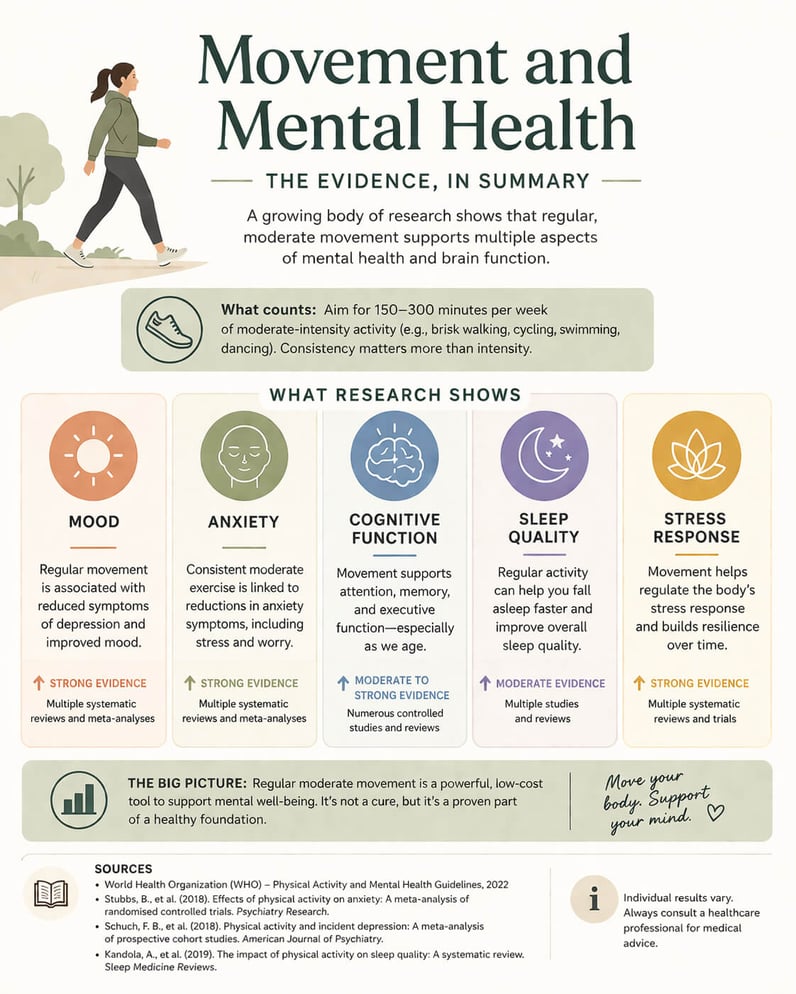
Research from multiple large-scale studies, including analyses supporting the World Health Organization’s physical activity guidelines, suggests that approximately 150 minutes of moderate-intensity activity per week — roughly 20–30 minutes daily — produces substantial health benefits for most adults. This is not a high bar. It is a brisk daily walk.
What matters more than hitting a specific intensity or volume is consistency and sustainability. The movement habit you can maintain across a decade produces infinitely more benefit than the training program you complete brilliantly for six weeks and abandon.
Why movement affects more than your body
The relationship between physical movement and mental health is one of the more robustly established findings in the research. Regular moderate exercise has been shown to reduce symptoms of depression and anxiety, improve cognitive function, enhance sleep quality, reduce the physiological stress response, and increase subjective wellbeing.
This is not a performance benefit. It is a quality-of-life effect that compounds over time. Moving your body is one of the most direct ways available to you to regulate your emotional and cognitive state — and it costs nothing.
The stress response — the cascade of physiological changes triggered by perceived threat — is one of the body’s most sophisticated systems. It is also one of the most misused.
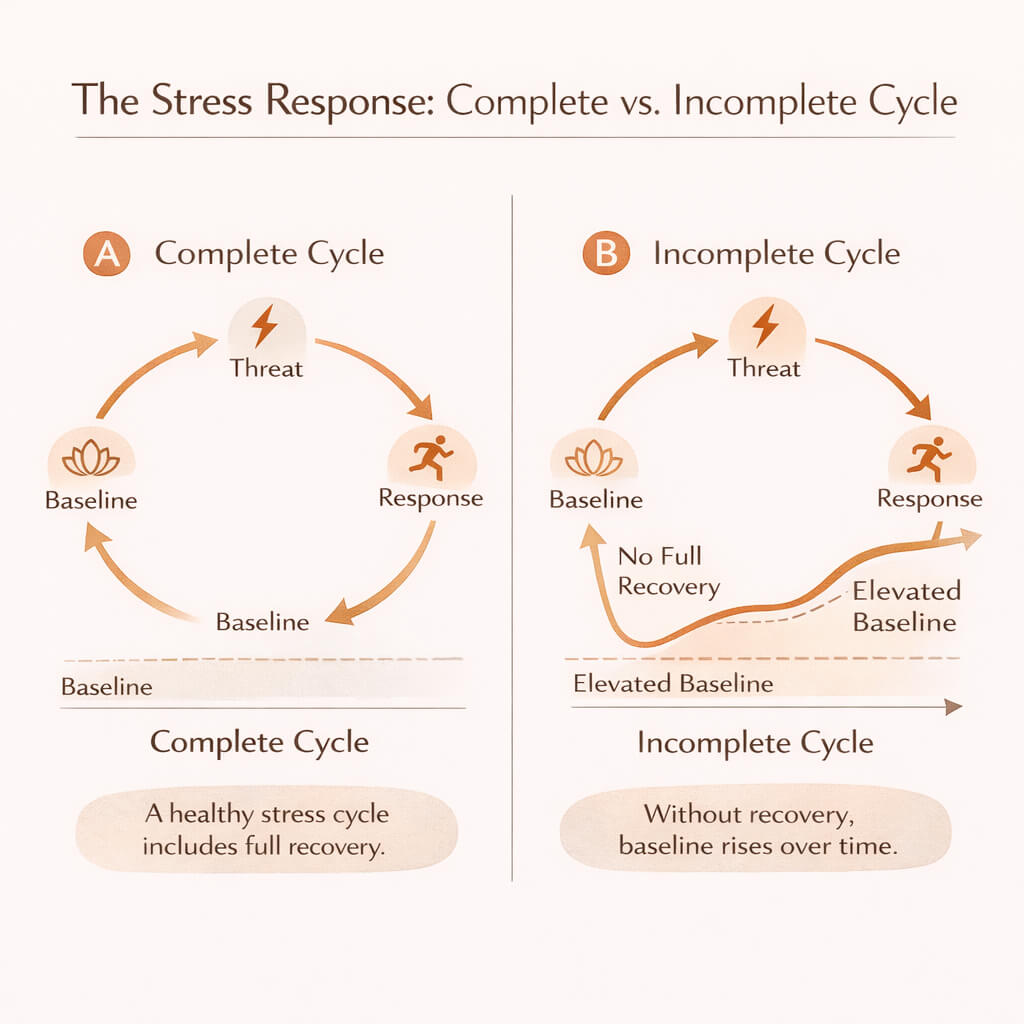
The system was designed for acute threats: mobilize resources, elevate heart rate and blood pressure, sharpen focus, suppress non-essential functions, deal with the threat, and then return to baseline. This cycle, when it completes properly, is not harmful. It is exactly what the system is for.
The problem is that the modern lifestyle — with its constant low-grade demands, financial anxiety, relationship friction, news cycles, overloaded schedules, and perpetual availability — keeps the stress response in a state of chronic partial activation. The system never fully turns off. And a stress response that never completes is a body that never fully recovers.
What happens when the stress response does not complete
Chronically elevated cortisol — the primary stress hormone — suppresses immune function, disrupts sleep architecture, increases inflammation throughout the body, impairs memory consolidation and cognitive flexibility, promotes fat storage (particularly visceral fat), and raises blood pressure. Over time, the body’s ability to return to a genuine resting state erodes. The new baseline becomes elevated. People stop noticing how activated they are because activation has become normal.
This is what many people mean when they say they are always tired: they are not technically tired. They are dysregulated. The body is running at a low-grade overdrive that consumes enormous energy without producing anything restful.
Recovery is physiological, not optional
Here is the thing that changes the conversation: recovery is not a reward for completion. It is a physiological requirement. The parasympathetic nervous system — the branch that enables genuine rest, digestion, immune function, and restoration — cannot do its work while the sympathetic system remains activated.
This is why a Saturday spent lying on the couch watching television does not always feel restorative. Passive distraction is not the same as genuine recovery. Genuine recovery involves actual physiological downregulation: slow breathing, reduced heart rate, reduced cortisol, body warmth, relaxed muscle tone. It involves the nervous system actually switching modes.
Practices that genuinely support recovery include slow, rhythmic movement, deep breathing, time in nature, genuine play, unhurried conversation with people you love, warm baths, and sleep. The common thread is not relaxation as a concept but physiological downregulation as a fact.
Modern culture has trained most people to override their bodies rather than listen to them. Push through fatigue. Ignore pain. Continue the performance. The body’s signals are treated as obstacles to output, not as useful information.
Interoception — the technical term for the ability to perceive internal bodily states — is a genuine and learnable skill. And it turns out that people with greater interoceptive awareness make better decisions about their bodies, recover more effectively from illness and injury, manage stress more effectively, and report higher levels of subjective wellbeing.
Listening to your body does not mean doing whatever it wants whenever it wants. It means developing the capacity to read its signals accurately — to distinguish genuine fatigue from situational boredom, real hunger from emotional eating, the pain of genuine injury from the discomfort of growth, the need for sleep from the habit of avoidance.

This is a different skill from tracking metrics. You can have excellent HRV data and still be completely disconnected from how your body actually feels. Body literacy is not data literacy. It is the developed capacity to be genuinely in relationship with your own physical experience.
Rest and Recovery as Active Practices
Rest has been demoted. In the dominant cultural narrative, it is something you earn at the end of sufficient effort — a reward, not a right. And for many people, even the rest they do take is not actually restorative, because it is laced with guilt, half-attention, or the ambient pressure to be doing something more useful.
Genuine rest is active in the sense that it requires intention. It is not the absence of activity. It is the presence of recovery.
The different types of recovery the body and mind need include: physical rest (sleep and low-intensity movement), sensory rest (reduced stimulation, quiet, absence of screen time), emotional rest (freedom from the pressure to manage or perform emotions), social rest (solitude or genuinely easy company), and creative rest (time when nothing is being produced or optimized).
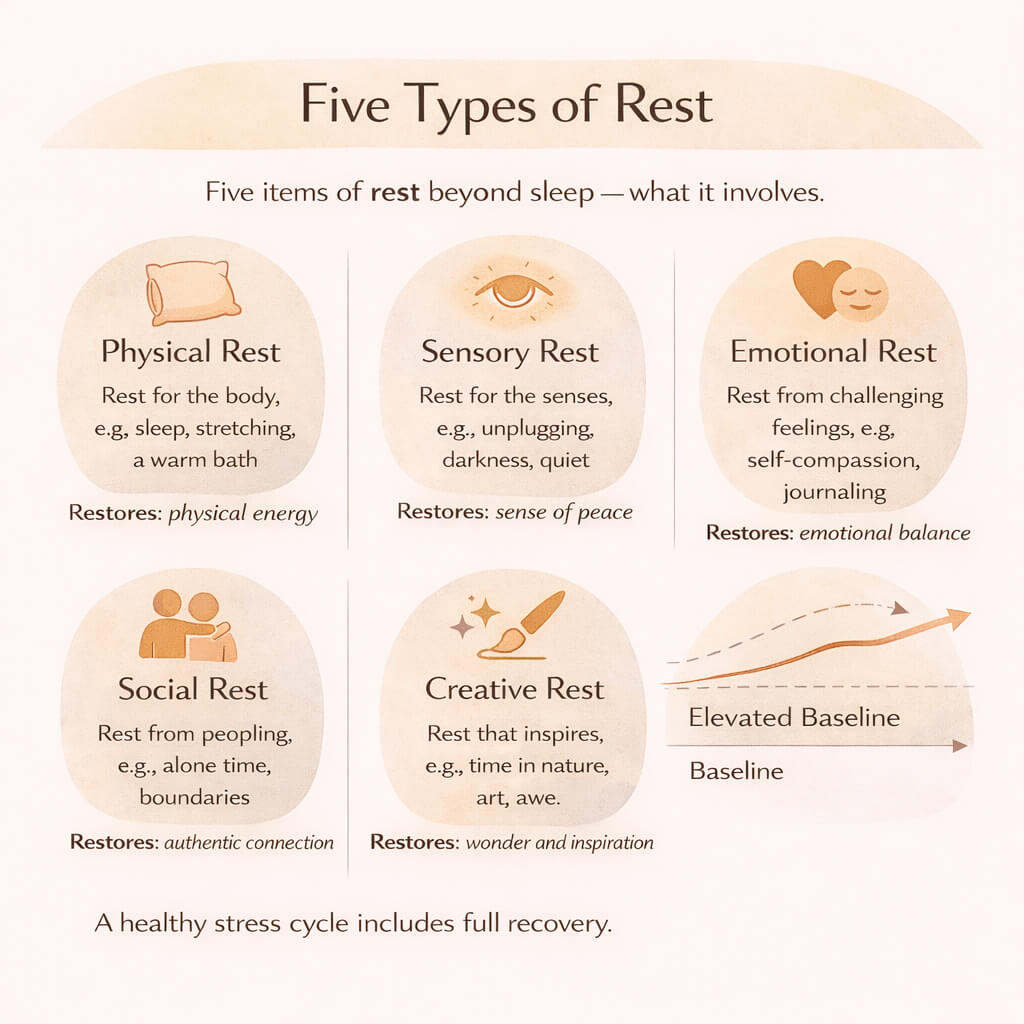
Most people default to a single kind of rest — usually screens — and wonder why they do not feel restored.
The practice of rest is not complicated, but it does require the conviction that it is legitimate — that your value is not a function of your productivity, and that caring for your body is not an indulgence but a requirement for a well-lived life.