
Becoming More Fully Yourself: A Guide to Growth That Is Honest, Patient, and Actually Yours
TABLE OF CONTENTS
If you have spent real time in the self-improvement world — reading the books, doing the work, attending the workshops, building the habits — you have probably discovered something that the self-improvement industry would rather you didn’t notice.
More of it does not always produce more of you.
At some point, the productivity protocols start to feel like a new form of performance. The personal development goals start to feel like a new species of striving. The metrics for self-improvement start to feel just as arbitrary and exhausting as the metrics they were supposed to liberate you from. And a quiet question surfaces: if I have been growing this whole time, why do I not feel meaningfully more like the person I want to be?
This pillar is not a rejection of growth. It is a different theory of what growth actually is — and what it requires.
The optYOUmize framework does not treat growth as an upward trajectory of accomplishment, habits acquired, or versions of yourself left behind. It treats growth as something closer to what the German tradition calls Bildung: the ongoing formation of a person — through learning, difficulty, reflection, relationship, and genuine engagement with life — into a more complete, more honest, and more fully themselves version of who they actually are.
This is slower work. It is less glamorous. It is considerably more real.
The Growth Trap — When Self-Improvement Becomes Another Performance
There is a version of self-improvement that has the same basic architecture as the achievement culture it claims to offer an alternative to. It has metrics (morning pages completed, meditations logged, habits tracked), a performance dimension (are you growing faster than you should be, compared to the people whose journeys you follow online), a shame dimension (you are not growing enough, not clearly enough, not consistently enough), and an implicit finish line that keeps moving.
This version of growth is not genuinely developmental. It is striving in different clothes.
The tell is in the feeling it produces. Genuine growth tends to feel, in retrospect, like expansion — like having more capacity, more clarity, more honest access to yourself than you had before. The growth trap tends to feel like a treadmill: you are moving constantly and not arriving anywhere, and stopping for a moment produces immediate anxiety.
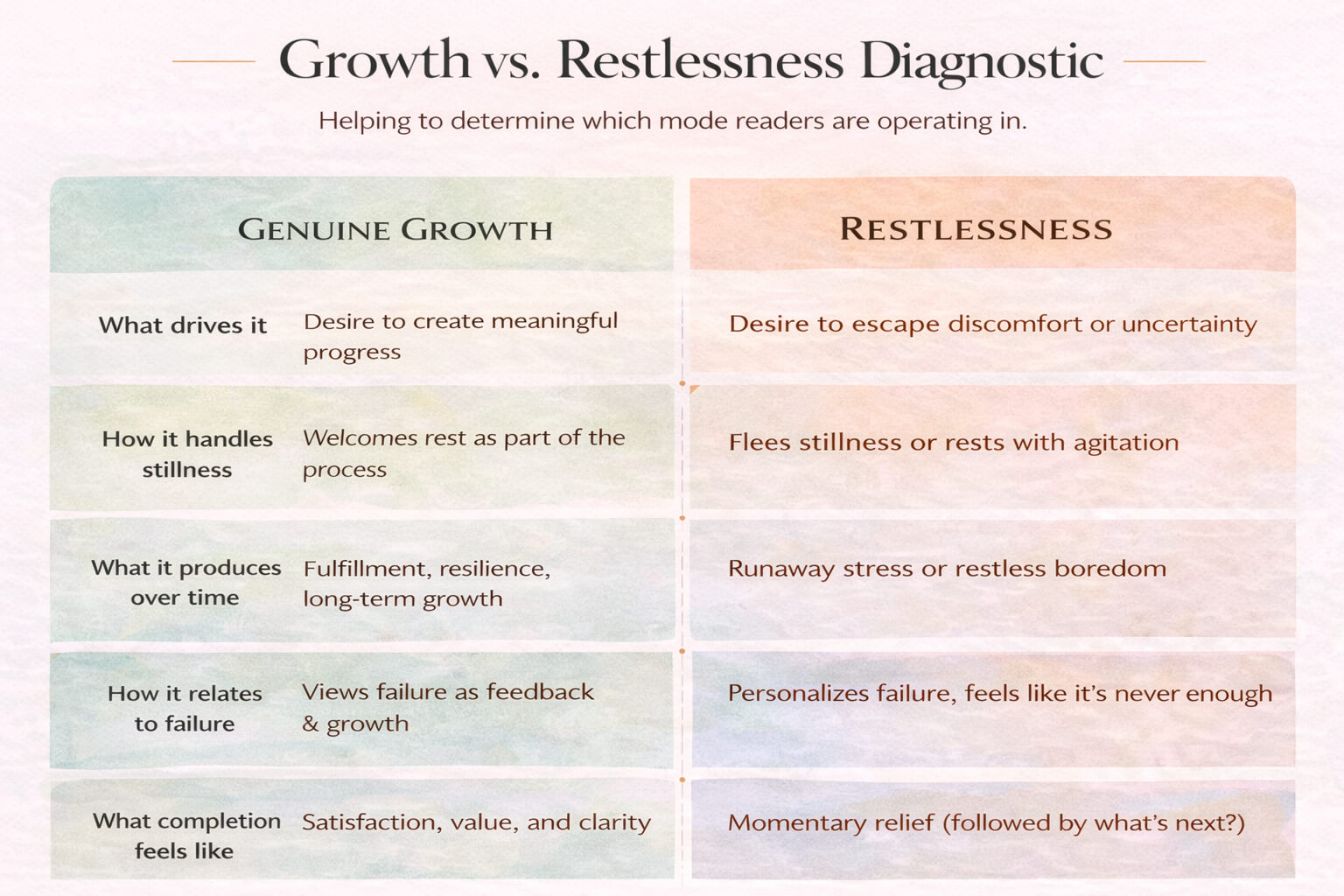
The distinction between growth and restlessness
Restlessness is worth distinguishing from growth because they can look identical from the outside, and because mistaking one for the other is expensive.
Restlessness is movement without genuine direction — the perpetual seeking of the next framework, the next teacher, the next self, driven not by developmental curiosity but by the discomfort of not moving. It often disguises itself as growth. But its underlying energy is escape rather than expansion. It is moving away from something — usually the anxiety of stillness, the fear of not enough, the discomfort of what is — rather than toward something.
Growth is movement in a genuine direction: toward more honesty, more capacity, more alignment between who you are and how you live. It can include stillness. It can include periods of apparent stagnation. It does not require perpetual motion.
The most useful question is: is this driven by curiosity and genuine care about who I am becoming? Or is it driven by discomfort and the anxiety of not enough?
Becoming vs. Achieving — A Different Model of Development
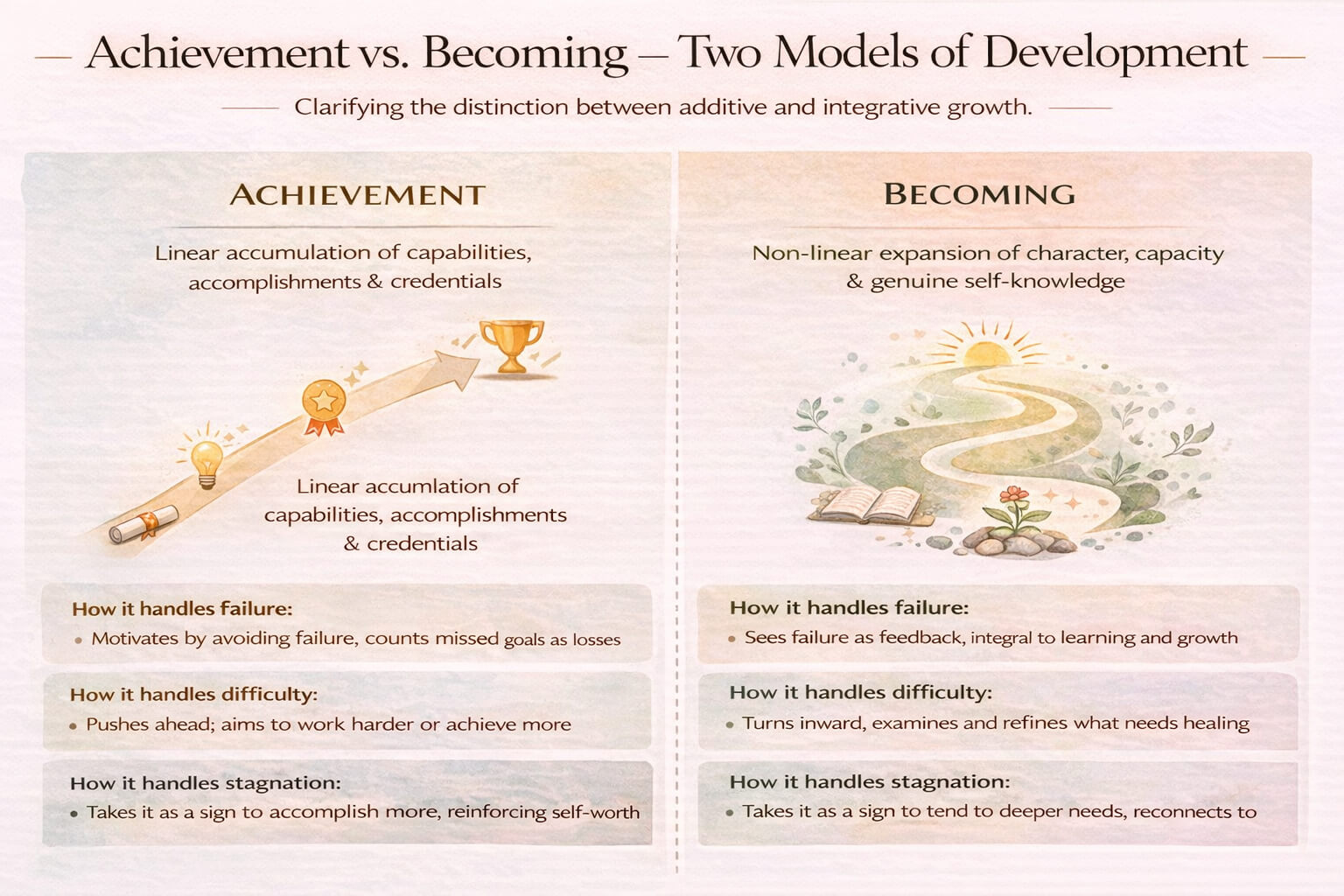
Achievement adds things to your life. Becoming changes who you are.
Achievement-oriented growth operates on an additive model: you acquire skills, certifications, habits, experiences, and accomplishments. You accumulate versions of success. The person at the end of this arc has a more impressive portfolio of capabilities and accomplishments than the person at the beginning. They may or may not be meaningfully different as a person.
Self-becoming operates on a different logic. It is not primarily about what you add, but about what becomes more integrated, more honest, more fully developed. The person who has genuinely grown in this sense has greater capacity — for difficulty, for connection, for honest self-knowledge, for genuine engagement with the world — not merely greater accomplishment.
The distinction shows up clearly in how failure is handled. Achievement-oriented growth tends to experience failure as a setback — a deviation from the upward trajectory that needs to be corrected and overcome as quickly as possible. Self-becoming tends to understand failure differently: as the specific material from which some of the most important development is made.
This difference in how failure is understood is not trivial. It shapes everything downstream: the relationship with risk, the capacity to stay in difficulty long enough to learn from it, the ability to be honest about what went wrong rather than defensive about it.
Self-Knowledge as the Compass for Growth
The most common problem with personal development efforts is that they operate without a clear sense of direction. People pursue growth in the abstract — better, more, stronger, higher — without a specific orientation that makes the pursuit genuinely theirs.
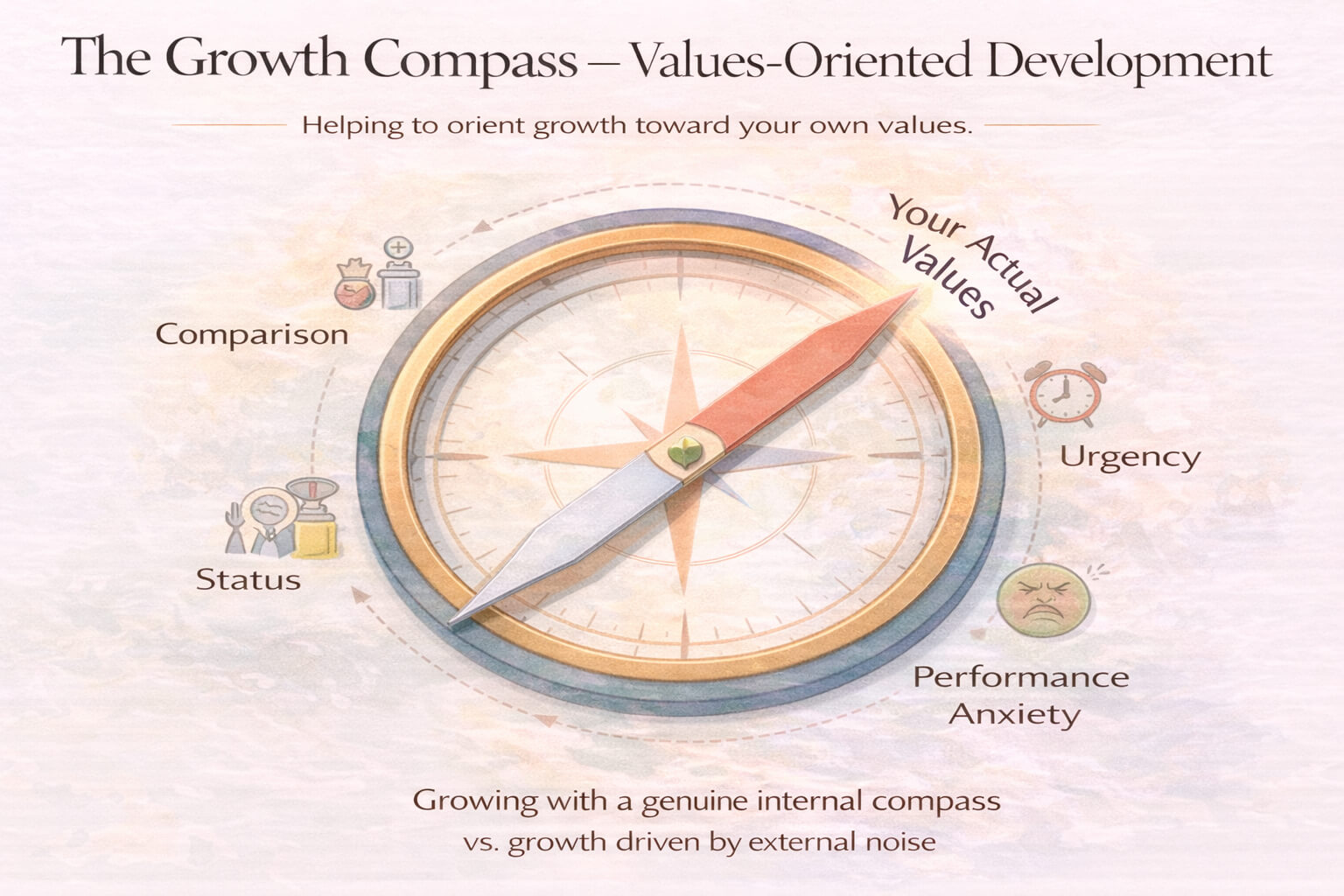
Self-knowledge is the compass that gives growth direction. Without it, you are growing — possibly — but you are not necessarily growing toward anything that is actually yours.
This is why the Mind & Inner Life pillar is the foundational one in this framework. Not because it is more important than growth, but because genuine growth requires knowing yourself well enough to know what you are growing toward. What your actual values are (not your stated ones). What kind of person you genuinely want to become (not the version you think you should aspire to). Where your real edges and blind spots are (not the ones that are comfortable to acknowledge).
Growth that is not oriented by self-knowledge tends to be borrowed growth — the pursuit of other people’s development models applied uncritically to your own life. It can produce real capability. It rarely produces the experience of becoming more genuinely yourself.
The Role of Failure, Difficulty, and Discomfort
The self-improvement industry has a complicated relationship with failure. On one hand, there is significant lip service to the idea that failure is a teacher, that resilience requires struggle, that growth happens outside the comfort zone. On the other hand, the content produced tends to present growth as an upgrade arc — smooth, progressively better, with difficulty as a brief plot device on the way to the next level.
The actual experience of significant growth almost never looks like that. It looks like protracted difficulty. It looks like staying in situations that do not resolve quickly. It looks like failure that does not immediately reveal its lesson. It looks like the long, unglamorous middle of a difficult process where the outcome is genuinely uncertain.
What difficulty actually produces
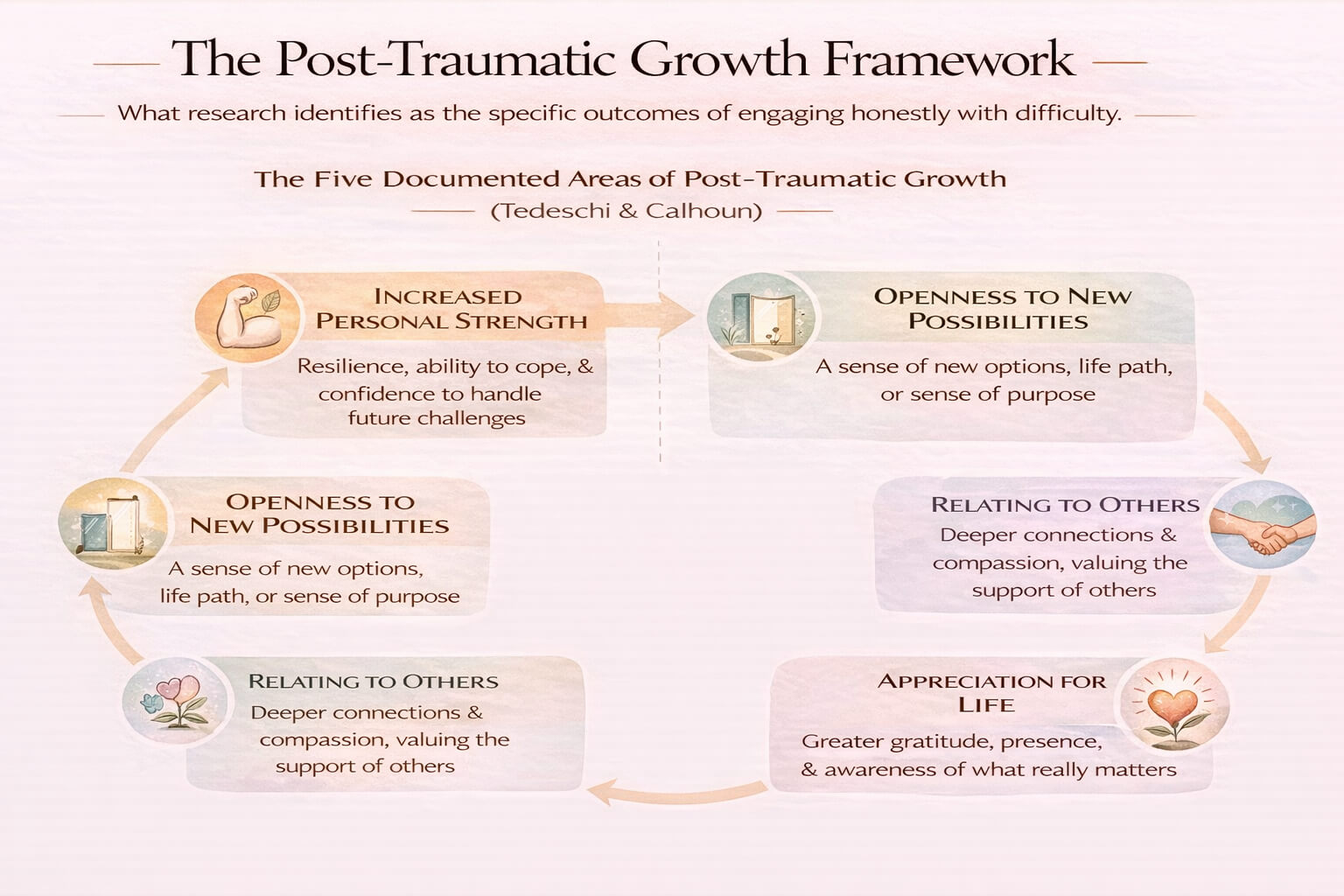
Research on post-traumatic growth — the documented phenomenon of psychological development that follows genuinely difficult experiences — finds that significant adversity, when engaged with rather than avoided, tends to produce lasting changes: expanded capacity for emotional experience, revised priorities and values, greater appreciation for relationships and ordinary life, increased sense of personal strength, and what researchers Tedeschi and Calhoun describe as existential growth — a deepened relationship with one’s own meaning and mortality.
This is not a call to seek suffering. It is a recognition that difficulty, when met with honesty and genuine engagement rather than avoidance or performance of coping, tends to produce development that smooth upward arcs do not.
The capacity to work with difficulty — to stay in it long enough to learn from it, without either collapsing under it or performing resilience for an audience — is itself one of the most important growth skills there is.
How to work with failure rather than around it
Working with failure requires, first, the willingness to look at it honestly — without the defensive story about why it wasn’t really your fault, and without the self-flagellating story about what it proves about your fundamental deficiency. Both responses protect you from the specific information that failure carries.
Honest failure engagement asks: what actually happened? What did I contribute to it? What assumptions did I have that turned out to be wrong? What would I do differently? What has this revealed about what I value, what I fear, or what I am not yet capable of?
This is not always comfortable. It is, however, generative in a way that avoidance and self-flagellation are not.
Learning as a Life Practice — Not Just a Career Tool
In the dominant cultural conversation, learning is primarily understood as a career tool — a way to remain employable, upskill, and stay competitive. This is not wrong. It is dramatically incomplete.
Learning — genuine, curiosity-driven engagement with ideas, skills, perspectives, and experiences beyond your current knowledge — is one of the most important practices in a full human life. Not because it makes you more productive, but because it makes you larger. More capable of understanding the world and the people in it. More able to hold complexity without collapsing it. More genuinely interesting to yourself.
The research on learning and wellbeing is consistent: engagement with challenging, interesting intellectual activity is associated with cognitive vitality across a lifetime, higher reported meaning and satisfaction, and the kind of ongoing development that keeps people feeling genuinely alive rather than merely occupied.
The meta-skill: how to learn well
Perhaps more important than any specific body of knowledge is the capacity to learn — to approach unfamiliar domains with genuine curiosity, to tolerate the discomfort of not knowing while you develop competence, and to revise your understanding when evidence requires it.
This is sometimes called learning agility. It is the ability to adapt, to be wrong and updated, to hold expertise lightly enough to keep improving it. In a world where the relevant knowledge base shifts faster than any training program can track, the capacity to learn is considerably more valuable than any specific thing currently known.
Cultivating this meta-skill requires the habit of deliberate engagement with things you do not yet understand — and the willingness to be genuinely bad at something while you develop competence in it.
Mentorship and the Teachers Who Shape Us
Some growth happens in solitude. Some happens in structured learning. Some of the most significant happens in relationship — specifically, in relationship with people who have developed something you have not yet developed, and who are willing to engage genuinely with your growth rather than simply delivering expertise.
Genuine mentorship is rarer than it sounds. It is not simply having access to someone more experienced. It is having access to someone who sees you with some accuracy, challenges you with care, and accompanies you through the difficulty of development rather than just pointing at the destination.
Finding these relationships — formal or informal, long-term or brief — is one of the highest-leverage things available to someone serious about genuine growth. Not because mentors have answers you don’t, but because certain kinds of development are only available in the presence of someone further along who cares about your development.
The inverse is also worth naming: teaching and mentoring others is itself one of the most reliable catalysts for your own growth. The requirement to articulate what you know, to meet someone where they actually are, and to hold space for their development tends to deepen your own understanding in ways that solo study does not.
Identity Evolution — How to Grow Without Losing Yourself
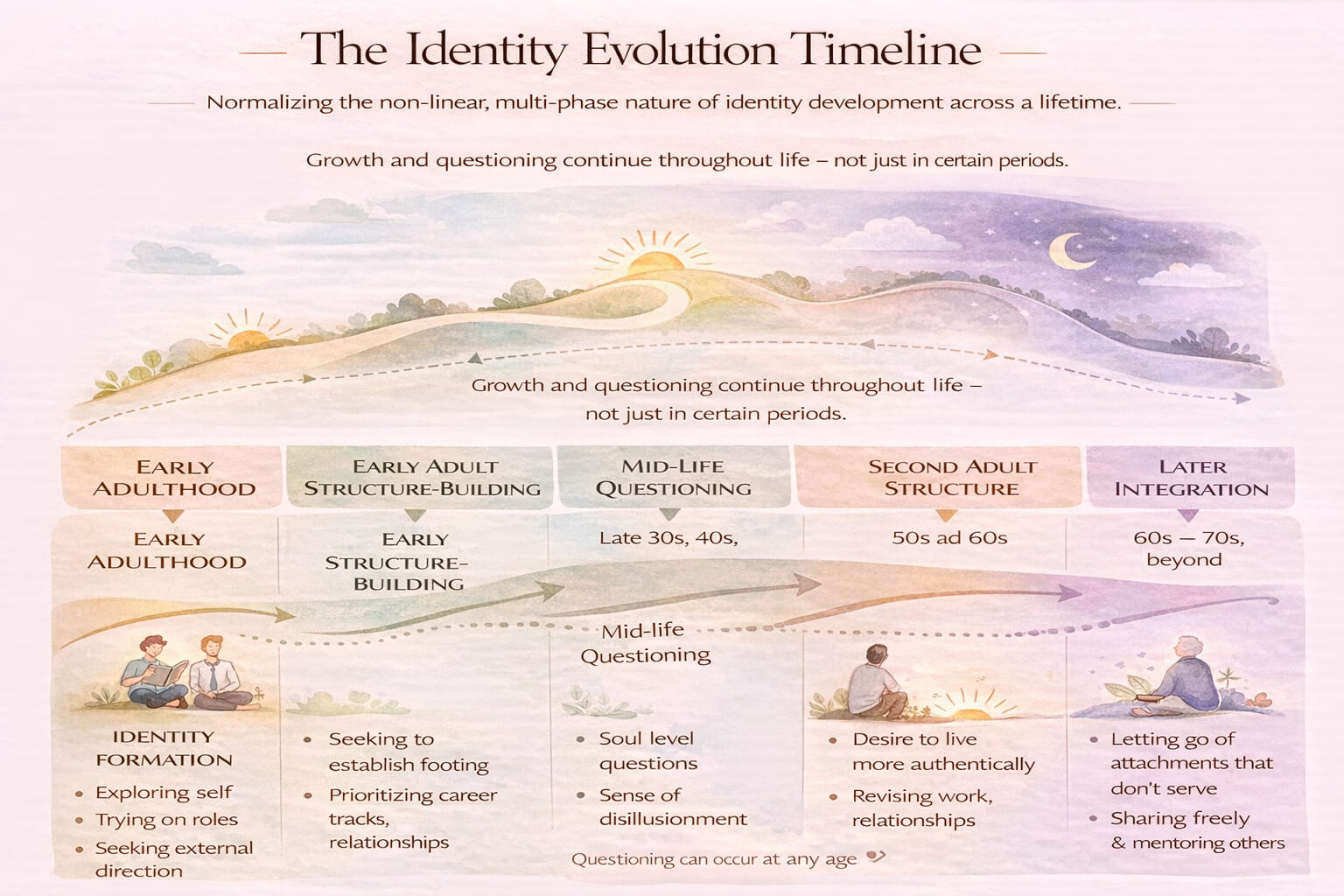
A genuine, sustained engagement with your own development will, over time, change you. The values that felt certain in your 30s may look different in your 40s. The person you were certain you were may feel less complete or less accurate than they once did. The commitments, relationships, and directions that made sense for one version of you may fit differently now.
This is not failure. This is development.
Identity evolution — the ongoing process of becoming more genuinely yourself across a lifetime — is marked by exactly this kind of productive discomfort: the grief and liberation of outgrowing old versions of yourself, the challenge of integrating new understanding with existing commitments, the sometimes disorienting experience of knowing that who you were before was real and who you are becoming is also real, and that the two are not quite the same person.
What stays stable while everything changes
The question that identity evolution raises is not just “who am I becoming?” It is “what is stable enough to give continuity to a self that is genuinely changing?”
The most honest answer seems to be: your relationship with your own experience. The quality of your self-observation. Your capacity for honesty with yourself. Your core values — not the beliefs that change as you learn more, but the deepest orientations toward what matters — tend to become clearer even as everything else evolves.
This is why self-knowledge is the compass, not the destination. You are not trying to arrive at a final, fixed self. You are trying to stay in an honest, curious, and engaged relationship with the person you are in the process of becoming.
Late Bloomers, Non-Linear Paths, and Why Your Timeline Is Your Own
One of the more insidious effects of the self-improvement industry is the implied developmental timeline. By 30, you should have this level of clarity. By 40, this degree of achievement. By 50, this amount of wisdom. Deviations from the implied arc are treated as deficits, delays, and failures to launch.
The actual developmental research tells a different story. Adult development is significantly non-linear. Many people’s most important growth happens in later decades — often precipitated by specific difficulties, transitions, or losses that early success insulates against. The late bloomer who finds their direction at 45, the person who does their most honest inner work in their 50s, the writer who publishes their first meaningful work at 60 — these are not outliers on a developmental failure curve. They are simply people whose arc happened at its own pace.
This matters enormously as a practical frame, because the anxiety about being behind on a timeline that was never actually yours is one of the most effective ways to undermine genuine development. It substitutes urgency for depth. It prioritizes the appearance of development over its reality.
Your timeline is not behind. It is yours.
Growth in the Direction of Your Values — Not Just Forward
The most important reframe in this pillar is this: growth is not forward. It is not faster, more, higher, or better by any general standard. Growth is in a direction — and the direction that matters is toward your own deepest values, toward greater honesty about your actual experience, toward more genuine engagement with the people and work and life that is yours.
A person who has grown in this sense is not necessarily more accomplished than they were. They are more themselves. They handle difficulty with more capacity and less defensiveness. They love the people in their life with more honesty and less performance. They work at what matters to them with more genuine engagement and less striving for validation. They experience their own life — whatever its external shape — as more genuinely their own.
That is what the long game of self-becoming actually looks like.
It does not require a dramatic narrative arc. It does not require public achievement. It does not require that your growth be visible to anyone else. It requires only that you take seriously the ongoing question of who you are becoming — and that you keep choosing, as honestly as you can, to move in the direction of your own deepest life. And to do it at a sustainable pace for growth you can maintain across a lifetime.

Frequently Asked Questions (FAQ)
What is the difference between growth and restlessness?
Growth is movement in a genuine direction — toward more capacity, more honesty, more alignment with your actual values. Restlessness is movement without direction — the perpetual seeking of the next practice, driven by discomfort with stillness rather than genuine developmental curiosity. The most useful test: is this driven by curiosity and genuine care about who you are becoming? Or by discomfort and the anxiety of not enough?
How do I know if I am actually growing?
Genuine growth tends to show up in specific ways: you handle situations that once overwhelmed you with more capacity; you notice your own patterns sooner and with less defensiveness; your relationship with failure has changed — you can face it honestly without it threatening your sense of worth; your values are clearer and your decisions more consistent with them. Growth is often invisible in the moment. It shows up in retrospect — in the difference between who you were and who you are now.
What role does failure play in genuine personal growth?
Failure — handled honestly — is one of the most reliable catalysts for genuine development. Research on post-traumatic growth finds that difficulty, when engaged with rather than avoided, produces lasting changes: expanded emotional capacity, revised priorities, greater appreciation for what matters, and a more robust sense of self. The self-improvement industry tends to skip this. But the difficulty is often where the most important development happens.
What is self-becoming?
Self-becoming is the ongoing process of developing into a more complete, more authentic, and more integrated version of who you actually are — as distinct from who you have been performing or who others need you to be. It is not a destination. It is a direction of travel: toward greater honesty, clearer alignment between values and choices, and a deeper relationship with your own life.
Is there a right timeline for personal growth?
No. Development is non-linear. Many people’s most significant growth happens in their 40s, 50s, and 60s. Late blooming is not failure — it is simply a different developmental arc. The anxiety about being behind a developmental timeline that was never yours is one of the most reliable ways to undermine the growth you are actually doing. Your timeline is your own.
How do I grow without burning out on self-improvement?
Orient growth toward something genuine — a direction that is actually yours, rooted in self-knowledge and actual values — rather than toward an externally imposed standard. Let the pace be honest. Include difficulty and stagnation rather than treating them as signs of failure. Build in genuine rest and integration time rather than perpetual motion. The person who sustains genuine development across a lifetime is not the one who maximized the pace. It is the one who kept showing up honestly over a long time.
