
The Architecture of Your Inner Life: Self-Knowledge, Emotional Intelligence, and the Mind That Makes Everything Possible
TABLE OF CONTENTS
There is a version of self-improvement that is very good at looking productive. You track your habits. You optimize your morning. You read the books, attend the workshops, journal the prompts. And yet somehow, years into this effort, you find yourself still reacting the same way to the same situations. Still telling yourself the same stories. Still stuck in the same loops, just with better notebooks.
This is not a failure of discipline. It is a failure of depth.
The inner life — the actual architecture of how you think, feel, perceive, and make meaning — is not something you fix from the outside in. It is the medium through which you experience everything. Your relationships, your work, your finances, your sense of time — all of it is filtered through the mind you carry around. And yet most self-improvement treats the mind as a tool to be retooled rather than a landscape to be genuinely known.
This page is about something different. Not how to upgrade your mind, but how to understand it. Not how to control your emotions, but how to work with them honestly. Not how to silence the inner critic, but how to finally hear what it is actually trying to say.
This is the foundational pillar of the optYOUmize framework — not because it is more important than the others, but because every other pillar runs through it. How you relate to yourself shapes how you relate to money, to other people, to time, to your own growth. Clarity here creates clarity everywhere.
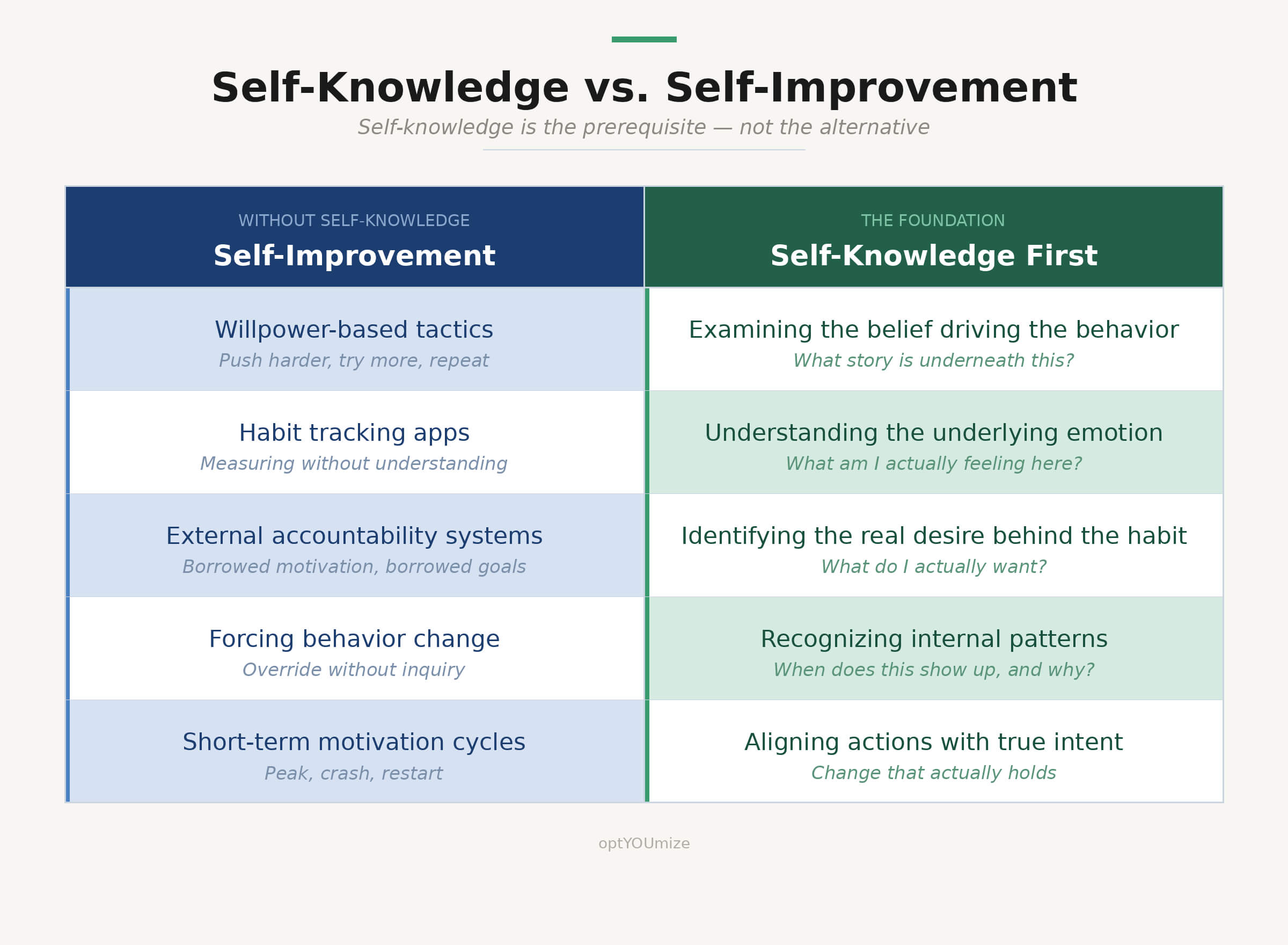
Self-Knowledge vs. Self-Improvement: Why the Distinction Changes Everything
Most of us approached self-improvement with the implicit belief that we already understood ourselves pretty well — and that what we needed was just better habits, better systems, better strategies to execute on what we already knew we wanted.
But there is a prior question that most self-improvement skips entirely: Do you actually know yourself?
Not in the shallow sense of knowing your strengths on a personality assessment. In the deeper sense: Do you understand why you react the way you do in certain situations? Do you know which of your beliefs about life were chosen versus inherited? Can you tell the difference between a genuine desire and a conditioned expectation? Do you know what you actually want — not what you think you are supposed to want?
Self-improvement, in its most common form, assumes the answer to these questions is yes and builds from there. It gives you better tools for a life you haven’t yet examined. This is why so much of it doesn’t stick.
Self-knowledge asks the prior question. And the answer, for most people, is that we know ourselves considerably less well than we assume.
What “inner life” actually means
The phrase “inner life” can sound soft, so it is worth being precise. Your inner life is the sum of your beliefs (about yourself, others, and how the world works — most of which you have never consciously examined), your emotions (the signal system that tells you what matters and what threatens), your cognitive patterns (the habitual ways your mind processes information and constructs meaning), your inner narrative (the ongoing story you tell about who you are and why things happen to you), your actual values as opposed to your stated ones, and the quality of your attention — where your mind tends to dwell, what it notices, what it ignores.
This is the internal architecture of your experience. It shapes what you perceive, what you interpret, what you decide, how you relate, and ultimately, how your life feels from the inside.
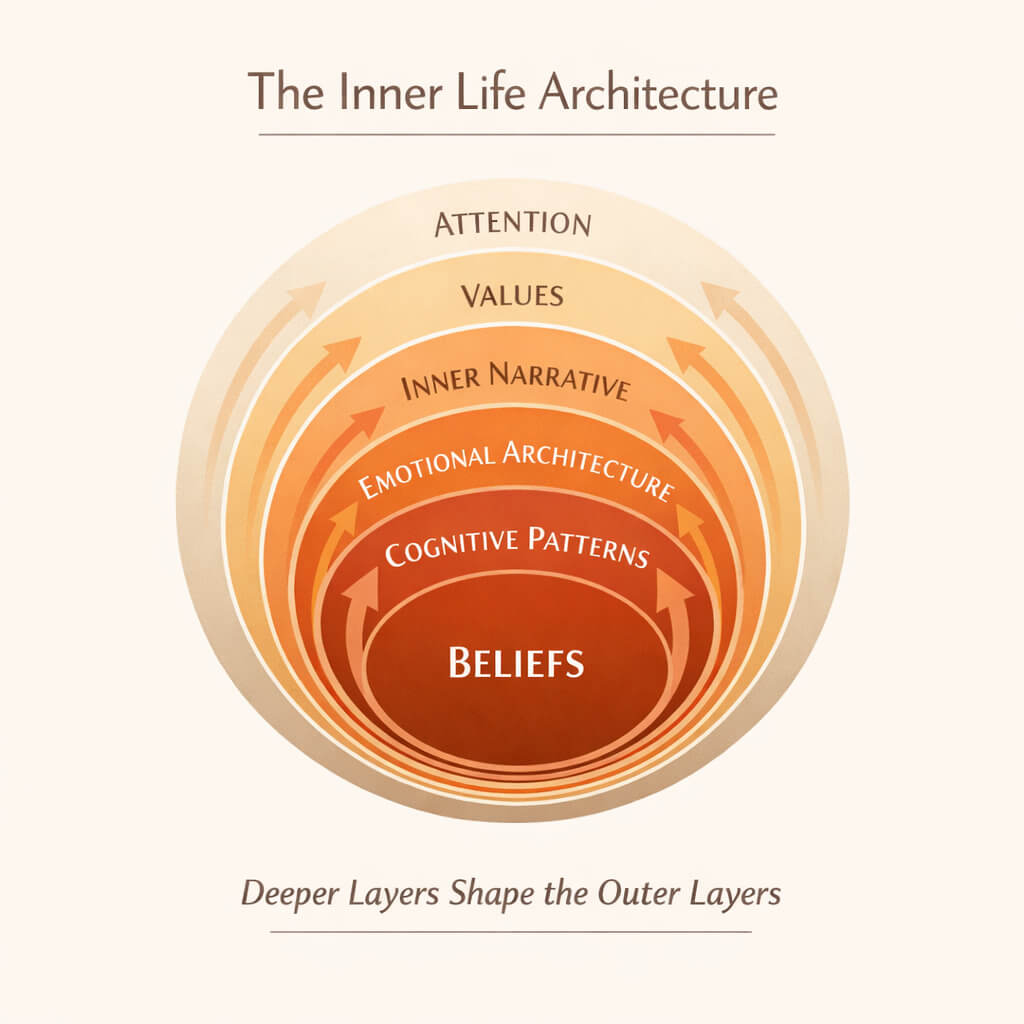
When this architecture is unclear to you — when you are running on inherited scripts and unexamined assumptions — you are not really living your own life. You are living a version of life that someone else’s conditioning largely wrote.
Why most self-improvement operates on the wrong level
Consider how standard self-improvement approaches procrastination. The typical answer: use a time-blocking system, set accountability, create friction for the bad behavior and rewards for the good one.
These are not useless. But they operate entirely on the surface.
Underneath procrastination, in most people, is something more interesting: fear of failure, perfectionism, a belief that value comes only from exceptional output, anxiety about being judged, a deeply ambivalent relationship with the work itself. Deal with those, and procrastination becomes considerably more tractable. Ignore them, and you will be fighting the same battle every morning while buying better planning apps.
The same is true for nearly every pattern you want to change. What looks like a discipline problem is usually a self-knowledge problem. What looks like a bad habit is often a coping mechanism for something that has never been examined. What looks like lack of motivation is frequently a signal that something is misaligned at a deeper level.
Behavioral strategies matter. They work significantly better, though, when they are built on genuine self-understanding rather than deployed against it.
Your Emotional Architecture: What Emotional Intelligence Really Means
Emotional intelligence has become popular enough to be stripped of much of its meaning. In corporate contexts it often means “appear emotionally appropriate.” In self-help contexts it sometimes collapses into “stay positive.” Neither of those captures what emotional intelligence actually is.
In its research-grounded sense, emotional intelligence involves four interconnected capacities: perceiving emotions accurately, using them to facilitate thought, understanding how they evolve, and working with them effectively. Translated into a real human life, it means something simpler and more demanding: the ability to be in honest, functional relationship with your own emotional experience.
Emotions are information, not obstacles
This is worth repeating because our culture works against it: emotions are not obstacles to clear thinking. They are a form of intelligence.
Your emotional system is constantly scanning your environment and internal state, registering what matters to you, what threatens you, what is missing, what is present. When you feel dread before a certain meeting, that is information. When you feel a specific kind of sadness after certain conversations, that is information. When you feel quietly alive about a direction you have not yet acknowledged out loud, that is information too.
The problem is not that we have emotions. The problem is that most of us have a limited vocabulary for them, a habit of suppressing or escalating them, and little practice in reading what they are actually saying.
Emotional intelligence begins with the simple but genuinely difficult practice of slowing down enough to ask: what am I actually feeling right now, and what might it be telling me?
What emotional intelligence looks like in a real day
It looks like noticing that what you have been calling “frustration” at your partner is actually exhaustion and loneliness — and responding to that instead.
It looks like recognizing, in the moment before you send an email, that you are operating from defensiveness rather than clarity — and choosing to wait.
It looks like being in a hard conversation, feeling the pull toward shutdown or retaliation, and staying curious instead.
It looks like knowing the difference between avoiding something because it is genuinely wrong for you, versus avoiding it because it is uncomfortable and unfamiliar.
None of this is easy. All of it is learnable. And almost none of it shows up on a productivity dashboard.
The Software Running Your Life: Beliefs, Assumptions, and Cognitive Patterns
Every person is operating from a set of beliefs so deeply embedded that they function not as beliefs but as reality. These are not things you think — they are the lens through which you think. They are the software running behind every decision, interpretation, and reaction.
Most of these beliefs were not chosen. They were absorbed — from your family of origin, your early experiences, your culture, the messages of the world you grew up in. Because they arrived before you had the cognitive capacity to evaluate them, they installed themselves at the operating-system level of your mind.
Common examples: the world is fundamentally unsafe, so I must stay vigilant. I am only valuable when I am achieving. Love is conditional on performance. Vulnerability is weakness. If I rest, I fall behind. I am fundamentally different from people who seem to be doing fine.
Most people carrying these beliefs would not describe them that way. They would say “I just feel anxious sometimes” or “I’m a perfectionist.” The belief itself remains invisible — felt only through its effects.
How to begin examining the assumptions you are living by
The first step is taking seriously the possibility that your assumptions are not reality. This sounds obvious. It requires real intellectual humility, because assumptions feel like observations, not conclusions.
Some useful questions: What do I believe, at the deepest level, about my own worth? What do I assume other people think of me by default? What happens inside me when I fail or make a mistake — what story do I tell? What do I believe I have to do in order to deserve rest, care, or love? Where in my life am I operating from fear that I have labeled as strategy?
These are not comfortable questions. They are, however, honest ones. And the cognitive-behavioral tradition — widely supported by research — offers structured frameworks for identifying and working with distorted thought patterns: catastrophizing, black-and-white thinking, mind-reading, personalization. These are not exotic pathologies. They are common features of how human minds work under stress, and most of us engage in them far more than we realize.
The Inner Critic: Understanding the Voice That Holds You Back
Nearly every person who takes their inner life seriously eventually comes face to face with a voice in their own head that is unkind to them. Sometimes it is quietly dismissive. Sometimes it is openly harsh. It catalogs failures, exaggerates flaws, compares you unfavorably to everyone around you, and applies standards to you it would never apply to someone you love.
Most approaches to the inner critic land in one of two unhelpful places: either ignore it and think positive thoughts instead, or turn it into a personality to be managed or defeated. Neither addresses what is actually happening.
Where the inner critic comes from
The inner critic is not a random defect. It has a developmental origin. For most people, it is the internalized voice of early caregivers, teachers, or culture — the messages about what you needed to be in order to be acceptable, loved, or safe. It often developed in a genuine act of protective adaptation: if you criticized yourself first, perhaps the external criticism hurt less. If you kept yourself small and compliant, perhaps you stayed safe.
The problem is that this protective mechanism does not update itself. It keeps running the same software long after the original threat has passed. And in adulthood, it can be quietly paralyzing.
What the critic is actually trying to do
Here is something worth sitting with: the inner critic is usually trying to protect you from something. From failure, from rejection, from the pain of trying and falling short. Its methods are terrible, but its intent — at some level — is protective.
When you understand that, you can begin to work with it differently. Instead of trying to destroy the critic, you can begin to hear what it is worried about, take that concern seriously, and then choose how to respond.
From self-attack to honest self-assessment
There is a significant difference between the inner critic and genuine self-assessment. Honest self-assessment is specific, fair, and motivated by learning. It sounds like: “That conversation didn’t go the way I wanted. I got defensive when I could have stayed curious. What do I want to do differently?” It is honest and it moves forward.
The inner critic is not specific, not fair, and not motivated by learning. It sounds like: “Of course you messed that up. You always do. What made you think you could handle something like that?”
Learning to tell the difference — and to respond to the first kind of voice rather than the second — is one of the more practically useful inner-life skills there is.
The Practice of Introspection: Tools That Actually Work
Introspection has a reputation problem. It gets associated with endless self-analysis that produces insight without action, with a particular personality type that loves to discuss its feelings at length in a way that makes everyone around it quietly check their phone.
Real introspection is not that. It is the practice of turning your attention — with genuine curiosity and appropriate structure — toward your own inner experience. And the evidence for its value is substantial.
Journaling as self-inquiry, not self-monitoring
There is a significant difference between using a journal to record what you did and using it to explore what you experienced, thought, and felt. The second is the one that builds self-knowledge.
Effective journaling for inner-life purposes is not about writing the perfect entry. It is about creating a consistent container for honest self-reflection. Useful starting points include: what am I carrying right now that I haven’t said out loud? Where do I notice resistance in my life, and what might it be about? What happened recently that I had a strong reaction to, and what was actually going on inside me? What do I want that I have trouble admitting I want?
The act of writing forces a kind of specificity that pure mental reflection often lacks. It also creates a record. Reading a journal from a year ago is one of the more illuminating practices available — you can see what was actually going on for you then, versus what you thought was going on.
Therapy, coaching, and the mirror only another person can hold
There is a reason therapy has been one of the most extensively studied and consistently effective interventions for human wellbeing: the presence of another person who is genuinely interested in your inner world, and who can reflect back things you cannot see yourself, is transformative in ways that solo reflection cannot replicate.
This does not mean everyone needs to be in therapy all the time. But for most people, some form of guided reflection — whether therapy, skilled coaching, or sustained honest conversation with someone you genuinely trust — will surface things that introspection alone won’t reach.
You have blind spots. Every person does. By definition, you cannot see them by looking harder. You need someone else to notice what you cannot.
Stillness and the space where insight lives
Modern life is engineered — accidentally or otherwise — to prevent stillness. The notification, the open tab, the podcast playing during what used to be a quiet walk. We have filled every interstitial moment with input, eliminating much of the space where genuine insight has room to emerge.
Stillness — in whatever form works for you — is not an indulgence. It is a requirement for a rich inner life. Whether that is meditation, a slow walk without headphones, sitting with nothing but a cup of coffee, or some other practice that creates a genuinely quiet space inside you — making room for it is not optional if inner-life development is the goal.

Emotional Regulation: Not Control, But Navigation
“Emotional regulation” sounds clinical, which may explain why it triggers either intimidation or dismissal. But the concept is simpler than the language suggests. It refers to your capacity to work with your emotional states rather than being entirely at their mercy.
Note what this is not. It is not suppression. It is not always feeling calm. It is not refusing to feel difficult emotions while performing equanimity. It is the ability to experience the full range of your emotional life while retaining some capacity to choose how you respond.
The pause between stimulus and response
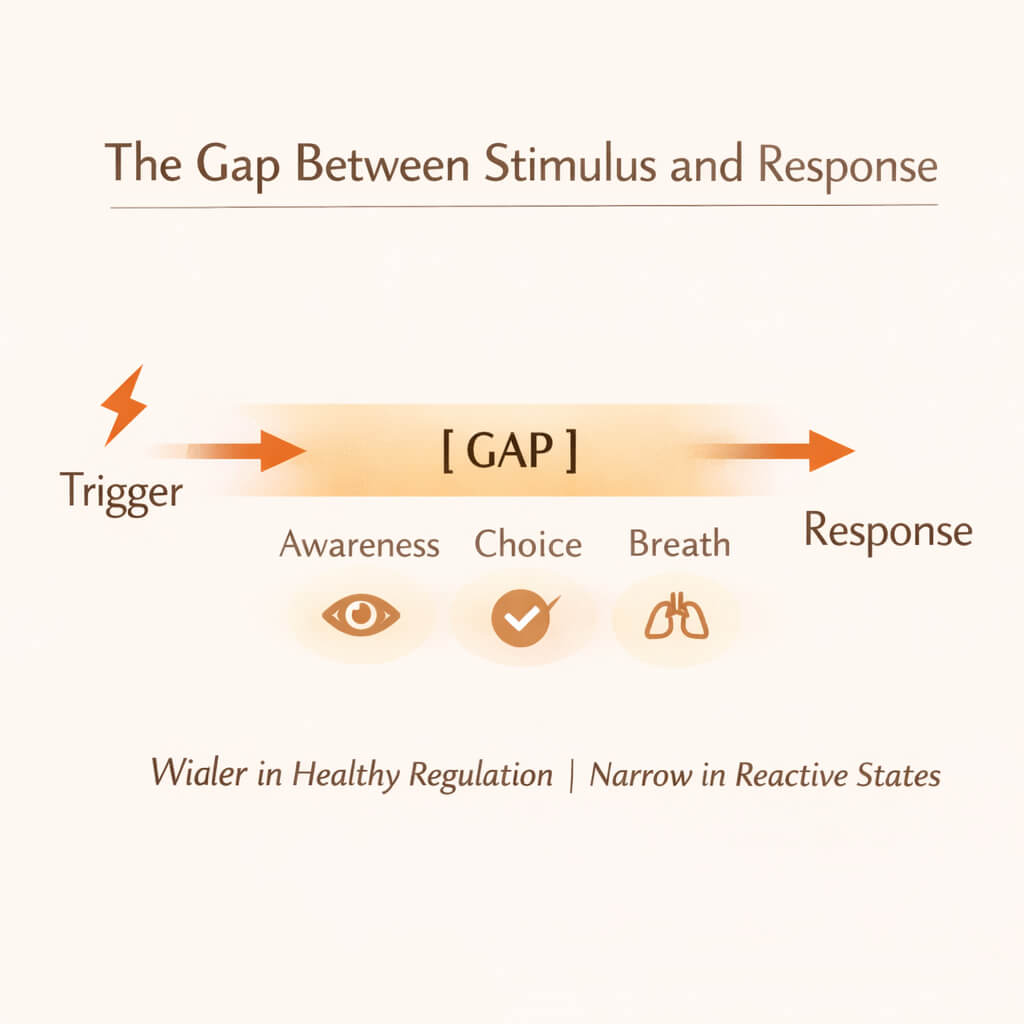
Between what happens to you and how you react, there is — at least theoretically — a pause. A gap. In that gap lives some degree of choice.
In practice, for most people, the gap is very small. Someone says something in a certain tone of voice and you are already responding before you have consciously registered what happened. The goal of emotional regulation work is to widen that gap — not to never feel triggered, but to have enough space between the trigger and the response to actually choose what comes next.
This is slow, unglamorous work. It is also among the most practically valuable inner work you can do. The quality of your relationships, your professional behavior, your parenting, your decision-making — all of it is substantially shaped by the width of that gap.
Building a repertoire of responses
One practical aspect of emotional regulation is expanding your repertoire of possible responses. Most of us, under emotional activation, have a small set of default moves: shut down, escalate, deflect, comply, flee. Over time, with awareness and practice, it becomes possible to develop a wider range: pause and breathe, name what is happening, ask a clarifying question, take space, express the feeling without acting it out.
This is not about performing composure. It is about genuinely having more choices — and therefore more freedom — in the moments that matter most.
Self-Compassion vs. Self-Criticism: A Distinction With Real Consequences
For decades, conventional wisdom held that high standards and self-criticism were the engines of high performance. Push yourself hard. Don’t let yourself off the hook. Hold yourself accountable. The softer view — be kind to yourself — was treated as an excuse for mediocrity.
Research, led substantially by psychologist Dr. Kristin Neff at the University of Texas at Austin, has told a different story.
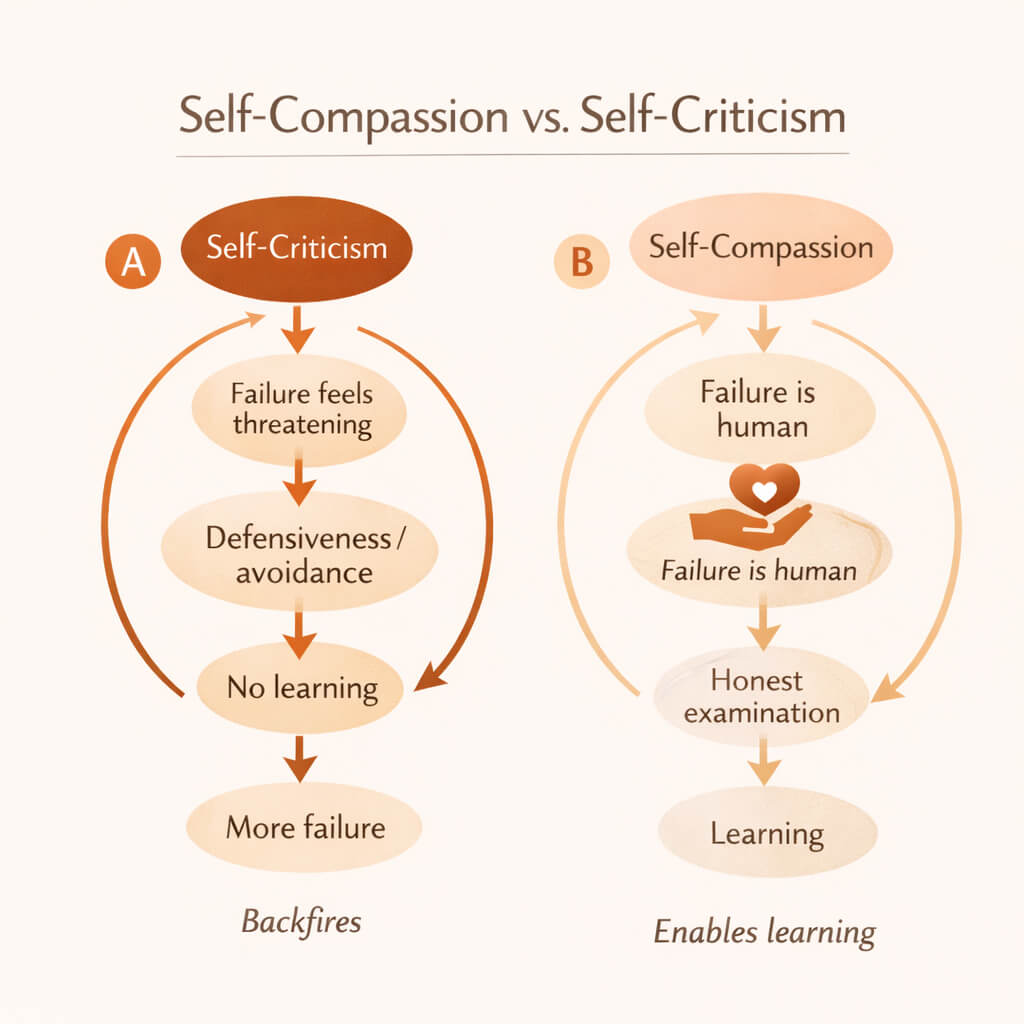
Self-compassion — defined as treating yourself with the same kindness and perspective you would offer a friend who was struggling — is consistently associated with greater resilience, higher motivation, more honest self-evaluation, and better learning from failure. Self-criticism, by contrast, is associated with anxiety, depression, perfectionism, and a reduced capacity to learn from mistakes.
The mechanism makes sense. Under self-criticism, failure becomes threatening to the self, which triggers defensiveness and avoidance rather than learning. Under self-compassion, failure becomes a shared human experience that can be faced honestly and learned from without threatening your fundamental sense of worth.
Self-compassion is not self-indulgence
This is the objection that almost always arises, so it is worth addressing directly. Self-compassion is not the same as lowering your standards, making excuses for yourself, or refusing to be accountable.
Self-compassion is what happens after something has gone wrong. It is what makes it possible to look at the thing honestly — without the defensive shutdown that harsh self-judgment triggers — and actually learn from it. It is the difference between “I did something I regret” and “I am fundamentally deficient.” The first can be examined and addressed. The second produces shame, which is one of the least useful emotional states for behavioral change that human beings have yet discovered.
A person high in self-compassion does not let themselves off the hook. They are better equipped to face what is on the hook, because they do not have to simultaneously protect their sense of self-worth while doing it.
Attention, Presence, and the Quality of Your Inner Experience
The attention economy has given us a new lens for a very old problem. The human mind has always wandered. It now has more sophisticated places to wander to, and an entire industry designed to exploit its tendency to do so.
But the real cost of fractured attention is not just productivity. It is the quality of your own experience.
When attention is perpetually fragmented — cycling between tasks, notifications, ambient stimulation, and anxious planning — you are not fully present in your own life. You show up to the dinner, the conversation, the moment. But something in you is elsewhere. The accumulating cost of that is a life that feels thinner than it actually is.
Attention and inner life are connected directly: your inner life is only as rich as the quality of attention you can bring to it. A mind that cannot settle is a mind that cannot reflect. A mind that cannot reflect cannot build the self-knowledge that makes genuine growth possible.
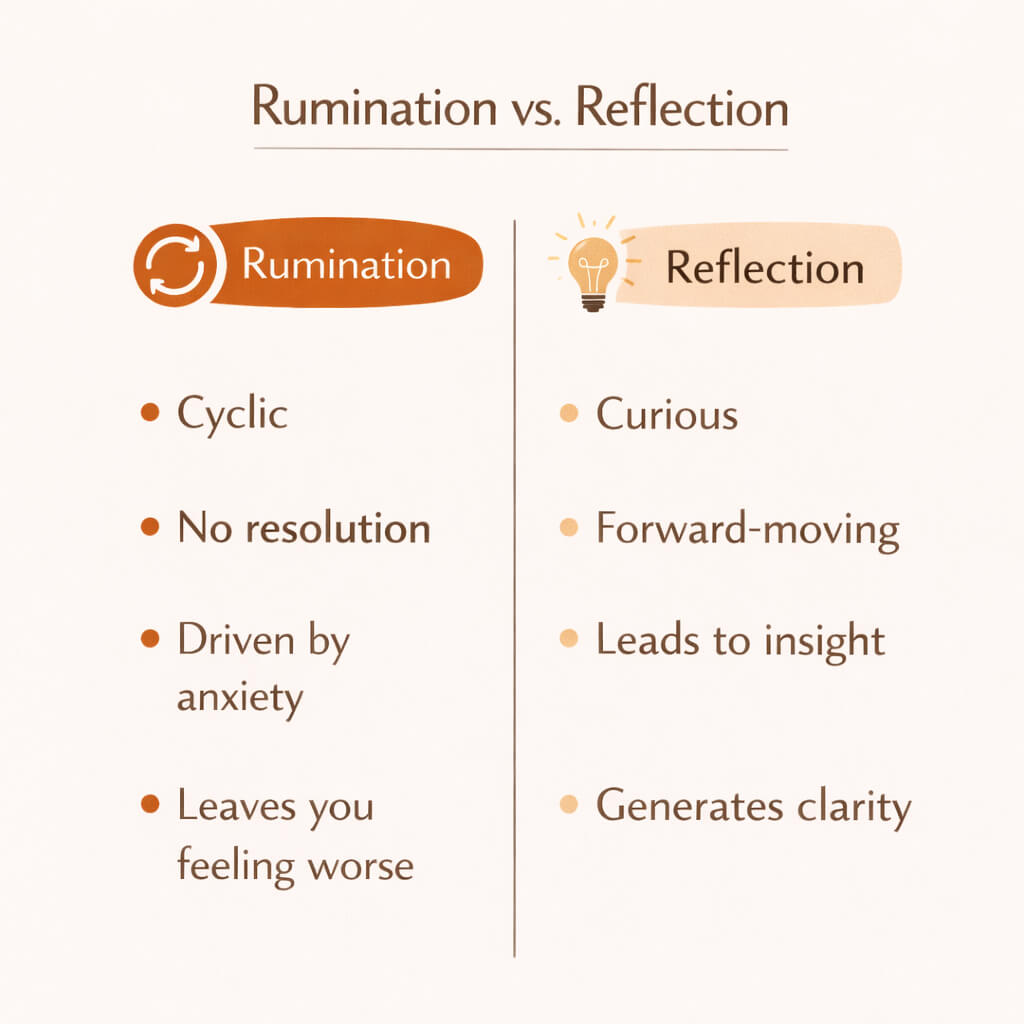
Rumination vs. genuine reflection
This distinction is worth holding carefully, because people often collapse the two.
Rumination is the mind getting stuck in a loop — replaying events, rehearsing anxieties, cycling through the same thoughts without resolution. It feels like self-reflection but it is not. It generates heat without light. Research consistently shows that rumination is associated with depression and anxiety rather than with insight or change.
Reflection is different. It involves turning attention toward your experience with curiosity and some degree of structure. It asks questions and waits for answers. It notices patterns without being consumed by them. It creates the conditions for genuine learning.
The distinction matters because people who tell themselves “I think about my life a lot” are sometimes ruminators — and the cure for rumination is often not more introspection. It is movement, physical engagement, creative work, or genuine connection with another person.
This Is a Long Game, Not a Transformation Project
Here is what this pillar actually asks of you: not a specific practice, not a transformation arc with a timeline, not a weekend workshop that changes everything. It asks you to treat the ongoing work of understanding yourself as a serious and worthy endeavor — one that runs alongside, and through, every other area of your life.
You will not arrive at a final self-knowledge. You will simply become, over time, a more honest and curious observer of your own experience. You will notice your patterns a little sooner. You will catch your assumptions a little more often. You will be less at the mercy of emotions you haven’t named, thoughts you haven’t examined, beliefs you didn’t choose.
This matters in every other domain. How you understand your mind shapes how you inhabit your body. How honest you are with yourself shapes the quality of your relationships. How aware you are of your cognitive patterns shapes your financial decisions, your relationship with time, your capacity for genuine growth.
Every other pillar of this framework runs through the inner life. This is not the most important one — it is the one that makes all the others more tractable.
Frequently Asked Questions (FAQ)
What is the difference between self-awareness and self-improvement?
Self-awareness is the ongoing practice of understanding your inner world: your beliefs, emotional patterns, cognitive habits, and inner narrative. Self-improvement is the effort to change specific behaviors or outcomes. The problem is that most self-improvement skips the self-awareness step — it tries to change the outputs without understanding the system producing them. Self-awareness makes self-improvement more targeted, more honest, and significantly more durable.
What is emotional intelligence in plain terms?
Emotional intelligence is your ability to perceive, understand, work with, and respond thoughtfully to emotions — both your own and others’. In practical terms, it means recognizing what you are actually feeling, understanding what those emotions are telling you, and making choices from that clarity rather than reacting automatically. It is a learnable skill, not a fixed personality trait.
How do I get to know myself better?
Consistent, honest self-reflection is the foundation. Journaling, therapy or coaching, moments of genuine stillness, and honest conversations with people who see you clearly are the primary vehicles. Underneath all of them is the same practice: turning toward your own inner experience with genuine curiosity, rather than constantly looking outward for the next system or the next benchmark.
What is the inner critic, and how do I work with it?
The inner critic is the internalized voice of early criticism and conditional love — often a protective mechanism developed in childhood. Working with it does not mean silencing it. It means learning to hear it differently: understanding what it is afraid of, separating its signal from its noise, and responding from self-compassion rather than from shame.
Is self-compassion the same as making excuses for yourself?
No. Self-compassion is what makes honest self-evaluation possible. Under harsh self-judgment, failure becomes a threat to your sense of self, which triggers defensiveness. Under self-compassion, you can face failure honestly and actually learn from it. Research by psychologist Dr. Kristin Neff consistently shows self-compassion is associated with higher motivation and better learning, not lower standards.
What is the difference between rumination and self-reflection?
Rumination is the mind cycling through the same thoughts without resolution — driven by anxiety or self-criticism. It feels like reflection but generates heat without light. Genuine reflection involves curiosity, forward movement, and actual insight. If thinking about your life consistently leaves you feeling worse rather than clearer, you may be ruminating rather than reflecting.
Something Powerful
Tell The Reader More
The headline and subheader tells us what you're offering, and the form header closes the deal. Over here you can explain why your offer is so great it's worth filling out a form for.
Remember:
- Bullets are great
- For spelling out benefits and
- Turning visitors into leads.
