
Skip to content

Money as a Tool for Freedom: The Psychology of Financial Wellbeing, Enough, and a Life That Doesn’t Cost You Everything

TABLE OF CONTENTS

 Let’s begin with a question that most financial content carefully avoids: how much is enough?

Not “how do I build wealth?” Not “how do I retire early?” Not “what is the optimal savings rate?” Those are valid questions, and there are better resources for them than this one. The question here is the prior one, the one that determines whether any amount of financial achievement will ever feel like enough: what are you actually trying to build, and why?

Most people have never answered that question explicitly. They are working from an implicit assumption — that more is better, that financial insecurity is an emergency and financial abundance is the goal, that the point of money is to have more of it. And those assumptions are driving enormous amounts of energy, anxiety, and effort in directions that may or may not actually lead anywhere satisfying.

This is a different kind of money conversation. Not about returns or tax strategies or optimization hacks. About the psychology underneath the finances. About the question of what money is actually for in a human life — and what it means to have enough of it.


What Money Is Actually For

Money is a tool. This sounds obvious, but it is widely and persistently forgotten.

A tool has value in proportion to what it enables you to do or build. A hammer is not valuable in itself — it is valuable because of what you can build with it. The same is true of money: its value is instrumental, not intrinsic. It is valuable because of what it enables.

What does money enable? At the most basic level: safety. Security from the physical threats of inadequate food, shelter, healthcare. Above that baseline: options. The ability to make choices that would not be available without financial resources — about where to live, what work to do, how to spend time, what risks to take.

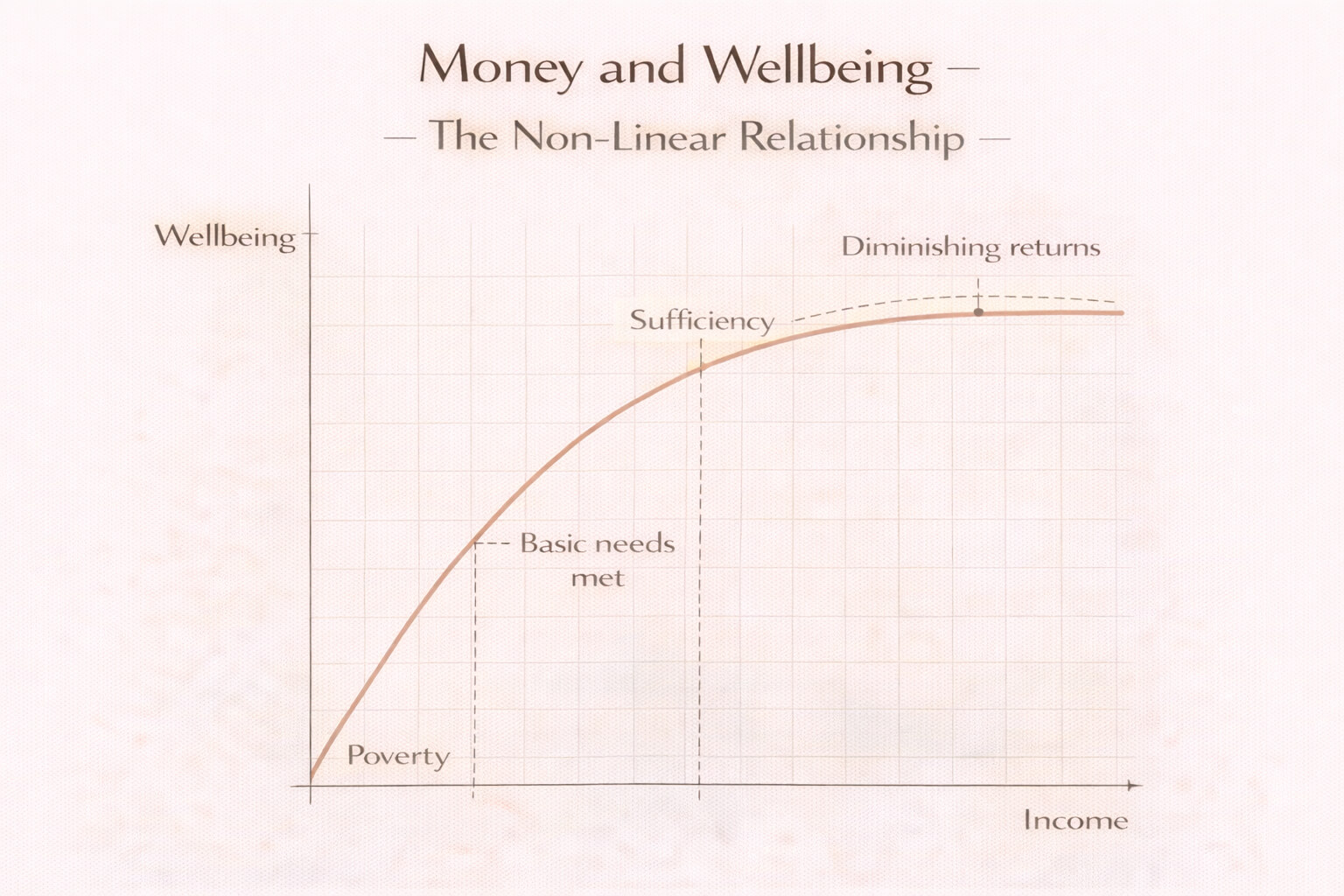
Beyond those two functions — safety and options — money’s relationship to wellbeing becomes considerably more complicated. Researchers have found that additional income beyond what provides genuine security and reasonable comfort produces rapidly diminishing returns in day-to-day happiness and life satisfaction. The relationship between money and happiness is real but non-linear: below a certain threshold, financial scarcity causes genuine suffering. Above that threshold, the returns from additional wealth on how life actually feels are much smaller than most people assume.

The mistake is treating money as the goal rather than the tool — accumulating it without a clear conception of what it is for, beyond more of it. When the goal is undefined, no amount is ever sufficient. The finish line keeps moving. The anxiety never fully resolves. And the life that was supposed to get better with each income increase stubbornly refuses to cooperate.


The Psychology of Money — Why We Think the Way We Think

Your relationship with money was shaped long before you made any financial decisions. The beliefs, habits, fears, and reflexes you bring to your financial life were absorbed in your family of origin, colored by formative experiences, and filtered through a culture that communicates powerful and often contradictory messages about what money means and what it says about you.

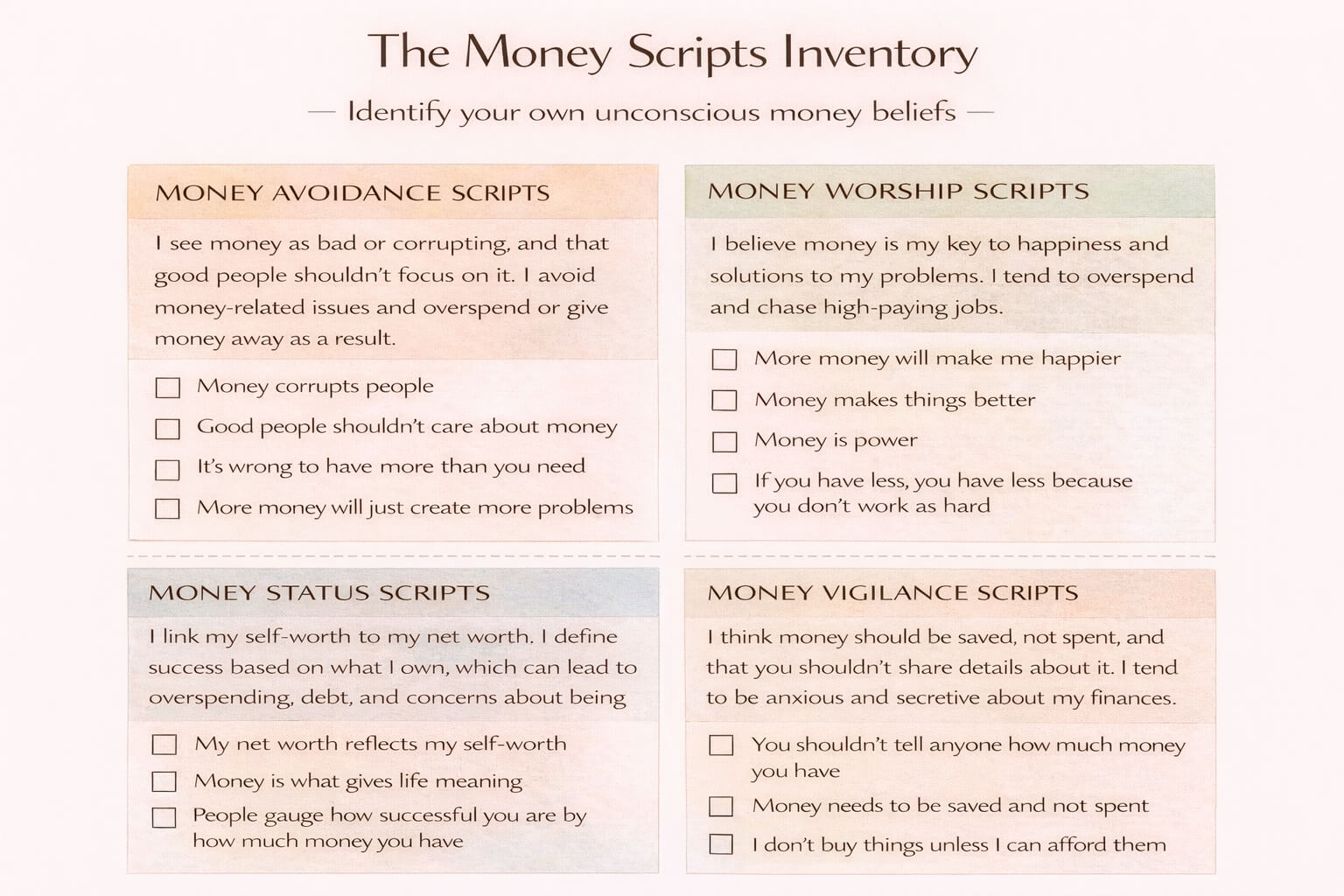
Financial psychologists call these embedded patterns “money scripts” — the unconscious narratives about money that drive financial behavior independently of income, knowledge, or intentions. Common money scripts include: “money is the root of all evil,” “rich people are greedy,” “money equals freedom,” “I don’t deserve financial abundance,” “more money would solve my problems,” “talking about money is vulgar,” and “I will never have enough.”

Most people hold some combination of these without being aware of it. And because they are unconscious, they drive behavior while remaining invisible — which is why many people behave financially in ways that contradict their stated beliefs and goals.

Hedonic adaptation and the moving target

One of the most robustly documented phenomena in the psychology of wellbeing is hedonic adaptation: the human tendency to return to a relatively stable level of happiness following significant positive or negative events. Applied to money, this means that income increases, wealth accumulation, and lifestyle upgrades tend to produce a burst of positive feeling — followed by rapid return to baseline, followed by the desire for the next increase.

The house was supposed to be enough. Then it was the neighborhood. The job was supposed to be enough. Then it was the title. The income was supposed to be enough. Then it was a different number.

This is not weakness. It is psychology. Understanding it does not eliminate it, but it does change the calculation: if you are organizing significant portions of your time, health, and relational availability around the pursuit of financial goals, it is worth being honest about how satisfying those goals will feel when you reach them — and for how long.

Loss aversion and financial anxiety

Behavioral economics research has consistently found that people experience the pain of financial loss approximately twice as intensely as they experience the pleasure of equivalent gain. This asymmetry — loss aversion — has significant implications for financial anxiety.

Even when the objective financial situation is stable or improving, the mind is constantly scanning for potential loss. A market fluctuation. An unexpected expense. An income instability. An economic headline. The threat-detection system that evolved to keep us safe from genuine scarcity is poorly calibrated for modern financial complexity — it treats potential loss with a seriousness proportionate to physical danger.

This is why financial anxiety so often persists in people whose finances are, by any reasonable measure, fine. The anxiety is not irrational. It is running on accurate software for the wrong environment.


The Enough Question — And Why It Is So Hard to Answer

“How much is enough?” sounds like a simple question. It is, in practice, one of the harder ones to answer honestly — because answering it requires you to name, explicitly, what you are building your financial life toward. And most people have never done that.

The research on money and wellbeing provides a useful starting point. The relationship between income and wellbeing is real but non-linear: below a certain threshold, financial scarcity creates genuine suffering across all measures of life quality. Above it, the relationship between more money and more wellbeing becomes considerably weaker and more variable.

The honest version of this research finding is: there is a level of financial sufficiency at which additional money stops being the primary lever for improving how your life actually feels. That level varies by location, family structure, health situation, and personal values. But it exists. And for most people in stable economies with median or above incomes, the point at which more money would meaningfully improve daily life quality is lower than they assume.

How to define enough for yourself

Defining enough is a personal act, not a mathematical one. It involves honestly answering questions that most people prefer to keep vague:

What does genuine security feel like — not freedom from all conceivable risk, but freedom from the fear that dominates daily life? What kind of choices do I actually want money to make available to me? What lifestyle genuinely serves my wellbeing, as opposed to the lifestyle I have assembled through social comparison and inertia? And — perhaps most usefully — what would I do differently if I already had enough?

That last question is often the most revealing. If you would not live much differently with more money than you have now — if the changes you are imagining are incremental rather than substantial — there is a reasonable possibility that you already have more than you think. And the anxiety is not about the number. It is about the belief underneath it.

money and wellbeing - the non-linear relationship


Spending as a Values Audit

Where you spend your money is not a neutral financial fact. It is a values statement. Your spending pattern reveals — more accurately than your intentions or your self-description — what you actually care about.

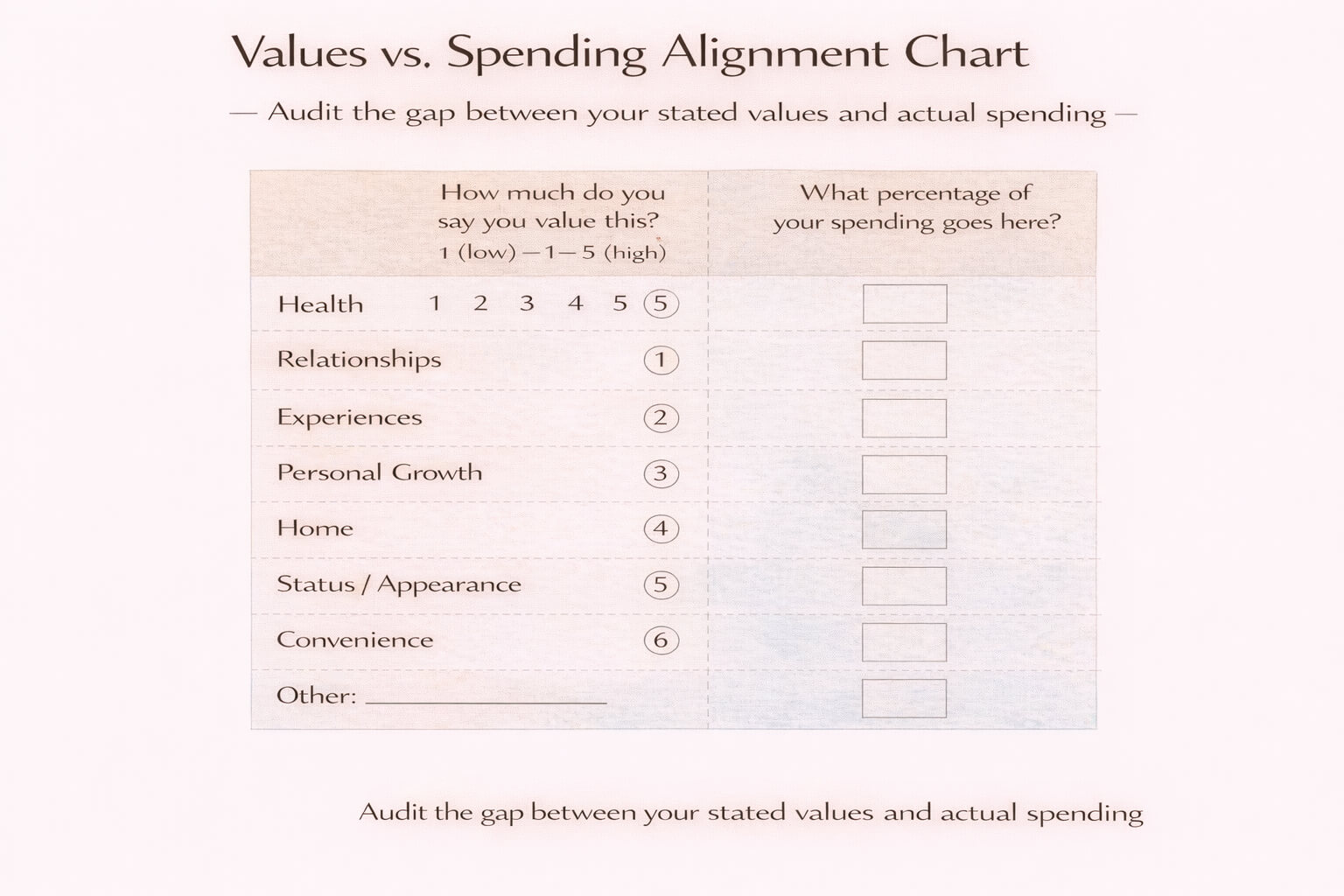
Most people, when they examine this honestly, find a significant gap between where their money goes and what they say they value. They say they value family time; their spending reflects a lifestyle that requires working hours that eliminate it. They say they value health; their spending on health is substantially smaller than their spending on convenience and entertainment. They say they value experiences over things; their purchasing history tells a different story.

This gap is not primarily a discipline problem. It is a clarity problem. Spending patterns drift — shaped by social comparison, marketing, inertia, and the low-level anxiety relief of acquisition — in directions that were never consciously chosen. The result is a financial life that is not a coherent expression of values but an accumulation of unconsidered decisions.

A values-based spending audit is the practice of looking at this honestly. Not with the goal of maximum frugality, but with the goal of alignment: spending more deliberately on what genuinely matters, and spending less — or stopping entirely — on what is driven by habit, comparison, or the momentary relief of consumption.

This audit tends to be both revelatory and liberating. Most people find they can reduce spending substantially in areas that provide minimal satisfaction, and redirect those resources toward things that actually matter, without any reduction in overall wellbeing. Sometimes with a significant increase.
the money scripts inventory


Financial Security vs. Financial Freedom — Why the Order Matters

Two concepts in personal finance are frequently conflated, and the conflation causes significant suffering: financial security and financial freedom.

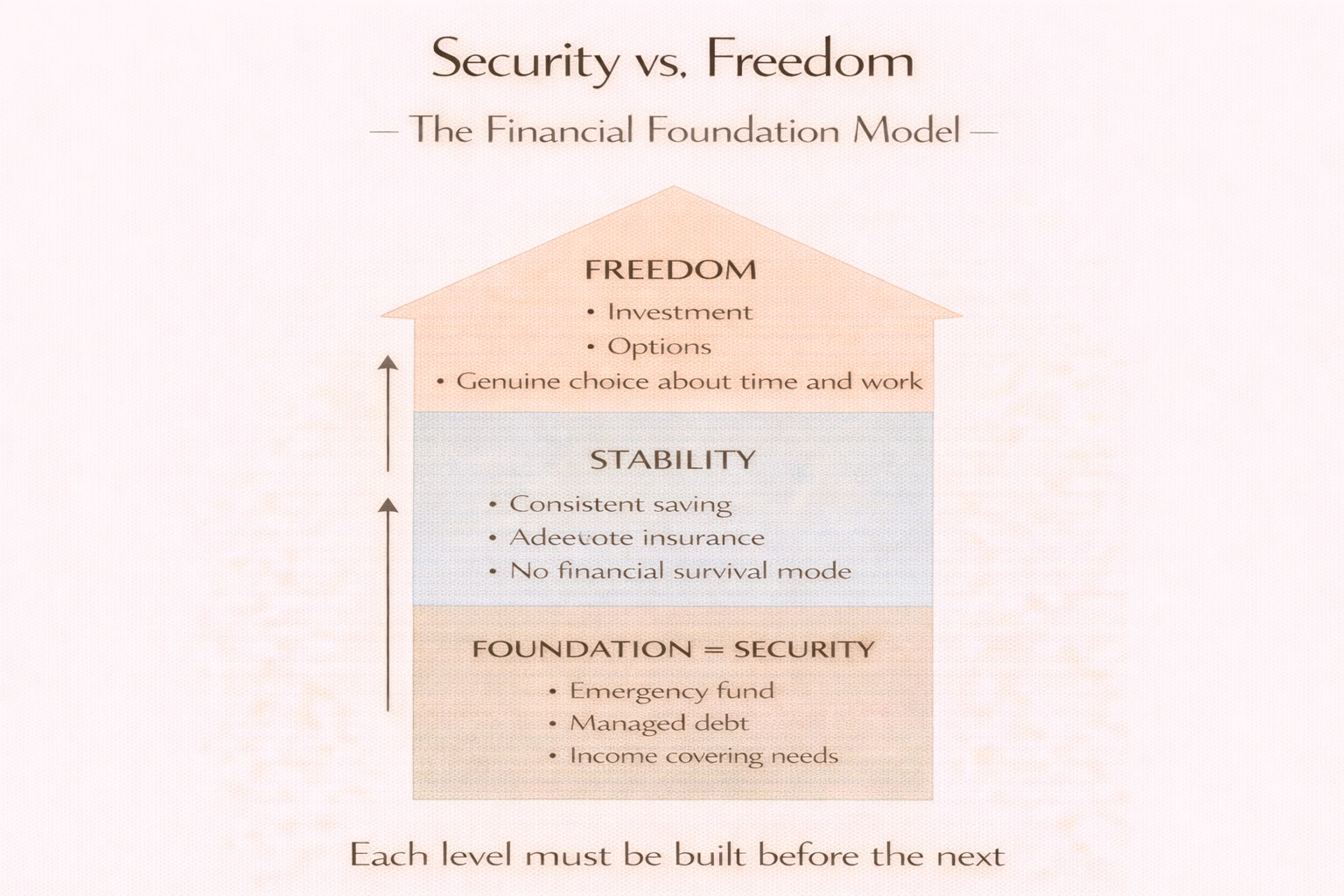
Financial security is the foundation. It is the state in which your basic needs are reliably met, you have a buffer against common financial disruptions (job loss, medical emergency, unexpected expenses), you are not servicing debt that consumes all available margin, and you are not living in financial survival mode. Security is the absence of financial threat as a daily experience.

Financial freedom is built on top of that foundation. It is the degree to which your financial situation gives you genuine choices: about how you spend your time, what work you do, what risks you can take, how you want your life to be structured. Freedom is the presence of options.

Most financial anxiety comes from confusing the two — particularly, from pursuing freedom before establishing security. A person trying to build financial independence while simultaneously carrying high-interest debt and with no emergency reserve is trying to build the second floor before pouring the foundation. The resulting instability keeps anxiety high regardless of income level.

The less glamorous but more honest sequence: build genuine security first. The emergency fund, the manageable debt situation, the income that reliably covers needs with some margin. From that base, the pursuit of freedom — the investments, the options, the choices — becomes exponentially more sustainable.
security vs freedom - the financial foundation model


Money and Self-Worth — Untangling the Knot

In a culture that communicates constantly that your financial situation reflects your character, discipline, intelligence, and value as a person, it is nearly impossible to develop a completely clean separation between self-worth and net worth. The connection is culturally embedded at a level that most people absorb before they have the language to question it.

The result is a particular kind of suffering that wealthy people also experience: the sense that financial success is validating and financial struggle is indicting. That your income is a report card. That people who earn more are, in some meaningful way, more.

This belief is worth examining directly, because it drives significant dysfunction: working harder than health or relationships can sustain, not for the money itself but for what the money says about you. Avoiding financially rational decisions (changing careers, taking time off, pursuing lower-income work that is more aligned) because the financial downgrade feels like a character downgrade.

When self-worth and net worth are decoupled — not easily, not quickly, but through the sustained inner work that the Mind & Inner Life pillar addresses — financial decision-making becomes considerably cleaner. You can choose work that is financially adequate rather than financially impressive. You can make spending decisions based on what actually matters to you rather than what signals the right things to the right people. You can define enough without the reference point of the comparison class constantly moving the target.
values vs spending alignment chart


Money and Relationships — The Conversations Nobody Has

Money is consistently ranked among the top sources of conflict in intimate relationships. This is not primarily because couples have genuinely incompatible financial situations — it is because they have fundamentally different money scripts, and those scripts are rarely explicitly articulated or examined.

One partner grew up in a household where money was chronically scarce, so financial security is existentially important to them. The other grew up in relative comfort, so money is more easily spent, less freighted with anxiety. Neither of these orientations is wrong. But they are incompatible unless discussed.

One partner uses spending as a source of pleasure and reward; the other experiences it as threat and waste. One partner believes debt is normal and manageable; the other experiences any debt as a crisis. One partner wants to live well now; the other wants to secure the future to an extent that limits living now.

These are not primarily financial disagreements. They are values and fear conversations wearing financial clothes. The most productive thing most couples can do about money is not review the budget — it is talk honestly about what money means to each of them, what they are each afraid of, and what they each believe a financially well-lived life actually looks like. That conversation, which most couples never have, tends to resolve more than any amount of spreadsheet work.


Financial Anxiety — When It Persists Despite the Numbers

Financial anxiety is not the same as genuine financial risk. They can coexist, but they are not the same. And for a significant number of people, financial anxiety persists in the face of objectively adequate or even strong financial situations — driven not by real threat but by psychological patterns that are out of date.

The distinction matters because the solutions are different. Genuine financial risk calls for practical financial action: income changes, expense reduction, debt management, building reserves. Psychological financial anxiety calls for inner work: examining the money scripts that are driving the threat response, developing clarity about what enough actually means, and learning to tolerate the inherent uncertainty of a financial future that cannot be perfectly controlled.

The person who earns well and saves appropriately but cannot stop running financial catastrophe scenarios in their head at 3am is not in financial trouble. They are in psychological trouble — and no additional income will resolve it without the accompanying inner work.


Building a Financial Life You Can Actually Live

The end goal of this pillar is not maximum wealth accumulation. It is a financial life that genuinely supports your actual values and wellbeing — one you can sustain without sacrificing your health, your relationships, and your sense of meaning in the pursuit of it.

That looks different for everyone. But some common elements: clarity about what enough means for you, spending patterns that reflect your actual values rather than your conditioned reflexes, a foundation of genuine security that reduces chronic anxiety, and a relationship with money that does not require it to validate your worth.

This is slower, less dramatic work than the typical financial optimization narrative. It is also more durable. A financial life built on genuine values tends to produce the satisfaction that financial success, on its own, consistently promises and inconsistently delivers.

 Frequently Asked Questions (FAQ)

How much money is actually enough?

Financial wellbeing research suggests that money significantly improves life quality up to a threshold where basic needs and reasonable comfort are met, and then produces diminishing returns. The honest answer is that enough is personal and must be consciously defined — it is the amount that provides genuine security, reasonable freedom, and alignment with your actual values without requiring a lifestyle so expensive it costs you your health, relationships, and time.

Why do I feel financially anxious when I’m doing okay?

Financial anxiety often persists independent of objective circumstances because it is rooted in psychological patterns — money scripts absorbed from family and culture, loss aversion, comparison, and a lack of clarity about what sufficiency actually means for you. The anxiety is often not a response to current reality. It is a response to unexamined fear.

What is the difference between financial security and financial freedom?

Security is the foundation: your basic needs are reliably met, you have a buffer against common disruptions, and you are not in financial survival mode. Freedom is built on top: the degree to which your financial situation gives you genuine choices. Security is the prerequisite. Freedom is the goal. Skipping the security step to pursue freedom creates instability that keeps anxiety high regardless of income.

Why do couples fight about money?

Money arguments are almost never only about money. They are about underlying differences in values, different money scripts from different formative experiences, power dynamics, and fear. The most productive money conversations in relationships are not about the budget — they are about what each person believes money means and what they are each afraid of.

What is values-based spending?

Deliberately allocating financial resources toward what genuinely matters to you — and away from what is driven by habit, comparison, or anxiety-relief. In practice: identifying what you actually value, auditing where your money goes, and closing the gap. The result is typically spending less overall but feeling more satisfied, because spending becomes a deliberate expression of what matters rather than a reflex.