
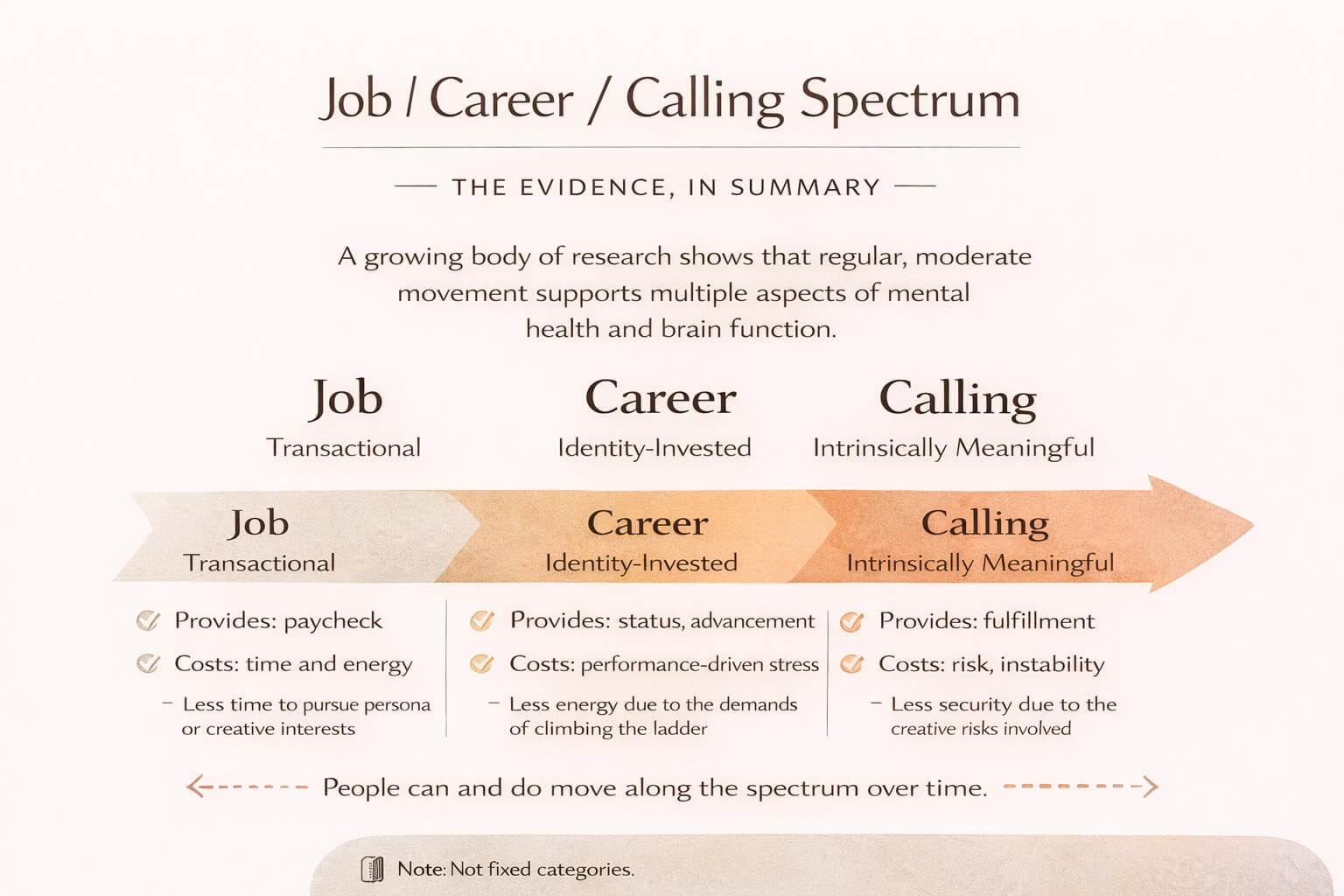
Researchers on work and wellbeing have identified three primary orientations people have to their work: the job orientation, the career orientation, and the calling orientation. Understanding the differences — and how people move between them — is genuinely useful.
In the job orientation, work is primarily transactional. You are there for the money, and you go home. The work does not take up much psychological space. This is not inherently a problem — it becomes one only if you are in a job orientation in work that was supposed to provide more.
In the career orientation, work involves investment in advancement and identity. You care about progress, recognition, and building something over time. You are emotionally invested in how your professional trajectory develops.
In the calling orientation, work carries intrinsic meaning. You would do this work — some version of it — even if the financial reward were less than optimal. The work itself is the point, in a way that goes beyond accomplishment or advancement.
Why calling is built, not discovered
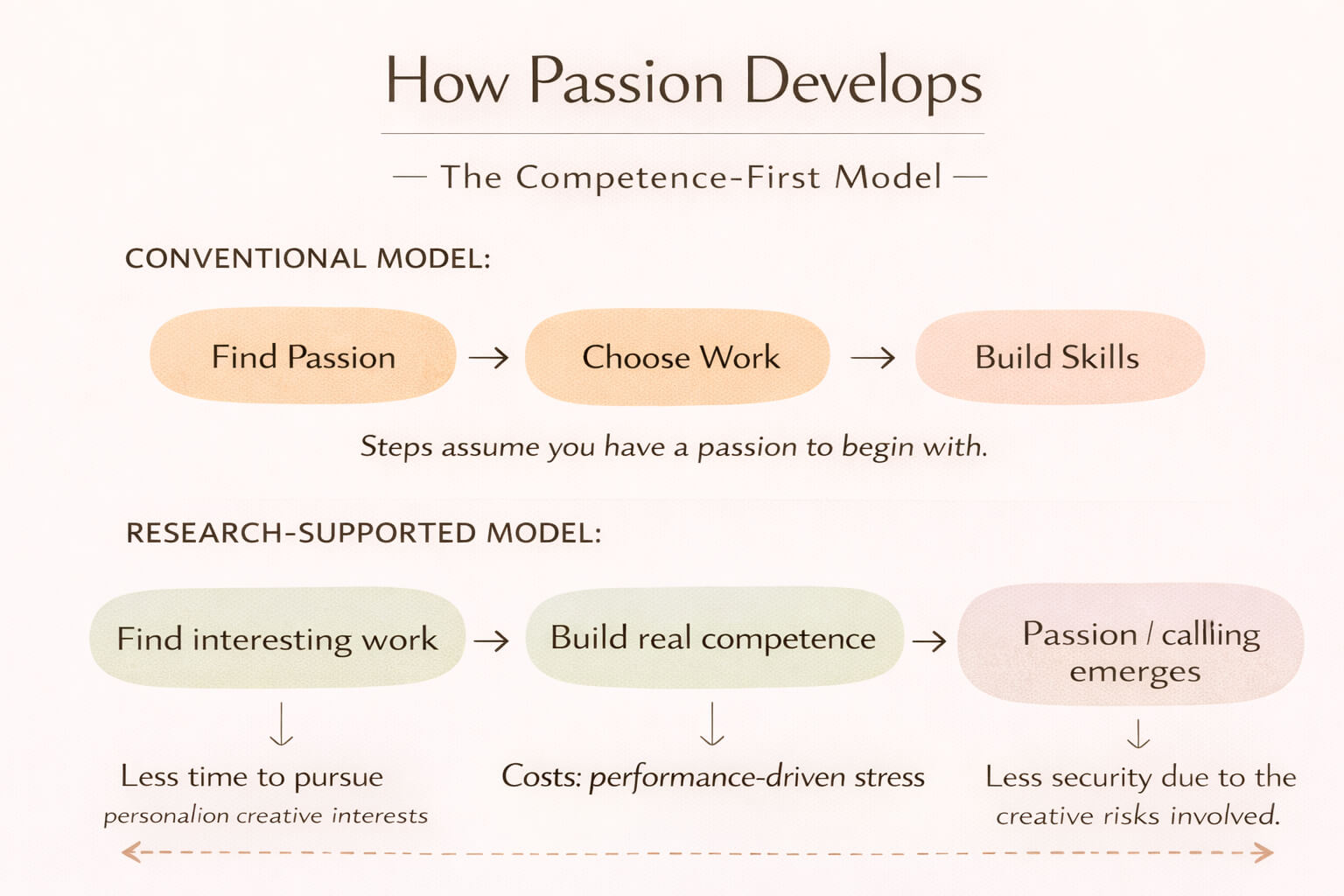
Here is where the conventional narrative gets this importantly wrong: calling is generally not something you find. It is something you build, over time, through the accumulation of skill, contribution, and genuine engagement with work you care about.
Career scientist Cal Newport’s research, summarized in So Good They Can’t Ignore You, makes a compelling case that passion for work typically follows competence rather than preceding it. People who describe loving their work are almost universally people who have gotten genuinely good at it. The sense of mastery, the autonomy that tends to come with expertise, the satisfaction of doing something excellently — these are what produce deep engagement. Not the other way around.
This is genuinely liberating once you absorb it. It means you do not have to already know your calling before you can begin moving toward meaningful work. You have to be willing to develop genuine skill in something you find interesting enough to invest in.
“Follow your passion” is perhaps the most repeated and least examined piece of career advice in the modern world. It sounds generous — it treats people as people with genuine inner lives and deep desires, not just workers to be deployed. But as practical guidance, it has real problems.
The first problem: most people do not have a pre-formed passion waiting to be followed. They have interests, inclinations, things they find more or less engaging. Turning those into work often changes them considerably — sometimes for the better, sometimes for the worse. Passion is not always a reliable compass.
The second problem: the advice treats passion as a cause when it is more often an effect. Passion for work tends to emerge from engagement, skill, and meaning — not the reverse. Waiting to feel passion before committing to a direction means waiting for something that may not arrive until you are already in it.
The third problem: “follow your passion” tends to ignore the structural reality that most passion does not come with a business model. Loving something is not the same as being good at it. Being good at it is not the same as being able to build a financially viable life around it. Conflating these creates genuine and unnecessary suffering.
What to orient toward instead
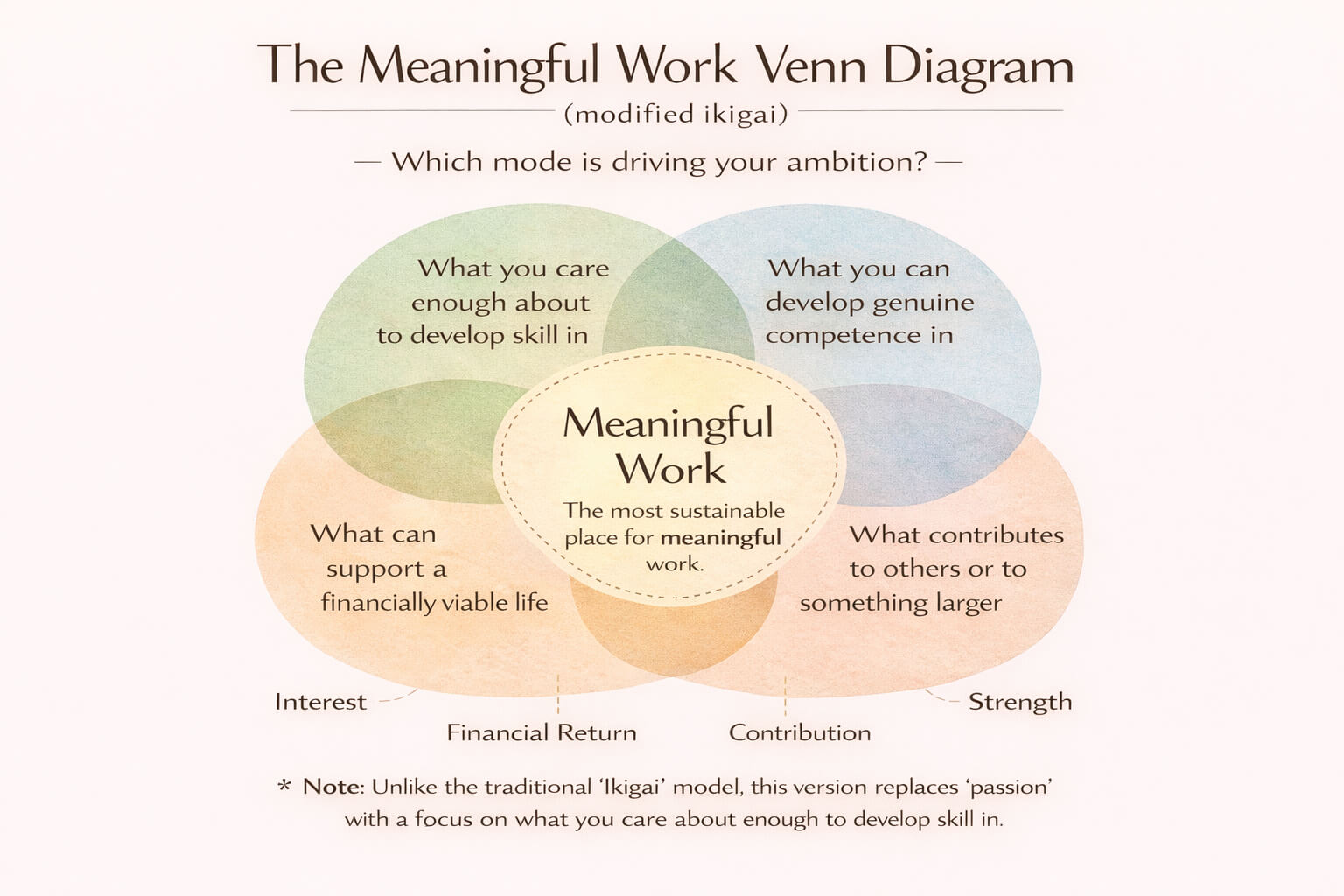
A more useful question than “what am I passionate about?” is: what do I find genuinely interesting? What work engages me enough that I would willingly get better at it? What problems would I stay with through the difficulty and tedium that all real development involves?
From there: in what direction do I want to develop? What does becoming excellent at this thing look like over the next ten years? And does the answer feel like something I actually want — not something I think I should want?
These are less romantic questions than “follow your passion.” They are more honest ones. And they tend to lead somewhere real.
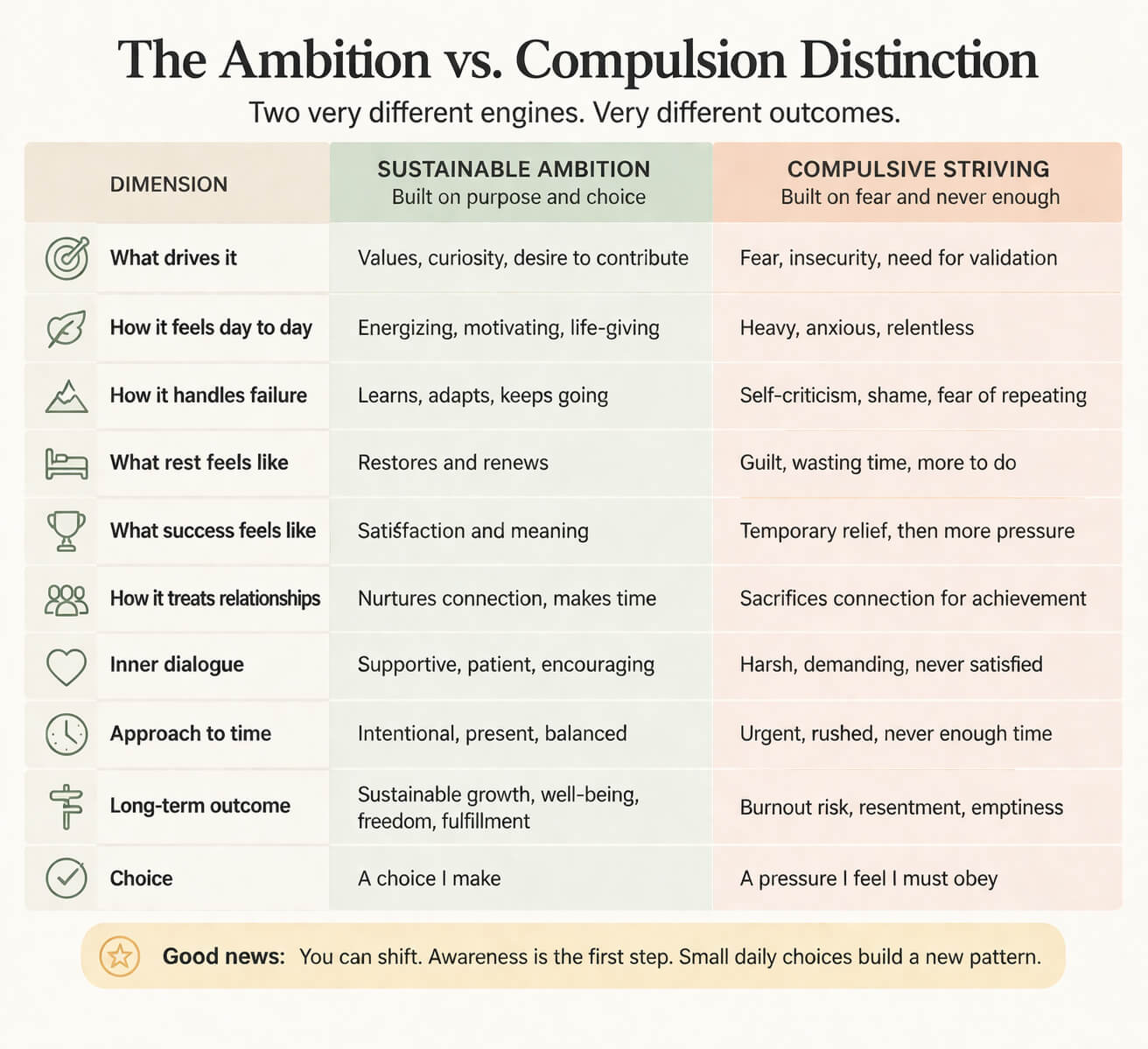
There are two very different engines that can drive a demanding career. From the outside, they can look identical. From the inside, they feel entirely different — and they lead to very different places over time.
The first engine is genuine engagement: curiosity about the work, satisfaction in craft, desire to contribute, care about the outcomes. This kind of ambition is self-sustaining over the long term because it is oriented toward something real. It has a natural relationship with effort because the effort produces something you actually want.
The second engine is compulsive striving: the relentless need to achieve driven not by what you want but by what you are afraid of. Fear of inadequacy. Shame about not being enough. The anxiety of the comparison. The terror of stopping and finding out there is nothing beneath the achieving.
Compulsive striving can produce impressive results. It can also produce a life that, on reflection, was lived almost entirely in service of other people’s definitions of success while systematically neglecting the things that actually matter.
How to tell which one you are running on
The most honest test is this: when you achieve the goal — the promotion, the income milestone, the recognition — do you feel satisfied and complete, even briefly? Or does the moment pass almost immediately, replaced by anxiety about the next benchmark?
Genuine ambition can rest. Compulsive striving cannot.
Genuine ambition is curious about the work itself. Compulsion is only interested in the outcome.
Genuine ambition can tolerate failure as information. Compulsive striving experiences failure as existential.
None of this means sustainable ambition is passive or low-intensity. It can be extremely demanding. But it demands from a place of care rather than fear. And that difference — in how the work feels, in what it does to you over time, in what kind of person it makes you — is everything.
Craft and Mastery as Sources of Meaning
One of the most underappreciated paths to meaningful work is the simple but demanding practice of getting genuinely good at something.
Mastery — the kind that takes years and requires sustained engagement — produces a distinctive form of meaning that is different from either passion or purpose. It is the satisfaction of real competence. The sense of being in genuine relationship with a body of skill or knowledge. The experience that psychologist Mihaly Csikszentmihalyi called flow: the absorption in challenging work that is both demanding and intrinsically rewarding.
This kind of mastery is available in many domains, not only the obviously creative ones. A software engineer who develops genuine depth of craft in their field. A teacher who becomes genuinely skilled at reaching students who are hard to reach. A manager who develops real expertise in creating conditions where people do their best work. A therapist who develops clinical depth over decades of genuine engagement with human suffering.
In each case, the source of meaning is not the job title or the salary or the recognition. It is the craft itself.
Protecting the conditions for real craft
Mastery does not emerge from scattered attention. It requires periods of deep engagement — what Newport calls “deep work” — where the mind can grapple with difficult problems without the constant interruption of notifications, meetings, and administrative noise.
Most modern workplaces are poorly designed for this. The default orientation is constant availability, rapid context-switching, and the performance of busyness rather than the reality of genuine work. For the person serious about craft, protecting focused time is not a luxury. It is the work.
Career Transitions and the Fear Underneath Them
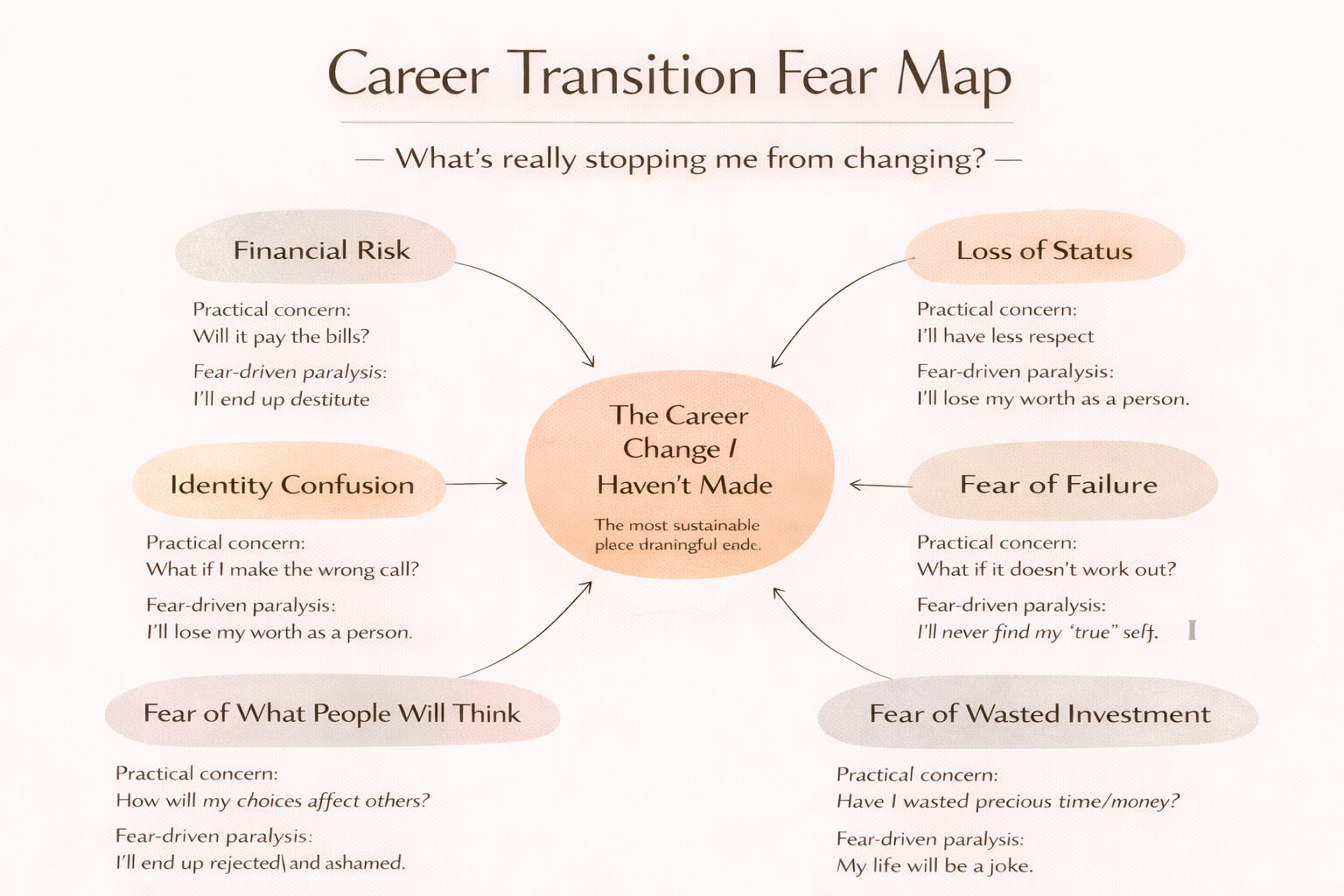
Most people who need to change their career know it long before they do anything about it. The gap between knowing and acting can span years — sometimes decades. In that gap lives a mix of legitimate practical concern and something deeper and harder to name.
The legitimate practical concern is real: financial obligations, risk of income disruption, the prospect of starting over in a new field at a different status level than the one you have earned. These deserve serious thought and honest planning.
But underneath the practical concern, in many cases, is fear. Fear of failure. Fear of losing the identity that has been attached to the current career. Fear of what it means about you if you leave. Fear of what other people will think. Fear that the grass is not greener and you will have given up something real for an illusion.
These fears are worth naming, because until they are named they tend to drive the bus while the person tells themselves the delay is purely practical. (The US Department of Labor has resources for career exploration and skills data)
Financial stability as prerequisite, not obstacle
The optYOUmize framework takes seriously the relationship between financial security and the freedom to pursue meaningful work. This is not a concession to capitalism — it is an honest acknowledgment that it is very difficult to take thoughtful career risks from a position of financial desperation.
Building the financial foundation that makes a career pivot possible is not a betrayal of purpose. It is often the most direct path toward it. The question of “how do I pursue meaningful work?” and “how do I build financial stability?” are, in the right order, more complementary than they are contradictory.
What Meaningful Work Actually Asks of You
Meaningful work is not passive. It makes demands.
It asks for honesty about what you actually value, separate from what you have been conditioned to value. That honesty is harder than it sounds. The inherited definitions of professional success are powerful and often invisible.
It asks for patience with development. Craft takes time. Calling, to the extent it exists, tends to emerge slowly, through genuine engagement and skill-building. The person who wants to skip to the part where the work feels meaningful without going through the part where you develop real competence is going to be disappointed.
And it asks, sometimes, for the courage to disappoint the wrong people. The parent who wanted a different career for you. The peer group whose validation you have been tracking. The version of success you have been performing that was never really yours.
These are not small things. But they are the cost of a working life that is genuinely yours.