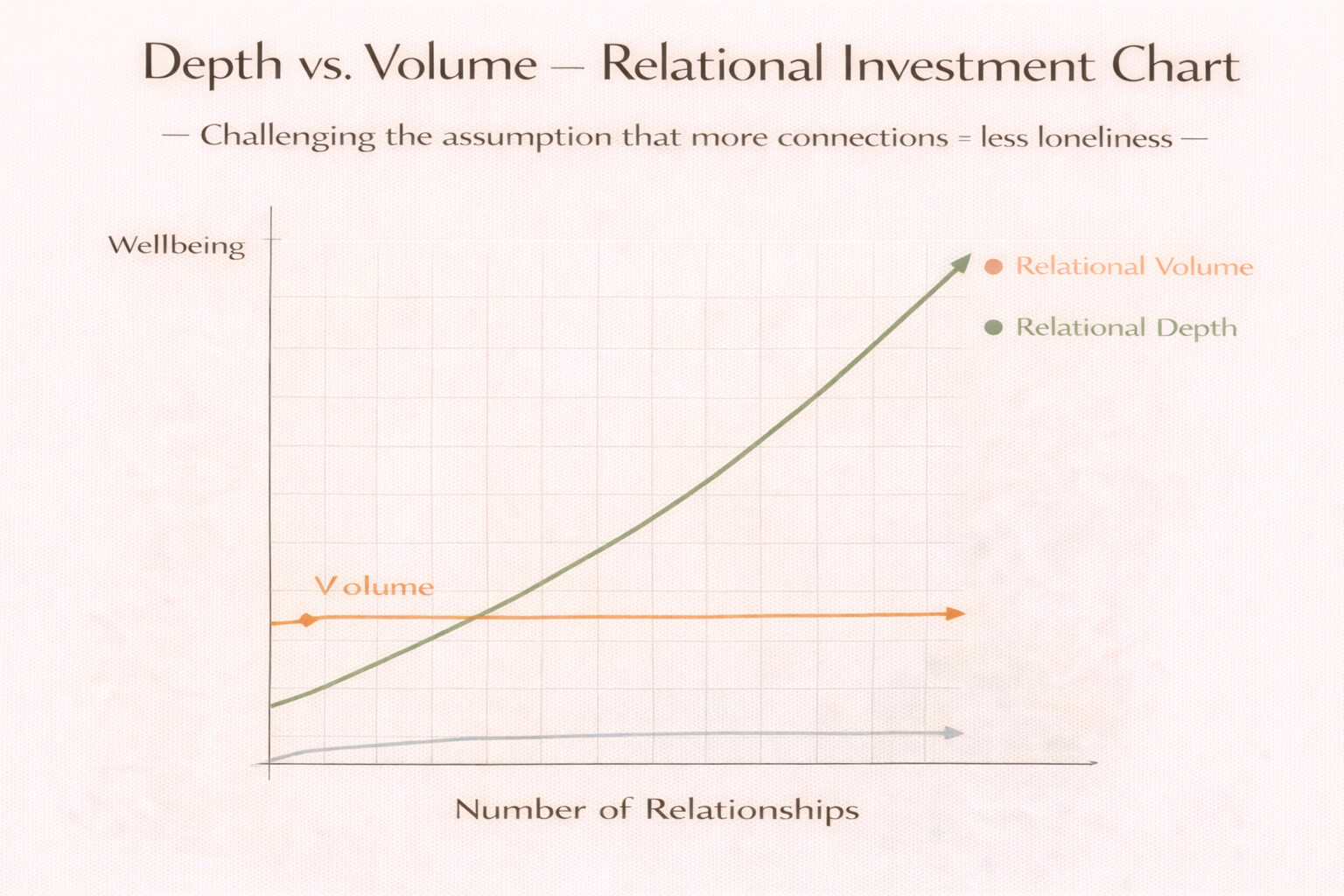
Here is something that reassures almost everyone who hears it: making and sustaining real friendships in adult life is genuinely hard, and it is hard for structural reasons, not personal failings.
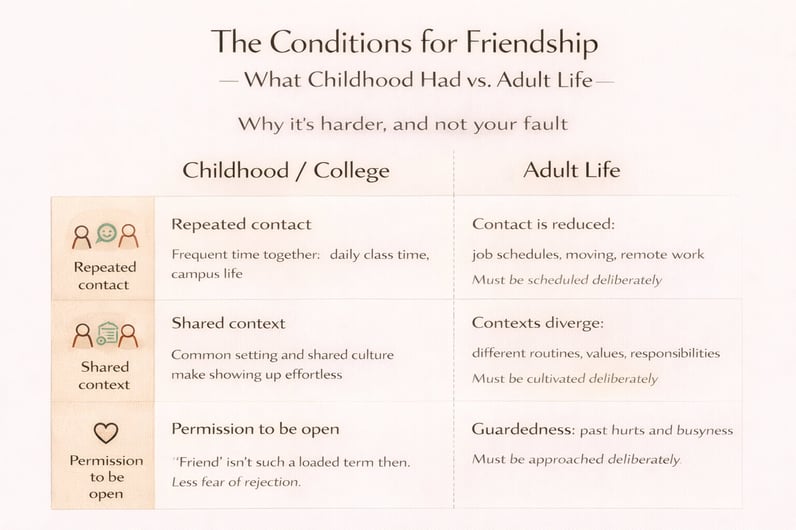
Friendship, as researchers have identified, tends to emerge naturally when three conditions are present: repeated, unplanned contact over time; a shared context that creates common experience; and an environment that encourages openness rather than performance. School and college provide all three. Adult life, for most people, provides none of them.
After the shared contexts of early life dissolve, adults are left to create the conditions for friendship deliberately — something that requires proactive energy, tolerance for awkwardness, and the willingness to be vulnerable before the relationship has fully earned that vulnerability. These are real costs. And in a life already demanding maximum output from a finite resource pool, they are costs that frequently do not get paid.
The result, for many people, is a social life that looks functional from the outside — connections, professional networks, acquaintances, family — and feels thin from the inside. Plenty of people to spend time with, very few people who actually know them.
Being known vs. being liked
This distinction matters enormously in adult friendship. Being liked is relatively easy. It requires showing up, being engaging, contributing to the group, not causing problems. Many people are quite good at being liked and are still privately lonely.
Being genuinely known is different. It requires showing the parts of yourself that are not curated — the uncertainty, the struggle, the aspects of your inner life that do not make good stories at dinner. It requires the willingness to be seen in your actual complexity rather than your best presentation.
Most adult social contexts do not create room for this. And so most adults move through their social lives being quite liked and not very known.
The specific work of genuine adult friendship is to create, deliberately and over time, the conditions where being known becomes possible. That requires consistency (showing up, not just when it is convenient), specificity (actually saying what is true for you, rather than what is easy), and the particular courage of reaching out first — and reaching out again — even when the reciprocation is slow.
Loneliness has taken on, in modern discourse, an uncomfortable double meaning. On one hand, we recognize loneliness intellectually as a social epidemic — a genuine public health crisis with measurable health consequences. On the other, we treat it personally as something quietly shameful — a sign of social inadequacy, of being someone others do not particularly want to be around.
Neither understanding is fully accurate.
Loneliness is not primarily a personal failing. It is primarily a structural problem. The architecture of modern adult life — geographic mobility, the decline of anchor institutions like religious communities and civic organizations, the atomization of the nuclear family, the replacement of genuine community with digital connection — has systematically dismantled the conditions under which belonging forms naturally.
People are lonelier now not primarily because they are worse at relationships. They are lonelier because the structures that once created belonging largely no longer exist, and nothing of comparable depth has replaced them.
The different faces of loneliness
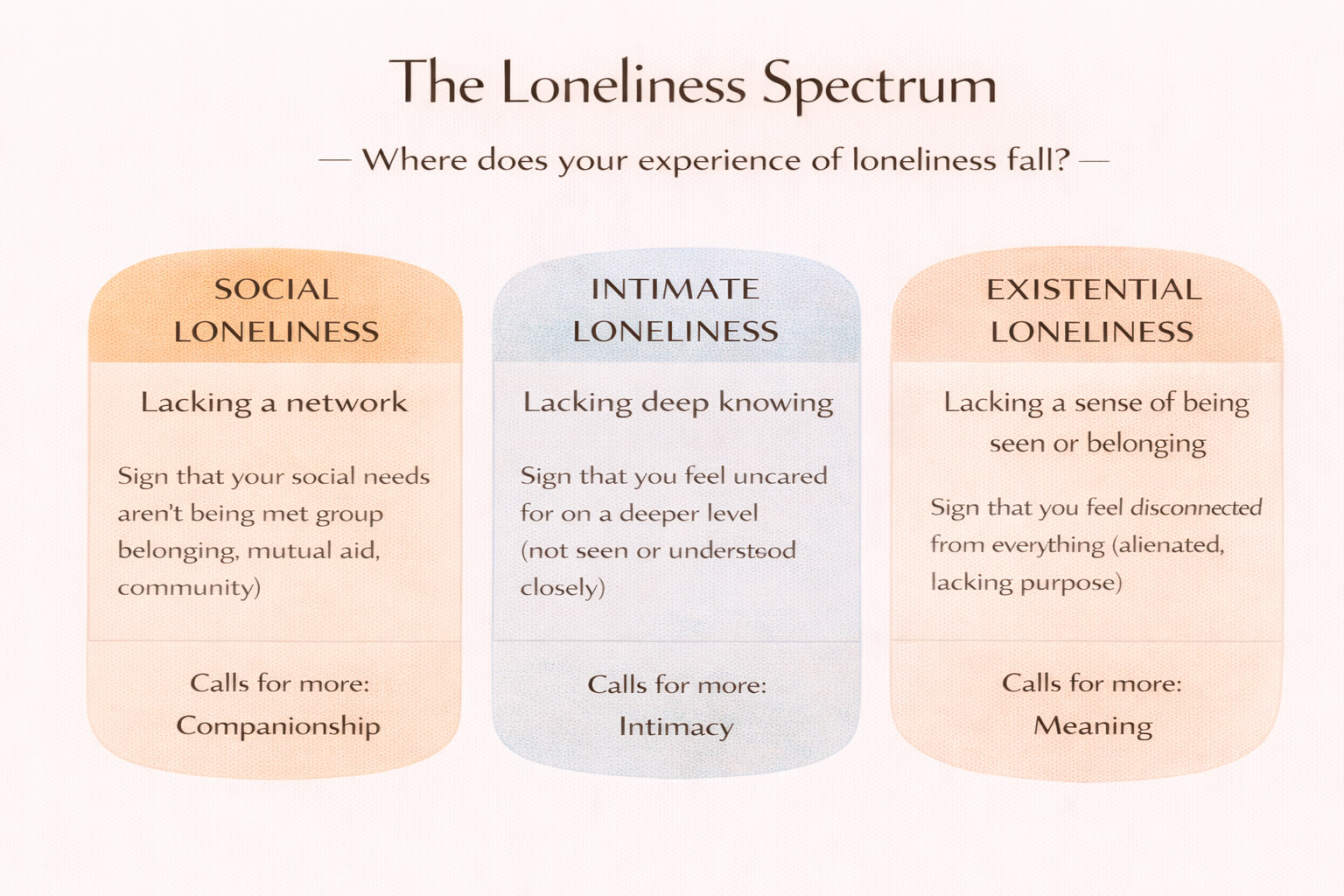
Loneliness is not one thing. There is social loneliness — the absence of a social network, of people to spend time with. There is intimate loneliness — the absence of a close confidant, someone who truly knows you. And there is existential loneliness — the deeper sense of not belonging anywhere, of not being known or seen even in the presence of people who care about you.
Each of these calls for a different response. Social loneliness calls for broadening one’s network and increasing contact. Intimate loneliness calls for deepening existing relationships — for the courage to be more genuinely known. Existential loneliness is less tractable, and often requires the kind of inner work that the Mind & Inner Life pillar addresses: developing a more honest relationship with your own experience, so that you can offer it more authentically to others.
The difference between loneliness and solitude
It is worth noting, because it changes the relationship: loneliness and solitude are not the same thing, even though both involve being alone.
Loneliness is the painful gap between the connection you want and the connection you have. It is involuntary and aversive.
Solitude is the chosen experience of being alone — often restorative, generative, a space for reflection and renewal. The capacity for genuine solitude — for being comfortably, even richly alone — is not the same as, and is not compatible with, chronic loneliness. You cannot have good solitude if you are genuinely lonely. But learning to be comfortably alone is, paradoxically, part of what makes genuine connection possible: it reduces the desperation and the need-to-be-liked that undermine the risk-taking that real intimacy requires.
Most people think of conflict as the problem in relationships. The research suggests it is not. The presence of conflict predicts almost nothing about relationship quality. What predicts relationship quality is how conflict is handled.
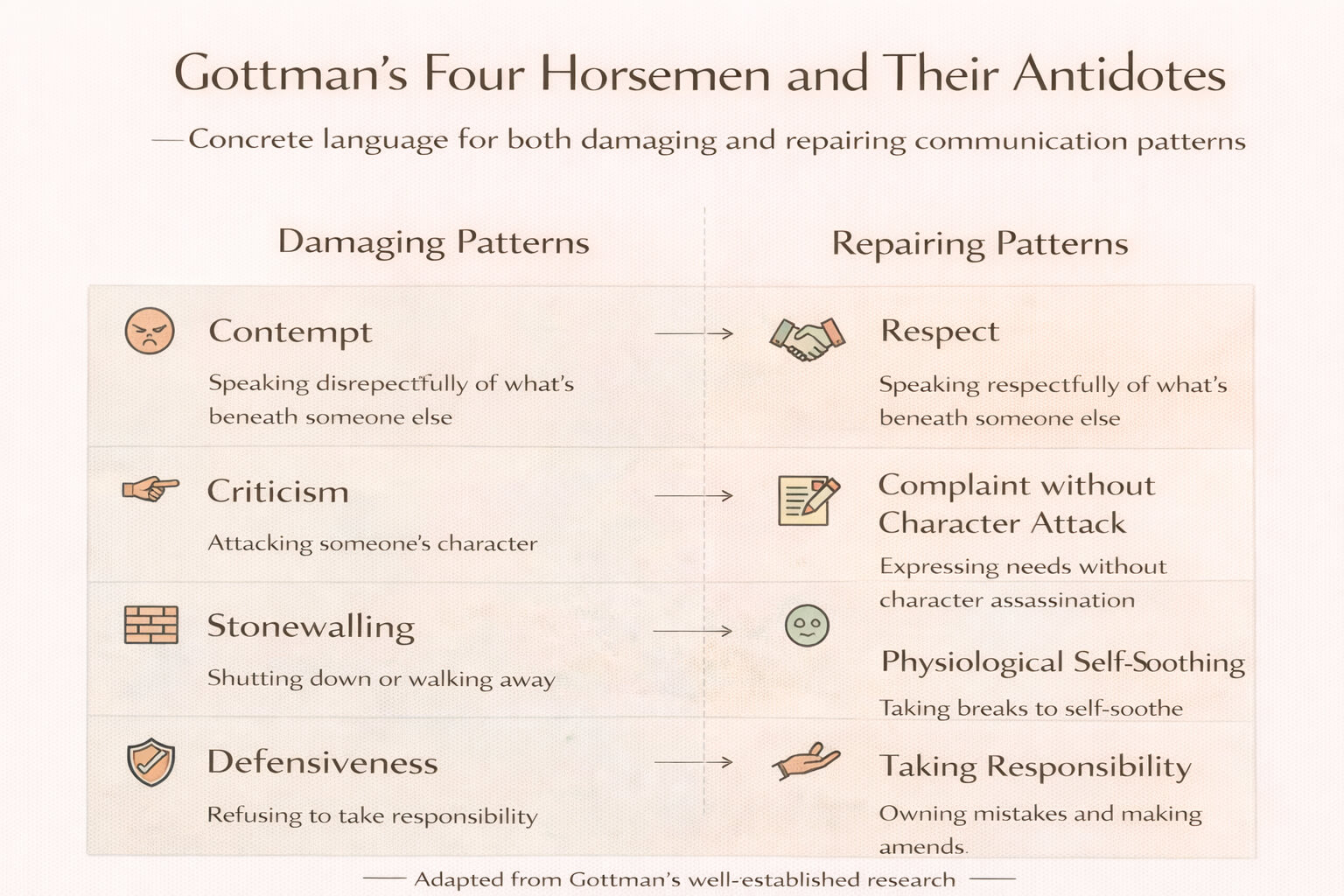
Relationship researcher John Gottman spent decades studying couples in a laboratory environment — watching them interact, measuring their physiological responses, and then following up to see what happened to their relationships. What he found was a specific set of communication patterns that are reliably predictive of relational damage: contempt (treating your partner as beneath you), criticism (attacking character rather than behavior), stonewalling (withdrawing from interaction entirely), and defensiveness (responding to feedback by counterattacking).
What he found among couples who sustained warm and functional relationships was something different: the ability to stay in difficult conversations without weaponizing them, to repair the connection after rupture, and — crucially — to maintain a basic posture of care and respect even when deeply frustrated.
What better conflict communication looks like
This is not a call for conflict avoidance — avoiding difficult conversations is one of the most reliable ways to create the relational distance that precedes separation. It is a call for better conflict, not less of it.
The practical foundations: slowing down enough to identify what you are actually feeling before responding. Distinguishing between what someone did and who they are. Asking a clarifying question before making an assumption. Naming your own state explicitly — “I am feeling defensive right now, which is probably not helping” — before it hijacks the conversation. And, perhaps most importantly, signaling that you care about the relationship even while in disagreement: these two things are not contradictory, but most people forget to make that clear during conflict.
Family of Origin: How Your Early Relationships Shape Everything
The relational patterns you learned in your family of origin — how emotions were handled, whether needs were met or dismissed, how conflict was navigated, what love looked and felt like — do not stay in the past. They travel with you.
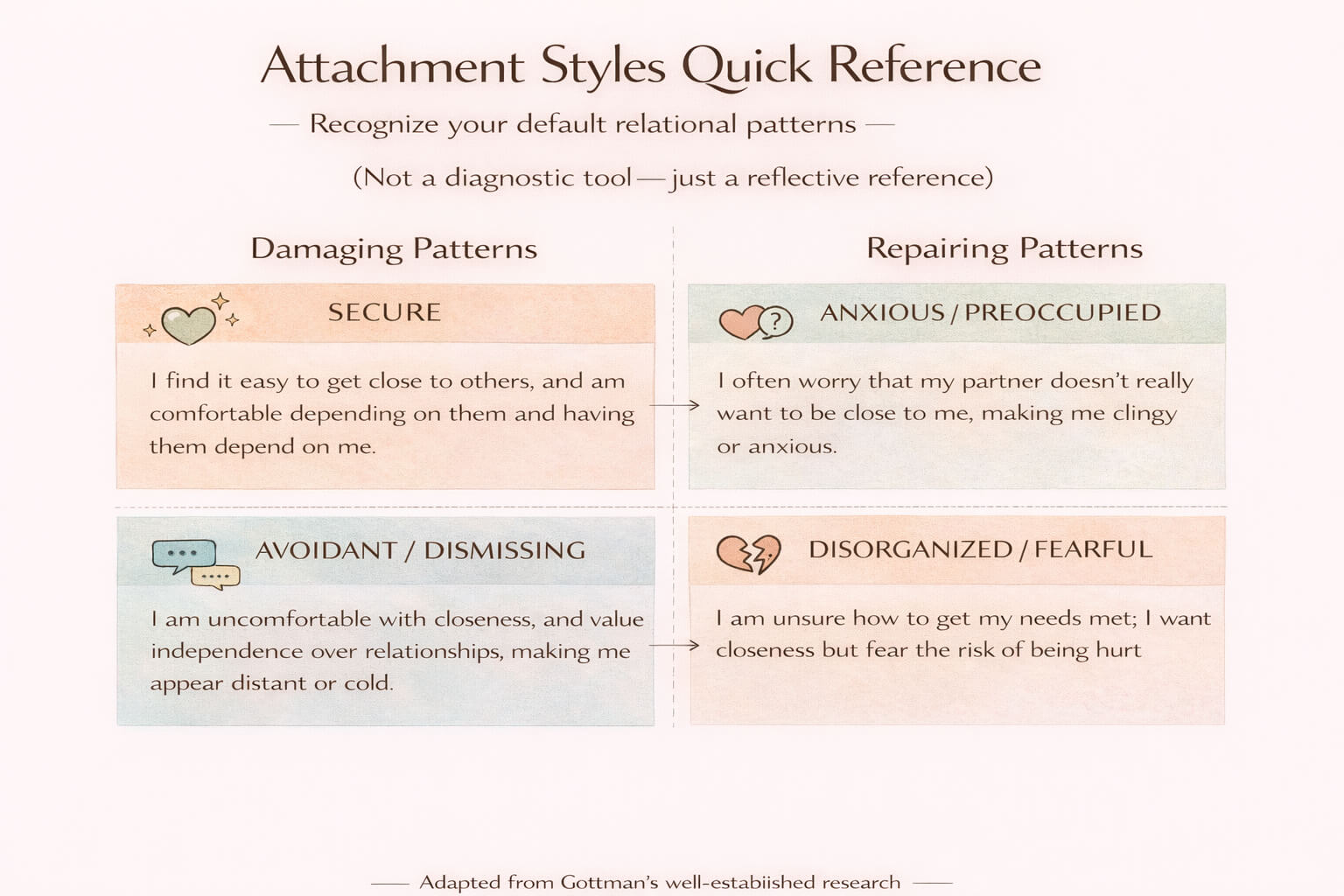
Attachment theory, one of the most robustly supported frameworks in developmental psychology, describes how early relational experiences create working models of relationship: internal templates for what to expect from intimacy, what makes relationships safe, and what to do when they feel threatening.
These templates are not destiny. But they are powerful defaults. The person who learned that emotional needs were burdensome tends to dismiss or minimize their own needs in adult relationships — and may judge others for having them. The person who learned that love was conditional tends to perform rather than connect. The person who learned that closeness leads to loss tends to keep a certain distance even from people they love.
Recognizing these patterns — not as pathology, but as learned strategies that made sense once and may not serve you now — is some of the most practically useful inner work a person can do in service of their relationships.
Community and Belonging in the Modern World
Beyond the intimate relationships of friendship and partnership, there is a broader human need that is harder to name but equally important: the need to belong somewhere. To be part of a community that holds you across time, that has shared references and mutual accountability, that exists independently of your utility to it.
This kind of belonging has become significantly harder to find in modern life. The institutions that traditionally provided it — religious communities, civic organizations, neighborhood associations, extended families who lived in proximity — have declined. Digital connection has filled some of the space with something that mimics belonging closely enough to be confusing, but does not quite provide it.
The qualities that make community real — commitment over time, shared physical presence, genuine accountability, the experience of being needed and needed by — are largely absent from the digital substitutes. Not entirely. But substantially.
Building genuine community in the modern world requires being intentional about the communities you belong to, showing up consistently rather than when it is convenient, investing in the infrastructure of belonging (the recurring dinner, the standing commitment, the group that meets even when you could skip it), and tolerating the awkward in-between phases before a community becomes real.
It is slower work than adding followers or connections. It is also considerably more nourishing.