
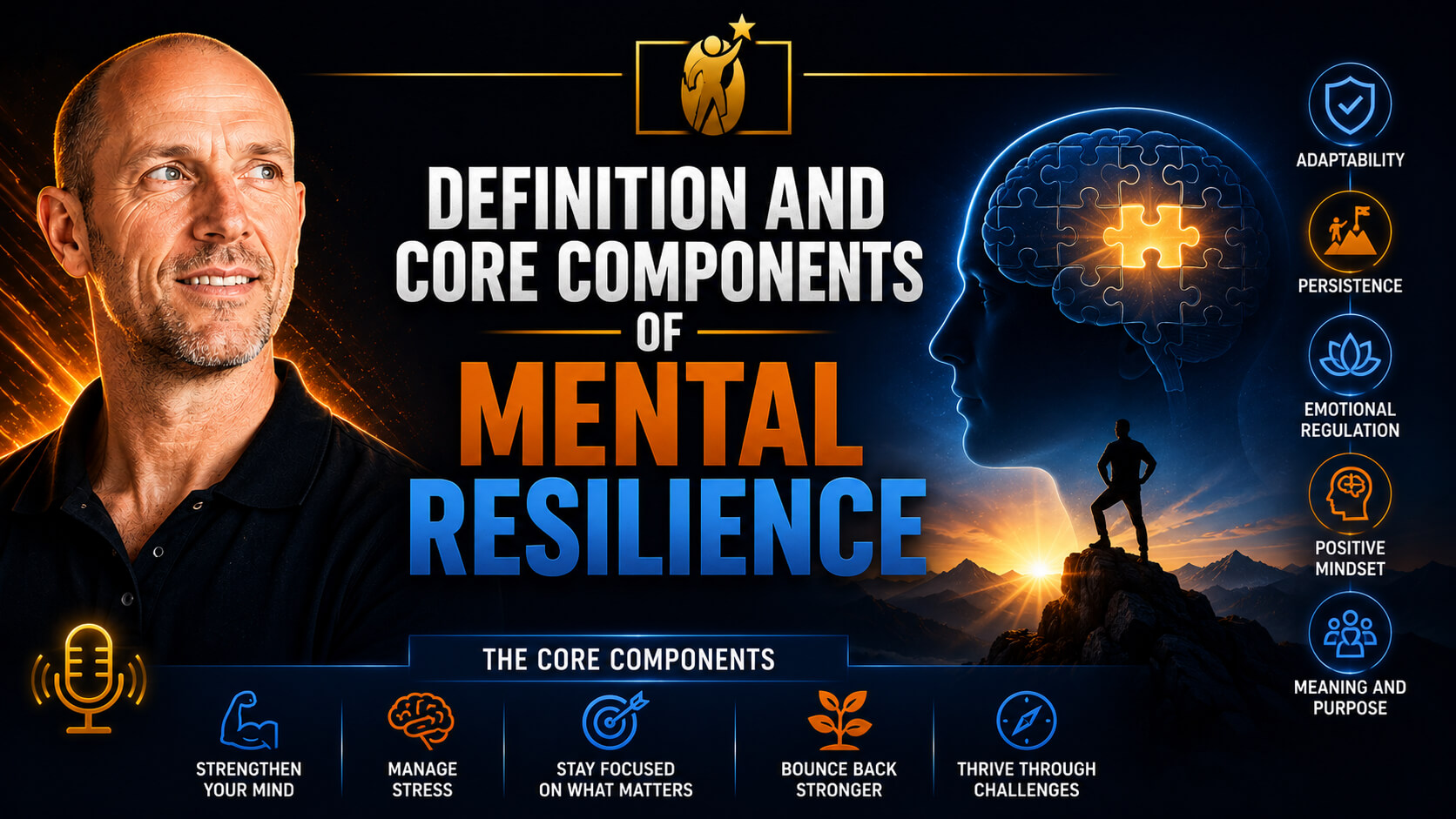
Definition and Core Components of Mental Resilience
Ever wondered why some people crumble under pressure while others not only survive but come out stronger? What if the difference wasn't luck or personality, but a set of learnable skills anyone can develop? In this post, you'll get a crystal-clear definition of mental resilience plus the four core components backed by psychology research—so you can start building it today. We'll cover what it really means, the science behind it, and actionable steps drawn from experts like the American Psychological Association (APA).
What Is Mental Resilience, Exactly?
Mental resilience is the process and outcome of successfully adapting to difficult or challenging life experiences, especially through mental, emotional, and behavioral flexibility. It's not about avoiding stress or never feeling pain—it's your ability to bounce back from adversity, trauma, tragedy, or even everyday stressors like job loss, relationship strain, or failure. [psychiatry+1]
The APA defines it simply: "the process of adapting well in the face of adversity". Think of it as psychological elasticity. Unlike "toughness," which often means gritting your teeth and powering through (potentially leading to burnout), resilience involves recovery, learning, and growth. For more on that distinction, check our post on Resilience vs Toughness: What Really Makes You Strong.
Research shows resilience is both a trait and a skill. It's influenced by genetics, but far more by environment and practice—up to 70% trainable over time. High-resilience individuals maintain competent functioning post-stress, emerging "strengthened and more resourceful".[en.wikipedia]
Why Does Mental Resilience Matter Now?
In our fast-paced world, chronic stress affects 77% of people daily, per the APA. Without resilience, it leads to anxiety, depression, and physical health issues. With it? Better mental health, relationships, and performance. Studies link resilience to lower cortisol, stronger immune function, and even longer life expectancy.[nature]
Link this to a growth mindset: Resilient people view challenges as "comprehensible, manageable, and meaningful," turning obstacles into opportunities.
Core Component 1: Connection – Your Resilience Network
The first pillar of resilience is connection—strong, supportive relationships that remind you you're not alone. APA research emphasizes prioritizing empathetic people: family, friends, mentors, or communities who provide emotional safety nets. [uca+1]
Why it works: Social support buffers stress hormones and boosts oxytocin, the "bonding hormone." A Harvard study (the longest on happiness) found close relationships more predictive of well-being than money or fame [Harvard Study of Adult Development]. Isolated people face 29% higher mortality risk.[en.wikipedia]
Action step: Schedule one meaningful conversation weekly. Join a group aligned with your values—online forums or local meetups. For brain science on stress responses, see How the Brain Responds to Stress and Adversity.
Core Component 2: Wellness – Fuel Your Body, Sharpen Your Mind
Wellness means physical self-care: sleep, exercise, nutrition, and mindfulness. Resilient people treat their bodies as resilience engines. Exercise alone cuts anxiety by 26%, per meta-analyses, while 7-9 hours of sleep rebuilds neural pathways. [nature+1]
Science backs it: Physical activity grows the prefrontal cortex (your stress regulator) and releases BDNF, a protein for neuroplasticity. Poor wellness? It amplifies amygdala overreactions, trapping you in fight-or-flight.[en.wikipedia]
Action step: Walk 20 minutes daily—combine with podcasts like optYOUmize for dual benefits. Track sleep with apps like WHOOP. Wellness ties into traits of top performers; explore Key Traits of Highly Resilient People.
Core Component 3: Healthy Thinking – Reframe for Power

Healthy thinking involves cognitive flexibility: optimism, self-efficacy, and reframing setbacks. Resilient minds ask, "What can I control?" instead of "Why me?" Fletcher and Sarkar's model highlights realistic planning, confidence, and impulse control. [psychiatry+2]
Evidence: Optimists recover 3x faster from surgery; self-efficacious people navigate crises with less PTSD. The Connor-Davidson Resilience Scale measures this via hardiness (commitment, control, challenge). [frontiersin+1]
Action step: Practice "3 Cs" reframing: Challenge (what's the evidence?), Control (my part?), Change (next step?). Journal nightly. Positive psychology pioneer Martin Seligman at UPenn offers free tools [positivepsychology.com].
Core Component 4: Meaning – Purpose Fuels Endurance
Meaning provides "why" behind the "what"—a sense of purpose driving you forward. Viktor Frankl's logotherapy shows Holocaust survivors endured via purpose [Man's Search for Meaning]. Modern research: Purpose lowers Alzheimer's risk by 2.4x [Rush University].[uca]
Components include values alignment and post-traumatic growth—50-70% report positive change after trauma. Besht model stresses self-efficacy and hardiness.[en.wikipedia]
Action step: Define your "ikigai" (Japanese for purpose): What you love, excel at, world needs, paid for? Review quarterly.
Myths Busted: Resilience Isn't What You Think
Myth 1: It's innate. Reality: Trainable—kids in risk factors thrive 70% with support.[en.wikipedia]
Myth 2: No emotions. Reality: Feel deeply, regulate wisely.
Myth 3: Solo journey. Reality: Connection is core [APA.org/topics/resilience].
Build Your Resilience: Start Here
- Assess: Take APA's resilience quiz [apa.org/topics/resilience].
- Daily Trio: Connect (text a friend), Wellness (move 10 mins), Think (reframe one thought).
- Track: Journal wins weekly—builds self-efficacy.
Resilience compounds: One month in, stress feels manageable; six months, you're thriving.(Sources: Inline citations from APA, Wikipedia synthesis, peer-reviewed studies for accuracy.)