
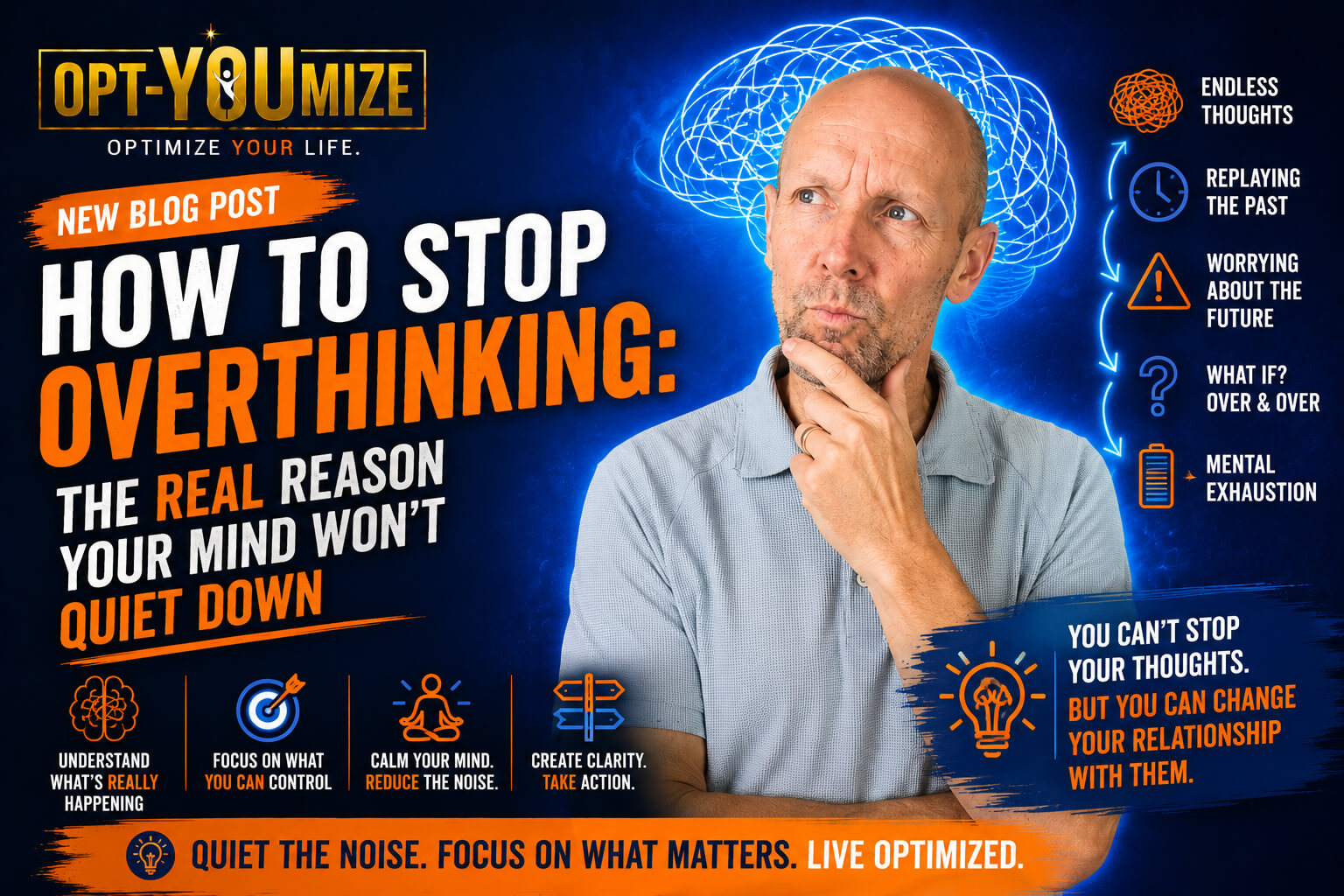
You know the feeling. You made a decision hours ago, maybe days ago, and your mind is still turning it over. Replaying a conversation. Rehearsing what you should have said. Running through every possible way a situation could go wrong. And despite all that mental activity, you're no closer to resolution. You're just tired.
That's overthinking. And the frustrating part is that it masquerades as problem-solving. It feels productive. It feels responsible. But in most cases, it's neither.
The direct answer: Overthinking, or what psychologists call rumination, is a repetitive thought pattern where your mind fixates on problems, past events, or future worries without reaching resolution. It's driven by anxiety, perfectionism, and a brain that hasn't learned to distinguish between productive reflection and stuck looping. Breaking the cycle requires interrupting the pattern, not thinking harder.
What Overthinking Actually Is (And Isn't)
There's a difference between thinking carefully about something and overthinking it. Careful thinking moves toward a decision, an insight, or a resolution. Overthinking circles. It arrives back at the same fear, the same regret, the same "what if" without generating any new information or actionable direction.
Psychologists use the term rumination to describe this pattern: repetitive, passive focus on distress and its possible causes and consequences. The key word is passive. You're not analyzing to improve. You're replaying without purpose.
Research published in the APA Monitor found that people who ruminate develop major depression at four times the rate of people who don't (20% versus 5%). That's not a minor risk differential. It's a foundational finding about how much our mental habits shape our mental health.
The distinction that matters: reflection serves you. Rumination uses you.
Why Your Brain Overthinks
Overthinking isn't random. It has drivers, and understanding them gives you actual leverage.
Anxiety and the threat-detection loop
Your brain has a very sophisticated threat-detection system. It evolved to keep you safe in environments where threats were physical and immediate. When you feel anxious about a relationship, a career move, a health concern that system activates. It starts scanning for danger. It rehearses bad outcomes so you'll be ready for them.
The problem: your brain can't easily distinguish between a tiger and a difficult conversation. The same mechanism that kept your ancestors alive now replays your awkward email from last Tuesday at 2 AM.
Anxiety drives overthinking, and overthinking sustains anxiety. The cycle becomes self-reinforcing. The more you ruminate, the more activated your threat system stays, and the harder it becomes to settle.
Perfectionism and the need for certainty
Overthinkers often have high standards for getting things right. Before they can move, they want to know the outcome. They want to think through every variable, anticipate every reaction, eliminate every risk. But certainty doesn't come from thinking longer. Most decisions in life require action in the presence of uncertainty and the demand for certainty before moving is a recipe for permanent paralysis.
The meta-cognitive trap
Some people believe, on some level, that worrying and over-analyzing is a form of caring - that if you really take something seriously, you'll think about it long and hard. This belief (worrying shows I care; letting go means I'm irresponsible) becomes its own engine for rumination. You keep thinking not because it helps, but because stopping feels like neglect.
Unresolved emotions looking for a cognitive exit
Sometimes overthinking is emotional processing in disguise. You're not really analyzing a problem, you're sitting with a feeling (fear, grief, anger, shame) that you haven't found a direct way to process. The mind keeps returning to it because the emotion hasn't been acknowledged, not because the problem hasn't been solved.
What Overthinking Costs You
This isn't just an annoyance. The research from the American Psychiatric Association on rumination is clear: repetitive negative thinking heightens vulnerability to anxiety, depression, insomnia, and impulsive behavior. It interferes with psychotherapy. It worsens and sustains the body's stress responses, including inflammation.
Beyond the clinical, overthinking costs you presence. Every hour spent replaying the past or rehearsing feared futures is an hour you're not actually here. Not with the people in front of you. Not engaged with what's real and available. Not moving toward anything.
And there's a physical dimension worth noting: chronic stress and sleep deprivation - two frequent companions of overthinking - impair the very cognitive functions you're trying to use to solve your problems. Research from the NIH confirms that sleep loss degrades memory, attention, decision-making, and judgment, the same capacities an overthinker is relying on to get through the loop. You think worse when you're tired, which often means you overthink more. This is explored more deeply in the context of body and vitality, where sleep and recovery sit at the foundation of everything.
How to Actually Stop Overthinking
This isn't about positive thinking. It's not about telling yourself to stop worrying. It's about interrupting the loop at specific points, redirecting your attention, and over time building a different relationship with uncertainty.
1. Name what you're doing
The first move is simply to recognize when you're in a rumination loop versus doing genuine productive thinking. Ask: Is this thought moving me forward, or is this the same thought I had twenty minutes ago? Naming it even just saying internally, "This is rumination" creates a small bit of distance between you and the thought. That distance is the beginning of agency.
2. Ask: Is there an action available right now?
If yes, take it. If no, the thinking isn't serving you it's just running. When there's no action available and no new information to gather, continued thinking is not analysis. It's cycling. Give yourself permission to set it down until there is something to do.
3. Move your body
This sounds almost too simple, but it works, and there's good reason why. Physical movement interrupts the neurological patterns underlying rumination. When your body is engaged, your brain shifts resources. Exercise, a walk, even standing up and doing something physical with your hands, these can interrupt a loop that pure willpower can't budge. The connection between movement and mental state is real and documented, and it's part of why physical wellbeing and mental wellbeing can't be treated as separate domains.
4. Scheduled worry time
This sounds counterintuitive, but clinical evidence supports it: if you contain your worrying to a specific 15-20 minute window each day, you can often interrupt the free-floating rumination that bleeds into everything else. When a worry surfaces outside that window, you note it and remind yourself you'll address it at the scheduled time. Surprisingly, many of those worries have dissolved by then, and the ones that haven't can be actually engaged with deliberately rather than passively obsessed over.
5. Write it down to get it out of your head
The mind loops partly because it's trying not to lose track of something. If you write down exactly what you're worried about, specifically, not vaguely, you offload the memory burden. The brain can let go of what's been captured. James Pennebaker's research on expressive writing has found consistent benefits for mental health from writing about difficult thoughts and feelings, not just logging them neutrally.
6. Distinguish the problem from your feelings about the problem
Overthinkers often conflate the practical problem (what should I do?) with the emotional charge (I'm terrified of getting this wrong). The thinking keeps going because it's trying to solve both simultaneously, and can't. Separating the two - addressing the emotion directly, then approaching the practical question separately - often breaks the deadlock.
7. Return to the present, deliberately
Rumination is time travel. It lives in the past (what I did wrong) or the future (what might go wrong). The present is the one place it can't survive for long. Whatever gets you genuinely present conversation, physical sensations, a task that requires your full attention is genuinely useful here, not as avoidance, but as a reset.
When Overthinking Is Trying to Tell You Something
Not all persistent thought is pathological. Sometimes your mind keeps returning to something because there is something unresolved - a decision that needs to be made, a conversation that needs to happen, a value that's being violated. Dismissing everything as "just overthinking" can become its own avoidance.
The question worth asking: Is my mind returning to this because there's something genuinely unresolved, or because I'm in a loop that won't produce anything new?
Genuine reflection has movement. It generates new considerations, clarifies something, leads somewhere. Pure rumination goes in circles. If you're thinking about the same thing in the same way and arriving at the same fear, that's a loop, not an inquiry.
The capacity to distinguish between the two is part of the broader work of cultivating your inner life, developing the self-awareness to know what your mind is doing and why, rather than just being swept along by it.
The Deeper Pattern Underneath Overthinking
At its root, most overthinking is a response to some version of: I need to get this right, and I'm not sure I will.
That anxiety about getting things wrong drives the endless revisiting. If you were certain you'd be okay regardless of how things turned out, you'd probably stop replaying so much. What you'd need isn't more information, it's a steadier sense of your own capacity to handle whatever comes.
That's not a cognitive fix. It's a deeper kind of confidence, one that comes from having navigated difficulty before, from knowing your values, from trusting yourself more than you trust the worst-case scenario your mind keeps constructing.
It's also connected to how you've designed your life overall: when your life has a clear enough shape - when you know what you value, what you're building, what you're willing to let go of — a lot of the anxious spinning quiets down. Not because life becomes easier, but because the framework for navigating it becomes clearer.
And when you're actively working on who you're becoming - rather than just managing who you currently are - rumination tends to lose some of its grip. That's the territory of growth and self-becoming: not self-improvement as performance, but as genuine change in how you relate to yourself and the world.
Practical Takeaways
- Name the pattern when it's happening: "This is rumination, not problem-solving."
- Ask whether there's an available action. If not, give yourself permission to set the thought down.
- Use physical movement to interrupt the neurological loop, not just as distraction.
- Try scheduled worry time, contain the looping rather than fighting it in real time.
- Write the worry down specifically to offload it from active memory.
- Separate the emotional charge from the practical problem, address them differently.
- Build a clearer life framework so fewer things feel existentially uncertain.
Frequently Asked Questions
What causes overthinking?
Overthinking is typically driven by anxiety (especially the brain's threat-detection system in overdrive), perfectionism (needing certainty before acting), and the belief that thinking harder will eventually produce the right answer. It can also be emotional processing in disguise, returning to a problem because an underlying feeling hasn't been directly addressed.
Is overthinking a mental health issue?
Occasional overthinking is a normal human experience. Chronic rumination - persistent, passive, repetitive negative thinking - is associated with increased risk of depression, anxiety, and insomnia. Research shows ruminators develop depression at four times the rate of non-ruminators. If overthinking is significantly affecting your daily life, speaking with a mental health professional is worth considering.
How do I stop overthinking at night?
Nighttime overthinking often intensifies because the external stimulation that distracts during the day disappears. Practical tools that help: writing down what you're thinking about before bed (to offload it from active memory), a brief wind-down routine that signals the brain to shift modes, limiting screens and news in the hour before sleep, and physical relaxation practices like slow breathing or light stretching. Chronic sleep disruption from overthinking creates a difficult feedback loop, poor sleep impairs the cognitive clarity needed to break the pattern during the day.
Can you overthink a decision and make it worse?
Yes. Research on decision-making consistently shows that beyond a certain point, additional information and deliberation don't improve the quality of decisions, they increase anxiety and can introduce new biases. Some decisions benefit more from a gut check or values clarification than from extended analysis. For decisions without a clear "correct" answer, the question is often less "which is right?" and more "which is most aligned with what I actually value?"
What is the difference between overthinking and reflection?
Reflection is purposeful and generative, it produces new insight, clarifies your thinking, or moves you toward a decision. Overthinking (rumination) is repetitive and passive - it circles back to the same fear or regret without generating new information or leading anywhere. If your thinking is producing movement, that's reflection. If it's producing the same loop on a shorter and shorter cycle, that's rumination.
If the loop in your head feels like it's running your life, you're not broken, you're dealing with a thinking pattern that a lot of people struggle with, often quietly. The good news is that patterns can change. Not overnight, and not by thinking your way out of thinking too much. But by developing a different relationship with your mind over time — one where you're the observer of your thoughts, not just their passenger.
That work lives at the heart of mind and inner life, not just quieting the noise, but building the kind of self-awareness that makes you less susceptible to it in the first place.