
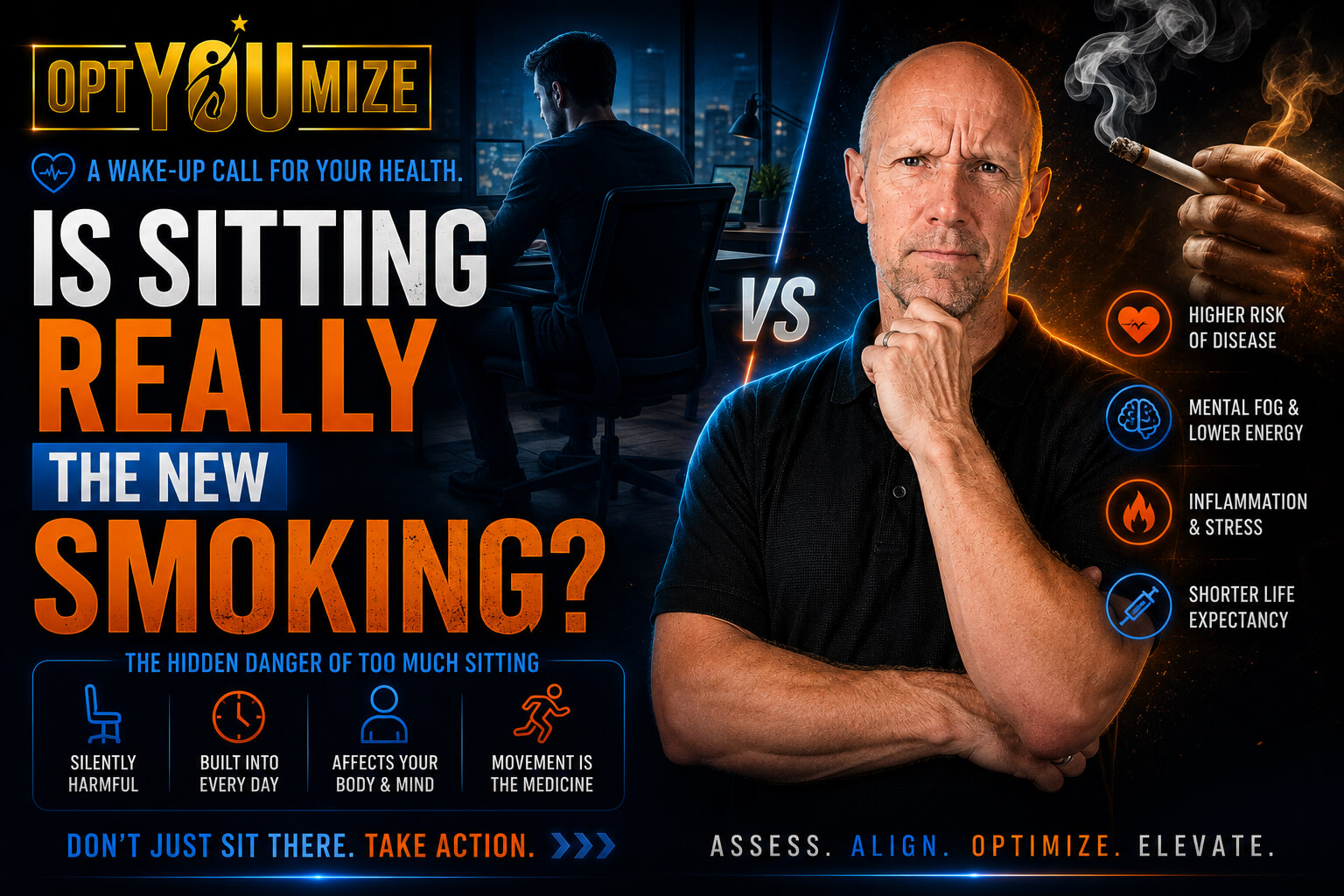
Is Sitting Really the New Smoking?
By Brett Ingram | Last updated August 2, 2026 | 8-9 minute read
Here's the direct answer: no, not literally - but that doesn't mean you're off the hook. Sitting for long stretches is genuinely linked to higher risk of heart disease, certain cancers, and earlier death. Smoking's risks are still far larger in scale: a pack-a-day habit raises your risk of dying from cancer or cardiovascular disease by well over 100%, where prolonged sitting raises it by somewhere around 10-20%. The phrase was coined in 2010 by a Mayo Clinic researcher trying to make a real problem impossible to ignore, and it worked - it just also oversold the comparison. The more useful, less catchy truth is this: sitting is one piece of a bigger problem, physical inactivity, and the fix is smaller and more forgiving than the slogan makes it sound.
Where "Sitting Is the New Smoking" Actually Came From
The line traces back to Dr. James Levine, an obesity researcher at Mayo Clinic, who told the Los Angeles Times in 2010 that sitting was "more dangerous than smoking, kills more people than HIV, and is more treacherous than parachuting." It was a deliberately shocking sentence, built to get a sedentary, screen-bound culture to sit up and pay attention - and as far as headlines go, it worked. More than a decade later, it's still the most repeated line in the entire wellness conversation about desks and chairs.
But repetition isn't evidence. When researchers actually put the two behaviors side by side, the math doesn't hold up nearly as cleanly as the sentence implies.
The Simple Answer: Sitting and Smoking Aren't Actually Comparable
According to public health researchers writing in The Conversation, people who sit a lot have roughly a 10-20% increased risk of certain cancers and cardiovascular disease. Smokers, by comparison, face more than double the risk of dying from cancer or cardiovascular disease overall, and more than a 1,000% increased risk of lung cancer specifically. Those aren't numbers in the same universe. Sitting is a real, independent risk factor. It is not, in any measurable sense, as dangerous as smoking a pack a day.
That distinction matters, because treating them as equivalent tends to produce exactly the wrong response in people: either genuine alarm that isn't proportional to the actual risk, or - just as often - a shrug, because a claim that obviously overreaches is easy to dismiss entirely, real risk included.
The Deeper Answer: What the Research Actually Shows
Here's where the nuance lives. Mayo Clinic's own updated review of the research, current as of March 2025, found that people who sat more than eight hours a day with no physical activity at all had a mortality risk "similar to the risk posed by obesity and smoking" - which sounds like it's restating the myth, until you read the second half of that same sentence: 60 to 75 minutes of moderate aerobic activity a day offset the effect almost entirely. The risk isn't fixed. It's conditional on what else is happening in your day.
| The Claim | What the Research Actually Shows |
|---|---|
| "Sitting is as dangerous as smoking" | Sitting raises risk by roughly 10-20%; smoking raises it by 100%+ overall and 1,000%+ for lung cancer specifically |
| "All sitting is equally harmful" | Sitting at a desk for work shows a weak link to long-term risk; sitting to watch TV shows a stronger one |
| "There's nothing you can do to offset a sedentary job" | 60-75 minutes of moderate activity a day offsets most of the added risk from 8+ hours of daily sitting |
| "A standing desk solves the problem" | Controlled studies of sit-stand desks found no measurable health benefit from 40-45 minutes of standing per workday |
Table compiled from the Mayo Clinic and The Conversation sources cited throughout this article.
Does It Matter What Kind of Sitting You're Doing?
This is the part most "sitting is bad" coverage skips entirely, and it turns out to matter a lot. Researchers tracking nearly 4,800 British public servants over 13 years, writing in The Conversation, found that once they accounted for obesity and physical activity levels, total sitting time, sitting at work, and sitting at home outside of TV-watching were not meaningfully linked to developing type 2 diabetes. The one type of sitting that did show a link was time spent watching television - and the researchers suspect that's less about the chair itself and more about what tends to travel with a lot of TV time: lower physical activity, less healthy food choices, and heavier exposure to food advertising.
In other words, the desk job you've been feeling guilty about may not be the actual villain. The habits that tend to cluster around a specific kind of sitting - the couch, the remote, the second and third episode - deserve more of the scrutiny than they usually get.
How Much Movement Actually Offsets a Sitting-Heavy Day?
The 60-75 minute figure isn't a one-off finding. It comes from a harmonized analysis of data on more than one million people, and it's the number Mayo Clinic's current guidance still points to. That's a meaningful chunk of a day, but it doesn't have to happen in a single block, and it doesn't have to be a formal workout - brisk walking counts, as does a bike commute, a lunchtime walk, or an evening spent actually moving instead of sitting again.
There's an important asterisk here, though. A 2024 Harvard study of roughly 90,000 people, tracked for about a decade, found that even among people who hit the recommended 150 minutes of weekly moderate-to-vigorous activity, the most sedentary among them still carried a higher risk of heart failure and cardiovascular death than the least sedentary. Hitting your exercise number doesn't fully cancel out fourteen hours of stillness around it. The two behaviors - moving enough and sitting too much - aren't perfectly interchangeable. They're both worth paying attention to on their own terms.
I-Min Lee, the Harvard T.H. Chan School epidemiologist behind much of this research, has spent her career pushing back against all-or-nothing thinking on this exact point. Her own research on step counts found that older women who averaged just 4,400 steps a day had a 41% lower mortality risk than the most sedentary women in the study - no 10,000-step target required. Her message to people who feel like they're already behind: "any little bit is better than doing nothing." That's a genuinely useful reframe for anyone who reads a headline like "sitting is the new smoking" and quietly decides the whole thing is too far gone to bother fixing.
Do Standing Desks Actually Help?
Probably not as much as the marketing suggests. Well-designed studies of people using sit-stand desks found that replacing sitting with standing for 40-45 minutes of a workday produced no measurable health benefit on its own - standing burns only marginally more energy than sitting does, and it isn't the same thing as moving. There's also a documented behavioral trap: people who use standing desks sometimes feel like they've "done their part" for the day and end up less active afterward, which can cancel out whatever small benefit standing provided in the first place.
None of this means a standing desk is a bad idea - for people who are very sedentary and deconditioned, it can be a reasonable first step. It just isn't the fix. If Office Space taught an entire generation of cubicle workers anything, it's that the problem with a desk job was never really about the furniture.
A More Useful Way to Think About This
I've built entire days around a laptop and a podcast editing timeline without standing up, and the tell was never how my back felt by 4pm - it was how flat and foggy the whole day felt in hindsight, like nothing had actually happened in it. That's closer to the real cost of a sitting-heavy day than any specific disease risk: not a dramatic health event, but a kind of low-grade erosion that's easy to keep ignoring because no single day of it does visible damage.
The research points toward a version of this that's genuinely doable, not another all-or-nothing standard to fail at quietly. A short walk after meals. Standing for phone calls. Taking the stairs. A 30-minute stand-or-stretch break built into a sitting-heavy afternoon. None of it requires a treadmill desk or a total schedule overhaul - it requires noticing that a day can pass entirely in one position, and deciding that's worth interrupting a few times. This is really the same thinking behind Body & Vitality at optYOUmize more broadly: the body isn't a productivity tool you optimize once and forget, it's a foundation you maintain in small, repeated decisions.
If you've noticed your energy sagging in ways that don't seem to track with how much you're sleeping, it's worth reading alongside this one - the reasons you're tired all the time often overlap with the reasons a day of sitting leaves you feeling drained rather than accomplished. And if the step-count number in this piece has you second-guessing what you actually need to be doing, we've already covered where the 10,000-step target came from - it wasn't science either.
Frequently Asked Questions
Is sitting really as bad as smoking?
No. Prolonged sitting raises the risk of certain cancers and cardiovascular disease by roughly 10-20%, while smoking raises overall cancer and cardiovascular death risk by more than 100%, and lung cancer risk by more than 1,000%. Sitting is a real, independent health risk - it just isn't in the same category as smoking.
How many hours of sitting a day is considered too much?
Research generally points to eight or more hours a day of sitting with little to no physical activity as the threshold where risk rises meaningfully. Below that, and especially when combined with regular movement, the picture looks considerably better.
Can exercise offset the health risks of sitting?
Largely, yes. A large analysis of data from more than one million people found that 60-75 minutes of moderate aerobic activity a day offset most of the increased mortality risk linked to eight-plus hours of daily sitting. That said, a 2024 Harvard study found that even people meeting standard exercise guidelines saw somewhat higher cardiovascular risk if they were extremely sedentary the rest of the day - so movement and reduced sitting both matter, not just one or the other.
Do standing desks actually help with the health risks of sitting?
Not as much as commonly assumed. Controlled studies found no measurable health benefit from 40-45 minutes of standing per workday at a sit-stand desk, likely because standing still burns only marginally more energy than sitting. They may be a reasonable starting point for very sedentary people, but they aren't a substitute for actual movement.
What's the best way to break up a sedentary day?
Short, frequent movement seems to matter more than one long session. A brisk walk after meals, standing during phone calls, taking the stairs, or a short walk every 30 minutes of continuous sitting are all supported by the same underlying principle: interrupting stillness, not eliminating sitting entirely.
Where This Leaves You
You don't need to panic about your desk job, and you don't need a $900 treadmill desk to fix this. What the actual research supports is much smaller and much more sustainable: move somewhere close to an hour a day in whatever form fits your life, break up long sitting stretches when you can, and pay closer attention to how you spend your evenings than to how many hours your job requires you to sit. That's a far less dramatic message than "sitting is the new smoking" - and it happens to be the one that's actually true, which is really the whole approach behind Body & Vitality at optYOUmize: treat your body as something you maintain steadily, not something you panic about in headlines and then quietly ignore.