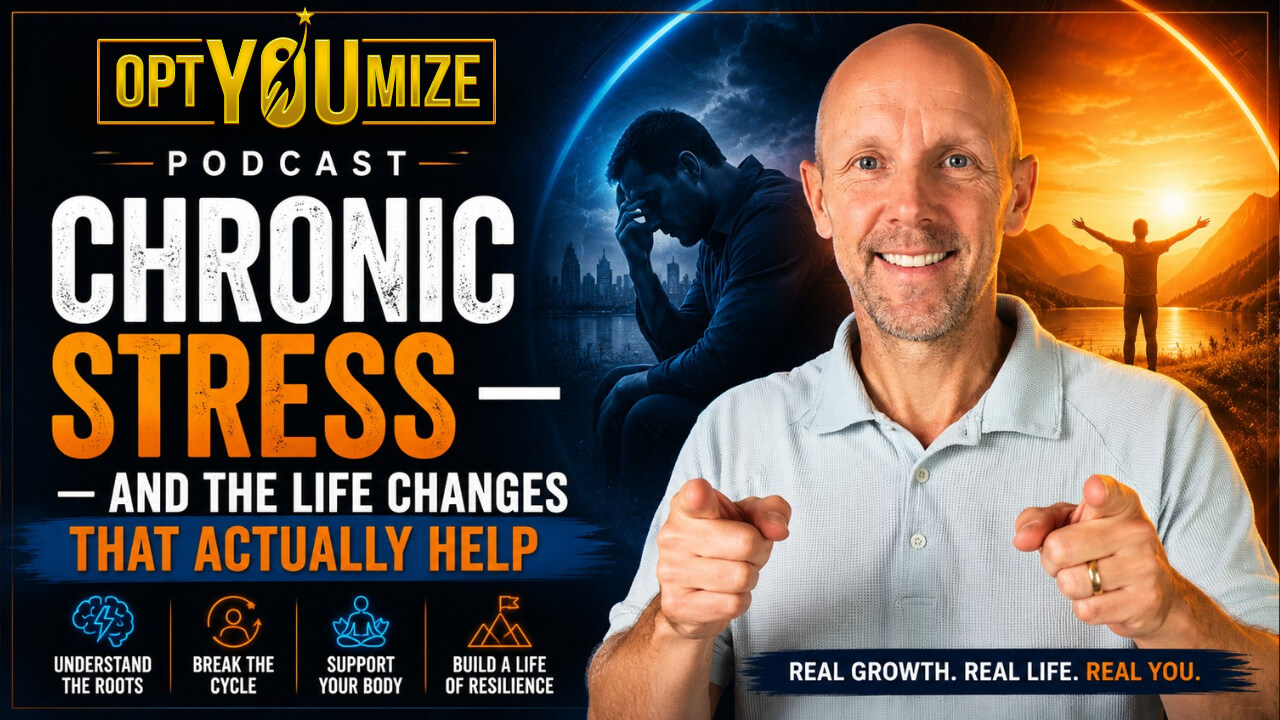
Chronic Stress — and the Life Changes That Actually Help
~22 min | June 16, 2026
Chronic stress doesn't feel like stress anymore — it feels like your personality. The short fuse, the wired-but-tired exhaustion, the sleep that doesn't restore, the inability to fully relax even on vacation — these aren't character flaws. They're what happens when your nervous system gets stuck in high alert and never gets the signal that it's safe to come down. In this episode, Brett Ingram breaks down what chronic stress actually is, what it's doing to your body in plain biological terms, and — most importantly — what small, realistic life changes genuinely move the needle.
What You'll Learn in This Episode
- Why traits you've labeled "just how I am" — short fuse, bad sleep, wired-but-tired — may actually be chronic stress in disguise
- The difference between useful short-term stress and a nervous system that never returns to baseline
- What cortisol and adrenaline do when they stop being tools and become your permanent setting
- How chronic stress quietly degrades sleep, energy, mood, cravings, and your presence in relationships — often all at once
- Why so many people normalize survival mode, and the cultural story that makes exhaustion feel like a badge of honor
- The one habit Brett changed first that shifted his mood, energy, and anxiety without overhauling his entire life
- Why small, consistent signals to the nervous system outperform dramatic lifestyle overhauls every time
Episode Timestamps
[00:00]Introduction — the feeling of not being able to relax anymore[01:00]What chronic stress actually is — and why it starts to feel like your personality[03:00]Short-term stress vs. chronic stress: when the recovery stops happening[06:00]The biology: sympathetic vs. parasympathetic nervous system, cortisol, and the gas pedal that stays pressed[08:00]How chronic stress shows up in daily life: sleep, cravings, mood, decision fatigue, and relationships[12:00]Why people normalize survival mode — and the cultural story that keeps them there[16:00]Life changes that actually help — what works and what doesn't[20:00]Body vitality, the inner side of recovery, and reflection questions[21:30]A simple weekly practice to start sending your nervous system a different signal
Episode Summary
Most people carrying chronic stress have stopped recognizing it as stress. It's become the background hum of daily life — the reason you snap at someone you love over something small, the reason you're exhausted but can't wind down, the reason you reach for caffeine at 3 p.m. not because you want it but because your body is running on fumes and needs fast fuel. Brett's central argument in this episode is one worth sitting with: a lot of what people have accepted as "just who I am" is actually a nervous system that never got permission to come down from alert mode.
The episode starts with a clear distinction that matters. Stress itself isn't the problem. Short-term stress — a deadline, a hard conversation, a demanding workout — is the system working exactly as designed. The body activates, responds, and then returns to baseline. That cycle, when it completes, is healthy. Chronic stress is what happens when the returning-to-baseline part stops happening. The threat passes, but the body keeps running the program. The alarm stays on long enough that you stop hearing it as an alarm. It just starts feeling like you.
Biologically, this plays out through the sympathetic nervous system — the gas pedal — staying partially pressed all the time. Cortisol and adrenaline, hormones designed for temporary bursts, remain elevated far longer than they were built for. A body operating in that state starts making different decisions: about energy allocation, digestion, immune response, sleep architecture, and emotional regulation. This isn't abstract. Brett names the specific places it tends to land first: sleep that doesn't restore, cravings for sugar and caffeine to manage flagging energy, mood that has less buffer for frustration, decision fatigue that makes even simple choices feel like too much, and a kind of hollowed-out presence in relationships that people around you can feel even if no one says anything out loud.
Brett shares his own experience of working sixteen-hour days while building his business — the point where snapping at family became his new normal, where he chalked up his irritability and absence to maybe just not being a good enough person. The reframe was significant: it wasn't a character problem. It was a pattern his nervous system had gotten stuck in, and when the pattern changed, so did he. The shift came not from a dramatic life overhaul but from committing to one thing: protecting seven hours of sleep, no matter how much was still on the list. Within days, mood improved. Anxiety dropped. Small frustrations started landing differently.
That single-habit-first approach is at the heart of what this episode argues actually works. There's no supplement, no miracle routine, no overnight fix for a nervous system that's been in high alert for months or years. What works is smaller and more sustainable: repeated ordinary moments that signal to the body it's safe to stand down. Protecting sleep. Consistent movement that supports rather than depletes. Genuine stillness — five minutes with no phone, no multitasking, no optimizing. Time outdoors. Better nutrition that stabilizes energy instead of spiking and crashing it. Transitions between tasks and environments instead of going full speed until collapse.
The episode closes with a reframe that sits at the core of the optYOUmize approach to building a physical foundation your body can actually recover in: recovery isn't a reward you earn after the to-do list is handled. That list will always keep filling. Recovery is part of how the system functions. A body and mind that get real rest make better decisions, have more patience, and have more capacity for the people and things that matter most. The goal isn't to eliminate stress. It's to stop designing a life where your body is constantly fighting your biology just to get through the day.
Resources Mentioned
- Sleep research on chronic sleep deprivation — Brett references studies on sleep's long-term health impact as a turning point in changing his own habits
- High-quality protein for recovery — introduced through his son's hamstring injury; grilled fish and chicken as simple, practical staples
- Calming music, affirmations, and meditations — Brett's morning practice for setting tone and lowering baseline stress before the day begins
Frequently Asked Questions
What is chronic stress and how is it different from regular stress? Regular stress is a short-term response to a demand — physical, emotional, or mental. It activates your body, helps you respond, and then the system returns to baseline. Chronic stress is what happens when that return never comes. The alarm stays on so long it stops feeling like an alarm and starts feeling like your personality — a short fuse you were born with, a sleep problem that's just how you are.
What are the most common signs of chronic stress? The clearest signs are exhaustion paired with an inability to wind down, sleep that doesn't restore, mood volatility over small things, frequent cravings for sugar and caffeine, and a flattening of presence in your relationships. Decision fatigue — where even simple choices feel draining — is another common one. Many people attribute these to personality traits rather than recognizing them as a nervous system running an outdated program.
What does chronic stress do to your body over time? Chronic stress keeps cortisol and adrenaline elevated far beyond what those hormones were designed for. A body operating in that state makes different decisions about energy, digestion, immune function, and sleep. It's the difference between a car actually turned off and resting versus one idling in the driveway with the engine revving — wearing down even when nothing is being demanded of it. Brett is careful to note he's not a doctor, but the connection between prolonged stress and the body's inflammatory and immune responses is well-documented.
Why do so many people normalize being chronically stressed? Part of it is cultural: there's a story that says busy, tired, and stretched thin is the price of success — a badge of effort rather than a warning sign. But a bigger part is simply duration. When the alarm has been on long enough, you stop hearing it as an alarm. It becomes your baseline, your personality, just what being an adult feels like. The difference between a life that's full of meaningful things and a life that's full of stress your body never recovers from can look identical from the outside. They feel completely different from the inside.
What's the most effective first step to start recovering from chronic stress? Start with one thing and protect it. Brett's first change was sleep — committing to seven hours regardless of what was still on the list, with the explicit belief that he'd be more productive during waking hours if he was actually rested. It took a few days to feel different, but mood, energy, and anxiety all shifted noticeably within that first week. The specific habit matters less than the consistency and the signal it sends: you're starting to tell your nervous system it's safe to come down.
How long does it take to recover from chronic stress? There's no universal answer, and Brett is honest about this. His experience was days to weeks before he felt a real shift — not overnight. The research suggests that the nervous system responds to repeated, consistent signals over time rather than to single dramatic interventions. Give yourself grace in the first few days when it feels like it isn't working. That's normal. The discomfort of stillness or early sleep is often a sign of just how unfamiliar "down" has become — not a sign the approach is wrong.
Is the wired-but-tired feeling a sign of chronic stress? Yes, and it's one of the most common ones. Wired-but-tired happens when your body is physically exhausted but your nervous system is still running its high-alert program — you're depleted but can't idle down. Your mind keeps moving even when your body is screaming for rest. This is the sympathetic nervous system (the gas pedal) staying partially pressed even after the demands of the day are over, which is exactly what chronic stress looks like biologically.
Keep Exploring
If this episode resonated, these are worth your time:
- Body & Vitality Pillar — The full framework for building a physical foundation that supports every other area of your life
- Mind & Inner Life Pillar — The full collection of writing on self-awareness, inner life, and the questions that live underneath how you think, feel, and choose
Enjoyed This Episode?
The best way to support optYOUmize is to subscribe and leave a review — it takes about two minutes and makes a real difference in helping more people find the show.
Apple Podcasts · Spotify · Amazon Music · YouTube
→ Leave a Review