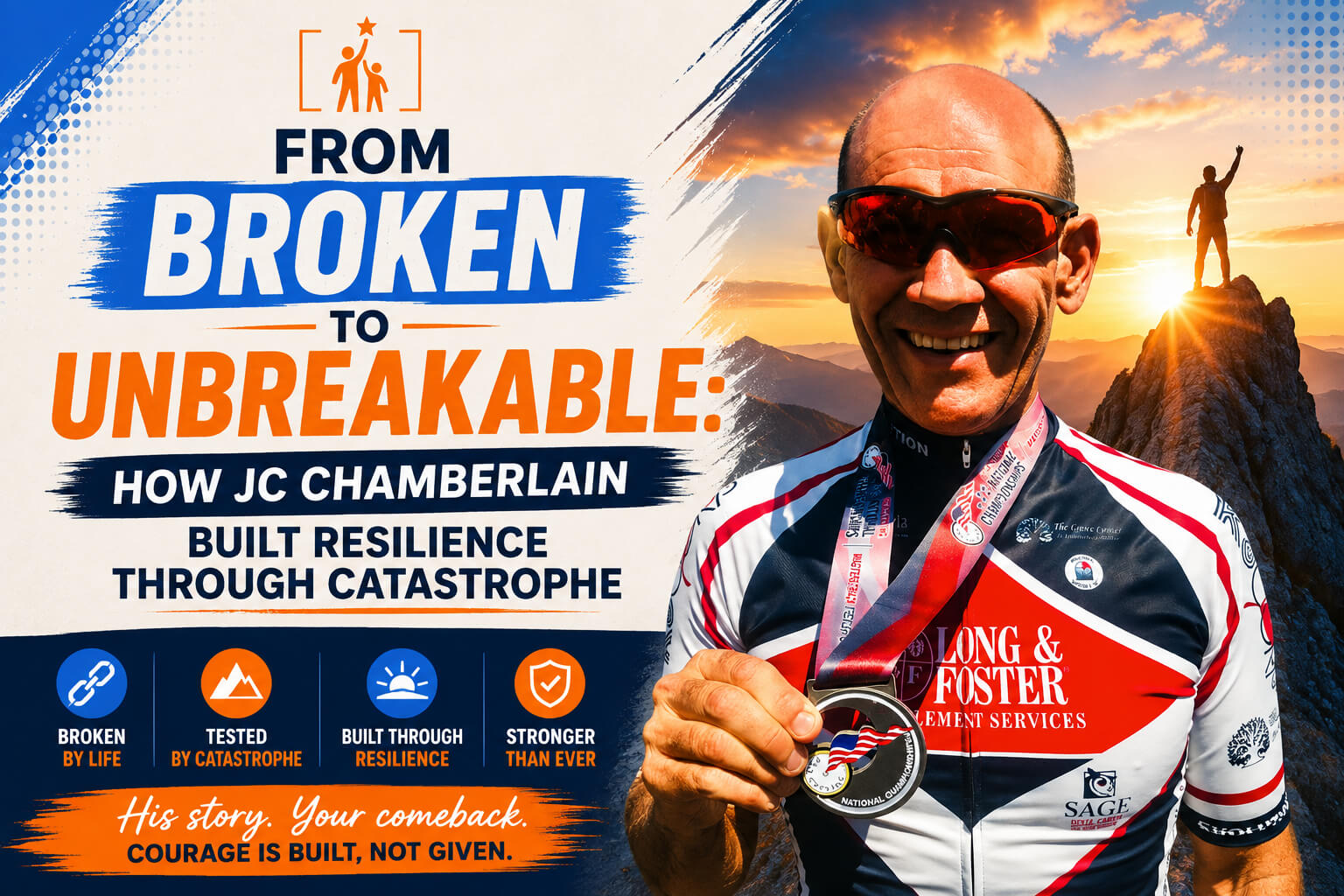
Building resilience as an entrepreneur isn't about being unbreakable by nature — it's about deliberately filling the right reserves before a crisis empties them. In this episode, JC Chamberlain shares the hard-won emotional wealth framework he developed after surviving a near-fatal cycling accident, cancer, and partial paralysis.
From Broken to Unbreakable: How JC Chamberlain Built Resilience Through Catastrophe
~44 min | September 29, 2025
JC Chamberlain has logged over 429,000 miles on a bicycle, managed billion-dollar commercial real estate, ran a global nonprofit across 40 countries, helped companies scale to mass markets, and survived both cancer and a near-fatal collision with a car traveling at 55 miles per hour. He is not a motivational speaker selling a polished story — he is someone who got thrown 100 feet, woke up paralyzed on one side, and spent the years that followed figuring out what actually sustains a human being when everything falls apart. The framework he built from that experience — and eventually put into his book Antidote — is what this conversation is about.
What You'll Learn in This Episode
- Why being "over-prepared for the road" — rather than preparing the road for your children — creates genuine resilience, and how JC's mother modeled this in a way that shaped his entire life
- The moment in the ambulance after his near-fatal crash that gave JC unexpected clarity, and what it changed about how he understood his own purpose
- The seven elements of emotional wealth — from dreams and health to spirit, love, and earning WELLTH — and why they only work when treated as interdependent, not isolated
- The think big, act small strategy for getting back on track when a setback, rejection, or crisis knocks you off course
- The physiology of stress relief: what myokines are, why intense physical activity crosses the blood-brain barrier, and how a 30-minute morning stretch-and-breathwork practice changes the day
- Why belonging to a group or community — not digital connection, but in-person or structured belonging — is the single most powerful resilience factor identified by the Harvard Grant Study
- The ephemeralization principle JC learned from an early Amazon and Apple investor, and how it applies to finding scalable business ideas hiding in plain sight
- JC's number one tip for entrepreneurs: eat the frog first — do the hardest thing before anything else, every day
Episode Timestamps
[00:00]Opening — introduction to JC Chamberlain[01:00]JC's backstory — rheumatic fever at four, told he couldn't do sports, and the reframe that started everything[03:14]Brett on preparing children for the road rather than preparing the road for children[05:32]The messy, non-linear nature of learning and entrepreneurship — why vulnerability is a requirement[08:47]The cycling accident — hit at 55 mph, thrown 100 feet, partially paralyzed, and the conversation with God in the ambulance[14:59]How to choose perspective over victimhood — and why most of us don't face a real test until we have to[16:49]The emotional wealth framework — seven life areas and the think big, act small strategy[18:17]No zero days — Brett's take on momentum and why stopping is more dangerous than going slow[20:05]How JC learned to scale companies — and the ephemeralization principle from a legendary Silicon Valley investor[27:36]Stress management: myokines, gratitude journaling, breathwork, and why the 30-minute morning practice matters[33:03]The Harvard Grant Study and why belonging is the most underrated resilience factor[37:55]The Antidote book — its origin and the seven elements of emotional wealth explained[43:26]Eat the frog first — JC's number one tip for entrepreneurs[44:16]Closing thoughts
Episode Summary
Nothing Is Going to Be OK — and That's the Point
JC Chamberlain's mother had a saying: don't worry, nothing is going to be OK. She meant it as preparation, not despair. Her worldview was that life would dish out things you couldn't anticipate, and the job was to be over-prepared — which is different from being shielded. When JC was four years old, rheumatic fever left his heart value damaged and doctors told him he would never be able to do sports. Rather than treating this as a verdict, he found a different path: he heard the Vienna Boys Choir, taught himself violin for three hours a day, and eventually became first chair in his middle school orchestra's first violin section. The lesson he carried forward was about reframing — not spinning bad news into false positivity, but genuinely looking at a closed door and asking what else is now possible.
This orientation toward chaos as opportunity became foundational. It shaped how he approached entrepreneurship, how he survived a near-fatal accident, and ultimately how he thinks about building a life that can actually withstand the unavoidable hard parts. Brett and JC spend time in the early part of this conversation on a related idea: the modern tendency to prepare the road for children rather than prepare children for the road. The problem isn't just that it fails to build resilience — it's that it produces people who are genuinely unprepared for the moment the road runs out. Disappointment, constraint, and the necessity of figuring things out yourself are not obstacles to growth. They are often the mechanism of it.
The Accident, the Ambulance, and What Followed
In 2012, JC was riding his bicycle when an SUV hit him at 55 miles per hour. He was thrown 100 feet. He broke teeth, fractured bones throughout his body, and woke up in the emergency room with tubes everywhere, partially paralyzed on his left side. His surgeon told him that with hard work, he might learn to walk again — but he should not hope to ride. JC's response to the surgeon: "Kind sir, you don't know who you're saying that to. If I have to blow through a straw to move a wheelchair, I'm going to move again."
What happened in the ambulance before he regained consciousness is something JC describes as one of the defining experiences of his life. He had what he calls a crystal clear connection — a direct conversation in which he asked the questions you'd expect: why me, why now, why this. The answer he received was that there was a more fatal accident in his future, and this one was survivable and chosen. Whether that was God, as JC understands it, or his own mind constructing meaning at the edge of survival, the effect was the same: he came back with a question rather than a verdict. What do you do with the rest of your life?
He spent seven weeks in the trauma hospital. The driver of the car that hit him followed the ambulance to the hospital and was holding JC's hand when he opened his eyes — a stranger who showed up anyway, hoping he would wake up. JC has spent the years since trying to understand what it means to have people show up for you, and what you have to build beforehand for that to happen.
The Emotional Wealth Framework
The book that emerged from this process is called Antidote: A New Emotional Wealth Framework to Build Resilience. Its premise is that resilience isn't a fixed trait — it's the result of ongoing investment in seven interconnected areas of life. When you've paid it forward into each of these accounts, they show up for you when you can't show up for yourself.
The seven elements are: your dreams (the original source of motivation and direction); learning (maintaining an active, humble relationship with what you don't know); health (a deep well of physical vitality built through consistent, above-threshold activity); spirit (connection to something larger than yourself, however you understand that); love relationships (the people who show up when you're in the hospital); giving back (contribution through time or money, which grows the connective tissue of your community); and earning WELLTH — a word JC spells W-E-L-L-T-H deliberately, because it is a combination of physical health, mental health, and financial wealth, not just one of the three. He considers earning WELLTH the most emotionally sensitive of the seven, which is why it needed its own framing.
The insight JC emphasizes is that these are not independent accounts. They are interdependent. When the accident stripped away his identity as a champion cyclist — which his brother, a physician, correctly identified as the hardest part to heal — the other six areas showed up in the gap. But only because he'd built them. The accident didn't create his resilience. It revealed what he'd already built.
What Actually Moves You Through Stress
JC's approach to stress management is concrete rather than aspirational. Stress produces cortisol, which disrupts normal cell renewal and allows cellular damage to compound. The antidote he uses is physical activity — not a walk around the neighborhood, but effort that pushes your heart rate above your comfortable threshold for 20 to 30 minutes. This produces myokines, molecules released by muscle tissue that cross the blood-brain barrier and shift the body's chemical environment measurably. He has ridden eight or nine thousand miles a year through cancer treatment and recovery. He still rides today.
But intensity alone isn't the whole practice. Every morning, before the day starts, he stretches for 30 minutes and does deliberate breathwork. He keeps a gratitude journal with space for three gratitudes, a section for intentions, and a section for one action. When he misses a day, he moves on. His rule: people don't drown because they can't swim — they drown because, when submerged, they fail to change the behavior that put them in the river.
The other stress factor JC returns to is belonging. The Harvard Grant Study, which followed a cohort of adults over 60 years, found that the strongest predictor of longevity and life satisfaction was close personal relationships — not wealth, not status, not physical health alone. JC's prescription is simple: belong to something with a schedule. A writer's group. An entrepreneurship summit. A cycling club. Something that gets you out of yourself, keeps you accountable to showing up, and creates the kind of interactions that digital connection mimics but doesn't replicate.
Think Big, Act Small — and Eat the Frog
When facing a setback — a rejection, a closed door, a health crisis, a relationship rupture — JC's strategic advice is to step back, reconnect with the dream that brought you here in the first place, and then act small. Not small forever. Small next. The big vision is the compass; the small action is the first step on the path. This is how he rebuilt his capacity to ride after the accident, how he navigates entrepreneurial setbacks, and how he coaches the founders he works with.
Brett adds a principle of his own: no zero days. Even when you're sick, overwhelmed, or out of energy, do one thing that moves you forward. The danger isn't going slowly — it's stopping. Inertia compounds in both directions, and the hardest part of any relaunch is the gap between the couch and getting started. Which is why JC's number one tip for entrepreneurs is to eat the frog first: identify the hardest, most important task of the day, and do it before anything else. Not because the frog gets easier — it doesn't. Because everything else gets lighter when it's done.
Resources Mentioned
- Antidote: A New Emotional Wealth Framework to Build Resilience — JC Chamberlain's book on building emotional resilience through seven interconnected life areas. Available at antidotethebook.com, including one-on-one coaching with JC.
- Harvard Grant Study — Longitudinal study of adult development over 60+ years, cited for its finding that close personal relationships are the strongest predictor of longevity and life satisfaction.
- What Got You Here Won't Get You There — Book referenced by JC Chamberlain in the context of carrying forward a different set of strengths through transformation (originally about corporate career transitions).
- Bob Proctor — Late personal development speaker; mentioned by JC as an influence during his career transition, particularly around paradigm shifts and energy.
- Bill Hambrick — Princeton entrepreneur and early Silicon Valley investor (Hambrecht & Quist); JC credits him with introducing the concept of ephemeralization — doing more with less — as a framework for spotting scalable business opportunities.
- Lewis Howes / School of Greatness — Podcast cited by JC as an early influence when he was considering leaving his job to pursue entrepreneurship.
Frequently Asked Questions
What is emotional wealth?
Emotional wealth is the accumulated inner resources across seven key life areas: dreams, learning, health, spirit, love relationships, giving back, and earning WELLTH (a deliberate blend of physical health, mental health, and financial wealth). JC Chamberlain's framework argues that when you invest in all seven consistently, they form a reserve you can draw on when crisis hits. It's the difference between being leveled by adversity and having enough in the bank to survive it — because the people, habits, and convictions you built in ordinary time show up for you in extraordinary time.
How do you build resilience as an entrepreneur?
Building resilience as an entrepreneur starts with returning to your original dreams when setbacks hit, then using a think big, act small approach to rebuild momentum one manageable step at a time. JC Chamberlain also points to consistent above-threshold physical activity, a daily gratitude and intention journal, breathwork, and deliberate belonging to a community with a real schedule. Resilience isn't a trait you either have or don't — it's built through repeated small investments across multiple areas of your life, long before you need them.
What is the "think big, act small" strategy?
Think big, act small means holding onto your large vision or core dream while taking the smallest possible next step when you're facing a setback, rejection, or crisis. Rather than trying to solve everything at once, you reconnect with why you started and then take one concrete, manageable action. JC Chamberlain applies this across entrepreneurship, athletics, and personal recovery as a way to restart momentum without being paralyzed by the distance between where you are and where you want to be.
What are myokines, and why do they help with stress?
Myokines are molecules produced by muscle tissue during vigorous physical exercise — specifically when you push your heart rate above your comfortable threshold for 20 to 30 minutes. They cross the blood-brain barrier and the heart blood barrier and produce measurable positive changes in the body's chemical environment, countering the cell-damaging effects of chronic cortisol. JC Chamberlain points to them as one of the best-documented biological mechanisms for stress relief — one that requires actual effort, not just gentle movement.
What is the Antidote book about?
Antidote: A New Emotional Wealth Framework to Build Resilience is JC Chamberlain's book about the seven interconnected life areas that sustain us through catastrophic setbacks. Written after his near-fatal cycling accident and his recovery from cancer, it lays out a framework for building emotional resilience before you need it — through consistent investment in dreams, learning, health, spirit, love, service, and financial and physical wellbeing. The book is available at antidotethebook.com.
What does "eat the frog first" mean for business?
Eat the frog first means identifying the hardest, most important task on your list and doing it before anything else. The logic is that the task you're most tempted to defer is usually the one that matters most — and when you do it first, everything that follows becomes lighter. JC Chamberlain offers it as his single most universal success tip: it applies in entrepreneurship, in physical training, in parenting, in marriage. The challenge is the same everywhere: we tend to avoid the hard thing. The discipline to reverse that tendency is what separates movement from stasis.
Why does belonging matter for resilience?
The Harvard Grant Study — one of the longest-running longitudinal studies of adult development — found that the people who lived longest and reported the most satisfaction were those who maintained close personal relationships throughout their lives. JC Chamberlain draws directly on this: belonging to a group, community, or network — something with a real schedule that gets you out of yourself — provides the accountability, warmth, and connection that digital interaction mimics but doesn't replace. It also gives you people who show up when your own belief in yourself runs out. That, he argues, is the most underrated resilience factor most entrepreneurs consistently neglect.
Keep Exploring
If this episode resonated, these are worth your time:
- Growth & Self-Becoming Pillar — The full collection of writing on resilience, transformation, and what it actually takes to become more of who you are over time.
- Body & Vitality Pillar — Writing on physical energy, nervous system health, and the body as the foundation everything else rests on.
Enjoyed This Episode?
The best way to support optYOUmize is to subscribe and leave a review — it takes about two minutes and makes a real difference in helping more people find the show.
Apple Podcasts · Spotify · Amazon Music · YouTube