
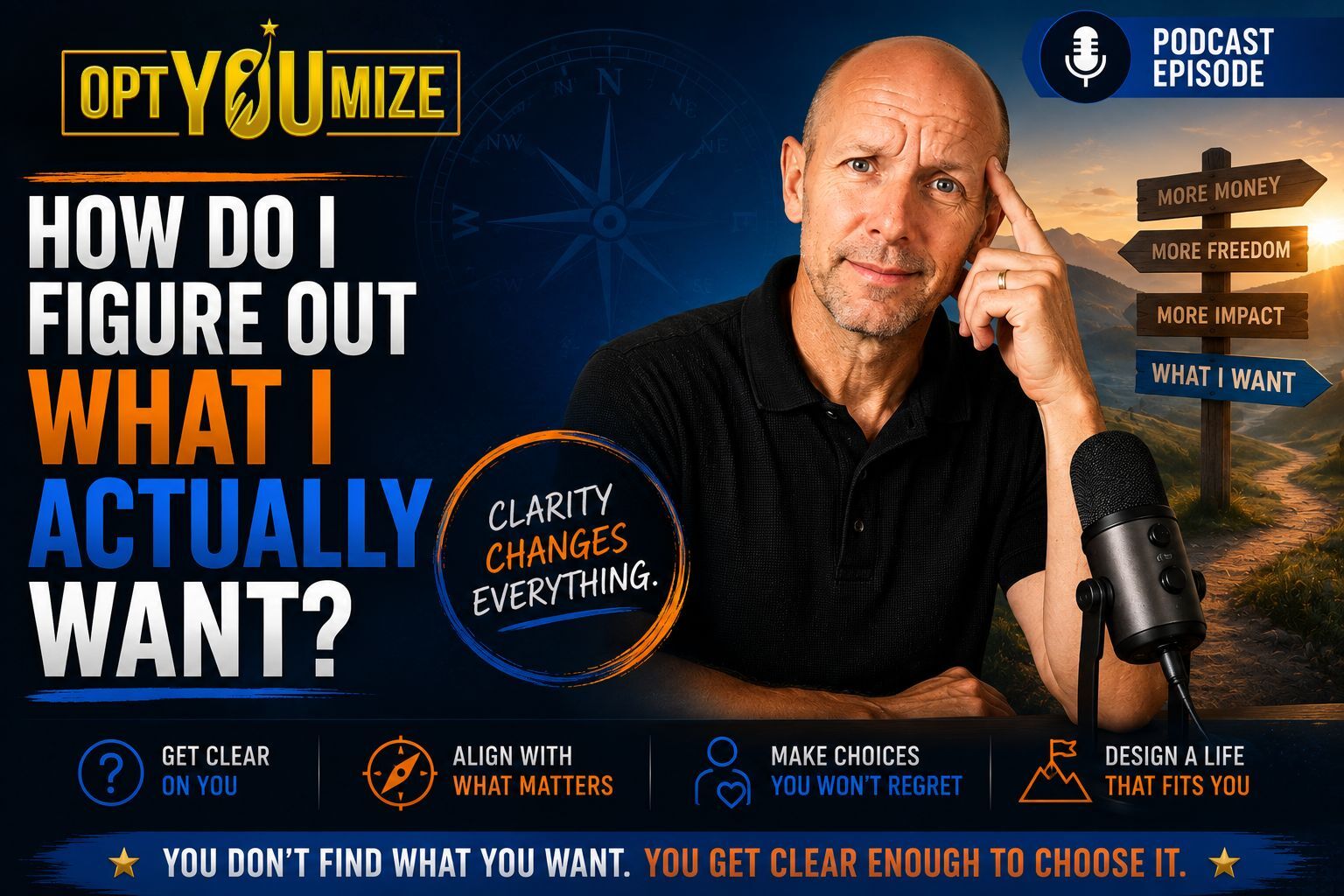
How Do I Figure Out What I Actually Want?
~23 min | August 14, 2026
You can't answer "what do I actually want?" by looking inward harder, because most desire isn't hidden — it's borrowed. In this episode, Brett Ingram makes the case that a lot of what feels like your deepest wanting was actually absorbed from the people around you, and that the brain's craving for something and its enjoyment of having it run on two separate systems that routinely disagree. He offers a three-question "wanting audit" — where a want came from, whether you'd like having it or just getting it, and whether you'd still want it in private — for telling a genuine desire from a borrowed one before you spend years chasing it.
What You'll Learn in This Episode
- Why "look inward and follow your heart" doesn't work — and why desire is mostly formed, not found, built out of what you were exposed to, praised for, and surrounded by
- René Girard's concept of mimetic desire: why so much of what you want, you caught from other people rather than generated yourself
- Kent Berridge's discovery that wanting and liking run on two different brain systems — and why the loudest craving is often the least reliable signal
- The three-question "Wanting Audit" for testing whether a specific desire is actually yours: the origin question, the liking question, and the private question
- Why intrinsic goals (growth, relationships, contribution) tend to hold up better over a life than extrinsic ones (status, image, wealth) — and why that finding is correlational, not a verdict on ambition itself
- The difference between reflection and rumination, and why thinking harder about what you want usually just generates heat, not light
- A simple one-week practice — the one-want audit and a daily "aliveness" note — for catching the wants you couldn't have found by sitting still
Episode Timestamps
[0:00]Introduction — the question that sounds simple and isn't[2:00]Why this hits hardest for people who are good at getting what they want[3:00]The trap in "figure out what you want" — desire isn't buried treasure[4:00]Why "look inward and follow your heart" doesn't work[6:00]Borrowed desire: René Girard and mimetic desire[9:00]Wanting isn't liking: Kent Berridge's two systems in the brain[12:00]The Wanting Audit — three tests, starting with the origin question[13:00]Test two: do you want to have it, or just to get it?[15:00]Test three: would you still want it if no one knew?[16:00]What the research says: intrinsic vs. extrinsic goals[18:00]The limit of thinking your way there — and the antidote[20:00]This week's practice: the one-want audit and the aliveness log[22:00]Rosebud, and the loudest want is rarely the truest one
Episode Summary
There's a version of "figure out what you want" that sounds like buried treasure — dig deep enough into yourself and the true answer will surface. Brett Ingram opens this episode by rejecting that model outright. The core claim: desire isn't mostly found, it's formed — built over time out of what you were exposed to, what you were praised for, and who you were standing next to when a want first showed up. If that's true, then sitting still and asking "but what do I really want?" on repeat won't get you anywhere. As Brett puts it, that kind of looping introspection means "all that's gonna do is generate heat. It's not gonna generate light."
The first idea Brett builds the episode around is French philosopher René Girard's concept of mimetic desire — the claim that we mostly want things because other people want them, not because of the qualities of the thing itself. We look around to see what's worth wanting, and then we want that. It's why a neighborhood suddenly appeals once a friend moves there, or a career milestone starts to matter only after someone your age hits it first. Girard's point, Brett stresses, isn't a moral indictment — "it's not that you're shallow or a follower... The failure is only in never noticing it's happening." Borrowed desire isn't automatically bad; some of it fits beautifully. The problem is chasing a borrowed want for a decade while assuming it's the deepest expression of who you are.
The second idea comes from neuroscientist Kent Berridge's decades of research at the University of Michigan: wanting and liking are two separate systems in the brain. Wanting — the craving, the pursuit — runs largely on dopamine. Liking — the actual pleasure once you have the thing — runs on a smaller, more fragile system, and the two can come apart completely. That's the mechanism behind the flat, quiet letdown after finally getting something you were sure about. "The loudest want is not the truest want," Brett says, and using raw craving as your guide to what you want will steer you straight toward the things you'll like least once you have them.
From these two ideas, Brett builds a practical tool: the Wanting Audit, three questions to run on any specific want. The origin question — where did this come from, and who did I first see wanting it? The liking question — do I want to have this, or just to get it? (Imagine the ordinary Wednesday six months later, not the moment of arrival.) And the private question — would I still want this if no one ever knew I had it? None of the three deliver a clean verdict, but together they show where a want came from and whether it's likely to satisfy. The pattern lines up with research from psychologists Tim Kasser and Richard Ryan on intrinsic versus extrinsic goals: people who organize their lives disproportionately around extrinsic goals — wealth, status, image — tend to report lower wellbeing, even when they get what they wanted. The finding is correlational, and Brett is careful to say ambition itself isn't the villain; the wants worth keeping tend to have an intrinsic core, even when they wear an extrinsic coat.
Brett also pushes back on his own framework: some wants can't be found by analysis at all. They only reveal themselves through action — small, cheap, reversible experiments, followed by honest noticing of what you actually felt, not what you predicted. That's the difference between reflection and rumination, and it connects directly to the difference between self-knowledge and self-improvement — the deeper terrain this episode sits inside. The homework is simple: run the Wanting Audit on one costly want this week, and keep a running note of the moments you felt genuinely alive, then compare the two lists. Closing with the "Rosebud" ending of Citizen Kane, Brett leaves listeners with the line the whole episode turns on: "You don't have to figure out everything you want today. You just have to stop mistaking a borrowed want for a life."
Resources Mentioned
- René Girard's mimetic desire theory — the idea that we largely want things because other people want them — Britannica: "What is mimetic desire according to René Girard?"
- Kent Berridge's "wanting vs. liking" research, University of Michigan — the neuroscience showing craving and enjoyment run on separate brain systems — Berridge Lab: Neuroscience of Liking and Wanting
- Tim Kasser & Richard Ryan's research on intrinsic vs. extrinsic goals — the correlational link between extrinsic-goal-focused living and lower wellbeing — Kasser, "Materialistic Values and Goals," Annual Review of Psychology (2016)
- Citizen Kane (1941 film) — referenced for the "Rosebud" ending and the idea of getting everything you wanted and finding out it was never really yours
Frequently Asked Questions
How do I figure out what I actually want in life? Run any specific want through three tests instead of trying to think your way to an answer: where it came from and who you first saw wanting it, whether you'd enjoy having it and not just getting it, and whether you'd still want it if no one ever knew. Wants that survive all three are far more likely to be genuinely yours.
Why don't I know what I want anymore? Because desire is mostly formed, not found — built out of what you were exposed to, praised for, and surrounded by — so there usually isn't a single "true" want hiding inside you waiting to be uncovered. What feels like confusion is often a list that's half yours and half absorbed from other people, with no way yet to tell them apart.
What is mimetic desire, and why does it matter for figuring out what I want? Mimetic desire is philosopher René Girard's idea that we largely want things because other people want them, not because of the qualities of the thing itself. A lot of what feels like a personal desire is actually a social signal picked up from a peer, a rival, or a culture — which isn't a character flaw, just how humans learn what to value in the first place.
What's the difference between wanting something and liking it? Neuroscientist Kent Berridge found that wanting (the craving, the pursuit) and liking (the pleasure once you have it) run on two different, separable systems in the brain. That's why a desire can feel intensely urgent and still deliver almost no satisfaction once you get the thing — the wanting system can fire hard even when the liking system barely responds.
Why do I get what I want and still feel unsatisfied? Because the intensity of a craving tells you almost nothing about how much you'll actually enjoy having the thing once you do — that's the wanting/liking gap. It's also often a sign the want was extrinsic (status, image, being seen) rather than intrinsic, and research shows extrinsically-organized goals tend to satisfy the least even when achieved.
What is the "Wanting Audit" from this episode? It's a three-question test for any want you're carrying: the origin question (where did this come from, who did I first see wanting it), the liking question (do I want to have it, or just to get it), and the private question (would I still want it if no one ever knew I had it). It won't produce a clean yes or no, but it shows where a want came from and whether it's likely to satisfy you.
Is it bad that a lot of my desires are borrowed from other people? No — Brett is explicit that borrowed doesn't automatically mean bad, and mimetic wanting is simply how humans learn what to value. Some desires you catch from other people fit you beautifully. The problem is only when you can't tell the difference and spend years chasing a borrowed want assuming it's the deepest expression of who you are.
Keep Exploring
If this episode resonated, these are worth your time:
- Mind & Inner Life Pillar — The full framework on self-knowledge and building a genuine inner life, not just optimizing your output → Mind & Inner Life Guide
- What Self-Knowledge Actually Is — A companion episode on why real self-knowledge means seeing yourself clearly in motion, not a personality-quiz result → optyoumize.com/podcast/what-self-knowledge-actually-is
- How to Stop Comparing Yourself to Others — A closer look at the same mimetic pull behind comparison and status-chasing → optyoumize.com/podcast/why-you-cant-stop-comparing-yourself
Enjoyed This Episode?
The best way to support optYOUmize is to subscribe and leave a review — it takes about two minutes and makes a real difference in helping more people find the show.
Apple Podcasts · Spotify · Amazon Music · YouTube