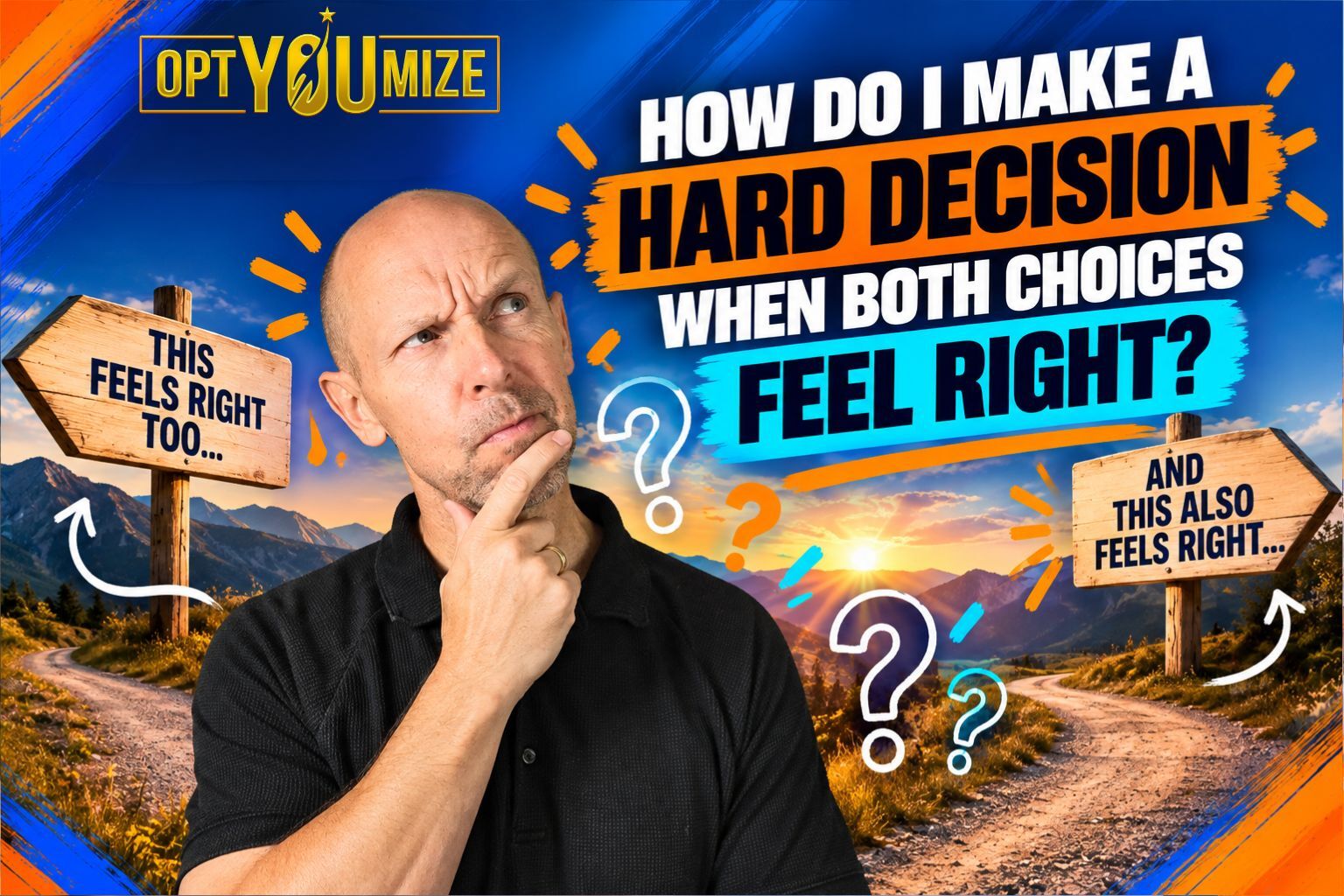
How to Make a Hard Decision When Both Choices Are Good
~22 min | October 9, 2026
When both choices are good, you're facing what philosopher Ruth Chang calls options that are "on a par": each better in some ways, neither better overall. No further analysis can break that tie, because there is no hidden right answer to find. In this solo episode, Brett Ingram explains why the pros-and-cons list won't tip, how to tell a genuinely hard choice from an easy one you're avoiding, and how to move from asking "which is better?" to "who do I want to become?"
What You'll Learn in This Episode
- Why a decision that won't tip is information, not failure: you've reached the edge of what calculation can do
- Ruth Chang's "on a par" idea, and why more spreadsheets and conversations can't rank genuinely matched options
- The sorting question: a genuinely hard choice needs commitment, while an avoided easy choice needs courage
- Why the question changes from "which is better?" to "which do I want to put myself behind?"
- Three questions for a hard choice: hard or avoided, what am I actually afraid of, and which choice asks me to become someone I'd respect
- Why certainty comes after you commit, and what affective forecasting and the maximizer research say about regret
- Two-way doors vs. one-way doors: when to decide fast and when to slow down
- The provisional yes: a few days of living inside a decision, and how to tell nerves from dread
Episode Timestamps
[00:00]The decision that won't tip[01:00]Introduction[01:30]The trap: treating good vs. good like a problem to solve[03:45]The "correct decision" model and where it fails[04:45]Ruth Chang and options that are "on a par"[06:45]Hard choice or avoided easy choice?[08:00]A risky job, the safe route, and the regret[09:00]Pros-and-cons lists as procrastination[10:00]From "which is better" to "who do I become?"[11:30]Why you can't pick wrong: Sliding Doors[12:30]Three questions for a genuinely hard choice[14:15]Commit first, certainty follows[15:00]Affective forecasting and the maximizer trap[16:00]Two-way doors vs. one-way doors[17:00]Boldness regrets and allowing yourself to grieve[18:15]The provisional yes: your practice this week[19:30]Nerves vs. dread[20:30]Pick up the pen[21:00]Key takeaways and closing
Episode Summary
Here's a strange thing about the biggest decisions of your life: the ones that keep you up at night are almost never the ones where you don't know the right answer. They're the ones where there may not be a right answer, and some part of you already suspects it. You've made the list, pros on one side and cons on the other, so many times the paper has a crease, and it still won't tip. Brett Ingram opens with a question that sounds backward. What if being unable to decide isn't a sign you haven't thought hard enough, but a sign you've thought as hard as thinking can go?
He starts by naming the trap. When two options are both real and both good, we treat the decision like a problem to be solved, as if the correct answer is out there and our job is to find it before we move. So we gather more information, ask more people and run the numbers again, and end up in the same place, a little more tired. The quieter cost is that being stuck begins to feel like a character flaw, as though everyone else just knows. But good versus bad is easy. When you can argue every side convincingly, there's no better choice to find, and that's true whether it's a safe job versus a risky dream, one city versus another, or staying versus leaving something that's fine for something unknown.
The reason, Brett explains, is that we've inherited one dominant model of decision-making: a good decision is a correct decision, and a smart person finds the best option by measuring, comparing and ranking. It's the engineering mindset applied to a human life, and it works for plenty of choices. It fails on the ones that matter most. Philosopher Ruth Chang, who gave a now-famous talk on hard choices in 2014 and has since become a professor at Oxford, puts her finger on the error: we assume the world always holds the answer to what we should do. In a genuinely hard choice, she argues, the options are on a par. Each is better in some ways and worse in others, neither is better overall, and they aren't exactly equal either. They're different kinds of good. If that's true, there's no further fact waiting to break the tie, and the spreadsheet and the tenth conversation can't find what isn't there. Brett compares it to ranking athletes across eras: you can compare them statistically a hundred ways and still never place them on one scale you feel complete about.
Before going further, Brett adds a necessary caution, because this idea can be misused. Not every stuck decision is a genuine good versus good. Sometimes one option really is better, and the reason you can't decide is that you don't want to do the thing you already know is right. So the first question is whether this is a hard choice or an easy choice you're avoiding. They need opposite medicine: a genuine hard choice needs commitment, and an avoided easy choice needs courage. Give a courage problem more analysis and you'll just build a more sophisticated hiding place. Brett shares his own story here. Early in his career he faced a risky opportunity that didn't pay well but had a high upside, against a safer route close to home. He chose the safe one and says plainly that he regrets it. The elaborate pros-and-cons spreadsheet, he suggests, may be the world's most respectable procrastination tool.
If the choice really is on a par, the heart of the episode is a shift in the question. It stops being which one is better, because that has no answer, and becomes which one do I want to put myself behind? Chang says that in hard choices, we get to create reasons. By committing to a path, you create reasons for yourself to be one kind of person rather than another, which is how we become the authors of our own lives. A hard choice isn't a place where you're weak because you can't find the answer. It's a place where the world has stepped back and handed you the pen. It also takes the sting out of "what if I pick wrong?", which secretly assumes there's a right answer you could betray. If the paths are on a par, you can't pick wrong. You can only pick, and make it right by how you live it. That's the relief, and it's also a dare. The road you didn't take stays perfect only because you never had to live its ordinary Tuesdays, the point of the Sliding Doors idea.
To make it usable, Brett offers three questions that move you from searching to authoring. First, is this a hard choice or an avoided one? Second, what am I actually afraid of? It's usually not choosing wrong but something more specific: losing the other life, regret, or being blamed if it goes badly. Say it in plain words, because fears shrink when they have to be specific. Third, which choice asks me to become someone I'd respect? One of your two good options is almost always pulling you toward a version of yourself you quietly admire, and that pull is the closest thing to a compass you'll get. Then comes the part that finishes it: put yourself behind the choice. A decision isn't made in the moment you pick. It's made in the weeks after, when you stop keeping the other door cracked open. You don't feel certain and then commit. It runs the other way, and the sureness grows into the space you made for it.
Two bodies of research help with the fear. Psychologists Daniel Gilbert and Tim Wilson's work on affective forecasting shows we overestimate how much and how long an outcome will change how we feel, so the catastrophe you're bracing for on the wrong path is usually milder and shorter than imagined. And Barry Schwartz found that maximizers, who need the absolute best option, tend to end up less satisfied and more prone to regret than satisficers, who choose something genuinely good and move on. On a par, good enough isn't a compromise. It's wisdom. There's a guardrail, too: this isn't "every option is fine, close your eyes and jump." Borrowing Jeff Bezos's language, a two-way door can be walked back through and should be decided quickly, since deliberating over a reversible choice is anxiety wearing a suit. A one-way door deserves your patience, and the three questions are for those. Expect to keep wondering about the road you didn't take. That's the price of being a person who can imagine, not proof you chose wrong. Daniel Pink's survey of more than 26,000 people found boldness regrets, the chances people didn't take, among the biggest categories. And a path that gets hard isn't a wrong choice. Hard is the texture of every real path, and grief at giving up the other good thing is allowed.
The practice is the provisional yes. Pick one path on paper, not forever, as an experiment. For three or four days, live as if it's final: don't reopen it, don't rerun the list, and talk about it as settled. Don't monitor whether you feel certain, because certainty is the wrong instrument. Notice whether you feel more like yourself or less, whether your chest loosens or tightens. If the provisional yes brings a quiet settling, commit for real and start building. If it brings steady dread, flip it and give the other path its own few days. Nerves are excitement about something that matters and sit alongside a pull toward the thing, the way performers and athletes feel before going on. Dread pulls you away. This is lived data instead of imagined data, on a question imagined data could never settle, and it fits inside an ordinary week. It's also a practical way into becoming the person you actually want to be.
Brett closes where he began, at the fork with the list in hand. If the paths are genuinely good, the scale was never going to tip, and that's the nature of the choice, not your failure. "The right answer isn't out there waiting to be found. You make it right by the way you live it."
Resources Mentioned
- Ruth Chang — philosopher (now Professor of Jurisprudence at Oxford) whose "on a par" framework for hard choices anchors the episode; see her TED talk "How to Make Hard Choices" (2014) — ted.com
- Daniel Gilbert and Timothy Wilson — psychologists behind affective forecasting research; Gilbert's Stumbling on Happiness (2006)
- Barry Schwartz — maximizers vs. satisficers; The Paradox of Choice (2004)
- Jeff Bezos — two-way and one-way doors, from his Amazon shareholder letters
- Daniel Pink — The Power of Regret (2022), based on his World Regret Survey of 26,000+ people
- Sliding Doors (1998) — film about one ordinary choice splitting a life into two versions
Frequently Asked Questions
How do I make a hard decision when both options are good? First check that the choice is genuinely hard and not an easy one you're avoiding. If the options really are on a par, more analysis won't rank them, so shift from "which is better?" to "which path can I commit to and build a life behind?" Then choose, and stop keeping the other door cracked open.
Why can't I make a decision even when I have all the information? When two options are each better in some ways and neither is better overall, there is no hidden fact left to find. Being unable to decide can mean you've thought as far as thinking goes, not that you haven't thought enough.
What does "on a par" mean? It's philosopher Ruth Chang's term for options that are comparable in value but not rankable: each is better in some ways and worse in others, and neither is better overall. They aren't exactly equal. They're different kinds of good.
How do I know if it's a hard choice or one I'm avoiding? Ask whether you could still not rank the options if you were brave, had nothing to lose and nobody would judge you. If one clearly wins and you dread doing it, you're avoiding an easy choice, and what you need is courage. If both still look good, it's a genuine hard choice, and what you need is commitment.
How do I know if I'm making the right choice? With genuinely matched options, you can't pick wrong in the sense of betraying a right answer. You pick, then make it right by how you live it. Ask which choice asks you to become someone you'd respect, and try the provisional yes: live as if you've chosen for a few days and notice whether you feel settled or dread.
How do I stop regretting the choice I didn't make? Expect to keep wondering about it. That's the price of being a person who can imagine, and it doesn't mean you chose wrong. Research on affective forecasting suggests outcomes hurt less and for a shorter time than we predict, and a path that gets hard isn't the same as a wrong one.
What's the difference between nerves and dread? Nerves are excitement about something that matters and usually sit alongside a pull toward it. Dread pulls you away. Both can make you shake, but they point in opposite directions, and a steady sinking dread during the provisional yes is a signal to try the other path.
What are two-way and one-way doors? It's Jeff Bezos's distinction. A two-way door is a reversible decision you can walk back through, so decide quickly. A one-way door is hard or impossible to undo and deserves patience. The three questions in this episode are for one-way doors.
Keep Exploring
If this episode resonated, these are worth your time:
- Growth & Self-Becoming — the pillar behind this episode, on who you're turning into and how to choose it on purpose → optyoumize.com/growth-self-becoming
- Can People Really Change? — on whether the person you're deciding to become is one you can actually build → optyoumize.com/blog/podcast/can-people-really-change
- Why Does Reaching Your Goals Feel Empty? — when the path you chose delivers less than you expected → optyoumize.com/blog/podcast/why-does-reaching-your-goals-feel-empty
Enjoyed This Episode?
The best way to support optYOUmize is to subscribe and leave a review — it takes about two minutes and makes a real difference in helping more people find the show.
Apple Podcasts · Spotify · Amazon Music · YouTube