
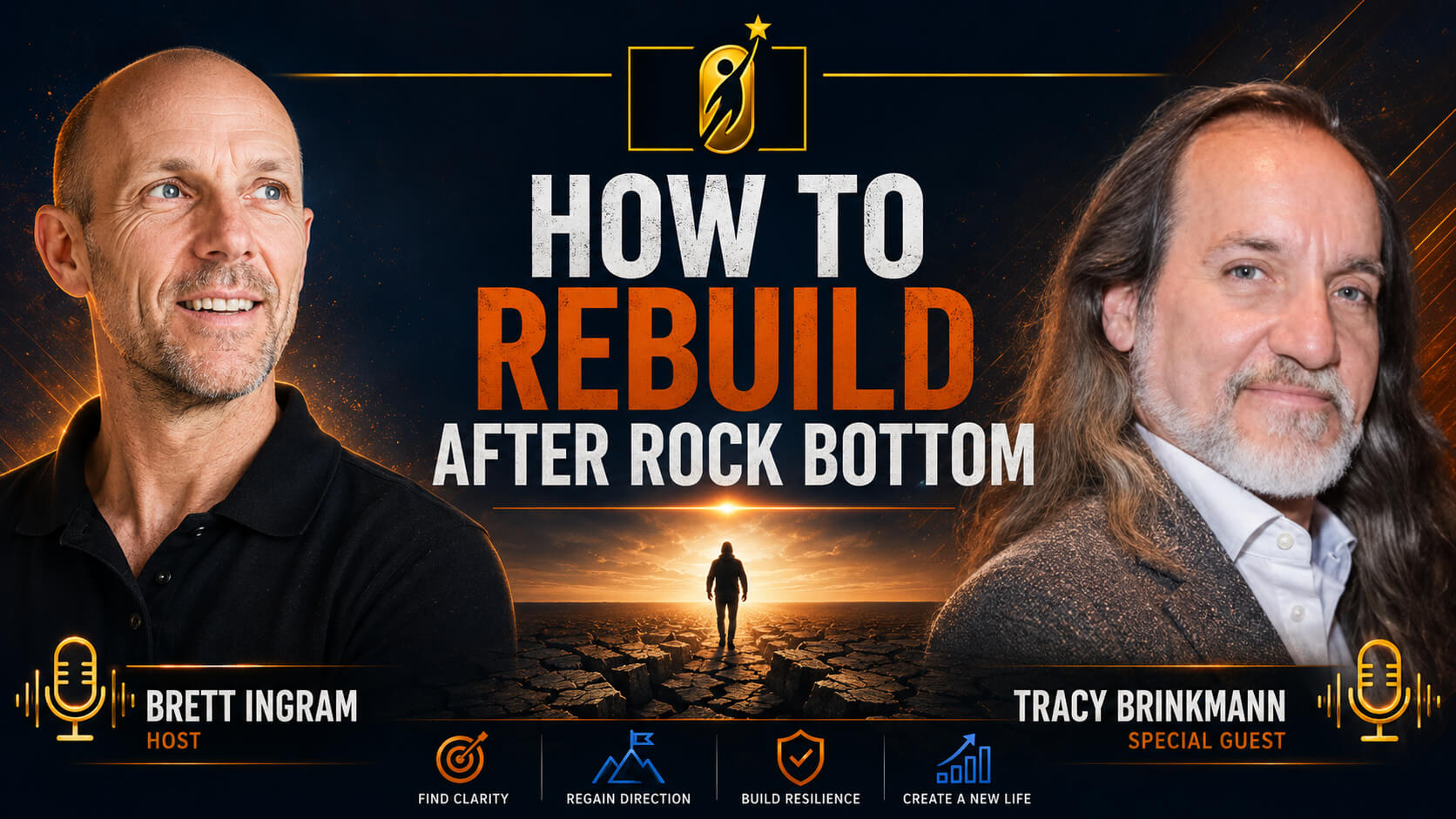
How to Rebuild After Rock Bottom: Tracy Brinkmann on Resilience, Mindset, and Starting Over
~58 min | January 13, 2025
Tracy Brinkmann has hit rock bottom not once, but three times — and rebuilt himself each time. His story moves from drug addiction and a police raid, to the death of his 18-month-old daughter, to a simultaneous divorce and bankruptcy that briefly silenced his podcast and nearly his voice. What carried him through each time wasn't a system or a strategy — it was the willingness to do the inner work before the outer work, to ask better questions instead of better plans, and to keep showing up honestly even when it felt fraudulent to do so. In this conversation, Tracy shares the frameworks and hard-won insights that now form the foundation of his coaching practice.
What You'll Learn in This Episode
- Why you can't separate yourself from a destructive lifestyle without fully changing your environment — and why "swimming in the same pond" makes recovery nearly impossible
- How losing his daughter Krista became the catalyst that launched Tracy's personal development journey and, eventually, his coaching career
- Why imposter syndrome silenced Tracy's podcast during his hardest season — and what he now knows he should have done instead
- The mindset shift that changes everything: asking "how can I?" instead of "why can't I?" — and why your brain responds to questions differently than statements
- The difference between time management and time allocation — and why most people have more time than they think, just misplaced
- The 15-minute strategy for making progress on a goal without needing large blocks of uninterrupted time
- How to use free content like a "dog whistle" — targeting the exact person you want to reach rather than shouting into a crowd
- The Bruce Lee principle that Tracy says he's lived his entire life by — and why it may be the best framework for authentic success
About Tracy Brinkmann
Tracy Brinkmann is a business and success coach, podcast host, product creator, and podcast production company owner whose coaching philosophy was forged through genuine adversity rather than theory. After navigating three major life crises — each of which could have ended his career before it started — he channeled his experience with personal development into a coaching practice and podcast focused on helping entrepreneurs, particularly parents building businesses alongside family life, create sustainable momentum without sacrificing what matters most.
Connect with Tracy:
- Website: darkhorseschooling.com
- Newsletter: darkhorseschooling.com/newsletter
- Free Resource: Side Hustler's Blueprint Audio Series
- Podcast: Dark Horse Entrepreneur
Episode Timestamps
00:00Introduction00:41Tracy's background: a military upbringing and landing in unstructured Southern California01:25Dip #1 — How a programming business led to drug use, a police raid, and the moment that changed everything07:50Dip #2 — Daughter Krista's illness, the transplant wait, and saying goodbye12:11Dip #3 — Divorce, bankruptcy, and the imposter syndrome that silenced the podcast15:15Why sharing your struggles builds credibility rather than destroying it20:11Mindset as foundation: how asking better questions rewires what's possible26:09Time allocation vs. time management — and how to find time you didn't think you had35:55Free content, niche targeting, and the "dog whistle" approach to audience building43:14Facebook video retargeting, lookalike audiences, and letting algorithms do the work56:11Tracy's #1 tip for entrepreneurs: the Bruce Lee principle for authentic success
Episode Summary
Some people arrive at a life philosophy through books and seminars. Tracy Brinkmann arrived at his through three distinct points at which his life effectively fell apart — and the slow, deliberate work of rebuilding each time.
The first collapse came during what should have been a triumph. Tracy had launched a database programming company, landed a significant client, and gone out to celebrate. Someone introduced him to methamphetamines as a productivity solution. What started as a way to get more work done became an addiction, then a business supporting the addiction, then a morning when police tape stretched across his condo. Tracy wasn't home when they kicked the door in. But he was there for the detectives who came back — and he was walking home from a holding cell, alone, when he heard his father's voice: family first. He had a three-month-old daughter. He called his parents that night.
"You can't extricate yourself from alcohol, drugs, whatever vice is pulling you down and still swim in the same pond," Tracy says. He removed himself completely — from the people, the environment, and the identity that had built up around it. He spent time doing warehouse work and temp accounting jobs, deliberately building his confidence back before stepping into anything that required trust. That patience — doing the inner work before demanding outer results — became a recurring motif in everything that followed.
The second collapse arrived without warning. His second daughter, Krista, was born a month early with a condition requiring a liver and small bowel transplant. In her first three months she had six major operations. For eighteen months, Tracy flew between Atlanta, where he worked at Coca-Cola headquarters, and Pittsburgh, where the specialists were. One weekend, he couldn't make her smile. He pulled her doctor into a hallway, then a janitor's closet, and finally got an honest answer: she would not survive the transplant. He made the decision to disconnect life support. He wrapped her in her blanket, rocked her to sleep, and told her everything he wanted her to know.
"It was a blessing and a curse," he says. "The blessing was I had the opportunity to tell her everything I wanted to tell her."
He didn't slip back into drugs. Instead, he threw himself into personal development — Zig Ziglar, Jim Rohn, Tony Robbins, anyone who was making the circuit. Not passively, but actively: taking notes, paying for one-on-one time, then taking action on what he learned. Within three years at Coca-Cola, he had received five promotions. People started asking what he was doing. That became the beginning of his coaching career.
The third collapse was quieter but no less real: a painful divorce and bankruptcy arriving simultaneously, just as he had built a personal development podcast with a genuine following. One night, sitting down to record, he stopped. You're a poser. You're on the microphone telling people how to have an amazing life while yours is falling apart. He hung up his headphones and didn't record for two years.
He knows now what he wishes he'd done differently. "I should have kept talking and just opened the curtain and said, here's what I'm going through. People probably would have appreciated it a whole lot more." The willingness to share the process — including the hard seasons — is what builds real trust with an audience. Performing a finished version of yourself keeps people at arm's length.
Much of the conversation turns on mindset — specifically, on the quality of the questions we ask ourselves. Tracy draws a sharp distinction between questions that generate movement and questions that generate shame. "Why am I so damn fat?" produces a defensive answer. "How can I build the physique I dream of?" gets your brain working toward something. The mind, Tracy argues, doesn't reliably distinguish between what's real and what you're vividly imagining — which means the questions you habitually ask are, in a meaningful sense, shaping the reality you experience.
On time, he pushes back on the conventional framing entirely. The problem isn't that people don't have enough time — it's that they haven't honestly examined how they're allocating what they have. The 15-minute strategy he describes is less a time hack than a psychological reframe: reduce the task to something small enough that resistance drops, begin, and let momentum do what it does. This is part of the patient, honest work of becoming more fully yourself — not a dramatic transformation, but a series of small commitments that compound.
He closes with the principle he says has guided his life since he read it as a teenager in Bruce Lee's Tao of Jeet Kune Do: absorb what is useful, discard the rest, and add what is uniquely you. Most people quote the first two lines. The third, Tracy says, is the one that matters most.
Resources Mentioned
- Tao of Jeet Kune Do by Bruce Lee — The martial arts philosophy book Tracy references as a lifelong guide; contains the "absorb what is useful" principle he closes the episode with — Find it here
- Tony Robbins / Anthony Robbins — Motivational speaker and coach Tracy credits as a major early influence; referenced a specific event in Atlanta — tonyrobbins.com
- Zig Ziglar — Author and motivational speaker Tracy lists among the formative voices in his personal development journey
- Jim Rohn — Entrepreneur and author Tracy credits alongside Ziglar and Robbins as shaping his early development work
- Blow (2001 film) — Referenced for timeline and geographic context of Tracy's early story in Southern California
- Miracle (2004 film) — Brett references this film during a discussion of the 1980 US Olympic hockey team; Jim Craig, the team's goalie, is cited as a speaker Brett heard at a corporate event
- Dark Horse Entrepreneur Podcast — Tracy's podcast, focused on entrepreneurial parents building businesses alongside family life — available on all major podcast platforms
- Side Hustler's Blueprint — Free private audio series from Tracy, designed to help turn passions into profitable ventures — darkhorseschooling.com/blueprint
- darkhorseschooling.com/newsletter — Weekly marketing tips from Tracy; focuses on practical strategies for online entrepreneurs
Frequently Asked Questions
How do you rebuild your life after hitting rock bottom? Tracy Brinkmann's experience across three major life collapses points to a consistent pattern: you have to fully change your environment, not just your intentions. Staying in the same social and physical context while trying to change your behavior rarely works. After removing yourself from what's pulling you down, the rebuild tends to start with small, low-stakes confidence-building — not dramatic reinvention — before gradually expanding into bigger commitments. The inner work, he argues, has to come before the outer work.
What is the difference between time management and time allocation? Time management implies there isn't enough time and that the goal is to squeeze more out of what exists. Time allocation starts from the premise that most people already have more time than they think — they just haven't examined honestly where it's going. Tracy recommends tracking everything you do across three days to surface the gaps. The 15-minute strategy follows from this: instead of waiting for a large uninterrupted block, identify small underused pockets of time and assign them to one specific task that moves you toward a goal.
How do you deal with imposter syndrome as a podcast host or content creator? Tracy stopped recording his podcast for nearly two years after feeling like a fraud while going through divorce and bankruptcy — only to realize later that sharing the difficult season openly would have built more trust, not less. His advice: don't perform a finished version of yourself. Audiences connect with the honest process, including the hard parts. Imposter syndrome often signals that you're holding yourself to a standard of completion that your audience never asked for.
How does asking better questions improve your mindset? Your brain treats questions as instructions. A question like "why can't I do this?" generates answers that confirm the limitation. A question like "how could I make this work?" directs your attention toward possibilities. Tracy describes visualizing himself on stage in front of thousands during a Tony Robbins event — not as a fantasy, but as a genuine question about what would need to be true. The mind, he argues, doesn't reliably distinguish between a vividly imagined scenario and a real one, which means the questions you habitually ask are shaping what feels possible.
What is the 15-minute strategy, and why does it work? The 15-minute strategy is a way to reduce the psychological resistance to starting a task. Instead of committing to an hour or more of focused work, you tell yourself the task only requires 15 minutes. This lowers the barrier enough that you begin. Once you're in it and engaged, most people continue well beyond 15 minutes — not because they forced themselves to, but because momentum replaced resistance. The real function of the strategy is getting started, not limiting time.
What does "absorb what is useful, discard the rest, and add what is uniquely you" mean in practice? This is Bruce Lee's principle from Tao of Jeet Kune Do, which Tracy cites as a lifelong guide. Most people quote the first two lines. The third — add what is uniquely you — is the one Tracy emphasizes. The principle means: go learn from the best coaches, mentors, and teachers available. Take what applies to your situation. Let go of what doesn't. But don't stop there and try to become a version of someone else. The final step is adapting everything through the filter of your own experience, values, and voice. The goal isn't to be a better Brett Ingram or a better Gary Vee. It's to be a more fully developed version of yourself.
Why is being authentic about your struggles better for your audience than projecting success? Because people connect with process, not performance. Tracy's decision to stop podcasting came from the belief that his credibility depended on having things figured out. What he learned was the opposite: an audience watching someone navigate a genuinely hard season in real time — honestly, without pretending — trusts that person far more than someone presenting a polished highlight reel. Shared struggle is one of the most reliable foundations for real connection.
Keep Exploring
If this episode resonated, these are worth your time:
- Growth & Self-Becoming — Tracy's arc across three life collapses is a case study in what genuine, non-linear personal growth actually looks like. This pillar explores the deeper framework.
- Mind & Inner Life — The mindset section of this conversation — asking better questions, the relationship between inner narratives and outer results — goes deeper in this guide.
- Purpose & Meaningful Work — Tracy's path from rock bottom to a coaching career he finds genuinely meaningful connects directly to the questions explored in this pillar.
Enjoyed This Episode?
The best way to support optYOUmize is to subscribe and leave a review — it takes about two minutes and makes a real difference in helping more people find the show.
Apple Podcasts · Spotify · Amazon Music · YouTube