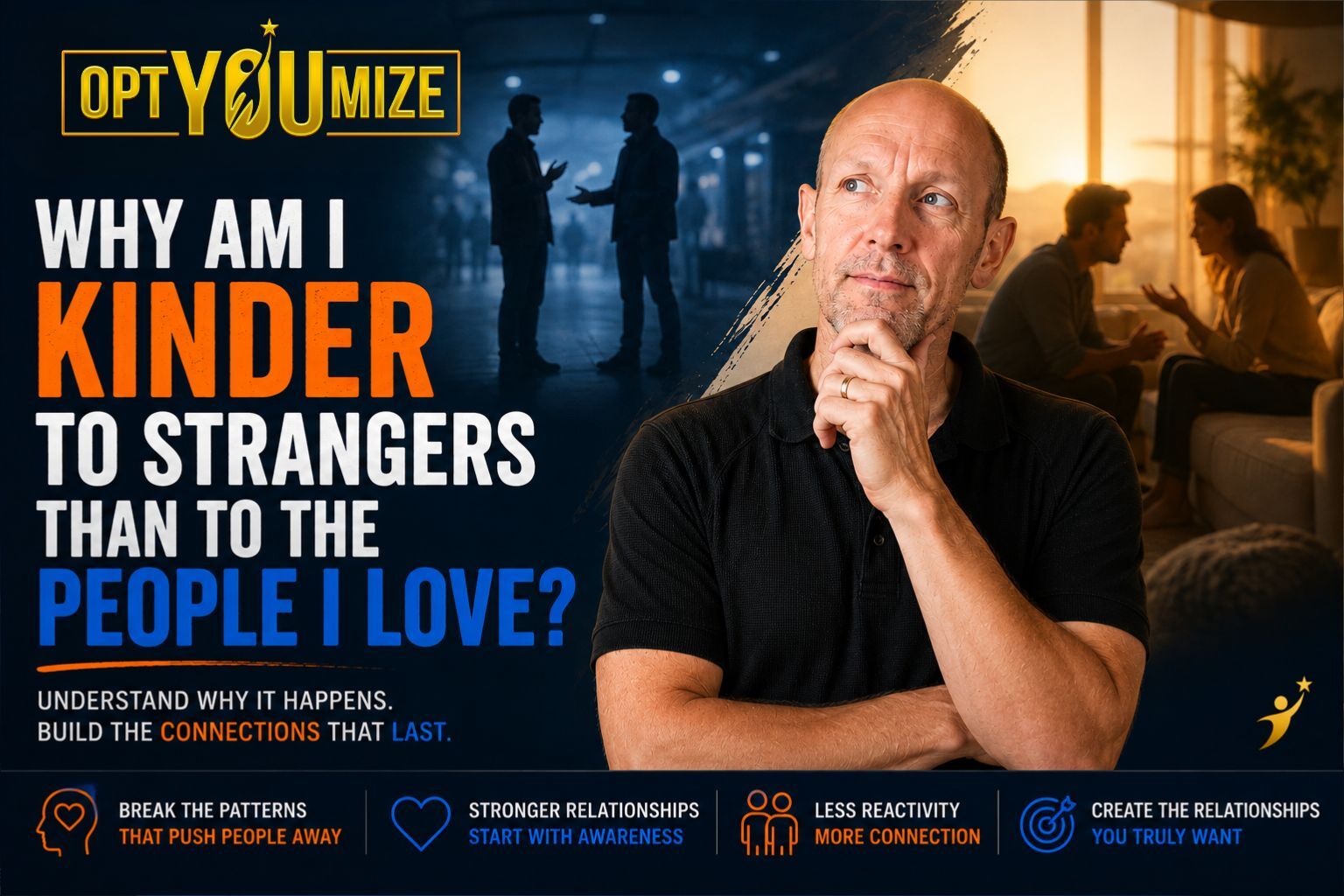
Why Am I Kinder to Strangers Than to the People I Love?
~20 min | August 19, 2026
You're not a hypocrite for being patient with strangers and short with the people you love — you're depleted. This episode breaks down the three real forces behind that pattern: the emotional labor of managing your face and tone all day, the way unresolved frustration gets displaced onto safer targets, and the deeper truth that the people closest to you get your worst moments partly because they're the one place you feel safe enough to stop performing. Brett Ingram introduces "the threshold" — a single conscious pause between your outer life and the people you love — as the practical alternative to just trying harder to be nice at the door.
What You'll Learn in This Episode
- Why you spend your best patience on strangers who mean nothing to you, while the people you love get the leftovers
- What "emotional labor" actually is, and why faking calm all day drains the same tank you need at home
- The psychology of displaced aggression — why a small thing at home (a dish, a lost set of keys) can trigger a reaction wildly out of proportion to the moment
- The real reason the people you love get your worst side: because they're safe, not because you love them less
- Why the standard advice — "just be more patient at home" — quietly makes the pattern worse
- The "threshold" — a single conscious pause between your day and your door, and why it works better than willpower
- A simple 10-second practice, and three reflection questions, to start changing the pattern this week
Episode Timestamps
[00:00]The moment at the door: kind to strangers, sharp with the people you love[01:00]Introducing optYOUmize and today's question[02:00]The quiet shame nobody talks about — and why it happens to good, loving people[03:00]Three real forces at work, and why they stack[04:00]Force #1: Emotional labor and the limited supply of "managing yourself"[07:00]Force #2: Displaced aggression — the psychology of kicking the dog[08:00]Force #3: Why safety, not love, explains the pattern[10:00]Why "just be more patient at home" backfires[12:00]The threshold: making the crossing from world to home conscious[15:00]The practice: the threshold pause and three reflection questions[17:00]The caveats — this isn't a pass for harm, and when the real problem is upstream[19:00]Closing: what to carry out of this episode
Episode Summary
Most people who snap at the people they love aren't cruel — they're the ones who held it together all day for everyone else. That's the paradox at the center of this episode: the same person who was gracious with a difficult coworker, patient with a stranger who took their parking spot, and warm in an email they didn't feel like writing can walk through their own front door and go flat, sharp, or gone the moment someone they love asks an ordinary question. Brett Ingram argues this isn't a character flaw. It's the predictable result of three forces stacking on top of each other, and understanding them changes what you actually do about it.
The first force is emotional labor — a term the sociologist Arlie Hochschild coined in 1983 for the work of managing your feelings to match what a situation demands: the customer service voice, the meeting face, the "I'm fine" you say a dozen times before lunch. That management draws on a real, limited supply. Research on "surface acting" — performing an emotion you don't actually feel — has found it genuinely depletes people, and that depletion spills over: a day of faking it at work has been linked to more tension and less warmth at home that same night. You didn't run out of love. You ran out of regulation.
The second force is displaced aggression — the psychological version of kicking the dog. When you're provoked somewhere you can't respond (you can't snap at your boss, you can't yell at traffic), the frustration doesn't disappear. It waits for a safer target. A 2000 meta-analysis by Amy Marcus-Newhall and colleagues confirmed this is a real, reliable effect — and found that displacement lands hardest when a small thing at home adds a spark to frustration you were already carrying in from somewhere else. The person at home didn't start the fire. They just struck the match.
The third force is the one that reframes the whole pattern: safety. Drawing on attachment researchers John Bowlby and Mary Ainsworth, Brett describes the people closest to you as a "safe haven" — the one place you're allowed to stop performing. That's the entire point of intimacy. But the same safety that lets you finally exhale is also the safety that makes home the place you leak your unmanaged, depleted self. The people getting your worst are getting it partly because you trust them not to leave.
That reframe is also why the standard advice — just be more patient at home — makes things worse. It asks you to add one more room of performance to a tank that's already empty. Instead, Brett introduces the threshold: a single conscious pause, wherever it fits your day, between the world and the people you love. One honest question — "what am I carrying, and do I want to hand it to them?" — turns an automatic crossing into a deliberate one. It's not a program or an app. It's ten seconds, once a day, at whatever boundary works for you: the last stretch of the commute, the hand on the front door, the moment you close the laptop.
Brett is careful to draw two lines around this idea. First, this isn't permission to perform calm or swallow real feelings — sharing that you're depleted is connection; dumping it on someone is collateral damage. Second, "I was tired" explains a short tone, but it never excuses cruelty, contempt, or anything that makes home unsafe for the people in it. And if you're chronically arriving at zero, the pause at the door won't fix a life that's structurally over capacity — that's a different, upstream conversation about what you've said yes to.
Resources Mentioned
- Arlie Hochschild — Sociologist who coined the term "emotional labor" in 1983 to describe the work of managing feelings to fit social expectations
- Amy Marcus-Newhall et al., 2000 meta-analysis — Research review confirming displaced aggression as a real, reliable psychological effect
- John Bowlby & Mary Ainsworth — Attachment researchers whose work on the "safe haven" concept underlies the episode's third force
- Everything Everywhere All at Once — Film referenced for the character Waymond's line on kindness as a strategy, not a weakness
Frequently Asked Questions
Why am I kinder to strangers than to my own family? It's usually not about loving your family less — it's about depletion. By the time you reach the people you love, you may have already spent the day's supply of patience managing your face, tone, and reactions for people who mean nothing to you. The people closest to you also feel safe enough that you stop performing around them, which means your unmanaged, tired self shows up there first.
What is emotional labor, and why does it drain me before I even get home? Emotional labor, a term coined by sociologist Arlie Hochschild in 1983, is the work of managing your feelings to match what a situation demands — the customer service voice, the meeting face, saying "I'm fine" when you're not. That management runs on a limited supply, and research on "surface acting" shows the exhaustion spills over into evenings at home, even though the cause has nothing to do with the people there.
Why does a small thing at home, like a sink full of dishes, trigger such a big reaction? This is displaced aggression: frustration from somewhere you couldn't respond — a boss, traffic, a bad meeting — waits and comes out later on a safer target. A 2000 meta-analysis found the displacement lands hardest when a small irritation at home adds a spark to frustration you were already carrying. The dish isn't the real source of the reaction; it's just what happened to be there.
Why do the people I love the most get my worst moments? Because they're safe. Attachment research describes close relationships as a "safe haven" — the one place you're allowed to stop performing and exhale. That safety is what makes intimacy possible, but it's also what makes home the place your depleted, unfiltered self leaks out. It's not that you love them less; it's that you trust them not to leave.
Why doesn't "just be more patient at home" work as advice? Because it asks you to add more emotional labor and performance exactly where your tank is already empty — the one room that was supposed to be where you could take the mask off. It also feeds a guilt spiral: snapping leads to shame, and shame depletes you further, making you shorter next time, not kinder.
What is the "threshold," and how do I actually practice it? The threshold is a conscious pause, wherever it fits your day — the last stretch of a commute, the hand on the front door, closing your laptop — between your outer life and the people you love. The practice is simple: at that boundary, take ten seconds and ask, "What am I carrying, and do I want to hand it to them?" It's not a program; it's one question that turns an automatic crossing into a deliberate one.
Is this pattern ever a bigger problem than just a hard day? Yes. Being tired explains a short tone, but it doesn't excuse cruelty, contempt, or anything that makes the people you live with feel unsafe — that's a different conversation. And if you're chronically arriving at zero, the threshold pause alone won't fix a life that's structurally over capacity; the real work may be upstream, in what you've said yes to.
Keep Exploring
If this episode resonated, these are worth your time:
- Relationships & Connection pillar page — Go deeper on how optYOUmize thinks about the people closest to you and the patterns that quietly shape those relationships
Enjoyed This Episode?
The best way to support optYOUmize is to subscribe and leave a review — it takes about two minutes and makes a real difference in helping more people find the show.
Apple Podcasts · Spotify · Amazon Music · YouTube