





Summary:
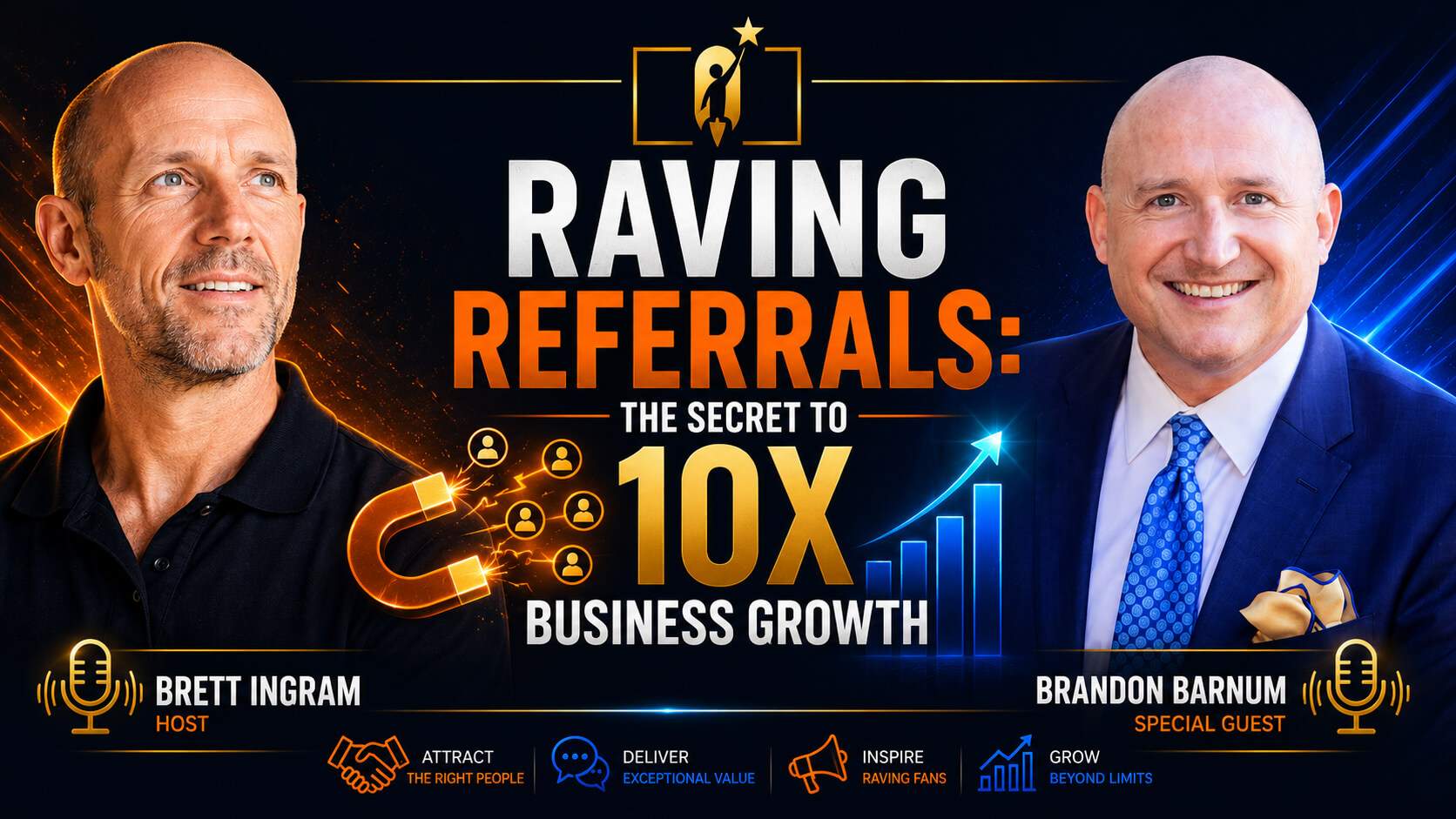
Join host Brett Ingram as he interviews Brandon Barnum, CEO of hoa.com and "The King of Referrals," to uncover proven strategies for building a thriving business through networking and referrals. Brandon shares how he 10x'd his income from $20,000 to $200,000 in just 18 months using referral-based marketing in the mortgage industry.
In this episode, you'll discover the three-step "Art of the Ask" framework for getting referrals without feeling pushy, why 84% of B2B sales start with referrals, and how to build strategic partnerships with complementary businesses. Brandon reveals common networking mistakes entrepreneurs make, explains the Bank Code personality system for better communication, and shares practical tactics for following up with referral partners to maximize long-term results.
Whether you're in real estate, consulting, or any service-based business, this conversation delivers actionable insights on replacing expensive lead generation with relationship-driven growth strategies that feel authentic and sustainable.
Timestamped Chapter List :
[00:00] Introduction - Meet Brandon Barnum, the King of Referrals
[02:45] Brandon's Background - From Struggling Single Dad to Six-Figure Success
[06:30] Why Referrals? - Asking Top Producers for Their Success Secrets
[10:15] The Biggest Networking Mistakes Entrepreneurs Make
[14:20] Building Strategic Referral Partnerships with Complementary Businesses
[18:45] The Power of Warm Leads vs. Cold Traffic
[21:30] The Art of the Ask - Three Steps to Getting Referrals Comfortably
[26:10] Setting the Stage for Future Referrals
[28:40] Communication Shortcuts - Using Bank Code Personality System
[32:15] Finding Clients Without Spending Money on Leads
[34:50] The "Magic Trick" That Opens Doors and Builds Rapport
[38:20] Serving vs. Selling - The Mindset Shift That Changes Everything
[41:30] Creating Your Referral Kit and Making It Easy to Refer You
[44:15] The Thank You Card System That Transformed Brandon's Business
[48:00] Following Up with Referral Partners - Building Trust Through Updates
[51:20] Influencer Marketing and Online Connections
[54:10] The Future of Business Relationships in an AI-Driven World
[57:30] Brandon's #1 Success Tip - Living by Design, Not by Default
Key Takeaways :
• Referrals convert 400% better than cold leads, and 84% of B2B sales start with a referral
• The Art of the Ask framework: (1) Set the stage upfront, (2) Listen for referral triggers, (3) Ask at the right time in the right way
• Only 2% of professionals have 10+ referral partners sending them at least one deal per quarter - most entrepreneurs operate as "lone wolves"
• Partner with complementary businesses that already serve your ideal clients (realtors with mortgage brokers, accountants with financial planners, etc.)
• Set expectations immediately - When a client signs, ask: "Once I've proven myself with five-star service, would it be okay if I ask for referrals?" (100% say yes)
• Listen for referral triggers like "thank you," "this is amazing," or expressions of gratitude - these signal peak referral state
• Always thank referral partners immediately with a handwritten card, then follow up with updates on what happened with their referral
• Use the Bank Code personality system to quickly identify communication styles and adapt your approach (action-oriented vs. detail-focused)
• Create a referral kit with brochures, gift certificates, or rack cards that make it easy for partners to refer you
• Focus on being interested, not interesting - Ask questions and genuinely care about the other person's challenges and goals
• Build relationships with a service mindset rather than commission-driven sales energy that pushes people away
• Get crystal clear on your goals - Brandon has written goals through 2050 and emphasizes living by design rather than by default
Episode Transcript:
The Art of Referrals - How to 10X Your Income Through Strategic Relationships
Master referral marketing strategies, business networking tips, and learn how to get referrals that transform your entrepreneurial success.
Episode Introduction
Brett Ingram: Hey everybody, this is Brett Ingram. This is The Optimized podcast, the show that helps entrepreneurs build their dream business and dream life. Today we're talking with Brandon Barnum, CEO of hoa.com. He's known as the King of Referrals and is an award-winning entrepreneur, speaker, and visionary leader devoted to helping people thrive through connection and community.
So the big question is: how are entrepreneurs like us who have too much to do in too little time able to build both the business and the life of our dreams? That's the question, and on this podcast, we'll explore the journey to the answer. My name is Brett Ingram, entrepreneur and award-winning product creator. I chose to build a business and have time for a personal life, and I want to help you do the same. Welcome to Optimize.
The Power of Connection in Business
Brett: I'm personally super excited about this because I really believe in the power and importance of making connections. Building business relationships helps us get to where we're going a lot faster and a lot easier. You can help other people at the same time and have a lot more fun along the way. So with that, welcome and thanks a lot for joining us, Brandon.
Brandon Barnum: I appreciate it, Brett. Thanks for having me. This is going to be fun. I'm looking forward to it.
Brett: I've had a lot of things that I wanted to talk to you about. I'm glad we were finally able to make this happen. Let's start off with your background. Can you give us a sense of how you started your career?
Brandon's Journey: From $20K to $200K in 18 Months
Brandon: I got started in the mortgage business. I had a child in college—found out you don't have to be married to have a kid. At 22, I had a son, and at 24, I was a single dad. At that point, I was only making about $20,000 a year, and once I had full custody and had daycare, I couldn't afford my mortgage payments, so I had to make a change.
I got into the mortgage industry and had somebody that ended up mentoring me. They taught me what I now call the art and science of raving referrals, and that helped me 10X my income from $20,000 to $200,000 a year within 18 months.
Brett: That's awesome. Was it just happenstance that you ended up in real estate because you figured "I've got to find a way to make money"? Or was there something more deliberate behind that?
Brandon: I'd always been attracted to real estate. My mom at the time was a commercial real estate broker, so I was definitely attracted to that industry. But quite frankly, I was just sitting there looking at the want ads, trying to figure out what to do next. I ended up in the mortgage industry—there was an opening, I took their personality profile, and they said, "You've got the perfect fit for the mortgage industry." And so there we were.
Brett: Where were you geographically at that time?
Brandon: Portland, Oregon.
Discovering Referral Marketing Strategies: Ask the Top Performers
Brett: A lot of people get into the real estate industry, struggle, and end up leaving or never reach the kind of entrepreneur success you achieved. What led you to focus on referrals and building a network as opposed to other ways of lead generation?
Brandon: What I did was I went out and asked all the top earners I could find—the top people in both the mortgage and the real estate industry. I just asked them, "What's your secret to success? What's working best for you?" And the common theme was referrals. Pretty much everybody was saying the same thing. I may not be the smartest guy in the room, but when I hear the same clues over and over again, I'm like, "Okay, there's something to this."
Brett: You were certainly smart to know to ask the question. I think a lot of us, when we get into something, we sort of go with whatever we see or what our instincts are. But it makes a lot of sense in any career or walk of life to look at what excellence looks like and see what we can take from that. Whether you're an athlete, a business person, or a singer—you want to take any tips that are going to help you get to where you want to go faster.
I'll share a secret with you—it's a little bit of a secret shame. When I started my career in digital marketing, one of the things that I did not do was focus enough on building a community and network. My belief at the time was, "Well, if I want to build a business, I've got to figure out a strategy, put my head down, get to work, and put all the pieces in place." I sort of neglected the whole community building piece, the whole networking for entrepreneurs side of things.
It wasn't until years later when I realized that a lot of those headaches I had, a lot of the problems I struggled through and kept banging my head against the wall—if I had just reached out to other people, the answers were right there. Somebody's already been through this, somebody already has a better answer. Instead of being stubborn or trying to feel like we've got to do it all ourselves, we start to leverage collective genius. That's when you get to all new heights. That is one of my personal regrets because I wish I had done it a lot sooner.
The Biggest Mistakes Entrepreneurs Make
Brett: In the field of entrepreneurship, whether it's in real estate or otherwise, what do you think are the big mistakes that people make when they're trying to grow their business or make sales?
Brandon: I think one of the biggest challenges I see is that people often act as a lone wolf or the lone ranger. They're out there all by themselves, rather than really building a team of people that serve the same perfect prospects.
I was in the mortgage industry. What I learned quickly as I started asking top producers where their business was coming from, they all said the same thing: realtors, financial planners, insurance agents, attorneys, accountants, and contractors that served homeowners. The common theme was all of these people served homeowners, and they had challenges their clients brought to them.
What I learned is that if I could be the answer to the challenges or questions that they had, then they would naturally refer me business and we would build our businesses together. That's one of the biggest challenges—most people go it alone. We've asked thousands of people how many referral partners they have that send them at least one deal per quarter, and only 2% have 10 or more. 2%!
Brett: Wow, that's astounding. It's so disarmingly simple when you say it, but I think for so many people, when they're in the throes of doing what they do, it's hard sometimes to stop and step back and look at it from the outside in.
The leads are all there—it's not that you're manufacturing leads. People that want to buy or sell real estate are everywhere, but you just need to find the right ways to tap into them. One of the really smart things in any industry is to look at what are the other supporting or parallel or aligned industries—places where our market is already hanging out. Maybe we can joint venture, maybe we could do some kind of deal or partnership, formal or informal, where we're sharing these leads.
Building Strategic Referral Partnerships
Brett: I remember when I was in sales for a few years—I was in staffing—and one of the things that every staffing agency owner used to tell salespeople was to go to the Chamber of Commerce meetings, go to the Society for Human Resource meetings. But all it was, was recruiters and staffing people because everybody knows that's the environment to do it. Even if you're trying to network or build relationships there, you're basically building relationships with other people doing what you're doing because it's too obvious.
But those parallel things—I've been in digital marketing and software for a long time, and one of the things we've always done as a collective group of entrepreneurs is we support each other. One of my colleagues will create a software app they want to launch, and we all get together and promote it. Then somebody else will launch one and we all get together and promote it. We sort of do that to support each other, and it provides essentially free marketing because you only pay commissions on sales that are made. It's a great win-win situation with an affiliate setup.
Brandon: Tremendous, tremendous. It's definitely one of the things that we teach, and one of the things that's led to a lot of success in my career is partnering with complementary businesses or professionals. Find the people that are already serving your perfect prospects every day, and then add value to them. I love what you guys are talking about because you've created an alliance of people that are cross-promoting each other's services. You all serve business owners and those business owners have different needs. If you can solve them, fantastic. But you may have a partner that offers a complementary solution that is a perfect fit for what you do.
Why Referrals Convert Better Than Cold Traffic
Brett: The fact of the matter is, as everybody knows, a warm lead or a referred lead from somebody who's trusted is far more valuable and far more easy to convert than trying to go through cold traffic, bring people through this entire sales process of awareness to interest and all those steps in between to get to a point where they're ready to buy.
In the old days, they used to say it was seven contacts before you could get somebody to do business with you. I heard recently—I haven't verified the stat myself—but somebody told me it's something like 26 or 62 or some insane number now in terms of the number of touchpoints you've got to have before you can get people to do business with you. So you've got to leverage other methods, don't you?
Brandon: Absolutely. It's such a noisy marketplace now. It's so easy to get our message out there through social media and other mediums, so you definitely want to have somebody that's singing your praises. The statistic that I've read is that someone is 400% more likely to hire you if they're referred to you. And if you're selling business-to-business services, 84% of B2B sales start with a referral.
So if you're trying to sell to a business owner or to a business itself, you need somebody that's championing you, bringing you in as your advocate, helping you get to the decision maker so that you bypass all the gatekeepers and get to the people that matter.
Brett: That's amazing. I know I have a son who's just graduating from college, so I'm very well aware of the whole job market. I was in staffing for years, and the number of people that actually land their jobs through referrals—I was one of the unicorns that actually applied to something on Hot Jobs back in the day and actually got the job. But almost everybody else, even other jobs I've had, it's through referral. It's through somebody saying, "Hey, you really should talk to so-and-so because I respect them, I've worked with them for years."
The Art of the Ask: How to Get Referrals Comfortably
Brett: You talk a lot about the Art of the Ask. Can you share with us what that is and how it works?
Brandon: Absolutely. This is one of the other big fails out there—a lot of people don't feel comfortable asking for referrals or help in general. We all want to show that we know it all, so we're so confident, and therefore people don't ask.
But the Art of the Ask is really about how to get referrals in a way that feels like service rather than sales. It makes it easy for them and you feel confident in the way that you do it. There are three steps to the Art of the Ask:
Step 1: Set the Stage
The first step is the most important—setting the stage. When you first get a client that decides to hire you, maybe they've signed the contract or told you they're moving forward, what you want to do before you let them out of that conversation is say:
"Hey, before I let you go, can I ask you a quick favor? Would it be okay if once I've proven myself to you and delivered a five-star experience, would it be okay if I ask you for referrals and for a testimonial?"
You'll find that 100% of people will say yes, because you're not putting them on the spot. You're not asking for anything now. You're basically saying, "I'm going to wow you with my service. I'm going to do a great job. You're going to love it. And once I've proven myself, then would it be okay in the future?"
So you'll get everybody that will say yes. You'll actually get some referrals right away because somebody will be like, "Well, now that you mention it, my brother, sister, cousin, aunt, client, coworker was actually just telling me they need somebody like you." So you'll get some referrals right now, but really we're setting the stage—we're planting seeds for the future.
Step 2: Listen for the Referral Triggers
Now you go to step two where you start serving that client. You're helping them, and you're listening for the referral triggers. The referral triggers could be as simple as: "Thank you. Oh, this is amazing. You're so great. I love it. This is fabulous. You helped me lose so much weight, save so much time, make so much money"—whatever it is that you provide as a solution for your service.
As soon as you hear that expression of appreciation, that person's in peak state. They've already agreed to refer you if you give them great service. Now they've told you that you just gave them great service, and now they're in a peak referral state.
Step 3: Ask to Get
What you want to do is say: "I'm so glad to hear you say that. Remember when we first started working together, I told you I was going to really wow you with our service and deliver that five-star experience that you deserve. Well, now that you've had that for yourself, I'm looking to take on a couple more clients. I'm just wondering, is there anyone that you know that I can help?"
And you want to customize that based on your industry, so it's not just so broad as "anyone," but maybe it's—again, if we're in the real estate conversation—"anybody that's thinking about buying or selling real estate that I can help."
When you do that and you set the stage, you listen for the triggers, and then you ask at the right time in the right way, number one: you feel confident and comfortable because you're not asking for anything. You're really saying, "I'm going to wow you. I'm going to do a good job, and when I do, I'd like to earn the right to ask you for referrals."
Why Traditional Networking Doesn't Work
Brett: That's brilliant. I'll tell you, just from my own experience—everybody's taught you go to an event, you've got to shake hands, get business cards, things like that. Well, I've done that, and when I get home, I don't call a single one of them. Because I don't really know them. We had a little bit of a conversation. I got a business card. I have a sneaking suspicion if I reached out, they'd be like, "Who is this?"
So I've never—maybe once or twice ever—called anybody after. And I wasn't even really selling anything. It's just even to partner with people, I just didn't feel that comfortable. And I'm not even an introvert, but I still had that uneasiness the way you're talking about people asking for referrals as well. And I think same idea—you feel weird, you're kind of benefiting, so it's weird to ask. So it's great to be able to frame it in that way.
Communication Shortcuts: The Bank Code System
Brett: If we look just at communication skills in general, obviously being able to communicate effectively, whether it's sales, business, even in your life, makes a huge difference. Are there any shortcuts either in the language we use or the way that we do it to make that more effective?
Brandon: Yeah, I use a system called Bank Code. It's a personality system, and what it does is it allows you to really identify who it is that you're talking to—what's their personality. A lot of people have taken personality assessments like Myers-Briggs or DISC or Kolbe or anything like that. Well, Bank Code is similar, but I carry these cards with me, and when I'm at a meeting, I can hand the card out.
Typically, what I say is: "Do you want to see a magic trick?" I get 100% of people that say yes—no one's ever said no. Then I hand them the cards and say, "Do me a favor, read the information on the cards, and then sort them in order of what's most like you to least like you. That's going to help me serve you better and save us both time."
Now what happens is they read the information on the cards and it takes them 60 seconds, maybe 90 seconds, to sort the cards in order of what's most like them to least like them. Then they hand the cards back to me, and what I do is I spend the next one to two minutes describing to them who they've just told me they are.
Now it's all about them, so they're fascinated. I'm not talking about me at all—it's all about you, the other person on the other side. But what this does is it's like instant empathy. If I know somebody's high action, I'm going to net it out fast. We're going to talk about the wins and what's going to be in it for them. But I'm not going to get into the details. Whereas if I've got someone who's a blueprint personality, they want to know the step-by-step system and process for getting a predictable result.
So once you understand how someone is naturally created to be, it helps you connect with them in a better way, and now you can really serve them more effectively.
Brett: That's disarmingly cool because I think the minute that you say, "Hey, let me share a story with you" or "a magic trick"—like any of those kinds of things—guards drop. We naturally feel repellent towards sales. Somebody knocks on the door, they're holding something in their hand, or they've got that pamphlet under their arm. The minute you open the door, you already know: "Oh no. Uh oh. It's a salesperson."
It's fascinating to me because they have those kids that go around with the magazine subscriptions, and they've done an amazing job teaching these kids how to use conversation starters and humor to disarm the people they're talking to. You still know you're being sold, but you just can't help but engage with them because they're likable, they're funny, and they're sharing all these things. I'm sure for them the experience is far better because instead of getting the door slammed in your face nine out of 10 doors that you go to, maybe not everybody buys, but at least you're having dialogue with people. You have a conversation, you're making people laugh, so it still makes your own day better as well.
I think sometimes we get too transactional in our thoughts. When we're focused on needing to make that sale, it's like, "What do I have to do in order to get them to say yes?" And that's when you lose it because you can't approach it that way.
Sales Without Cold Calling: Finding Clients Through Relationships
Brett: Prospecting and finding leads for a lot of people is a big challenge. If you talk to salespeople in particular, they'd probably list it as their number one thing. They would say it's really expensive, it's hard to get leads, it takes a lot of time. Is there really a way to find clients without spending money on leads if we're good at the networking side of things?
Brandon: Oh yeah, absolutely. I think it all comes down to relationships, but you've got to be intentional about it. There are some people that want to buy leads and just work with cold relationships, prospects for their business, and that's fine. I prefer to work by referral. I always want somebody to open the door, introduce me, edify me, build my expert authority so that by the time I get into a conversation, that person already respects me at a higher level than if somebody just knocked on the door and said, "Hey, I've got something I want to tell you."
Part of it too is having the mindset of serving rather than selling. I think that's so important because a lot of people have that "commission breath." You get around them and you can just smell it on them, and they start to pitch-slap you. All of a sudden you're like, "Man, I just met you. I don't know anything about you. You don't know anything about me, and you're pitching me on your product, and it may or may not be the right fit."
Rather than that, most people also focus on being interesting rather than interested. When you really start getting interested in the people that you're talking to and you find out what they care about, you can typically find a way to meet them in the middle and then build that rapport. When you do that with people that are serving your perfect prospects every day, then all of a sudden you get phone calls, emails, text messages, social DMs from people that are eager to talk to you rather than wanting to stay away from you.
Brett: Obviously that's amazing because I think it also, if you're the person in the sales role, it's a lot more fun. It's a lot more comfortable.
I'll tell you a funny little sidebar story. I was not in a sales role when I was working in New York. I was in a professional services role at an IT consulting company. We had brought in this new head of sales, and they had said to me, "You know, because you've been here a while and he's brand new with our company, would you go with him on a few sales calls? And then if there's any questions about the professional services that we offer, you're there to answer it." I said, "Sure, of course."
So I go with him on the sales call. We had just bought a new office—the CEO of the company always had a dream to have an office in the Chrysler building. When we started, we were in this little crawl space down at 110 Wall Street with exposed ceilings. We eventually got to a level of profitability where he got his dream office.
So this was all brand new. The new sales guy comes in, I go with him to a client site. He sits down with the client, the three of us are sitting there, and the first thing he says to the client is: "Hey, you know what? We just got a new office in the Chrysler building."
And I sat there and I thought to myself, "I'm not in sales, but I'm pretty sure that's not a good lead-in for a sales conversation." First of all, the guy doesn't care where our office is. Second of all, he's going to say, "No wonder your prices are so expensive."
But to your point, what I'm getting at is your point rings so true. The minute that we flip our perspective and we start focusing on them, the value to them, and it's all about them, that's when their ears open and they start to listen. When we start talking about us and trying to tell them how good we are and how we're able to fill their need, that's when they start to back up.
It's amazing how, for some reason, intuitively, generally, salespeople go to that: "Let me tell you all the good stuff, and if I tell you enough good stuff, then you're going to realize that I'm the right fit and you're going to do business with me." And at the end of the day, it's generally the opposite, which I think is fascinating.
Creating Your Referral Kit and Follow-Up System
Brett: I want to touch a little bit deeper on the referral side of things. You said it's always better to get that warm referral. Is there a step you go through after you've gotten the referral—somebody says, "Okay, I'm going to refer you to John Smith"? Do you have them do any other step? Is there any other ask in there to bridge that gap or that relationship?
Brandon: Well, you definitely want to train your referral partners how best to refer you, so I always recommend that you have a referral kit—something that makes it easy for them to refer you, whether that's a brochure, a rack card, a referral rewards structure, a gift certificate. Something that they can use to easily refer you, and it also stands as a reminder for them to refer you.
So if you give them something physical that they can give their clients and customers to introduce you, that's always better because now you've got the trust transfer and the client's got something that they can do some research about you from the beginning. So I always say be easy to refer and make sure you give your partner something to refer you with.
But then the other thing is—what I found, another fail, is a lot of people don't follow up and follow through, even to thank the people that give them referrals and then give them updates. And dude, I learned this the hard way, quite frankly.
The Thank You Card Lesson
I used to run a mortgage company and I had a client call me one day and he said, "Hey Brandon, I just want to check in with you and see how it went with Mike Jones." And I went, "Oh, it was amazing. We just closed on his refinance like three weeks ago. Thanks so much for referring him to me."
And then there was this awkward pause. After a second and a half he says, "Do you mind if I give you a little coaching?" I'm like, "Yeah, man. Feedback is the breakfast of champions. All the feedback I can get."
He said, "You know, it's a really good idea to thank people who give you referrals." And I felt like such a biggest loser—I totally forgot to thank this guy for referring this client. And the John Jones who had referred the client was a VP at Intel. So this was a great client, perfect client, gave me lots of business.
Then he says, "It's also a good idea to follow up and let people know what happened with the referrals that they gave you."
So I immediately changed my processes within my company. I had about 30 loan officers working for me at the time, and I taught them this lesson so they didn't have to learn it themselves. We created thank you cards so that as soon as somebody got a referral, that was part of your workflow—to fill out a thank you card, pop it in the mail, and thank the person that gave you referrals.
Then what I learned was that last piece was so important. When I actually followed up and let the people that were referring business know about what was going on, how I was able to help their clients, or if I wasn't able to, what that did is it built the trust even higher. Now they felt more confident because they knew that I was going to be a true professional, follow up, follow through, and keep them informed all the way through the process.
Brett: I love that because you don't even think about that perspective. But if I referred somebody and then they came back and said, "Hey, this worked out really great"—whether they made a deal or not—I would then feel very comfortable to open my Rolodex a little bit further and say, "There were a couple of ornery people that I wasn't going to refer you to because I was a little nervous and I didn't want that to blow back on me. But now that I—" I'm not going to say that, but I'm going to think that. And then I'm going to say, "You know what? Now that I got you on the phone, here's a couple more. Why don't you go reach out to them as well?"
So I love that. And sometimes, despite the fact that it was a humbling or hard lesson, sometimes those are the best because they stick with us. When we have that moment where we slap our forehead, it sometimes makes that total change where we realize, "Hey, there's a better way to do this." And once we do that going forward, it changes the whole game. So that's awesome. And what a way to learn it, but good for him to be honest with you too, because a lot of people, if they have an issue or whatever, they just won't say anything. They'll just hang up the phone and just be like, "Okay, well that's the last referral I'm going to make to him."
Brandon: It was great. It was great. And what it allowed me to do is learn that lesson. That was 20 years ago, but that stuck with me because it was a smack upside the head. And as a result of that, what I really realized is that first referral they give you too is precious. The first time that somebody gives you a referral, you've got the opportunity to win their trust and their loyalty. So take care of that client like it's gold, and when you do and you report back to the person who gave you the referral, it can lead to a lot more.
Brett: That's a great approach.
Online Connections and the Future of Influencer Marketing
Brett: Talking about connections, we've talked a lot about in-person or the normal kinds of things, but any discussion about that nowadays would be remiss if we didn't discuss the online version of this as well. I understand the mechanics of it are going to be the same, but I'm just curious—to address this in the online world, if you're thinking about connections, you're thinking about community, typically you're thinking about stuff like influencer marketing. What kind of impact has that had on the way business operates, and where do you think that's headed?
Brandon: I think we're going to continue to see an expansion of it. I think it's only going to get more and more prolific as we move forward. I think that we're coming to a time, especially with the evolution of AI, we're entering into this agentic world that I think we're going to see so many dramatic changes over the next two to three years in the way that we do business, the way that we operate, and the way that life works for us with AI making a lot of decisions for us and helping make things easier for us.
The reality is relationships are going to be more important than ever. And when it comes to influencer marketing, I always say influence the influencers. Find the people who are leading your industry, leading your clients, and then do everything that you can to make a difference to them where they want to promote you and your products and your services because they know it's going to add value to their clients and customers.
What we're doing here is an example of that. You are an influencer—you've got an audience of people that listen to you and they rely on you to get great information. And I appreciate you inviting me onto your show so that I can share some of my information with them. This is a perfect example of working together where it's synergistic and symbiotic. We're both helping each other, and our goal mutually is to help as many people as we can.
Brett: I love this because where else would I have an opportunity to have somebody like you come on, have a conversation with you for 30, 45 minutes, pick your brain, ask you whatever I want? You're sort of on the spot, you're stuck. I just love it because I learn something every day and it's such a blast because I really enjoy talking to people, learning things, and also helping people showcase stuff they've done, accomplishments they've had, and distinctions they've made.
Because let's face it, we all go through this journey of life and there are secrets and there are tricks and there are shortcuts. Why not share them? Why not get to a place where we can all make our lives easier? Because the high tide rises all ships. If we share what we know and share that information, then everybody wins. That's one of the reasons I started this in the first place—I just love having that opportunity.
Where to Find Brandon Barnum
Brett: So where can people find you, find your products, find your services, and connect with you?
Brandon: Yeah, so best place to check out all my stuff is brandonbarnum.com. There you'll see links to different things. I would recommend people take the Referral Score Quiz. It'll take you all of 60 seconds. You'll self-score yourself on the top 10 best practices when it comes to referrals. And the average score is 37 out of 100. So there's probably some blind spots in your business that you're not even aware of.
Once you take the Referral Score Quiz, it'll immediately point out some of those gaps. But if you go to brandonbarnum.com, you can find out about me, you'll find out about hoa.com, Raving Referrals, and so much more.
Brett: Awesome. Thanks for that.
Brandon's #1 Tip for Entrepreneur Success
Brett: All right, I've got one last question I've got to ask you because I always want to know what everyone's going to say. What's your number one tip for success as a business owner or an entrepreneur?
Brandon: Number one tip for success is to get crystal clear on what it is that you want to create, accomplish, and achieve. I've got all my goals written through the year 2050.
Brett: Wow.
Brandon: I think too many people live life by default rather than by design. They're not really creating their life—they're just living with whatever comes to them, rather than being intentional about what they want to create and accomplish and achieve.
So I say get crystal clear on what it is that you want to do and keep working at it every day. There's going to be obstacles and setbacks, but if you just keep focused all that attention and intention on what it is, the outcomes that you desire, they're going to show up in your life.
Brett: That's great advice. Love it.
Episode Wrap-Up
Brett: All right, with that, it's just about time to wrap things up. I want to thank you again so much, Brandon, for sharing all your insights and great tips with us. Visit ravingsreferrals.com to find his book and online course to empower you to grow your business and improve your life.
Thanks for tuning in and as always, remember: no matter what you want from your business and your life, don't compromise, optimize.
Be sure to subscribe so you get every episode and share it with a friend. And until next time, remember: no matter what you want for your business and your life, don't compromise, optYOUmize.
FAQ :
What are referral marketing strategies and why do they work?
Referral marketing strategies involve building relationships with complementary businesses and satisfied clients who naturally recommend your services to others. They work because referred leads are 400% more likely to convert than cold leads, and 84% of B2B sales start with a referral. Warm introductions bypass the trust-building phase, allowing you to connect directly with qualified prospects who already have confidence in your expertise.
How do I ask for referrals without feeling pushy or uncomfortable?
Use Brandon Barnum's three-step "Art of the Ask" framework: (1) Set the stage upfront by asking new clients if it would be okay to request referrals after delivering five-star service, (2) Listen for referral triggers like expressions of gratitude that signal peak referral state, and (3) Ask at the right time by saying, "Now that you've had that experience, I'm looking to take on a couple more clients—is there anyone you know that I can help?" This approach feels like service rather than sales.
What are the best business networking tips for entrepreneurs?
Focus on building strategic partnerships with complementary businesses that already serve your ideal clients. Only 2% of professionals have 10+ active referral partners, so intentionally cultivate these relationships. Rather than attending generic networking events where everyone does what you do, identify parallel industries (like realtors partnering with mortgage brokers, or financial planners partnering with accountants) and create mutual referral systems. Always be interested rather than interesting—ask questions and genuinely care about solving others' challenges.
How do I build referral partnerships that actually generate business?
Create a referral kit with brochures, gift certificates, or materials that make it easy for partners to refer you. Immediately thank anyone who gives you a referral with a handwritten card. Most importantly, follow up with updates about what happened with their referral—whether you closed the deal or not. This builds trust and demonstrates professionalism, making partners more comfortable opening their network further. The first referral is precious—treat it like gold to win long-term loyalty.
What's the difference between sales without cold calling and traditional lead generation?
Sales without cold calling relies on relationship-driven growth where referral partners introduce you to prospects who are already predisposed to trust you. Instead of buying expensive cold leads and making countless touchpoints (now estimated at 26-62 contacts before conversion), you enter conversations with expert authority already established. This approach is more cost-effective, feels more authentic, and dramatically shortens the sales cycle because you bypass gatekeepers and skepticism.
How can I find clients without spending money on advertising?
Build intentional relationships with people who serve your perfect prospects every day. Adopt a "serve rather than sell" mindset—focus on being interested in others rather than trying to be interesting. When you genuinely help solve problems for your referral partners and their clients, phone calls, emails, and messages naturally come from people eager to work with you. This requires patience and relationship-building but generates sustainable, high-quality leads without advertising costs.
What personality systems help improve communication in sales?
Brandon Barnum uses the Bank Code system, which allows you to quickly identify someone's personality type and adapt your communication style accordingly. By having prospects sort cards describing different personality traits, you gain instant insight into whether they're high-action (focused on wins and outcomes) or blueprint-oriented (wanting step-by-step processes). This creates instant empathy and allows you to serve clients more effectively by communicating in their preferred style.
How important are online connections and influencer marketing for business growth?
Online connections and influencer marketing will continue to expand dramatically, especially as AI transforms how we do business. However, this makes authentic relationships more important than ever. The key is to "influence the influencers"—find leaders in your industry who serve your target clients and add value to them. When they see your products or services genuinely help their audience, they'll naturally want to promote you, creating synergistic partnerships where everyone wins.
What should I do immediately after getting a referral from a client or partner?
First, send a thank you card immediately—make this part of your workflow. Second, keep the referral partner updated throughout the process, whether you close the deal or not. This demonstrates professionalism and builds trust, making them more confident in referring you again. Third, treat that first referral like gold—it's your opportunity to win their loyalty. When you report back positively, it often opens the floodgates to more referrals.
How can entrepreneurs live by design rather than by default?
Get crystal clear on what you want to create, accomplish, and achieve—write down specific goals with timelines (Brandon has goals written through 2050). Most people live by default, accepting whatever comes their way rather than being intentional about designing their ideal business and life. Focus your attention and intention daily on your desired outcomes. While obstacles and setbacks will occur, maintaining clarity and consistent focus will help those outcomes manifest in your life.