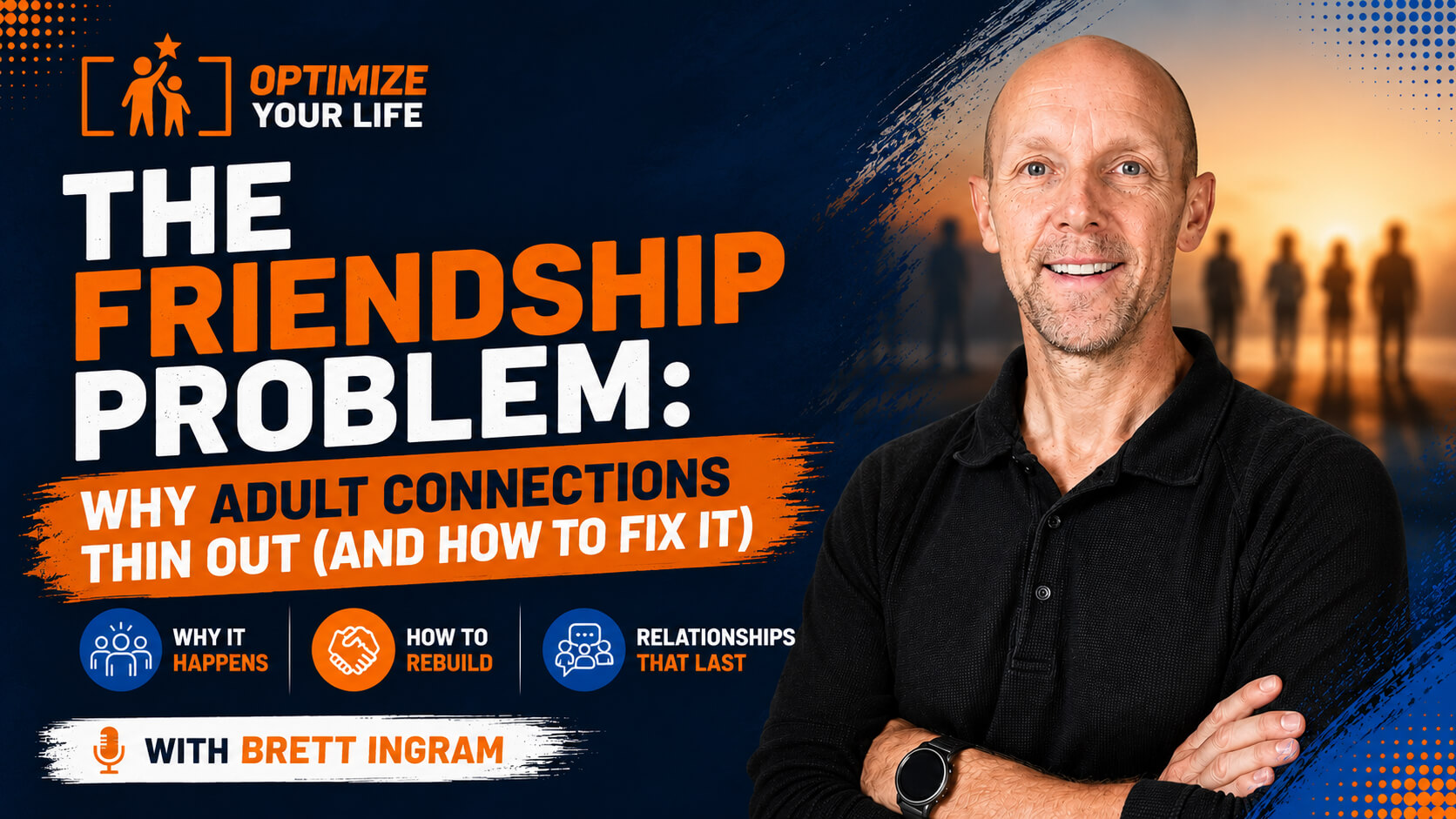
The Friendship Problem: Why Adult Friendships Fade and How to Rebuild Them
~20 min | June 8, 2026
Adult friendships don't end with a fight — they fade quietly, without a villain, without a reason. You can be surrounded by people and still feel completely unknown. In this episode, Brett Ingram explores why deep friendship becomes structurally harder after your 20s, why "being liked" and "being known" are not the same thing, and what it actually takes to rebuild genuine connection as an adult — starting with one specific ask to one specific person this week.
What You'll Learn in This Episode
- Why the friendships you formed in school were built by a system — and why that system disappeared without warning the moment you graduated
- How adult life (career, family, geography, exhaustion) doesn't just get in the way of friendship — it was never designed with friendship in mind
- The difference between being liked and being known, and why most adults are starving for the latter without being able to name it
- Why digital connection mimics the feeling of closeness without delivering the depth — and what in-person time does that no conversation thread never can
- How performing wellness ("things are great, really busy") keeps the people around you from actually reaching you — and compounds loneliness
- The awkwardness of intentional adult friendship, why that awkwardness is the entry fee rather than a warning sign, and what almost always happens when you push through it
- Six practical, undramatic moves that actually rebuild friendship — including how to ask better questions, send a real first text, and create recurring structure that removes the decision cost
Episode Timestamps
[00:00]Opening question: when did someone last actually know what was going on with you?[01:00]Introduction and episode framing[02:00]The slow fade — what adult friendship loneliness actually feels like[02:30]What school was doing for you (and stopped doing the day you graduated)[04:00]How life narrows: career, family, geography, and the structural withdrawal[05:00]The friction of adult life and the illusion of digital connection[08:00]Being liked vs. being known — the core of the friendship problem[12:00]Adult friendship is built, not found — and why the awkwardness is the entry fee[15:00]Six practical moves to rebuild friendship intentionally[19:00]The one action to take this week
Episode Summary
There's a specific kind of loneliness that's hard to name. It's not the loneliness of isolation — you have people around you. You go to things, you show up, your social life exists on paper. But somewhere along the way, the friendships that used to feel easy became distant, and catching up started to feel less like reconnection and more like updating each other on strangers' lives.
Brett opens this episode with a direct challenge: when was the last time someone really knew what was going on with you? Not "fine, busy, things are good" — but the actual stuff underneath.
What he argues in this episode is that adult friendship loneliness isn't a personal failure. It's a structural one. The environments that automatically built friendships — school, dorms, shared early-career chaos — worked because of one simple formula social scientists have confirmed again and again: proximity plus repetition. You didn't have to try to see those people. The system put you in the same room, week after week, for years. And then it stopped. Nobody warned you. They just handed you a diploma.
From that point forward, adult life filled the space that used to hold your friendships. Career, family, geography, exhaustion, and good intentions that keep getting bumped. Brett is honest about this from his own life — two of his closest childhood friends now live in Texas and Oregon. He loves them no less. But the reality of where life took everyone is that maintaining those relationships now requires something school never demanded: deliberate effort.
The section of this episode that earns the most careful listening is the distinction between being liked and being known. You can be well-regarded, included, popular in the room, and have a full social calendar without ever feeling truly seen. What most adults are quietly starving for, Brett argues — even when they can't name it — is to have at least one or two people who know their actual situation. Not the highlight reel. The real thing. The stuff they're worried about, what's hard, what they're quietly proud of.
The painful irony is that adult social culture works against this. We perform for each other. We meet each other's representatives. "Things are great, actually, really busy" — and so nobody knows you're struggling, and nobody reaches out, and the loneliness compounds. Brett is clear-eyed about his own role in this dynamic: the people in our lives feel closer when we open up first. Vulnerability invites vulnerability.
This leads to the most important reframe in the episode: in adulthood, deep friendship is not something that happens to you. It's something you build — intentionally, imperfectly, and often a little awkwardly. That awkwardness, Brett argues, is not a sign that something's wrong. It's the entry fee. And on the other side of that awkward first move is almost always a person who's just as hungry for connection as you are.
The practical section doesn't reach for grand gestures. It reaches for the small, repeated moves that actually work — and it's grounded in the same formula that built your best friendships to begin with: repeated contact in low-pressure situations over time. Send a specific text (not "we should catch up"). Turn vague intentions into actual calendar events. Create recurring structure that removes the decision cost. Ask better questions — "what's been on your mind lately?" instead of "how are you?" Let people see something real. Show up again even when it feels slightly vulnerable.
This is what genuine connection actually requires in adulthood — not a perfect moment, not the exact right words, but a willingness to show up imperfectly, consistently, and let somebody in.
Brett closes with a single specific ask: think of one person — just one — who you've been meaning to reach out to. Not a vague "we should catch up." Something real. Something specific. "I was thinking about you. Do you want to grab coffee Saturday?" That's it. One person. One ask.
Frequently Asked Questions
Why do adult friendships fade even when nothing went wrong? Most adult friendships don't end with a fight — they end with a structural withdrawal. The environments that automatically created repeated contact (school, shared housing, early career) disappear in your 20s, and adult life fills the space with career, family, and exhaustion. When the shared context is gone, the friendship drifts — not because of any failure, but because the mechanism that was building it no longer exists.
What's the difference between being liked and being known? Being liked is surface-level — it means people enjoy your company, include you, think well of you. Being known means someone understands your actual situation: what you're worried about, what's hard, what you're quietly working through. Most adults have plenty of the former and not enough of the latter. The distinction matters because only the latter addresses the specific kind of loneliness that's hard to name.
How do you rebuild a friendship that has drifted? Start with a specific ask, not a vague intention. "We should catch up soon" almost never leads anywhere. "Are you free Thursday? I'd love to actually catch up, not just text" signals that you mean it. From there, the goal is repeated contact in low-pressure situations over time — the same formula that built your best friendships in the first place, now created deliberately instead of handed to you by circumstance.
Why does reaching out to people as an adult feel so awkward? Without the cover story of shared context — a class, a workplace, a neighborhood — reaching out feels exposed. You're two adults deliberately trying to build something, and that vulnerability doesn't have the social scaffolding it used to. Brett's argument is that this awkwardness is the entry fee for adult friendship, not a warning sign. And on the other side of that awkward first move is almost always a person who's just as relieved you reached out as you are that you did it.
Does digital connection count as real friendship? It can supplement real friendship but doesn't replace it. Reacting to someone's Instagram story, texting a meme, or scrolling someone's feed creates a feeling of being caught up that doesn't actually transfer depth. Brett learned this firsthand when a colleague pushed him to attend an in-person event after years of managing everything digitally — the difference in relationship depth was immediate and unmistakable. Face-to-face time builds something that no amount of online interaction fully replicates.
How many close friends do you actually need? Fewer than you might think. The episode's advice isn't to build a larger social network — it's to go deeper with the people you already have. One honest conversation beats five surface-level hangouts. What most adults need isn't more friends; it's more depth with the ones already in their lives.
What's one practical thing I can do this week? Think of one person you've been meaning to reach out to — someone you genuinely like, someone you've lost touch with, or someone you see occasionally but never get beneath the surface with. Send them a specific message, not "we should catch up." Something like: "I was thinking about you. Do you want to grab coffee on Saturday? I want to actually catch up, not just text." One person. One specific ask. That's the whole assignment.
Keep Exploring
If this episode resonated, these are worth your time:
- Growth & Self-Becoming Pillar — The full collection of writing on resilience, transformation, and what it actually takes to become more of who you are over time.
- Relationships & Connection Pillar — A deeper look at what genuine connection requires across all areas of adult life
Enjoyed This Episode?
The best way to support optYOUmize is to subscribe and leave a review — it takes about two minutes and makes a real difference in helping more people find the show.
Apple Podcasts · Spotify · Amazon Music · YouTube