
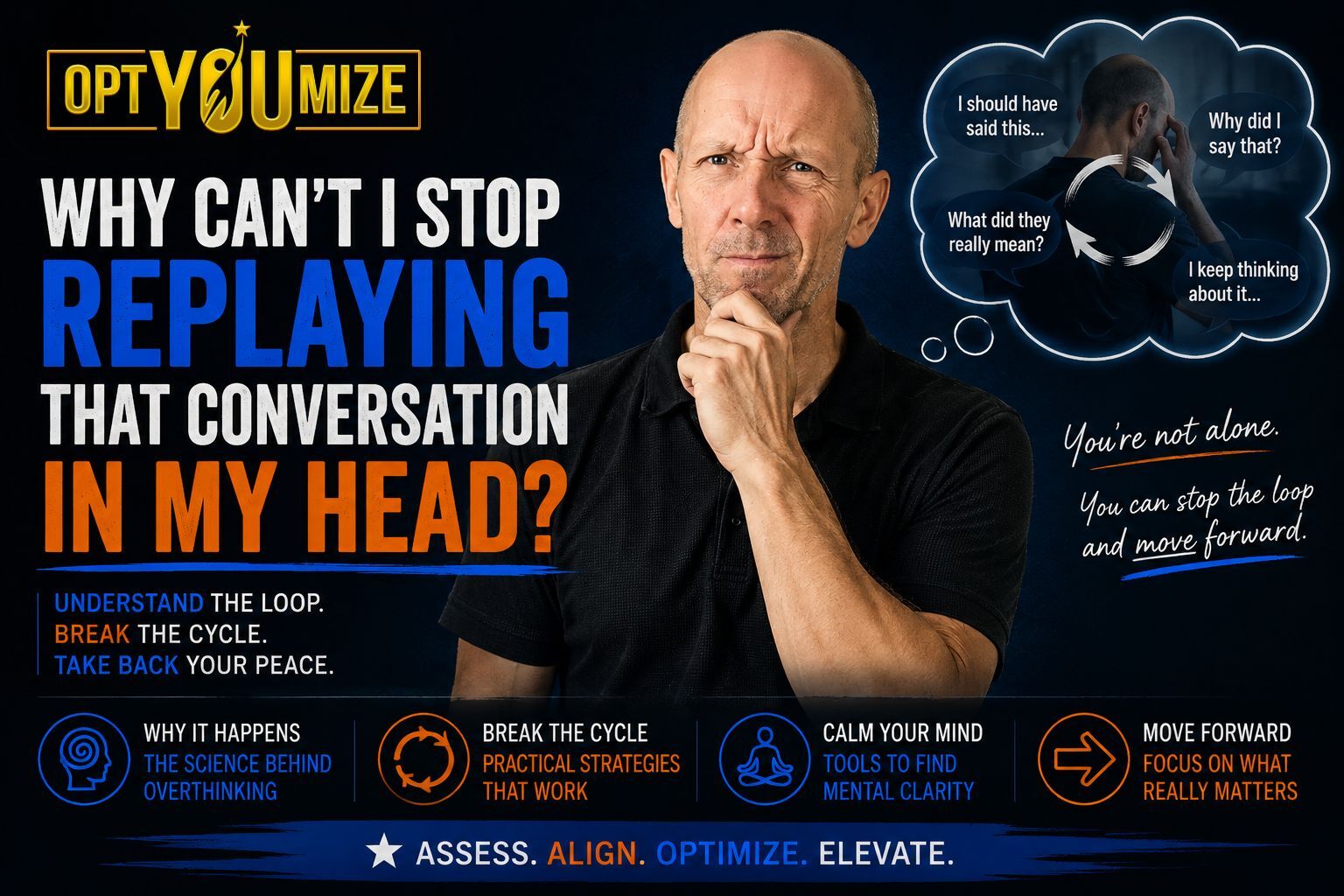
Why Can't I Stop Replaying That Conversation in My Head?
~22 min | August 21, 2026
It's not a character flaw that you're replaying that comment, that tone, that thing you should have said — it's your mind doing its job badly. This episode breaks down what rumination actually is, why it feels productive even though it never resolves anything, and why the standard advice (stop overthinking it, just think positively) quietly makes it worse. Brett Ingram reframes the 2am replay as misdirected care — real concern with nowhere to go — and walks through three moves to redirect it: creating distance from the loop, asking whether it wants an action or a feeling, and giving it a channel out of your head.
What You'll Learn in This Episode
- What rumination actually is, and why replaying something forty times leaves you with zero new information
- Why your mind loops specifically on things that feel unfinished and unsafe at the same time
- Why most replays are about people, not tasks — and what that says about how your brain tracks belonging
- The research showing rumination doesn't just fail to solve problems, it actively makes you worse at solving them
- Why "just stop overthinking it" and "just think positively" both backfire, and the famous experiment that proves it
- The reframe at the center of the episode: rumination is misdirected care, not a malfunction
- Three concrete moves — creating distance, asking "action or feeling," and finding a channel — plus a simple "two a.m. reset" you can use tonight
Episode Timestamps
[00:00]The 2am replay: reliving a conversation frame by frame[01:00]The real question — what is your mind actually trying to do?[02:00]Naming it: what rumination actually is, and why it feels productive but isn't[03:00]The "Buckner moment" — watching your worst footage on repeat[05:00]You're not broken: the Harvard study on mind-wandering and mood[06:00]Why the mind loops: unfinished and unsafe at the same time[07:00]Why most loops are social — belonging, safety, and the people around you[08:00]Susan Nolen-Hoeksema's research: rumination makes the problem harder to solve[09:00]The white bear experiment — why forcing yourself to stop backfires[10:00]The reframe: rumination is misdirected care[12:00]Move 1: Name the loop and create distance (distanced self-talk)[14:00]Move 2: Ask the one honest question — action or feeling?[17:00]Move 3: Give it a channel — say it, write it, move your body[19:00]The limits: when it's more than rumination, and when the loop is right[20:00]The Two AM Reset — a three-step practice you can use tonight
Episode Summary
You're an intelligent, capable adult who solves real problems all day — and yet at 2am, you're powerless against one specific conversation, replaying it frame by frame, hunting for the edit that would make it come out clean. Brett Ingram argues that this loop isn't a malfunction. It's your mind trying to protect you. It's just going about it badly.
Psychologists have a name for it: rumination — the habit of responding to distress by replaying the causes, the meaning, and the what-ifs, without ever moving toward resolving anything. That's the trap. Rumination feels like processing, so it feels productive, but you can watch the same footage forty times and end up with exactly zero new information — the same trap the Fever Pitch character falls into, replaying the Buckner moment instead of living his own life.
The mind loops on anything that feels unfinished and unsafe at the same time — a conversation with no clean ending, paired with something you care about (your competence, your kindness, your standing with someone) feeling at stake. Put those together, and your mind treats the moment like an active threat, refusing to file it away because filing it away feels like giving up on protecting you. Most replays are social rather than practical, because for most of human history, belonging was survival — which is why you might replay an awkward comment to a friend for a week and forget an actual mistake at work by Friday.
The cruel twist, backed by the late Yale psychologist Susan Nolen-Hoeksema's decades of research, is that rumination doesn't just fail to solve the problem — it actively makes you worse at solving it, muddling your thinking and eroding the very relationships you're looping about.
Brett takes apart the two most common pieces of advice — "just stop overthinking it" and "just think positively" — and shows why both backfire, using Daniel Wegner's famous 1980s "white bear" experiment: people told not to think about a white bear end up thinking about it more, not less, because suppression forces part of the mind to stand guard over the very thought it's trying to avoid.
The reframe at the center of the episode: rumination is misdirected care — real concern about something that matters, aimed at a problem it can't solve by staying in your head. From there, Brett offers three moves. First, name the loop and create distance from it, using Ethan Kross's research on "distanced self-talk" — talking to yourself in the second or third person instead of "I." Second, ask the loop one honest question: is this a real action you need to take, or a feeling you need to let yourself feel? The two require opposite responses, and confusing them is why loops never end. Third, give it a channel out of your head — say it to someone, write it down, or move your body.
Brett closes with two honest caveats: when the looping is relentless, trauma-linked, or pulling you somewhere dark, that's a sign to talk to a professional, not a podcast framework. And sometimes the loop is right — it's not malfunctioning, it's a messenger for a conversation you've been avoiding. The episode ends with a simple "two a.m. reset" — name it, ask action-or-feeling, pick one channel — and the reminder that the goal was never to stop caring. It's to give the caring somewhere to go.
Resources Mentioned
- Susan Nolen-Hoeksema — Late Yale psychologist whose decades of research established that rumination impairs, rather than aids, problem-solving
- Daniel Wegner — Psychologist behind the 1980s "white bear" thought-suppression experiment and the concept of the "ironic process of mental control"
- Ethan Kross — University of Michigan psychologist and author of Chatter, whose research on "distanced self-talk" underlies the episode's first move
- A well-known Harvard mind-wandering study — Real-time experience-sampling research referenced in the episode finding minds wander roughly 47% of waking hours (researcher/citation not named in the source transcript — confirm before publishing, likely Killingsworth & Gilbert, "A Wandering Mind Is an Unhappy Mind," 2010)
- Fever Pitch — Film referenced for the scene of a character replaying his team's worst loss on repeat instead of moving on
Frequently Asked Questions
Why can't I stop replaying an embarrassing or painful conversation in my head? Your mind loops on things that feel both unfinished (no clean resolution) and unsafe (something you care about — your competence, your standing with someone — feels at stake). When both are true at once, your mind treats it like an active threat and keeps it "open" rather than filing it away, because filing it away feels like giving up on protecting you.
What is rumination, and how is it different from normal reflection? Rumination is the habit of replaying the causes, meaning, and what-ifs of a distressing moment without ever moving toward resolving it. A lesson has an endpoint — you learn something and the thinking is done. A loop has no endpoint — you circle the same ground and arrive nowhere, no matter how many times you replay it.
Why doesn't telling myself to "just stop thinking about it" work? Because suppressing a thought requires part of your mind to keep checking whether you're thinking about it — which keeps the thought alive instead of closing it. Psychologist Daniel Wegner demonstrated this with his famous "white bear" experiment: people told not to think about a white bear thought about it more than people who were never given the instruction at all.
What is "distanced self-talk," and how does it help with rumination? It's talking to yourself using your own name or "you" instead of "I" — for example, "you're looping on this again" instead of "why did I say that." Researcher Ethan Kross found this small shift creates enough psychological distance to lower distress and help people see a situation more clearly, without suppressing the thought.
How do I know if I'm dealing with a real action or just a feeling that needs to be felt? Ask the loop directly: is there something I actually need to do or say, or is this just a feeling I haven't let myself feel? If it's an action, write down the smallest next step — the moment there's a plan, the urge to keep replaying it tends to drain away. If it's a feeling, name it and let it be there; you can't think your way out of something that just needs to be felt.
What's the fastest thing I can do at 2am when the loop starts? Try the "two a.m. reset": name the loop and step back from it ("this is a loop, not a lesson"), ask whether it's an action or a feeling and respond accordingly, then pick one channel for tomorrow — tell one person, write one page, or take one walk. Even just naming the loop is a win on its own.
When is replaying a conversation actually a sign I need to talk to a professional? If the looping is relentless, tied to a trauma you keep reliving, feels intrusive and frightening, or is pulling you into a darkness that's hard to climb out of, that's beyond ordinary rumination — it's a sign to talk to a real professional, not something a framework alone is meant to fix.
Keep Exploring
If this episode resonated, these are worth your time:
- Mind & Inner Life pillar page — Go deeper on how optYOUmize thinks about the mental patterns that quietly shape your days
Enjoyed This Episode?
The best way to support optYOUmize is to subscribe and leave a review — it takes about two minutes and makes a real difference in helping more people find the show.
Apple Podcasts · Spotify · Amazon Music · YouTube