
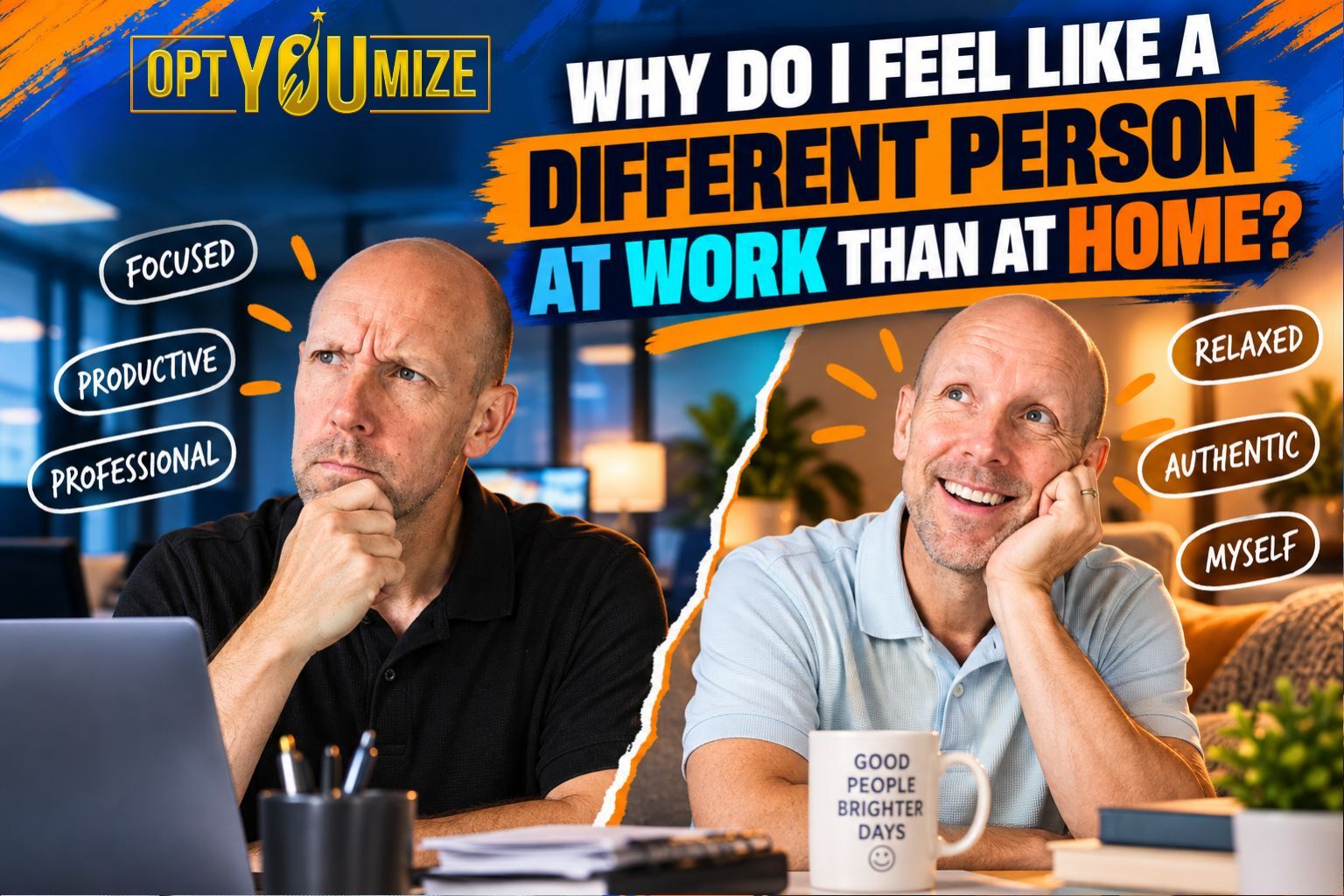
Why Am I a Different Person at Work Than at Home?
~19 min | October 8, 2026
Yes, it's normal to be a different person at work than at home, and it's usually not a problem. The problem is the cost of switching between the two, and whether the gap between them rests on values you don't actually share. In this solo episode, Brett Ingram explains why the split is built in, why "bring your whole self to work" gets it backward, and gives you a three-question Through Line Test and a one-week Doorway Audit to find out which kind of gap you're living in.
What You'll Learn in This Episode
- Why the "one fixed true self" you betray by adapting doesn't hold up, and what personality psychology says instead
- Brian Little's free traits: why acting out of character on purpose, for something you care about, isn't fakeness
- Arlie Hochschild's surface acting vs. deep acting, and why pasting on a feeling is the form most strongly linked to burnout
- Why "bring your whole self to work" can turn into a costume with better branding, and why integrity beats sameness
- Difference vs. distance: same core with a different volume, versus a gap built on values you don't hold
- The Through Line Test: your through line, the tax, and your restorative niche
- The Doorway Audit: a one-week practice that costs no extra time
Episode Timestamps
[00:00]The drive home: who are you becoming?[01:00]Introduction[01:20]Why the work self and home self feel like two people[02:00]The Slack-open face, and why the relief at five is data[03:00]Free traits: acting out of character on purpose[04:30]Emotional labor: surface acting vs. deep acting[05:30]Why "bring your whole self to work" is a trap[06:45]Integrity: the structural kind[07:30]Difference vs. distance[08:45]The Through Line Test: your through line[09:45]The tax: how much recovery does it take?[11:00]The restorative niche[13:00]When the test surprises you[14:00]Severance and the split that becomes a prison[14:45]What this is not: no, you don't have to quit[16:00]The Doorway Audit: your one practice[17:30]Are your work self and home self on speaking terms?[18:15]Key takeaways and closing
Episode Summary
You know the drive home, or the walk from the desk to the kitchen when home and work share the same twelve feet of carpet. Somewhere in that gap, something changes. Your voice drops half an octave, your face does less, and the person who said "happy to jump on a call" at 4:58 dissolves into someone else standing in the kitchen. Brett Ingram starts here, and his first move is to retire the question most people ask about it. Which one is the real me? is the wrong question. The better one is quieter: why does it cost so much to get from one to the other?
Being different in different rooms isn't the problem. Everybody does it. The problem is the tax: the hour of decompression, the short fuse with the people you love most, the sense that you're renting out your best hours and bringing home the receipts. The relief you feel at five o'clock is data, not weakness.
The popular advice is to collapse the split: bring your whole self to work, be authentic, be the same person everywhere. Brett argues that advice rests on something that isn't true. Personality psychologists describe a set of core traits, but also a habit of acting out of character on purpose in service of things we care about. Brian Little calls these free traits: a natural introvert runs a lively meeting because the project matters, and a blunt person softens their edges with a grieving friend. That isn't fakeness. It's a person with values and other people in the room. The same behavior carries a different internal cost for a teacher who's genuinely giving all day than for an employee performing enthusiasm for a mission they privately find hollow.
That cost has a name. Sociologist Arlie Hochschild described emotional labor, the work of managing or faking feelings as part of a job, and drew a line between deep acting, where you try to summon the feeling, and surface acting, where you paste it on with nobody home. Across decades of research, it's surface acting that's most strongly linked to burnout and emotional exhaustion. So when you come home wrung out from a day that wasn't hard on paper, part of the explanation may be the gap between your face and your insides. It isn't free, and you pay for it in energy.
Taken literally, "bring your whole self to work" asks you to flatten a healthy fact, and at its worst becomes a quiet demand to hand over parts of your life that were never the workplace's business. Brett's alternative is integrity in the structural sense, the way an engineer talks about a bridge's structural integrity: not whether it's good, but whether it holds together under load. You can be deeply guarded about your private life and still have total integrity at work. The question isn't whether you're the same person in every room. It's whether there's a through line that survives the move, or whether you left the load-bearing parts of yourself in the car.
That leads to the distinction at the heart of the episode: difference vs. distance. Difference is adapting to the room, same core and different volume. Distance is the gap between who you are and who you're performing, when that gap is built on values you don't share. In Brett's words, "Difference flexes, distance tears." It matters beyond you, too: the people at home get the drained version while the office gets the bright one.
To make it usable, Brett offers the Through Line Test, three honest questions. First, your through line: what two or three things are true about you in every room, and do they travel through the office door or wait in the car? Second, the tax: how much recovery does it take to become yourself again? A few minutes in the parked car is normal friction. Two hours and a closed door before the real you comes back online is a tax, and often a sign you're surface acting something fundamental. Third, the restorative niche, Little's term for a place, person, or pocket of time where you drop the act. It might be a walk without a podcast or a friend you can let your guard down with. Doom-scrolling restores nothing.
The test doesn't always point the same way. Sometimes the answer is to budget your warmth better, since a job can spend a real resource all day and leave little for home. Other times it's structural: if your workplace punishes telling the truth kindly, no restorative bath fixes a job that requires you to betray a core value daily. Brett is clear on what the framework is not: a mandate to quit, a promise to feel radiantly yourself every day, or a diagnosis. And to the "I have a mortgage" objection, he answers that the tax is real whether or not you can afford to look at it, and small adjustments exist even inside a job you can't leave.
The practice is the Doorway Audit. For one week, catch the exact moment you switch, whether it's the doorway, the driveway, or closing the laptop, and ask one question. Monday through Wednesday, ask the tax question: how much do I need to recover right now, and from what? Thursday and Friday, ask the through line question: which part of me did I leave in the car today? At the end of the week, look for the pattern, because the pattern is the insight. As Brett puts it, you can't redesign what you refuse to look at. This is the kind of attention that makes doing work that matters without self-erasure possible.
He closes with a question instead of a verdict. It was never which one is the real you, because they both are. The question is whether they're on speaking terms. "That wince is the start of the design."
Resources Mentioned
- Brian R. Little — personality psychologist behind free traits and the restorative niche; see Me, Myself, and Us: The Science of Personality and the Art of Well-Being (2014)
- Arlie Russell Hochschild — sociologist who coined emotional labor and distinguished surface acting from deep acting; The Managed Heart: Commercialization of Human Feeling (1983)
- Hülsheger & Schewe (2011) — "On the costs and benefits of emotional labor: A meta-analysis of three decades of research," Journal of Occupational Health Psychology (research behind the burnout finding; not named in the episode)
- Severance — Apple TV+ series about employees whose work and personal memories are surgically split
Frequently Asked Questions
Is it normal to feel like a different person at work than at home? Yes. Personality psychologists describe people acting out of character on purpose, in service of things they care about, and Brian Little calls these free traits. Adapting to different rooms is common and often healthy. The thing to watch isn't the difference but the cost of switching.
Why am I so exhausted after work even when the day wasn't hard? One contributor may be surface acting, showing a feeling you don't have. Sociologist Arlie Hochschild separated it from deep acting, where you actually try to feel the thing, and decades of research link surface acting most strongly to burnout and emotional exhaustion. The gap between your face and your insides takes energy.
Is it bad that I act differently at work than with my family? No. Brett Ingram's point is that being different in different rooms is normal, and the real question is whether your core holds across them. He separates difference, the same core at a different volume, from distance, a gap built on values you don't actually share.
Should I bring my whole self to work? Not literally. Taken at face value, the advice asks you to flatten the healthy fact that you're different with colleagues than with close friends, and it can become a quiet demand to hand over parts of your life that aren't the workplace's business. Aim for integrity instead: a few things that stay true in every room.
How can I be more authentic at work without oversharing? Authenticity isn't sameness or full disclosure. You can be guarded about your private life and still have integrity at work. Name two or three things that are true about you in every room, such as telling the truth kindly or being steady in a crisis, and check whether they travel with you.
What is a restorative niche? It's Brian Little's term for a place, person, or pocket of time where you can drop the act and be unmistakably yourself. Examples from the episode include time alone, a walk without a podcast, quiet coffee before anyone's awake, a friend you can let your guard down with, or a creative hobby. Doom-scrolling feels like a break but doesn't restore anything.
What is the Doorway Audit? It's a one-week practice from this episode. Catch the moment you switch from work to home, such as the doorway, the driveway, or closing the laptop. Monday through Wednesday, ask how much you need to recover and from what. Thursday and Friday, ask which part of you you left in the car. Then look for the pattern.
Keep Exploring
If this episode resonated, these are worth your time:
- Purpose & Meaningful Work — the pillar behind this episode, on doing work that matters without losing yourself in it → optyoumize.com/purpose-meaningful-work
- How to Actually Enjoy Your Life (Not Just Get Through It) — when a good life still feels like something you manage rather than live → optyoumize.com/blog/podcast/how-to-actually-enjoy-your-life
- Why Can't I Relax Even When I Have Time? — on the restoration that gets optimized out of your calendar → optyoumize.com/blog/podcast/why-cant-i-relax-even-when-i-have-time
Enjoyed This Episode?
The best way to support optYOUmize is to subscribe and leave a review — it takes about two minutes and makes a real difference in helping more people find the show.
Apple Podcasts · Spotify · Amazon Music · YouTube