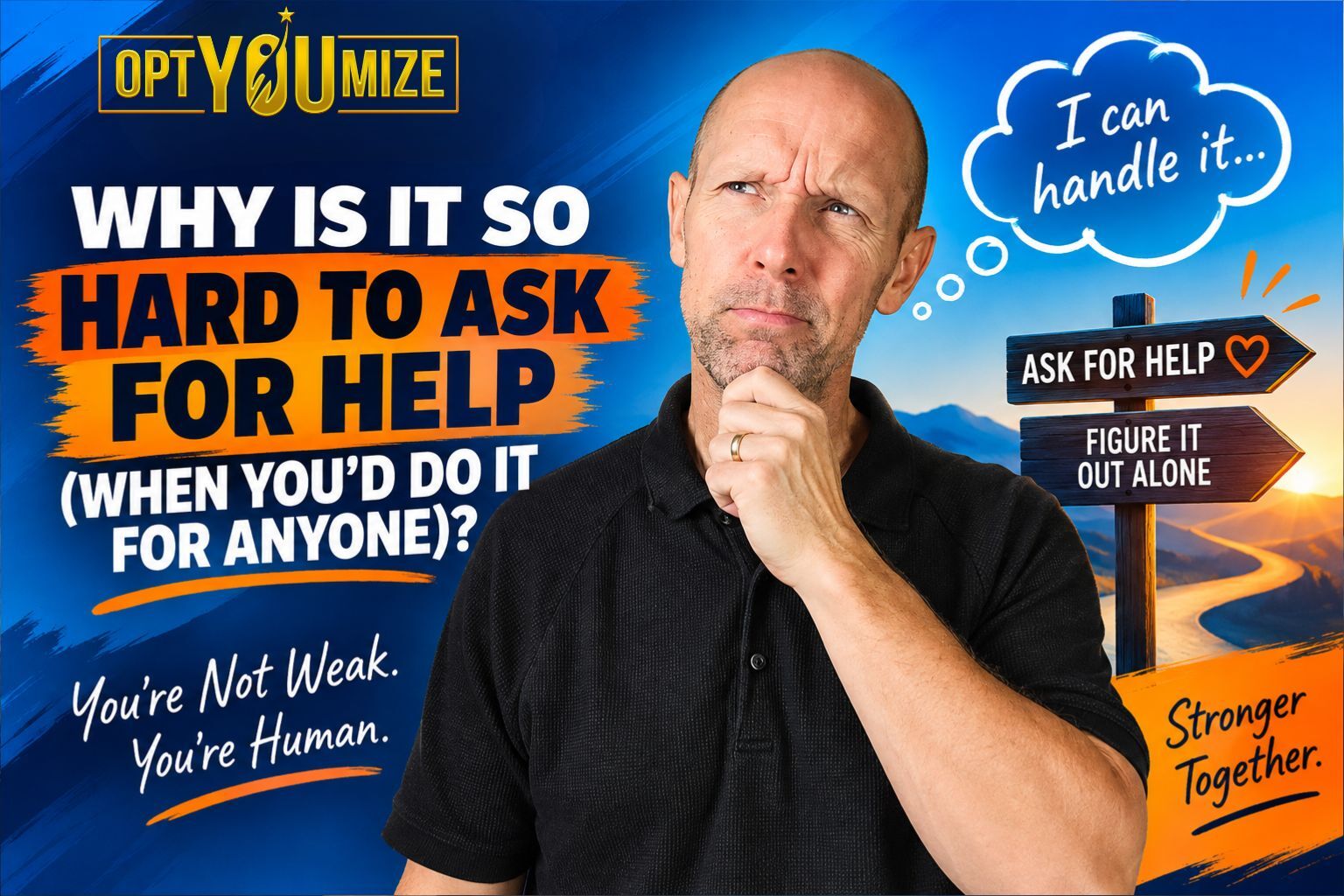
Why Is It So Hard to Ask for Help (When You'd Do It for Anyone)?
~20 min | September 21, 2026
Asking for help is hard for capable people not because they're stubborn or bad at vulnerability, but because they've mispriced it. There are three costs you assume the ask will carry — that you'll look weak, that you'll be turned down, and that you'll owe a debt — and the research on all three says the numbers in your head are wrong. In this solo episode, Brett Ingram walks through what each price actually costs, why the person who only ever gives is holding half a relationship hostage, and a small experiment that lets you check the price yourself without having to perform vulnerability.
What You'll Learn in This Episode
- Why the people everyone else leans on have the least practice being on the receiving end — and what that quietly costs them
- The "beautiful mess effect": you see your own vulnerability in high-definition close-up and everyone else's from a warmer distance
- Why people underestimate others' willingness to help by roughly half — and why that figure comes from studies on total strangers
- The reason saying no is usually harder than saying yes, and why you never get to see that side of the ledger
- Why "I don't want to be a burden" isn't generosity — it's a decision you made on someone else's behalf
- Help as a current rather than a loan, and what you take from people when you only ever let them receive
- Where the fear is legitimate: the difference between real discernment and a wall wearing the costume of discernment
- The One Ask — a small, falsifiable weekly experiment that tests the three prices with real data
Episode Timestamps
[00:00]The friend you'd drop everything for[01:10]Introduction[01:35]Why the capable one has no practice being helped[03:20]The frame: three prices you think asking will cost[03:50]The Competence Price and the beautiful mess effect[05:55]The Rejection Price: people say yes about twice as often as you predict[07:05]Asking as the overlooked skill[09:15]The Debt Price: help is a current, not a loan[11:20]Benjamin Franklin's borrowed book[12:40]When not asking really is wisdom[14:30]The One Ask experiment[17:05]Brett on his own difficulty asking[18:15]Key takeaways and closing
Episode Summary
Start with a thought experiment. A friend calls and says, "I'm stuck, can you come?" You're already reaching for your keys. You don't think they're weak. You don't resent the interruption. Some quiet part of you feels good about being the person they called.
Now reverse it. When you're the one buried, overwhelmed, in over your head — how often do you make that call?
For a lot of people, and especially for the competent ones, helping is easy and being helped is almost unbearable. Brett Ingram opens this episode by naming who it's really for: the reliable one. The person who gives good advice, shows up in a crisis, and is everyone else's first call. Precisely because of all that, they have almost no practice on the receiving end. An entire identity gets built around being the one who helps, and the muscle for being helped goes soft from never being used.
His central claim is that this isn't a willpower problem. It's a pricing problem. You're not refusing to ask — you're declining to pay three specific prices you assume the ask will cost. And all three are marked up.
The Competence Price is the fear that asking makes you look weak, that the request is a small confession reading I couldn't handle it. The research pushes back hard. In 2018, Anna Bruk and colleagues published seven studies in the Journal of Personality and Social Psychology and gave the finding a name that stuck: the beautiful mess effect. People tend to evaluate their own displays of vulnerability harshly — messy, exposing — while reading the identical act in someone else as honest, brave, human. Same act, two entirely different cameras. The harsh judgment you're bracing for is one you're making about yourself and almost nobody else is making about you. As Brett puts it: you're the only person in the transaction who thinks the ask makes you smaller.
The Rejection Price has an actual number attached. Francis Flynn at Stanford and Vanessa Bohns ran a now-classic set of studies — one published in 2008 — asking participants to predict how many strangers they'd have to approach before enough said yes to borrowing a phone, filling out a questionnaire, or walking a couple of blocks to the campus gym. Replicated many times since, the finding is that people underestimate others' willingness to help by roughly half. We predict needing to ask about twice as many people as we actually do. And these were strangers — not the people who love us. The reason for the gap is instructive: when you're asking, you feel every ounce of the awkwardness and can vividly imagine the no. What you can't feel is the pressure on the other side, where turning down a sincere, direct request from someone you care about is genuinely uncomfortable. Saying no is often harder than saying yes. You just never see that side of the ledger. Which reframes the burden worry entirely — a burden is dumped on someone with no way out; a request is offered with a way out. When you never ask, you aren't sparing anyone. You're quietly deciding on their behalf that they wouldn't want to show up for you.
The Debt Price is the one that runs deepest among givers: if I ask, now I owe you. Here Brett challenges the whole model. Help as a transaction is exactly the wrong frame for the relationships that matter. In a real relationship, help isn't a loan — it's a current, and it's supposed to run both directions. When you refuse to ever ask, you think you're staying clean and independent, but look at what you're doing to the people who love you: you only ever let them receive from you, and never let them give. Being needed, being trusted with something that matters, is one of the deepest ways people feel close. The person who can only give and never receive isn't holding the relationship up — they're holding half of it hostage, keeping everyone close enough to help and never close enough to be leaned on. Because connection is built on mutual need, not one-way service, the very thing you're doing to protect your relationships is quietly starving them. A story from Franklin's autobiography carries the point: unable to win over a rival in the Pennsylvania legislature in the 1730s, Franklin didn't do the man a favor — he asked to borrow a rare book from his library. The rival, flattered to be asked, lent it, and was friendly for life. Asking gave the other man a way in.
Then the fair caveat, which Brett refuses to skip. Sometimes the answer really is no and it stings. Some people genuinely do keep score, and declining to owe them is wisdom rather than fear. Some workplaces and family dynamics make showing need unsafe. The skill isn't just asking — it's asking well: the right person, something specific, in a way that gives them a real out. What he's arguing against is the blanket rule that decided everyone is unsafe and every ask is weakness. "That rule isn't protecting you. It's just isolating you with extra steps." The difference between I read this situation and chose not to ask and I never ask anyone for anything is the difference between judgment and a wall wearing the costume of judgment.
The practice is deliberately small, and explicitly not an instruction to go be brave — because "be more vulnerable" is vague, exhausting, and turns asking into one more performance. It's called the One Ask. Sometime this week, pick one thing you'd normally grind through alone: a ride, a second set of eyes on an email, an hour of childcare, a question you'd otherwise spend an hour googling. Before you ask, write down your prediction — how weird will it be, how likely is a no, how much will you owe afterward. Then ask one specific person, directly. Afterward, compare what happened to what you predicted. You're not becoming a different person; you're running one clean test and letting reality quote you the number instead of your imagination. For most people the gap between prediction and reality is the entire education. And watch the other person, too — whether they seemed put upon or pleased to be asked. That data matters as much as your own comfort.
What the experiment is really doing is bigger than getting a ride. Every time you ask and the ceiling doesn't fall in, you chip at the story underneath: that you're only lovable when you're useful, only safe when you're self-sufficient, only acceptable when you need nothing from anyone. That story has cost some of the most capable, generous people a quiet, well-hidden loneliness. It comes down one small ask at a time.
The episode closes where it started, with that friend. You are that person for someone — probably for several someones. There are people who would feel honored, trusted, and glad if you let them show up for you the way you show up for them. Every time you decide not to ask, you think you're sparing them. You might just be robbing them of the chance to be, for you, what you love being for everyone else. The strongest thing in a relationship isn't being the one who never needs anything. It's being someone who can both give help and receive it.
Resources Mentioned
- "Beautiful Mess Effect: Self–Other Differences in Evaluation of Showing Vulnerability" — Anna Bruk, Sabine G. Scholl & Herbert Bless (University of Mannheim), Journal of Personality and Social Psychology, 2018. Seven studies on why we judge our own vulnerability more harshly than others do — https://www.researchgate.net/publication/326743464_Beautiful_mess_effect_Self-other_differences_in_evaluation_of_showing_vulnerability
- "If You Need Help, Just Ask: Underestimating Compliance With Direct Requests for Help" — Francis J. Flynn (Stanford GSB) & Vanessa K. B. Lake, now Vanessa Bohns (Cornell), Journal of Personality and Social Psychology, 2008. The source of the "roughly half" underestimation finding — https://www.gsb.stanford.edu/insights/francis-flynn-if-you-want-something-ask-it
- The Autobiography of Benjamin Franklin — the primary source for the borrowed-book story, now popularly called the "Ben Franklin effect" — https://en.wikipedia.org/wiki/Ben_Franklin_effect
- Relationships & Connection pillar — optyoumize.com/relationships-connection
Frequently Asked Questions
Why is it so hard to ask for help when I'd help anyone else? Usually because you've built an identity around being the capable one, which means you have almost no practice being on the receiving end. Beneath that sits a miscalculation: you assume asking will cost you competence, invite rejection, and leave you in debt. Research suggests all three are substantially overestimated. The clearest sign it's a miscalculation rather than a real cost is the double standard — you would never judge a friend for asking you the same thing.
Does asking for help make you look weak? Mostly to yourself. A 2018 set of seven studies by Anna Bruk and colleagues, published in the Journal of Personality and Social Psychology, found what they called the "beautiful mess effect": people tend to evaluate their own displays of vulnerability more negatively than they evaluate identical vulnerability in others. Think of the last time someone you respect admitted they were in over their head and asked for your help. You most likely felt trusted and closer to them — not less impressed. That's how your ask reads to other people too.
Why do I feel like a burden when I ask for help? Because you're comparing the wrong two things. A burden is something dumped on someone with no way out. A request is offered with a way out — they can say no. Research by Francis Flynn and Vanessa Bohns found people underestimate others' willingness to help by roughly half, even when asking complete strangers. When you never ask, you're not sparing people a burden; you're quietly deciding on their behalf that they wouldn't want to show up for you.
Are people actually willing to help if I ask? More willing than you predict, by a substantial margin. In studies where participants guessed how many strangers they'd have to approach to get a set number of yeses — for things like borrowing a phone or being walked to the campus gym — people expected to need about twice as many asks as they actually did. That finding has been replicated many times. Part of the reason is that we feel our own awkwardness intensely while having no access to the discomfort on the other side, where turning down a sincere, direct request is genuinely hard.
How do I get better at asking for help? Start small and treat it as data collection rather than bravery. Pick one low-stakes thing this week you'd normally handle alone, write down your honest prediction of how the ask will go, then ask one specific person directly. Afterward, compare what actually happened to what you predicted. Framing it as an experiment gets past the wall in a way that "be more vulnerable" never does, and the gap between prediction and reality tends to be the whole lesson.
Is it ever right not to ask for help? Yes, and the episode is explicit about it. Some people genuinely keep score and will hold a favor over your head; declining to owe them is discernment, not fear. Some workplaces and family situations make showing need genuinely unsafe. The real skill isn't asking indiscriminately — it's asking well: the right person, for something specific, in a way that leaves them a real out. What's worth questioning is the blanket rule that everyone is unsafe and every ask is weakness.
What am I taking from people when I never let them help me? The chance to give. Being needed and being trusted with something that matters is one of the main ways people feel close to each other. If you only ever let the people who love you receive from you, you're keeping them at arm's length — close enough to be helped, never close enough to be leaned on. Help in a real relationship works like a current, not a loan, and the flowing in both directions is the point.
Keep Exploring
If this episode resonated, these are worth your time:
- What Is Social Fitness — and Why Does It Matter? — If the "asking is a deposit, not a withdrawal" idea landed, this is the maintenance work underneath it
- Why Do You Feel Lonely in a Relationship? — The loneliness of being close enough to help but never close enough to be leaned on, examined up close
- How Many Close Friends Do You Actually Need? — On who you'd actually make the One Ask to, and why the number is smaller than you think
- Relationships & Connection — The pillar this episode belongs to: how closeness actually gets built
Enjoyed This Episode?
The best way to support optYOUmize is to subscribe and leave a review — it takes about two minutes and makes a real difference in helping more people find the show.
Apple Podcasts · Spotify · Amazon Music · YouTube