
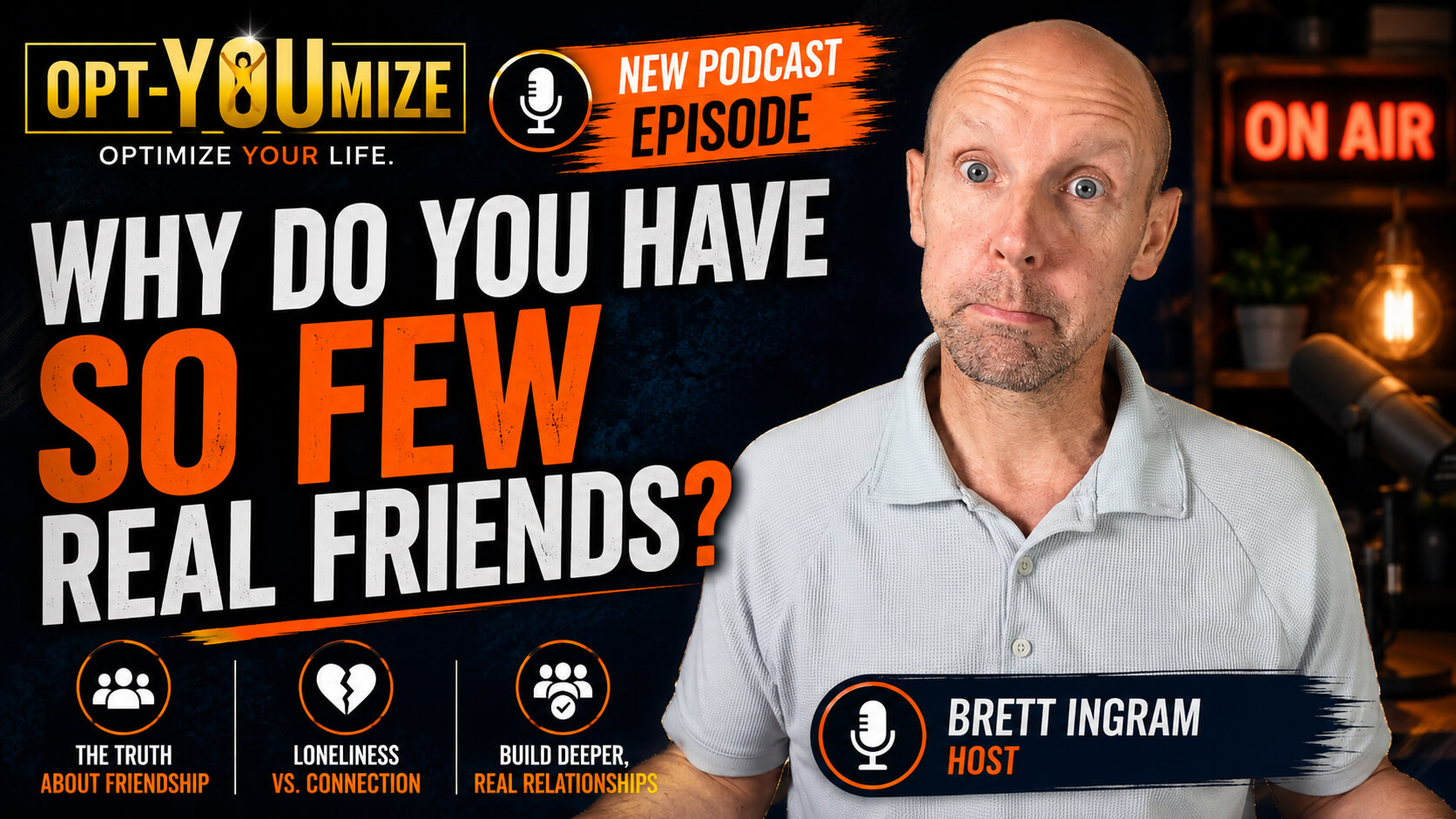
Why Do You Have So Few Real Friends?
~29 min | July 23, 2026
Feeling lonely despite a full calendar isn't a sign that something's wrong with you — it's what happens when the structures that used to build friendship automatically (school, teams, shared hallways) quietly disappear from adult life. In this episode, Brett Ingram breaks down why a life full of contact can still feel short on real connection, and lays out a three-part framework — repetition, revelation, and reaching first — for deliberately rebuilding the kind of friendships that used to form on their own.
What You'll Learn in This Episode
- The "who could I call at 2am" test — a fast, honest gauge of how many people in your life actually know you
- Why friendship used to form automatically: the three conditions (repeated unplanned contact, shared context, a relaxed environment) that school and early jobs handed you for free
- Why "put yourself out there more" misses the real problem — most lonely adults have a shortage of depth, not contact
- The difference between being liked and being known, and why you can be excellent at one and starving for the other
- What the data actually shows: the share of Americans with no close friends has roughly quadrupled since 1990
- The Repetition, Revelation, Reaching First framework — three deliberate ingredients for building adult friendship on purpose
- Why solitude and loneliness aren't the same thing, and how to tell which one you're actually living in
Episode Timestamps
[00:00]Introduction — the quiet gap between a full life and real friendship[02:00]Getting precise: it's not aloneness, it's thinness — the "call at 2am" test[04:00]Why this isn't personal — a verdict on the conditions, not on you[05:00]The three conditions that used to build friendship automatically[07:00]How adult life quietly removes them — proximity, repetition, unstructured time[09:00]The friendship recession, in the data[10:00]Being liked vs. being known — why more socializing doesn't fix loneliness[13:00]The reframe: friendship is built, not found[14:00]Why connection is foundational, not optional[17:00]The framework: repetition, revelation, and reaching first[24:00]The one-week experiment, and two honest objections[28:00]Closing thought and the question to carry forward
Episode Summary
Most adults don't have a shortage of people — they have a shortage of depth. That's the distinction Brett Ingram draws at the center of this episode: you can have a full calendar, a phone full of contacts, and a reputation as genuinely likable, and still go quiet with the sense that almost no one would notice if you disappeared for a month. Brett's diagnostic for this is uncomfortably simple — the "who could I call at 2am" test. Not who would text back, but who would actually pick up, and actually get it, without already being family. For a lot of high-functioning adults, that number is smaller than they'd admit out loud.
The core argument of the episode is that this isn't a personal failing — it's structural. Researchers who study friendship point to three conditions that reliably produce it: repeated unplanned contact with the same people over time, a shared context that creates common experience, and an environment relaxed enough for people to drop the performance. School, college, and early jobs hand you all three for free. Adult life quietly removes them. Seeing the same people stops happening by accident and starts requiring a calendar invite. Careers and families fill the unstructured time friendship used to grow in. And geography scatters the people who once had proximity — the thing most adult friendships actually depended on. As Brett puts it, "The friend didn't betray you, you didn't betray the friend. The shared hallway just disappeared." The data backs up the feeling: Brett cites Survey Center on American Life research showing the share of Americans reporting no close friends at all has roughly quadrupled since 1990, with an even sharper decline among men.
From there, Brett pushes back on the standard advice — get out there more, network, say yes to everything — arguing it treats loneliness as a volume problem when it's actually a depth problem. The real distinction is between being liked and being known. Being liked is a skill: show up, be pleasant, be useful, don't cause problems. Being known is riskier — it means someone sees the uncurated version of you, not your representative. Most adult social settings, Brett argues, are optimized for the former.
This matters more than it might sound. Brett points to the Harvard Study of Adult Development — running for more than eighty years — which found relationship quality, not wealth or career success, was the single strongest predictor of who stayed happy and healthy into old age. The flip side is just as stark: the U.S. Surgeon General's 2023 advisory found chronic social disconnection carries a mortality risk on the order of smoking up to fifteen cigarettes a day.
The episode's framework for rebuilding friendship deliberately, without turning it into another self-improvement project, has three parts: repetition (a standing, recurring point of contact — not a one-off "we should grab coffee"), revelation (choosing the honest sentence over the smooth one, in small doses, and letting trust build over time), and reaching first (treating the first move as generosity, not neediness, since most stalled friendships are just two people waiting for the other to go first). None of it is about becoming more extroverted — Brett is clear that depth is introvert-friendly, and one real conversation beats ten shallow ones. It connects directly to the deeper work of building real connection: friendship was never something you were supposed to find fully formed. It's something you build, on purpose, with people who already like you and are simply waiting to actually know you.
Resources Mentioned
- Survey Center on American Life — "The State of American Friendship: Change, Challenges, and Loss" — Survey data on the decline in close friendships since 1990 — americansurveycenter.org
- Harvard Study of Adult Development — 80+ year longitudinal study on what predicts long-term happiness and health — adultdevelopmentstudy.org
- U.S. Surgeon General's 2023 Advisory, "Our Epidemic of Loneliness and Isolation" — Federal report on the health risks of chronic social disconnection — hhs.gov
- The Repetition, Revelation, Reaching First framework — Brett's original three-part framework for deliberately rebuilding adult friendship, introduced in this episode
Frequently Asked Questions
Why do I feel lonely even though I'm surrounded by people? Because most adult contact is "social-shaped" — work lunches, kids' events, group chats — without much depth to it. Brett calls this the gap between being liked and being known: you can be well-liked across dozens of low-stakes interactions and still be short on the few people who actually know you.
What is the "who could I call at 2am" test? It's a quick honesty check from the episode: if something happened tonight, how many people who aren't already family would you actually call, and know they'd pick up and get it? For a lot of successful, well-liked adults, that number is smaller than expected — and it's a more accurate measure of real connection than how full your calendar looks.
Why is it so much harder to make close friends as an adult? Friendship reliably forms under three conditions: repeated unplanned contact, a shared context, and a relaxed environment where people can drop the performance. School, college, and early jobs provide all three automatically. Adult life removes them — seeing the same people requires scheduling, careers and families consume the unstructured time, and moves scatter the proximity friendships depended on.
Has adult friendship actually declined, or does it just feel that way? It's measurable. According to the Survey Center on American Life, the share of Americans reporting no close friends at all has roughly quadrupled since 1990, to about one in eight adults. Among men, the share reporting six or more close friends fell from around 55% in 1990 to about 27%.
What's the difference between being liked and being known? Being liked is a skill — show up, be pleasant, be useful, avoid conflict. Being known means someone has access to the uncurated parts of you: the uncertainty, the struggle, the stuff that doesn't make a good story. Most adult social settings are built for the former, which is why you can be well-liked and still privately lonely.
What's the actual framework for rebuilding adult friendship? Three ingredients: repetition (a recurring, standing point of contact rather than a vague "let's catch up"), revelation (choosing the honest sentence over the easy one, in small doses), and reaching first (treating the first move as generosity rather than neediness). Together, they manually rebuild the conditions that used to create friendship automatically.
Keep Exploring
If this episode resonated, these are worth your time:
- Relationships & Connection Pillar — The full framework on building genuine connection, friendship, and belonging as an adult → Relationships & Connection Guide
- Attachment Styles in Relationships — A closer look at the patterns that shape how close you actually let people get → optyoumize.com/blog/attachment-styles-in-relationships
- Mind & Inner Life Pillar — Goes deeper into the self-knowledge work that makes it easier to be known, not just liked → Mind & Inner Life Guide
Enjoyed This Episode?
The best way to support optYOUmize is to subscribe and leave a review — it takes about two minutes and makes a real difference in helping more people find the show.
Apple Podcasts · Spotify · Amazon Music · YouTube