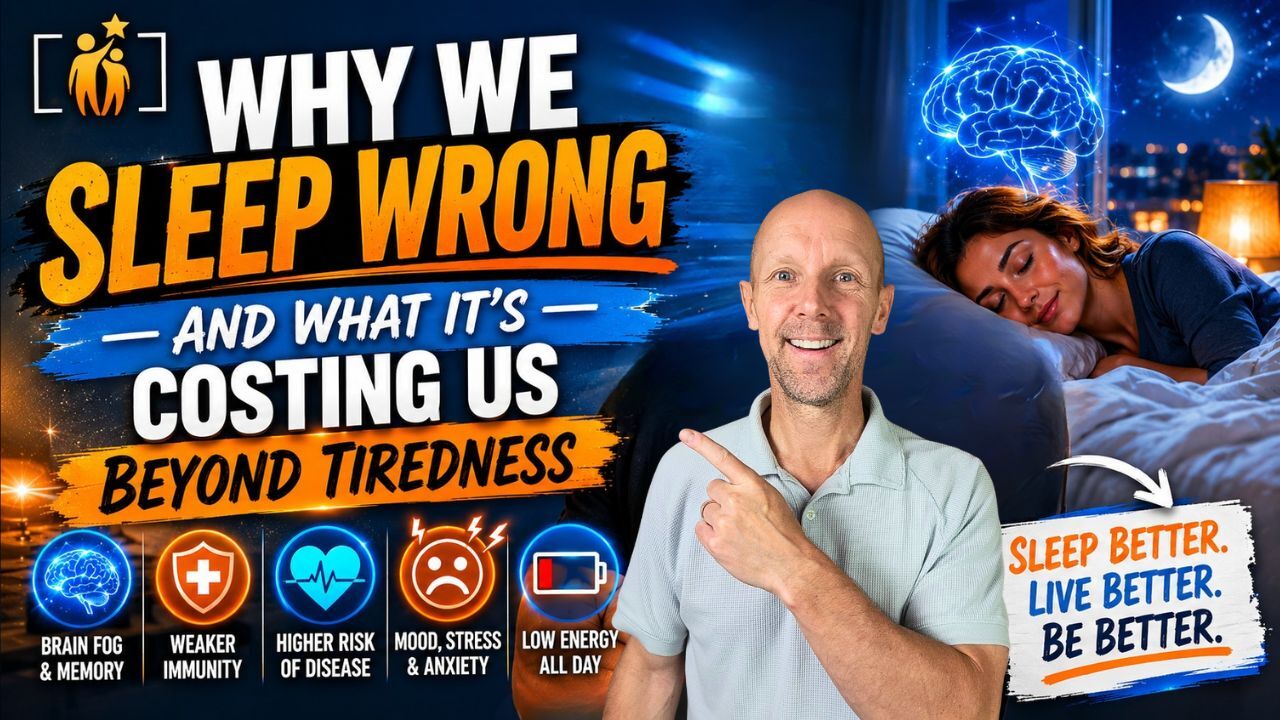
Why We Sleep Wrong — And What It's Costing You Beyond Tiredness
~22 min | June 4, 2026
Most people treat sleep like a phone charger — plug in when the battery's dead, unplug when you have to leave, and settle for 60% if that's all you have time for. But sleep isn't passive recovery. It's the most important biological work your body and brain do in any 24-hour period — and when you consistently cut it short, the costs go far deeper than tiredness. They show up in your decisions, your relationships, your cravings, your stress response, and ultimately, in how you see yourself.
What You'll Learn in This Episode
- Why sleep is active biological work — not downtime — and what your brain is actually doing while you're unconscious
- How sleep deprivation degrades decision-making, impulse control, and emotional regulation at a structural level, not just a "tired" level
- Why chronic sleep debt can quietly reshape your identity — making you believe the depleted version of yourself is just who you are
- How hustle culture's glorification of exhaustion is a biological misunderstanding, not a performance strategy
- Why "catching up on the weekend" doesn't fully work, and what the real alternative looks like
- The connection between poor sleep, spiking cravings, and the failure of willpower — and why it has nothing to do with discipline
- Four honest reflection questions to help you assess what sleep is actually costing you right now
Episode Timestamps
[00:00]Cold open — the real reason you can't stay consistent[01:00]Introduction and episode framing[02:00]The phone-charger mindset — how most people think about sleep (and why it's wrong)[04:00]What sleep actually is: memory consolidation, hormone regulation, immune repair, and the glymphatic flush[07:00]Brett's personal story — his mother's chronic sleep deprivation and its long-term consequences[09:00]The real costs of poor sleep: decision-making, emotional regulation, cravings, stress response, and identity[13:00]Hustle culture and the biological misunderstanding — why exhaustion is not ambition[16:00]Sleep as the foundation of body vitality — why all other health habits work uphill without it[19:00]Four reflection questions and a challenge to commit to one shift
Episode Summary
There's a story most driven people tell themselves at some point: "I'll rest when things slow down. Right now I just need to push." It's a story Brett Ingram has told himself, and one he spent years living out — grinding through grad school, a full-time job, small kids at home, and a business he was building from scratch, running on five or six hours a night and calling it normal.
This episode is about why that story isn't ambition. It's a coping mechanism with branding on it.
The central reframe Brett offers is simple but significant: sleep is not the absence of your day. It's not downtime, not recovery in any passive sense. It's active biological work — some of the most critical your body performs — and it only happens when you're unconscious. During sleep, the brain consolidates memory, processes emotion, and flushes out metabolic waste through the glymphatic system. Hormones that regulate hunger, stress, and growth are produced and balanced. The immune system completes a significant portion of its repair. And each sleep stage — light, deep, REM — does something distinct. Cutting sleep short doesn't just mean less of it. It often means cutting the most valuable parts.
What makes this episode especially grounded is that Brett isn't speaking from a position of having figured it out. He's speaking from having lived the costs. His mother worked third shift as a nurse for roughly fifteen years, sleeping four to five hours a night, staying awake during the day so she wouldn't miss her family's waking hours. By her early 70s, she'd developed memory problems. Not long after, a stroke. Brett is careful to say it's anecdotal — he doesn't have clinical proof — but the pattern, combined with the research he's since reviewed, reads clearly to him in retrospect.
The costs he walks through are worth sitting with, because they go far beyond fatigue. Decision-making degrades structurally — the prefrontal cortex, responsible for impulse control, long-term thinking, and nuanced judgment, is one of the first things to suffer. Emotional regulation drops, making you measurably more reactive, more likely to read neutral situations as threats. Hunger hormones shift, driving cravings for high-sugar and high-fat foods — not because of a willpower failure, but because your biology is compensating for an energy deficit in the only way it knows how short-term. Cortisol doesn't regulate as well, so small friction piles up and recovery from stress takes longer.
And then there's the piece that Brett calls out as the one that doesn't get talked about enough: sleep affects who you believe you are. When you're chronically sleep-deprived, you start to build an identity around the depleted version of yourself — the one who can't stick to things, who's always behind, who snaps at the people they love, who doesn't have the energy for what matters. You may not realize that version of yourself isn't you. It's your nervous system running on empty.
This connects directly to what Brett calls a culture problem. Exhaustion gets mistaken for ambition. The hustle-culture framing — "I'll sleep when I'm dead," 4 a.m. wake-up posts, bragging about surviving on five hours — isn't a performance strategy. It's a biological misunderstanding. The analogy Brett reaches for is elite athletes and bodybuilders: the best coaches in the world will tell you that training breaks the body down. Recovery is where adaptation happens. Mr. Olympia competitors sleep 10 to 12 hours a day during training because they understand that every hard workout is only as good as the rest that follows it. You don't get stronger in the gym. You get stronger in the recovery.
The same principle applies to the mind, creativity, emotional capacity, and relationships.
This is why, in Brett's framework, sleep sits at the base of [the foundation of body vitality] — not as one habit among many, but as the floor everything else is built on. You can eat well, move your body, manage stress, supplement, meditate. All of it matters. But if sleep is broken, those other habits are working uphill. Fix the floor, and everything built on top of it gets more traction.
Brett closes with four reflection questions — not a protocol, not a checklist, but genuine prompts: What's actually true about your sleep over the last few weeks? Are there areas where you've been frustrated with yourself that might have a sleep component you've been overlooking? What story have you been telling yourself about sleep — and is it serving you? And if you slept better, consistently and intentionally, what version of yourself shows up?
Resources Mentioned
- Stephen Covey's The 7 Habits of Highly Effective People — Referenced for the "run the machine without maintenance" analogy — Amazon
Frequently Asked Questions
Why does sleep deprivation affect decision-making so much? The prefrontal cortex — the part of the brain responsible for impulse control, long-term thinking, and nuanced judgment — is one of the first regions to suffer under sleep deprivation. After poor sleep, you're more reactive, more impulsive, and more likely to prioritize short-term comfort over what you actually want long-term. This isn't a willpower issue. It's a structural neurological one.
Can you catch up on sleep over the weekend? Partially, but not fully. You can reduce some of the acute impairment, but the research shows that weekend recovery doesn't fully reverse the cumulative effects of chronic sleep debt — particularly on cognitive performance and emotional regulation. Consistency matters more than compensation.
Why do I crave junk food when I'm sleep-deprived? Two key hunger hormones — ghrelin (which stimulates appetite) and leptin (which signals fullness) — are disrupted by poor sleep. Ghrelin rises and leptin falls, driving cravings for high-sugar and high-fat foods. This isn't a lack of discipline. Your biology is compensating for an energy deficit in the only short-term way it knows how.
How does sleep affect relationships and emotional availability? Sleep deprivation measurably increases emotional reactivity and makes you more likely to interpret neutral situations as threatening or negative. You become less present, shorter-tempered, and less emotionally available — often without realizing it. People close to you feel the absence, even when you attribute it to stress or busyness rather than sleep.
What's the minimum amount of sleep most people actually need? Science generally points to seven hours as a minimum for most adults, with optimal performance often requiring seven to nine. Individual variation exists, but the percentage of people who genuinely function well on less than six hours is very small — far smaller than the number who believe they do.
How does chronic sleep deprivation affect your sense of identity? Over time, the traits that emerge from chronic sleep debt — irritability, low patience, poor follow-through, emotional unavailability — can feel like permanent personality features rather than symptoms of deprivation. You start to believe the depleted version of yourself is just who you are. Brett's point is that for many people, that identity shift is reversible once sleep is addressed.
If I genuinely don't have time to sleep more, what should I do? Brett's experience — and the research — suggests that sleeping more often creates more productive waking hours, not fewer. The quality of thinking, decision-making, and focus when well-rested frequently more than compensates for the extra hour spent asleep. The constraint may be real, but the tradeoff is often misunderstood.
Keep Exploring
- Purpose & Meaningful Work — The full guide to what meaningful entrepreneurship actually looks like, including how to show up, sustain yourself, and build work that matters.
- Time, Rhythm, & Rest — Why rest isn't inefficiency, and how to build recovery into your life as a feature, not a reward → Time, Rhythm, & Rest Guide
- Life Architecture - A deeper look at designing a life around what actually matters instead of default expectations.
Enjoyed This Episode?
The best way to support optYOUmize is to subscribe and leave a review — it takes about two minutes and makes a real difference in helping more people find the show.
Apple Podcasts · Spotify · Amazon Music · YouTube