How to Stop Comparing Yourself to Others
~21 min | July 27, 2026
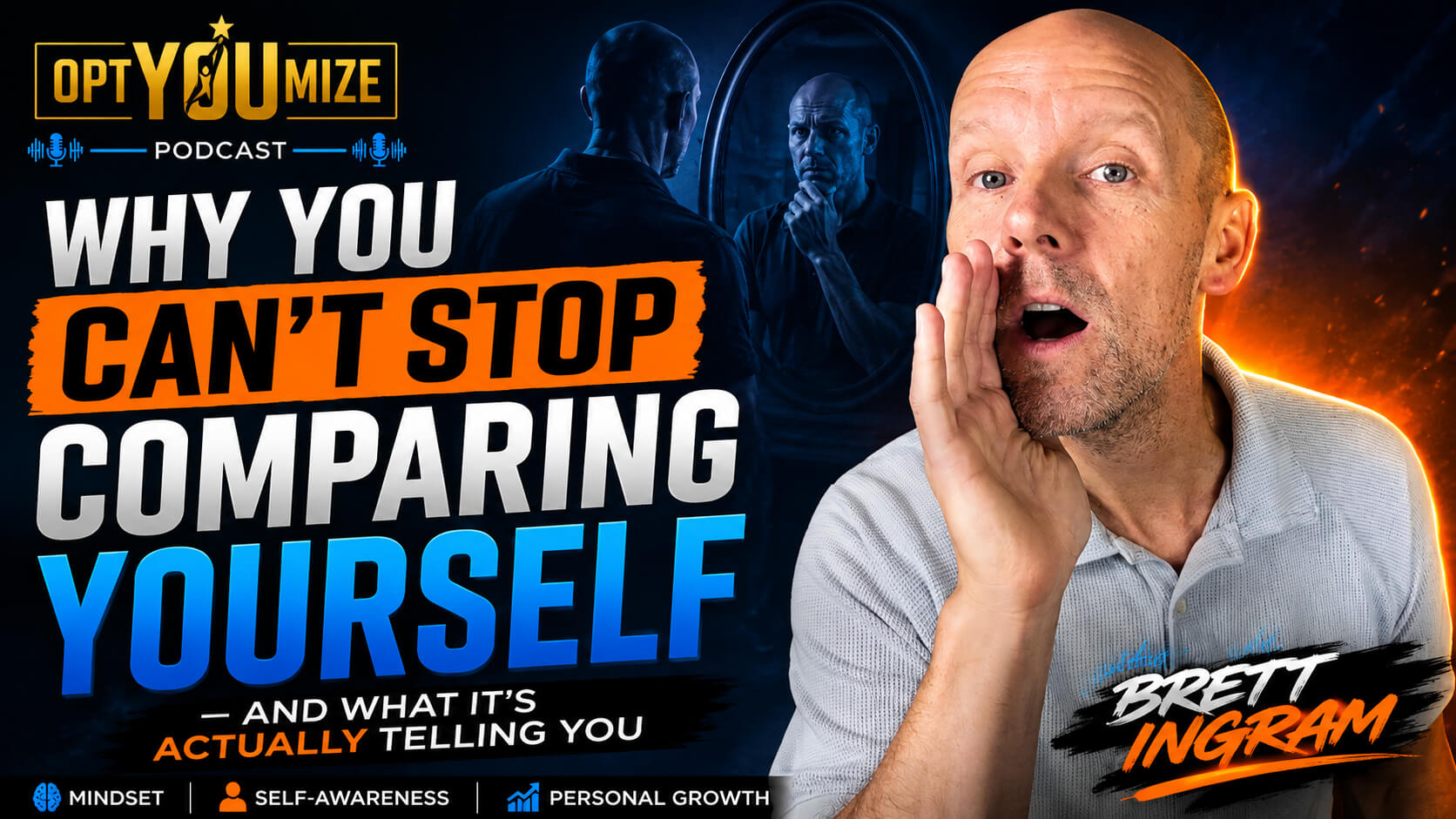
You can't stop comparing yourself to others, and treating it like a bad habit you should be able to quit only adds shame to the pile. Comparison is built into how humans figure out where they stand — it's the ruler your mind reaches for whenever a question has no objective measure. This episode reframes the whole problem: the goal isn't to silence comparison but to read it. The sting you feel is information, pointing at either a value that's genuinely yours or a borrowed metric you never actually chose — and learning to tell the two apart is the real work.
What You'll Learn in This Episode
- Why comparing yourself is evidence you're a person, not evidence something is wrong with you
- Why the reflex is strongest on the parts of life that have no scoreboard — marriage, parenting, whether your work adds up
- How social media rigged an ancient instinct by pitting your whole life against everyone else's highlight reel
- What a 2014 study found about social media, upward comparison, and self-esteem — and why the evidence deserves honesty, not overclaiming
- The assimilation–contrast distinction: why the same success can inspire one person and flatten another
- A three-question framework — whose scoreboard, what's it pointing at, what's the smallest honest move — you can run in 90 seconds
- How realizing you don't want something can be one of the most freeing outcomes available
Episode Timestamps
[00:00]The four-second collapse: happy until you see someone else's life[01:15]Why you're wired to compare — and why willpower won't switch it off[02:30]Festinger's social comparison theory and the missing ruler[03:15]A story from the soccer field: feeling great until you get to know the other dads[05:00]Why it's worse now: a few hundred neighbors vs. thousands of highlight reels[06:30]The invisible price tag — debt, help, and unhappiness you never see[07:45]What the research actually says (and where it's honest to hedge)[08:45]Inspired or crushed? Assimilation, contrast, and the film Amadeus[10:40]Why "just stop comparing yourself" is useless and a little harmful[12:30]The three questions: scoreboard, signal, smallest honest move[14:30]Running the framework on career, marriage, and fitness[16:30]Three cautions so you don't misuse it[18:20]The 90-second practice for the week[19:40]Whose scoreboard are you playing on? — closing
Episode Summary
We tend to treat comparison as a personal weakness — something disciplined, well-adjusted people have supposedly grown out of. This episode starts by taking that weight off your shoulders. Comparing yourself to other people isn't a character flaw; it's evidence that you're human. Back in 1954, psychologist Leon Festinger laid out what he called social comparison theory: when there's no objective ruler for something, we reach for the nearest available one, which is other people. That's why comparison bites hardest exactly where it matters most and can least be measured — whether you're a good parent, whether your career adds up, whether your life means anything. Nobody agonizes over comparing their shoe size. They agonize over the things with no scoreboard.
So if the reflex is this normal, why does it feel so much worse than it used to? Because the environment changed while the wiring didn't. For almost all of human history you compared yourself to a few hundred people whose whole lives you actually saw — the good mornings and the bad ones, the arguments, the ordinary Tuesdays. Now the comparison set is thousands of strangers, and you're not seeing their lives. You're seeing their highlight reels: the launch, not the eighteen months of doubt before it; the vacation, not the credit card statement after it. You're pitting your entire unedited life against the single best moment other people chose to publish. It was never a fair fight. Brett illustrates it with a moment from his own life — feeling genuinely good about working from home and being present for his kids, right up until a conversation with other dads at soccer practice made him wonder if he'd made the wrong call entirely. Nothing about his life had changed. Only the ruler had.
There's real research here, handled with care. A 2014 study by Erin Vogel and colleagues, Social Comparison, Social Media, and Self-Esteem, found that heavier Facebook users tended to have lower self-esteem, with the link running specifically through upward comparison. The honest caveat: it's correlational, the effect runs both ways, and no single study settles it — but it lines up with what we already sense, that a steady diet of context-free upward comparison wears people down. The more interesting finding is that looking "up" doesn't automatically hurt. Psychologists distinguish assimilation ("that's possible, that could be me") from contrast ("that just proves how far behind I am"). Same person, same achievement, opposite effects. As the episode puts it, the sting isn't fixed — it has a dial, and the dial is your relationship with the comparison, not the comparison itself.
That's why "just stop comparing yourself" is such bad advice. You can't — it's like telling someone to stop feeling hungry — and even if you could, you'd be throwing away real information. Envy is one of the most honest signals you have precisely because it slips past your rehearsed answers about what you're supposed to want and points at what you actually want and don't have. The move is to calibrate the instrument, not smash it. This is where the episode connects to building a clearer relationship with your own mind: instead of killing the signal, you read it with three questions. Whose scoreboard is this — did I ever choose this measure? What is the sting pointing at — a genuine value, or a borrowed metric? And what's the smallest honest move — one step toward it this week, or the quiet, freeing decision to stop keeping score? You can run it standing in your kitchen in about ninety seconds. The point isn't to feel less. It's to understand more — and to finally answer, for yourself, whose scoreboard you're actually playing on.
Resources Mentioned
- Leon Festinger, "A Theory of Social Comparison Processes" (1954) — the foundational paper establishing that we evaluate ourselves against others when objective measures are missing. Human Relations, 7(2), 117–140.
- Vogel, Rose, Roberts & Eckles, "Social Comparison, Social Media, and Self-Esteem" (2014) — linked heavier Facebook use with lower self-esteem via upward comparison. Psychology of Popular Media Culture, 3(4), 206–222.
- Amadeus (1984) — used as an illustration of contrast comparison, with Salieri undone by proximity to Mozart's genius.
- Mind & Inner Life pillar page — https://www.optyoumize.com/mind-inner-life?hsLang=en
Frequently Asked Questions
Why can't I stop comparing myself to others? Because comparison isn't a habit — it's a built-in way of measuring yourself when no objective ruler exists. Festinger's social comparison theory showed we use other people as a yardstick precisely for the questions that can't be measured directly, which is why it's strongest on the things we care about most.
Is comparing yourself to others normal? Yes. It's standard human wiring, not a sign of insecurity or weakness. The episode's phrase is that you're "running standard human software." What varies isn't whether you compare, but whether you let an unexamined comparison run your mood and your decisions.
Why does social media make comparison worse? It distorts the inputs. You're comparing your whole, unedited life — including everything nobody else can see — against other people's curated highlight reels. Research associates heavy upward comparison online with lower self-esteem, and you can never see the invisible debt, help, or unhappiness behind someone's polished image.
What's the difference between healthy and unhealthy comparison? It's the difference between assimilation and contrast. Assimilation turns someone else's success into proof that something is possible for you and pulls you forward. Contrast turns the same success into evidence of how far behind you are and pushes you down. The comparison itself is neutral; your relationship to it decides the effect.
How do I deal with envy of someone's success? Treat the envy as data, not shame. Ask whose scoreboard you're using, whether it points to a value that's genuinely yours or a borrowed metric, and what the smallest honest move is. If it's real, take one small step toward it. If it's borrowed, consciously stop keeping score on it.
How do I know if a goal is actually mine or something I absorbed? Look underneath the sting. If it points to something you genuinely care about and have been neglecting, it's a real value worth one honest step. If you realize you don't actually want the thing — you just don't want to look behind — it's a borrowed metric, and putting it down is a relief, not a failure.
Keep Exploring
If this episode resonated, these are worth your time:
- Mind & Inner Life (pillar page) — The home base for building a steadier relationship with your own thoughts and self-evaluation → https://www.optyoumize.com/mind-inner-life?hsLang=en
- Money & Financial Wellbeing (pillar page) — Because so much comparison is really about borrowed scoreboards of money and status → https://www.optyoumize.com/money-financial-wellbeing?hsLang=en
- Life Architecture — How the seven pillars fit together into a whole, intentional life → https://www.optyoumize.com/life-architecture?hsLang=en
Enjoyed This Episode?
The best way to support optYOUmize is to subscribe and leave a review — it takes about two minutes and makes a real difference in helping more people find the show.
Apple Podcasts · Spotify · Amazon Music · YouTube