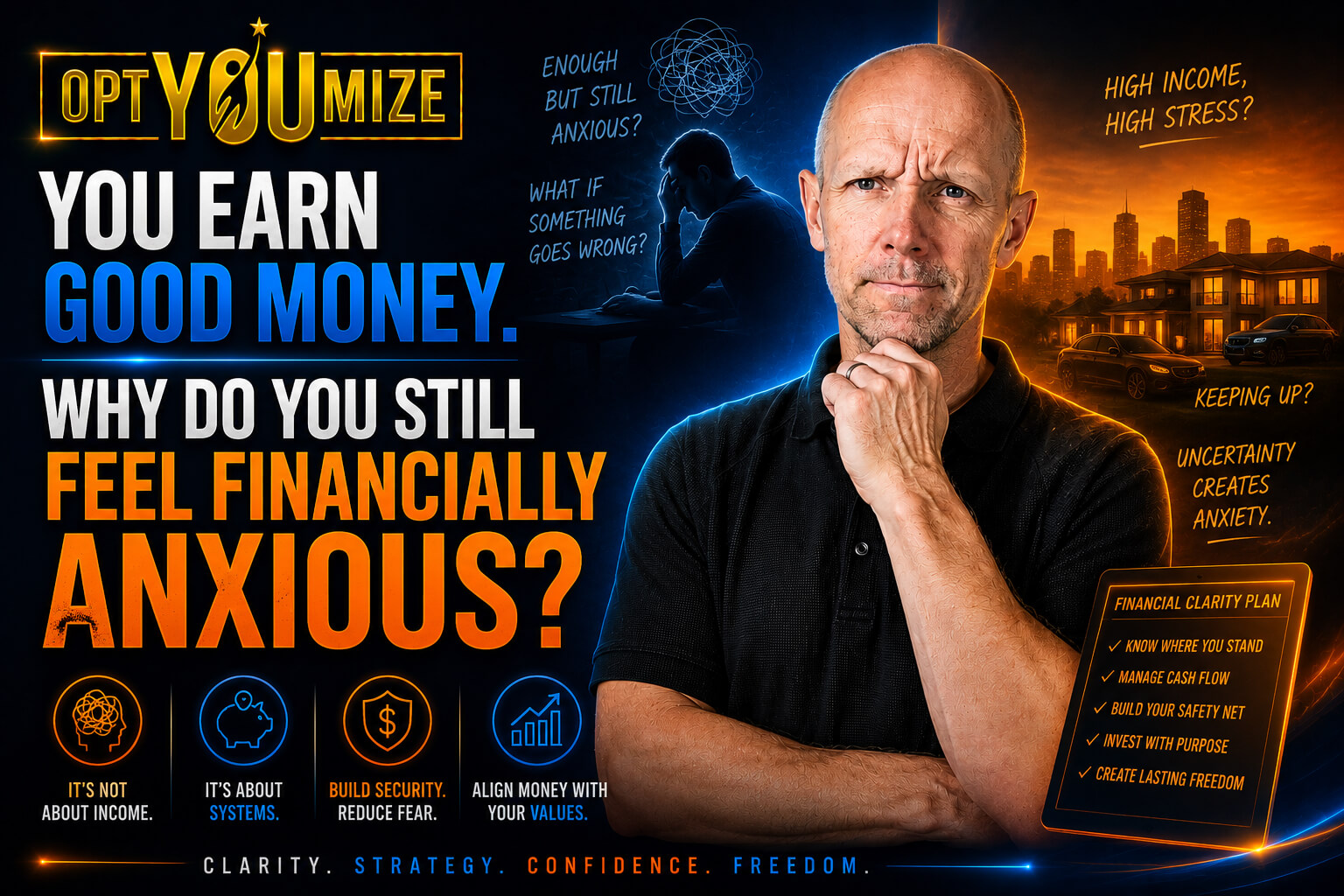
You Earn Good Money — Why Do You Still Feel Financially Anxious?
~21 min | July 30, 2026
Financial anxiety doesn't reliably fall as income rises, because feeling secure is a psychological state built on a moving reference point and an inherited story about money — not a number your bank balance eventually crosses. In this episode, Brett Ingram separates financial stability, a measurable fact, from financial security, a feeling, and shows why earning more — without touching the reference point or the story underneath it — just quietly raises the bar for what "safe" would require. You'll leave with a ten-minute exercise, the Security Gap, for telling whether your anxiety is pointing at a real shortfall or a finish line you've been redrawing out of habit.
What You'll Learn in This Episode
- Why "money dysmorphia" lets you feel broke while the statement says otherwise — and why it follows people right up the income ladder
- The three forces that keep "enough" quietly out of reach: hedonic adaptation, social comparison, and the money scripts you inherited without choosing them
- What the income-and-happiness research actually found, once two researchers who'd publicly disagreed teamed up to reconcile their studies
- The difference between financial stability (a fact) and financial security (a feeling) — and why most money advice only ever works on one side of that gap
- A three-question sequence for telling whether your money anxiety points at a real problem or a moving line
- The ten-minute "Security Gap" exercise for naming what "enough" actually means for your life, with no app or spreadsheet required
- Why sometimes the anxiety is right — and how to tell when it is
Episode Timestamps
[00:00]The number goes up, the fear doesn't (cold open)[01:15]Intro[02:00]The alarm that won't turn off[04:00]Money dysmorphia: feeling broke while the statement says otherwise[05:30]Why "enough" keeps moving: the hedonic treadmill and lifestyle creep[08:00]Whose reference point are you living on?[09:30]The money story you didn't write[11:30]Why "earn more" and "budget harder" both miss[13:30]What the income-and-happiness research actually found[15:30]Stability vs. security: the Security Gap[18:00]The ten-minute Security Gap reflection[20:00]When the anxiety is telling the truth (important caveat)[21:30]Draw the line and stop moving it — closing
Episode Summary
You can watch the number in your account go up — a raise, a good year, a balance that would have stunned you a decade ago — and feel almost exactly as uneasy as you did before. That's the puzzle this episode sits with: why doesn't earning more ever seem to produce the calm you assumed it would? The answer, Brett argues, has almost nothing to do with the number itself.
There's a name for the gap between how your finances actually look and how they feel: money dysmorphia, a distorted read on your own situation where you feel broke while the statement says otherwise, or one bad month from ruin while sitting on a genuine cushion. It shows up at every income level, including high earners — this isn't a feeling reserved for people who are actually struggling. Three forces keep it in place, and they stack. Hedonic adaptation is the tendency to adjust quickly to a new normal, so whatever felt like a luxury becomes the baseline and the baseline starts to feel like the floor — the everyday version of what's commonly called lifestyle creep. Social comparison recalibrates your sense of "enough" against the people around you, so spending that would have looked lavish a few years ago just looks normal once your circle has risen with your income. And underneath both sits a money script — a story about money installed early, watching how the adults around you handled scarcity, fear, or sudden loss — that no raise ever directly answers, because the story was never about the number.
This is also where the two most common pieces of money advice — earn more, or budget harder — quietly fail the people who follow them best, because both assume the problem is math. The research says otherwise. Kahneman and Deaton's well-known 2010 finding that emotional well-being levels off around $75,000 a year became conventional wisdom for a decade, until Killingsworth's 2021 study, using real-time sampling instead of memory, found happiness kept climbing with no ceiling in sight. Rather than argue in public, the researchers ran an "adversarial collaboration" and published a 2023 reconciliation: for most people, well-being keeps rising well past $100,000, but for an unhappy minority it plateaus regardless of income — because their suffering was never actually about money. Money is very good at solving money problems. It's surprisingly bad at solving problems that only look like money problems.
That distinction is the spine of the episode: financial stability is a fact — income, expenses, savings, debt, runway — it either exists or it doesn't. Financial security is a feeling, built on a reference point and a story, not a balance. Brett calls the distance between the two the Security Gap, and offers three questions for locating your own: is this a number, or is it my nervous system; where is the line, and is it moving; and whose voice is the alarm, mine or one I inherited? From there, the episode walks through a ten-minute practice — write your real numbers, name the figure that would let you exhale and compare it to what that number was years ago, then finish the sentence "when I feel unsafe about money, what I'm really afraid of is ___." The goal isn't a budget overhaul; it's clarity about which problem you actually have.
One important caveat runs through the second half: sometimes the anxiety is telling the truth. If the numbers genuinely don't work, that's a real gap deserving a real plan, not a story to reframe. This episode is for the quieter, more common situation — where the facts say okay and the feeling still says danger — which connects directly to what "enough" actually means as a working idea, not a fixed number. Brett closes with Kurt Vonnegut's account of a party on Shelter Island, where his friend Joseph Heller — needled about a billionaire host who made more in a day than Catch-22 had earned in its entire history — replied that he had something the billionaire never would: "the knowledge that I've got enough." Not enough as in stop building. Enough as in a line that finally stopped moving.
Resources Mentioned
- Daniel Kahneman & Angus Deaton, "High income improves evaluation of life but not emotional well-being" (PNAS, 2010) — the widely cited finding that emotional well-being appeared to level off around $75,000 a year.
- Matthew Killingsworth, "Experienced well-being rises with income, even above $75,000 per year" (PNAS, 2021) — a real-time sampling study finding no happiness ceiling.
- Matthew Killingsworth, Daniel Kahneman & Barbara Mellers, "Income and emotional well-being: A conflict resolved" (PNAS, 2023) — the adversarial collaboration reconciling the two prior findings. https://pubmed.ncbi.nlm.nih.gov/36857342/
- Kurt Vonnegut, "Joe Heller" (The New Yorker, 2005) — source of the Vonnegut/Heller "enough" anecdote closing the episode.
- Money & Financial Wellbeing pillar page — https://www.optyoumize.com/money-financial-wellbeing?hsLang=en
Frequently Asked Questions
Why do I still feel financially anxious even though I earn good money? Because feeling secure is a psychological state, not a bank balance. As income rises, spending and expectations tend to rise with it, so the number that would make you feel "safe" keeps moving. Underneath the math is usually an inherited story about money that a raise never directly answers.
What is money dysmorphia? Money dysmorphia is a distorted read on your own financial reality — feeling broke while your statement says otherwise, or feeling one bad month from ruin while sitting on a genuine cushion. It shows up at every income level, including high earners, and it isn't a sign of ingratitude or irrationality.
Why does earning more sometimes make financial anxiety worse instead of better? Because hedonic adaptation and lifestyle creep quietly raise your baseline every time your income rises, so what used to feel like a luxury becomes the new floor. Your sense of "enough" also recalibrates against the people around you, so a higher income can widen the gap between what you have and what feels sufficient rather than closing it.
What's the difference between financial stability and financial security? Financial stability is a fact — income, expenses, savings, debt, and runway — it either exists or it doesn't. Financial security is a feeling, the felt sense that you're okay, and it runs on a reference point and a story rather than a balance. Most money advice only addresses stability, which is why it can leave the underlying anxiety untouched.
How do I figure out if my financial anxiety points to a real problem? Ask three questions in order: is this a number or my nervous system, where is the line and is it moving, and whose voice is the alarm. If the actual numbers are tight, that's a real gap worth a concrete plan. If the numbers are fine and the alarm is still loud, the anxiety is likely pointing at a story rather than a shortfall.
What is the "Security Gap" exercise? It's a ten-minute reflection with three steps: write down roughly where you actually stand financially, write the number that would let you exhale and compare it to what that number was a few years ago, and finish the sentence "when I feel unsafe about money, what I'm really afraid of is ___." No app or spreadsheet is required — the goal is clarity about which problem you have, not a budget overhaul.
Does more money actually make people happier, according to research? For most people, yes — a 2023 reconciliation of prior conflicting studies found well-being keeps rising with income well past $100,000. But for a minority, well-being plateaus regardless of income, because their unhappiness was never really about money in the first place.
Keep Exploring
If this episode resonated, these are worth your time:
- How Much Money Is Enough — The financial version of the "enough line" and what happens when a number keeps relocating itself → https://www.optyoumize.com/podcast/how-much-money-is-enough
- What Is Lifestyle Creep — Why More Money Doesn't Feel Like Freedom — A closer look at the mechanism that quietly cancels out every raise → https://www.optyoumize.com/blog/lifestyle-creep-why-more-money-doesnt-feel-like-freedom
- Money & Financial Wellbeing (pillar page) — The home base for building a grounded, honest relationship with money and security → https://www.optyoumize.com/money-financial-wellbeing?hsLang=en
Enjoyed This Episode?
The best way to support optYOUmize is to subscribe and leave a review — it takes about two minutes and makes a real difference in helping more people find the show.
Apple Podcasts · Spotify · Amazon Music · YouTube