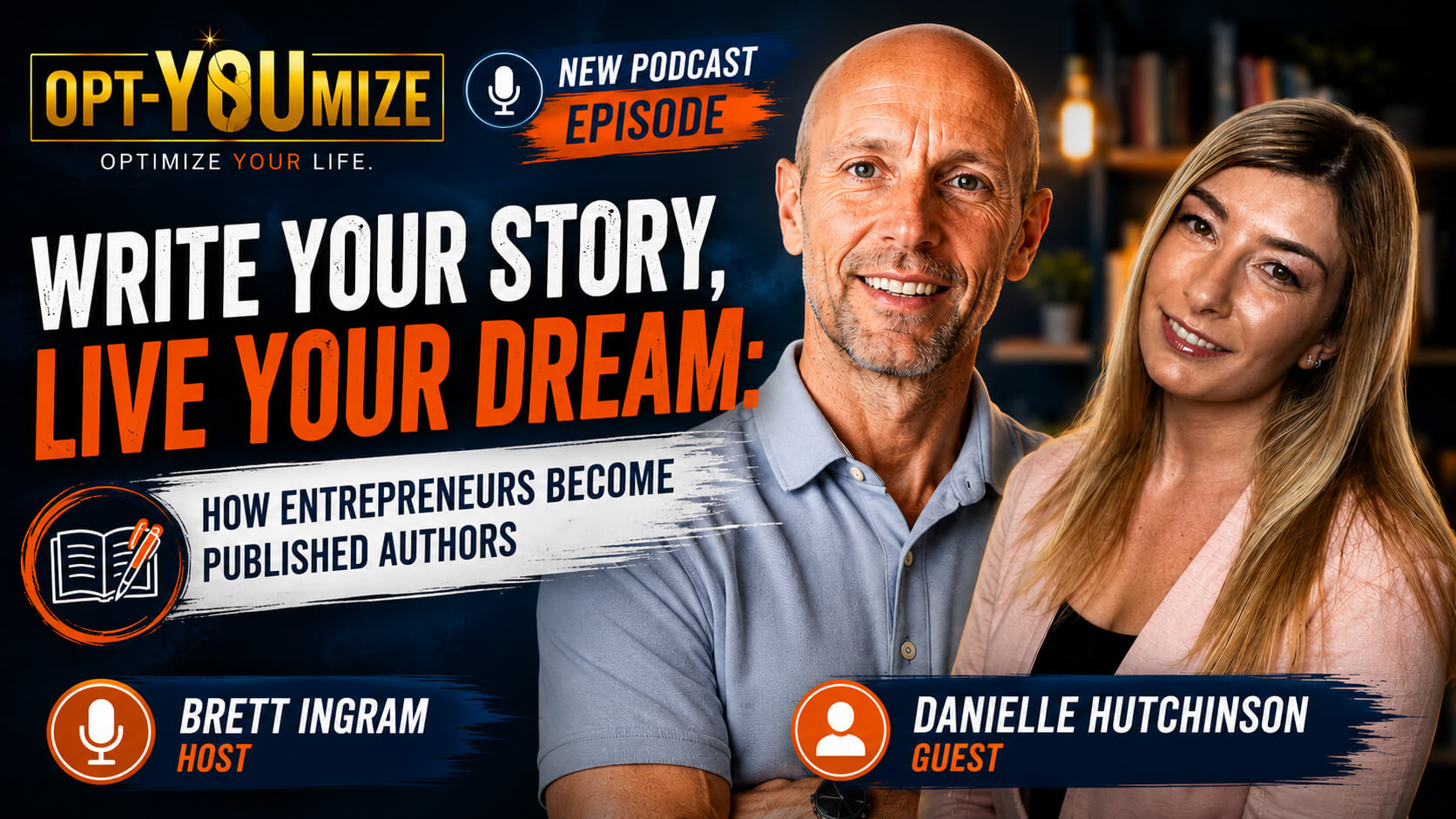
Most entrepreneurs have a book idea sitting somewhere in the back of their mind — but getting it out of their head and onto a shelf feels impossibly complicated. In this episode, Brett talks with Danielle Hutchinson of Authors on Mission about how to write a book as an entrepreneur, what ghostwriting actually involves, and what separates a forgettable book from one that connects and endures.
Write Your Story, Live Your Dream: How Entrepreneurs Become Published Authors
~33 min | June 25, 2025
Danielle Hutchinson started as an English teacher who discovered she had a rare gift for capturing other people's voices on the page. Today, as the lead angel writer at Authors on Mission — one of Inc. Magazine's fastest-growing companies in the US — she's helped write more than 1,100 books for executives, entrepreneurs, and first-time authors. She's also a digital nomad who has traveled the globe multiple times while working from cafes in South Korea, Japan, and Europe. Her conversation with Brett is one of the most practical and honest discussions of the book-writing process you'll find for people who are serious about getting their story told.
What You'll Learn in This Episode
- Why almost every entrepreneur has a compelling story to tell — and why they rarely believe it themselves
- What a ghostwriter actually does, and why the final book is still authentically yours
- The most common mistakes first-time authors make — including the one that makes books feel unreadable
- Why vulnerability and personal setbacks aren't weaknesses in a book — they're the engine that keeps readers going
- How AI is changing (and not changing) the publishing world, and what it can and cannot replace
- The real difference between traditional publishing and self-publishing — and which gives you more control
- What realistic timelines for writing a book actually look like (including Danielle's fastest turnaround: seven days)
- The first step to take if you're ready to finally get your book written
Episode Timestamps
Note: Timestamps are approximate, inferred from transcript pacing. Exact timestamps will vary.
[00:00]Opening — Brett introduces Danielle Hutchinson and Authors on Mission[01:30]Danielle's background: from English teacher to ghostwriter and digital nomad[03:30]The digital nomad life — writing a memoir for a Silicon Valley exec from a cafe in Busan[08:10]Why entrepreneurs almost always have a book on their bucket list — and what stops them[09:00]What ghostwriting actually is — and why the book is still yours[12:00]How ghostwriters capture a client's authentic voice[15:40]The biggest mistakes first-time authors make: jargon, bragging, and missing the human element[17:15]Brett's own story: why he almost didn't start the podcast — and what sharing setbacks really does[19:30]Memoir vs. framework books — when each one makes sense[21:30]What makes a good book great: knowing the market and standing out[22:40]Realistic timelines — from seven days to years[24:45]Traditional vs. self-publishing: pros, cons, and the Authors on Mission middle ground[26:50]AI in publishing — what it can help with and what it will never replace[30:00]The first step to take if you're ready to write your book[31:30]Danielle's number one tip for entrepreneurs: don't settle, don't stop
Episode Summary
The Book Idea You Keep Putting Off
Brett opens this episode with a simple observation: almost every entrepreneur he coaches or talks to has a book idea somewhere on their list. It might be vague — a feeling that their journey is worth documenting, or that the framework they've developed could help others. But the idea never quite becomes a manuscript. The usual culprits are time and structure, but the deeper obstacle, as this conversation reveals, is often a belief that the story isn't remarkable enough to be worth telling.
Danielle pushes back on that gently and directly. In her experience working across more than 1,100 books, she's found that everyone has insights worth sharing — and that the people who underestimate their own story are often the ones who've lived most fully inside it. Proximity breeds invisibility. You stop seeing what's remarkable about your own experience precisely because it's yours.
What a Ghostwriter Actually Does
One of the more useful parts of this episode is Danielle's explanation of what ghostwriting really involves — because the assumption most people carry is wrong. The common fear is that hiring a ghostwriter means putting your name on someone else's book, that the ideas and voice and perspective will belong to the writer, not to you. Danielle calls this a myth, and explains why.
The ideas, the stories, the case studies, the framework — all of that comes from you. The ghostwriter's job is to be a platform for getting that material out clearly, compellingly, and in your voice. It's a skill that takes real development: she describes it as like learning to speak someone else's language, or stepping into a costume, or becoming bilingual. You immerse yourself in how a client speaks, what words they emphasize, what they care most about, and you write from inside that perspective. When it's done well, the client reads it and recognizes themselves — not the writer's version of them, but themselves.
This matters especially for entrepreneurs who are considering a book as both a personal legacy and a business asset. The book needs to feel like you, because in most cases, it's going to be how potential clients, collaborators, and audiences decide whether they trust you. A book that reads like it was written by someone else does the opposite of what you need.
The Two Mistakes That Kill Most First Books
Danielle has a sharp eye for what makes books fail, and two patterns come up consistently.
The first is jargon. Writers naturally default to the vocabulary of their own field — the shorthand they use with colleagues, the industry terminology they take for granted. But a book written for a general or business audience needs to define that language, not assume it. Danielle is careful to distinguish between dumbing down and defining well. You're not making the content simpler. You're making it accessible enough that someone outside your exact specialty can engage with it and act on what you're saying.
The second mistake is all success and no struggle. Many first-time authors want to lead with credentials and achievements — fortune 500, founding stories, big milestones. But nobody wants to read 250 pages of someone being right about everything. What actually keeps readers going is recognizing themselves in the narrative. And you only give them that when you're honest about the obstacles, the failures, the moments of genuine uncertainty. Brett adds his own version of this: when he was about to launch the podcast, he spent weeks frozen by the feeling that he didn't have enough answers to warrant hosting a show about entrepreneurship. What broke him loose was realizing that the journey itself — not having all the answers — was exactly the point. Sharing that vulnerability isn't a weakness. It's the thing that makes an audience trust you.
Publishing in the Age of AI
No conversation about writing in 2025 can avoid AI, and this one doesn't. Danielle's take is honest and balanced. Amazon is already saturated with AI-generated books — quantity flooding a market where quality is increasingly rare. But she's not dismissive of AI as a tool. It's genuinely useful for organization, research, outlining, and quick responses. What it cannot do is capture the human voice with real authenticity, particularly the kind of voice that carries personal experience, emotional texture, and the earned perspective that comes from actually living through something. AI writing, she notes, tends to loop — repeating itself in slightly different phrasing, using vocabulary nobody actually uses, filling space without saying anything new. A book built on that foundation may look complete but won't feel like anyone in particular wrote it.
The distinction that Brett and Danielle land on: AI can be a useful base or scaffold, but human authenticity has to come in at some point. The stories you've lived, the losses you've navigated, the specific way you see the world — those are yours, and they're what make a book worth reading.
Your First Step
For anyone ready to move from bucket-list item to actual manuscript, Danielle makes the starting point refreshingly simple: book a consultation at authorsonmission.com. You don't need to know what you want to write about. You don't need a finished outline. You don't need to have figured out whether you want a memoir or a framework book, traditional or self-publishing. The consultation is where you begin to figure that out — with someone alongside you who has helped more than a thousand authors do exactly the same thing.
The episode closes with Danielle's single tip for entrepreneurs: don't settle, don't stop. She works a full teaching day and then a second shift until midnight on her writing projects. But she's clear that the effort isn't a burden — when the work is something you genuinely love, the second shift barely registers as work at all. That, too, is part of the story worth telling.
If writing and publishing a book feels like something you're meant to do — or if you're building a business around your ideas and haven't yet crystallized them into a lasting piece of work — the full framework for thinking about what that kind of meaningful contribution looks like is at the Purpose & Meaningful Work pillar.
Resources Mentioned
- Authors on Mission — Danielle's ghostwriting and publishing company; one of Inc. Magazine's fastest-growing companies in the US. authorsonmission.com
- Authors on Mission Podcast — Danielle's own podcast featuring conversations with authors about the writing and publishing process. Available on major podcast platforms.
Frequently Asked Questions
How can a busy entrepreneur write a book without having time to write?
The most direct answer is to work with a ghostwriter — someone who captures your ideas, stories, and voice and shapes them into a manuscript. This is the model Authors on Mission uses: the ideas, framework, and expertise are entirely yours, while the ghostwriter handles the drafting. The process typically starts with an outlining and consultation phase where you share your vision, vocabulary, and what you want the book to accomplish. From there, the writing happens around your schedule rather than requiring you to carve out time to write.
Is a ghostwritten book really your own book?
Yes — a well-ghostwritten book is authentically yours. The ideas, stories, case studies, and perspective all come from you. The ghostwriter's job is to capture your voice so accurately that you read the finished draft and recognize yourself in every line. Danielle describes the skill as becoming "bilingual" — stepping into the client's way of speaking, thinking, and framing ideas. The result is a book that sounds like you, because it is you — just shaped and structured by someone with the craft to make it readable and compelling.
What are the biggest mistakes first-time authors make?
Two come up most often. First, writing in industry jargon that assumes the reader shares your expertise — good books define the language rather than assume it. Second, focusing too heavily on accomplishments and not enough on setbacks. Readers don't connect with someone who's always been right; they connect with someone who's struggled with the same things they're struggling with. Vulnerability and honest storytelling aren't weaknesses — they're what gives a book staying power.
What's the difference between self-publishing and traditional publishing?
Traditional publishers offer credibility and distribution but impose rigid guidelines on your content, cover, and timeline — and you surrender significant creative control. Self-publishing gives you full ownership and flexibility but leaves you to navigate formatting, ISBN registration, and marketing largely on your own. Authors on Mission offers a middle path: you retain creative control, work with an angel writer to produce the manuscript, and the company handles formatting and publishing, while lending its name for credibility.
How long does it take to write a book?
It varies enormously. Danielle has completed books in as few as seven days for clients with urgent deadlines, while other projects have stretched across a year or more — often because the author is still finalizing decisions after the manuscript is done. The speed largely depends on how organized the client is, how available they are for collaboration, and how decisive they are when it comes to final edits. The writing itself, with a skilled ghostwriter, can move faster than most people expect.
How is AI changing the book publishing world?
AI has flooded platforms like Amazon with generated content, making the market more saturated but also raising the value of authentic, human-voiced books. As a tool, AI is genuinely useful for outlining, research, and drafting early structure — but it can't capture earned personal experience, emotional specificity, or the particular way a real person sees the world. Books built primarily on AI tend to feel generic: repetitive phrasing, vocabulary no one actually uses, and a voice that belongs to no one. Human authenticity remains the differentiator.
What's the first step to becoming a published author as an entrepreneur?
Book a consultation — even if you don't yet know what you want to write. You don't need a finished outline or a clear direction; the consultation is precisely where you start to figure that out. Authors on Mission works with clients at every stage, from "I have a vague sense I have a story to tell" to "I have a framework and just need someone to help me structure and write it." Starting the conversation is the step most people keep delaying, and it's the only one that matters.
Keep Exploring
If this episode resonated, these are worth your time:
- Purpose & Meaningful Work Pillar — The full collection of writing on career, contribution, entrepreneurship, and doing work that actually means something. If you're building something worth telling a story about, this is where to go deeper.
- Growth & Self-Becoming Pillar — Writing on personal transformation, long-term becoming, and the work of growing into who you're meant to be — including the discipline it takes to create something lasting.
Enjoyed This Episode?
The best way to support optYOUmize is to subscribe and leave a review — it takes about two minutes and makes a real difference in helping more people find the show.
Apple Podcasts · Spotify · Amazon Music · YouTube