
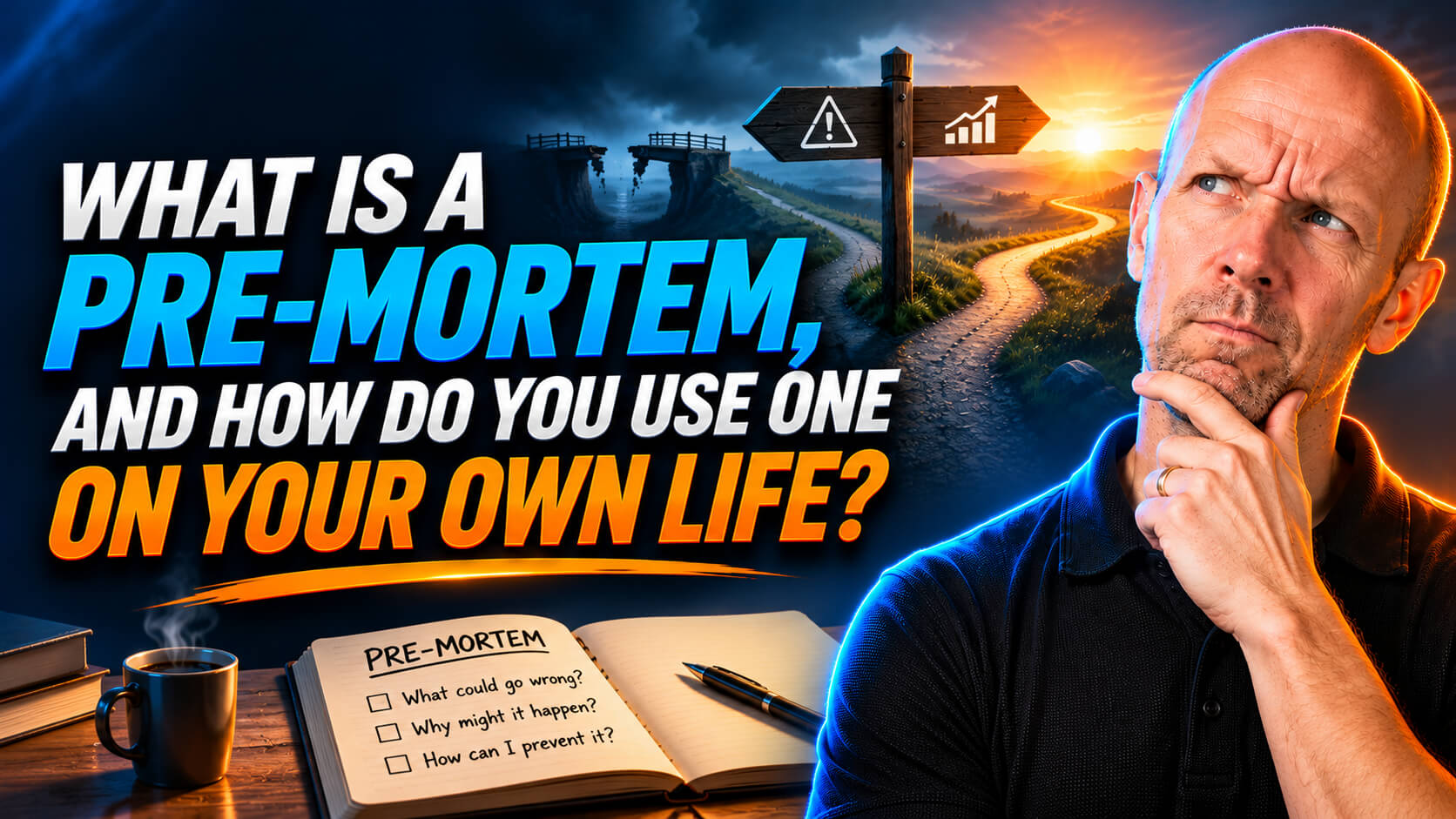
What Is a Pre-Mortem, and How Do You Use One on Your Own Life?
By Brett Ingram | Last updated November 6, 2026 | 6 minute read
A pre-mortem is a planning exercise where you imagine your project or decision has already failed, then write down every reason why. Psychologist Gary Klein described the technique in Harvard Business Review as a way for teams to surface problems while there's still time to fix them. It works just as well on your own life: before you quit the job, sign the lease or commit to the new routine, you spend 20 minutes looking back from a future where it went badly, and you build the fixes in now.
The Simple Answer
A post-mortem happens after something dies. A pre-mortem happens while it's still alive and you can do something about it. You picture the failure as a done deal, which makes it easier to be specific and honest. “What could go wrong?” invites vague worry. “It went wrong. Why?” invites a story, and stories have details you can act on.
Why Does Imagining Failure Help?
Because most of us plan like optimists and worry like amateurs. When we plan, we fall for our own best-case version. When we worry, we spin in circles at 2 a.m. without producing a single usable thought. A pre-mortem gives worry a job, a time limit and a notepad.
Klein's framing, as I read it, is that people feel permission to speak up once failure is treated as a given rather than a doubt. On a team that means the quiet skeptic finally gets heard. In your own head it means the nervous part of you gets a seat at the table instead of heckling from the back. Think of it as a kind of Back to the Future for decisions: you visit the bad timeline on purpose, take notes, and come back before Biff has the sports almanac. (I'll admit that's where the analogy ends. Please don't build a DeLorean.)
How Do You Run a Pre-Mortem on a Personal Decision?
You don't need a team or a whiteboard. A notebook and a quiet half hour will do. Here's the version I'd use.
- Name the decision in one sentence. “I'm leaving my job to freelance.” “We're moving across the country.” “I'm training for a half marathon.”
- Set the time machine. Pick a date 6 to 12 months out. Write: “It's [that date], and this turned out to be a mistake.”
- Write the reasons, fast. Set a timer for 10 minutes and list every cause you can think of. Don't edit. Include the boring ones (cash ran out) and the uncomfortable ones (I avoided the hard conversation).
- Sort them. Mark each reason by how likely it feels and how bad it would be.
- Turn the top few into actions. For each one, decide on a prevention, a tripwire or a backup plan.
- Decide. Go ahead, adjust the plan, or wait. All three are legitimate wins.
What Does a Pre-Mortem Look Like in Practice?
Here's an example for a made-up reader, Dana, who's thinking about leaving a steady job to freelance. This is an illustration, not a case study.
| Imagined cause of failure | Likelihood / impact | What Dana does about it |
|---|---|---|
| Savings ran out before clients showed up | High / High | Build a runway of several months of expenses first; set a "go back to employment" tripwire date |
| Only one client, who then left | Medium / High | Line up at least two prospects before giving notice |
| Loneliness without coworkers | Medium / Medium | Schedule a weekly coworking day or standing coffee |
| Never learned to price or invoice properly | Medium / Medium | Talk to two freelancers about rates; use a simple contract template |
| Burnout from no boundaries | Medium / High | Set working hours and a hard weekly day off before day one |
Notice what happened. Dana didn't talk herself out of anything. She found five problems with five answers, and the plan got stronger. Sometimes a pre-mortem does change the answer, and that's useful too. Learning “not yet” for the price of one notebook page beats learning it from a bank statement.
What About the Positive Version? (The Pre-Parade)
This one's my own addition, not Klein's, so take it for what it's worth. After the failure round, flip it: “It's a year from now and this went wonderfully. What did I do that made it work?” You'll often find the answers are habits and relationships, not luck. It's a good way to keep the exercise from souring your enthusiasm, and it gives you a short list of things to protect.
When Is a Pre-Mortem Worth Doing?
Use it when the decision is big, hard to reverse, or expensive in time, money or relationships. Skip it for choosing lunch.
| Good candidates | Probably overkill |
|---|---|
| Changing careers or leaving a job | Which streaming show to start |
| Moving cities or buying a home | Rearranging the living room |
| Taking on a major commitment (caregiving, board seat, big project) | Trying a new recipe |
| Launching a new routine you've failed at before | Picking a gym playlist |
It pairs well with a bigger-picture review. If you haven't done one lately, start with a life audit to see where you actually are, or sketch a few futures with an odyssey plan, then pre-mortem the one you're leaning toward.
Where Can a Pre-Mortem Go Wrong?
Three ways, in my experience. First, it can become a worry festival. The timer and the action step are what keep it useful, so don't skip them. Second, you can treat the list as a prediction. It isn't. It's a brainstorm of possibilities, and most of them won't happen. Third, you can do it and then ignore it. A reason with no action next to it is just a complaint.
It also doesn't replace your own willpower, or lack of it. Many failures on the list will come down to defaults and friction, which is why the fixes work best as structure, not resolutions. We cover that in why willpower doesn't work and what to build instead. And if you're drifting through big decisions without looking at them at all, living by default vs. living by design is the place to start.
This post is general information, not financial, legal or career advice. For major money or health decisions, consult a qualified professional.
Frequently Asked Questions
What is a pre-mortem in simple terms?
It's a planning exercise where you assume your project or decision has already failed and list the reasons why, so you can fix the weak spots before you commit.
Who invented the pre-mortem?
Psychologist Gary Klein developed and popularized the technique, describing it for a business audience in Harvard Business Review in 2007.
How long should a personal pre-mortem take?
About 20 to 30 minutes is plenty: 10 minutes of fast listing, then 10 to 15 minutes sorting the reasons and choosing actions. Bigger decisions deserve a second pass a week later.
Is a pre-mortem the same as worrying?
No. Worry loops without an outcome. A pre-mortem has a time limit, a written list and an action for each top risk, which turns anxious energy into a plan.
Where This Leaves You
Pick one decision that's been quietly rattling around your head. Tonight, write “It's a year from now and this went badly,” set a timer for ten minutes, and see what comes out. You're not trying to talk yourself out of anything. You're trying to walk in with your eyes open. For more tools on building a life on purpose, explore our Life Architecture pillar.