
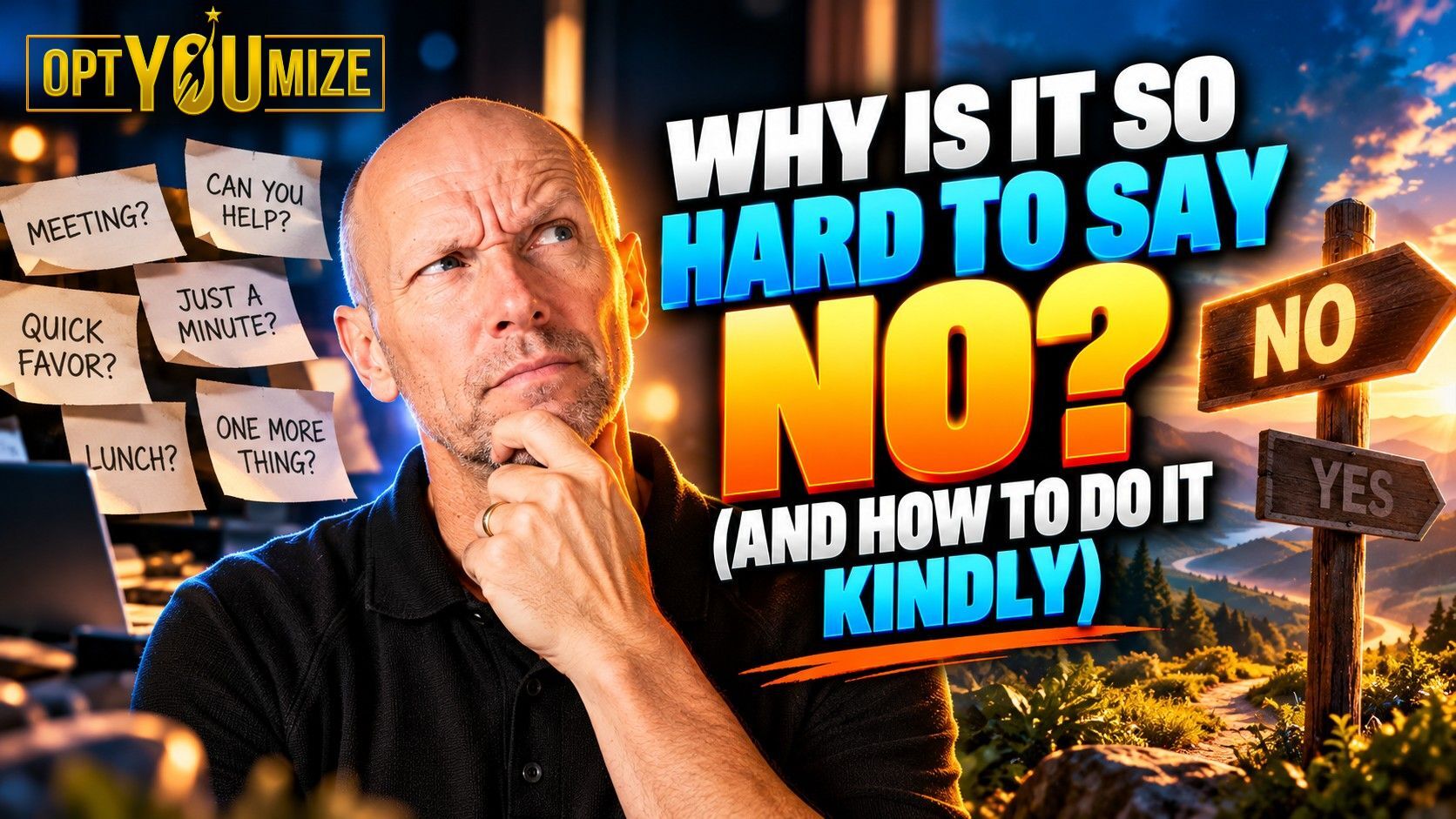
Why Is It So Hard to Say No? (And How to Do It Kindly)
By Brett Ingram | Last updated October 19, 2026 | 6 minute read
Saying no is hard because the cost of refusing is immediate and visible, while the cost of agreeing is delayed and easy to ignore. You can picture the awkward silence, the disappointed face, the "oh, okay." You can't picture next Thursday at 9 p.m., when you're doing a favor you never wanted to do. Add a social instinct to stay in good standing with people, and a yes starts to feel like the safe choice. It usually isn't. It's just the choice that bills you later.
The Simple Answer
We say yes because the discomfort of a no arrives now and the price of a yes arrives later. The fix is not to become a harder person. It's to make the real cost of yes visible before you answer, and to have a kind, short way to decline ready to go.
What Makes Saying No So Uncomfortable?
Part of it is simple math that our brains do badly. A request lands in the present tense, with a real person attached. Your calendar, your energy, and your future self are abstractions. The person wins.
There's also research suggesting we misjudge how people see the whole exchange. In a series of studies, Francis Flynn and Vanessa Lake found that people asking for help underestimated how likely others were to say yes, by up to 50 percent. The explanation they tested: the person asking gave less weight to how awkward it is to turn someone down, and more to the practical cost of helping.
That finding is about asking, but it points at something useful on the other side. Refusing a direct request is socially uncomfortable enough that people often comply even when they would rather not. In other words, the pressure you feel is not a character flaw. It's a well-documented feature of how requests work. (My own reading of the study, not the authors' claim: if saying no feels hard, you are in very large company.)
Why Do the Costs of Yes Stay Hidden?
Because a yes rarely feels expensive in the moment. "Sure, I can help with that" takes two seconds. The two hours, the mental load, and the resentment all show up on a different day, wearing a different outfit.
Jim Carrey's character in Yes Man spends a whole movie committing to everything, and the comedy works because we recognize the pattern: each yes seems harmless on its own. Together they eat the week. If you want the broader version of this, time confetti describes how small commitments scatter your hours into pieces too small to use.
| What a no costs | What a yes costs | |
|---|---|---|
| When you feel it | Right now | Later, often days or weeks |
| How it feels | Sharp but brief: guilt, awkwardness | Dull and lasting: fatigue, resentment |
| How visible it is | Very. A person is looking at you. | Hidden inside your calendar |
| Who pays | Mostly the other person, briefly | Mostly you, and the people who get the leftovers |
That table is a framing tool, not a study result. But if you run it before answering, the lopsidedness is hard to unsee.
Does It Matter Whether You Say "I Can't" or "I Don't"?
It might. In a paper in the Journal of Consumer Research, Vanessa Patrick and Henrik Hagtvedt tested two ways of refusing a temptation. "I can't" sounds like an outside rule. "I don't" sounds like a choice you've made about who you are. Across their studies, the "I don't" framing was more effective at supporting goal-directed behavior, particularly when the goal came from the person rather than from someone else. They found that a feeling of empowerment helped explain why.
Note what that study is about: resisting temptations. Declining requests from other people is a neighboring skill, not the same one. But the idea carries over as a practical experiment. "I don't take on new commitments on weeknights" is a statement about your life. "I can't, sorry" invites negotiation: Oh, just for an hour?
How Do You Say No Without Feeling Guilty?
A three-part structure works for most situations. This is my suggestion rather than a research finding, and it's simple enough to use on a Tuesday.
- Acknowledge the person. "Thanks for thinking of me." This tells them the no is about your capacity, not their worth.
- Say the no plainly. "I'm not able to take this on." No elaborate excuse. Long explanations sound like openings for a counteroffer.
- Offer something only if you mean it. "I can do a 20-minute call next week," or a name of someone who might help. If you don't mean it, skip it.
And the underrated fourth option is the pause: "Let me check my calendar and get back to you tomorrow." You are not dodging. You are moving the decision out of the moment where social pressure is loudest. A tired brain also tends to say yes more easily, which is one reason decision fatigue is worth understanding before a long day of requests.
How Do You Decide What to Say No To?
Ask what the yes would replace. Every commitment has an invisible roommate: the thing you won't do because you said yes. A few questions help:
- Would I say yes if it were happening tomorrow? Future commitments feel lighter than they are. If tomorrow's version makes you wince, be honest about next month's.
- What am I giving up? Sleep, a workout, dinner with someone you love? Name it out loud.
- Is this one of my few high-value things? The 80/20 rule applied to life is a useful lens here: a small share of your commitments probably drives most of what matters to you.
- Am I saying yes to avoid a feeling? If the real reason is dodging a moment of guilt, that's a small price to avoid a large bill.
If you don't yet know what your priorities are, you'll struggle to protect them. A life audit is a decent way to find out what's actually on your plate before you start saying no to things.
What If Saying No Damages the Relationship?
Sometimes there's a flicker of disappointment. That's normal, and it's usually short. The relationships worth keeping tend to handle an honest no better than they handle a resentful yes. A friend who finds out later that you've been quietly stewing about helping them move is getting worse information than a friend who heard "I can't this weekend, but I'd love to buy you pizza afterward." If someone punishes every no, that's useful data too. Not a call to cut anyone off. Just a reason to notice the pattern.
Frequently Asked Questions
Why do I feel guilty when I say no?
Because refusing a direct request is socially uncomfortable, and the discomfort shows up immediately. The guilt is mostly a signal that you care about the relationship, not proof that you did something wrong.
How do I say no politely?
Thank the person, state the no plainly, and offer an alternative only if you really mean it. "Thanks for thinking of me. I'm not able to take this on right now." Skip the long explanation.
Is saying no selfish?
Not by default. Overcommitting often means doing several things poorly, or doing them resentfully. A clear no protects your capacity for the commitments and people you care about most.
Should I say "I can't" or "I don't"?
Research on resisting temptation found "I don't" framing more effective than "I can't," especially for goals that matter to you personally. It's reasonable to try the same idea with requests: "I don't take on new projects midweek" states a boundary rather than inviting negotiation.
Where This Leaves You
You don't need to become someone who refuses everything. You need a pause before you answer, a short script you're comfortable with, and a clear sense of what your yes is protecting. That's life design at its most practical: deciding in advance what gets your time, so you're not deciding under pressure. If you want more ways to build a life on purpose, explore our Life Architecture pillar.