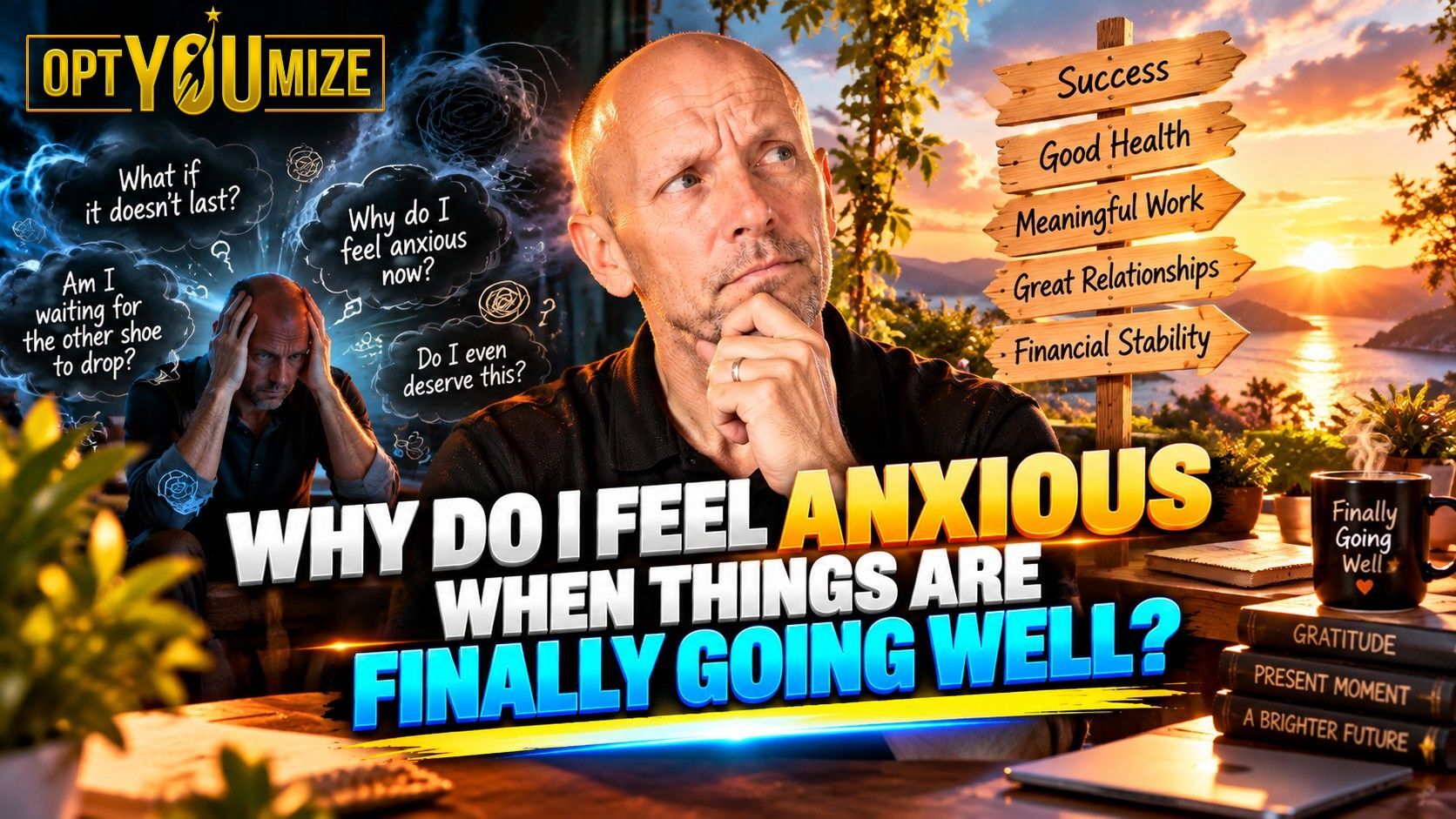
Why Do I Feel Anxious When Things Are Finally Going Well?
~20 min | October 30, 2026
You feel anxious when things are going well because your mind is wired to track threats and to fear loss, so a good life simply gives it more to guard. Researcher Brene Brown calls this foreboding joy, and it is a protective flinch, not a character flaw. In this solo episode, Brett Ingram explains the three forces behind it, why "just be grateful" backfires, and a three-move framework for letting good things actually land.
What You'll Learn in This Episode
- Why a good life doesn't switch off your threat-detection system, it gives the system more to guard
- How loss aversion turns the things you love into the things you're afraid to lose
- Why your body can learn to treat calm as the quiet before something hard, and why excitement and anxiety feel almost identical physically
- Why "just be grateful" and "just relax and enjoy it" add guilt on top of the original feeling
- What foreboding joy is, and why joy may be the most vulnerable emotion
- The reframe: a capacity problem, not an anxiety problem
- The three moves (name it, separate signal from weather, let it land) and a ten-second daily practice
Episode Timestamps
[00:00]The dread in the middle of a good life[01:10]Introduction[01:50]Naming the feeling: you're not broken[02:50]Force one: the negativity bias[04:30]Force two: loss aversion and having something to lose[05:50]Force three: your nervous system's story[06:50]Why "just be grateful" backfires[08:10]Foreboding joy and Brene Brown's research[10:15]A capacity problem, not an anxiety problem[11:00]The three moves: name it, signal vs. weather, let it land[13:30]What letting it land looks like in a real week[14:20]When it's more than foreboding joy[15:50]Does bracing actually protect you?[16:15]The ten-second daily practice[17:30]Key takeaways: you don't have to earn it twice
Episode Summary
Somewhere in the middle of a good stretch, your chest tightens instead of opens. Brett Ingram opens the episode with a plain message for anyone who knows that feeling: there is nothing wrong with you. It isn't ingratitude and it isn't self-sabotage. It has a name and a reason, and once you understand it, you can stop fighting yourself.
He begins by explaining why a good life can register as a threat, and he names three forces that are usually in the room at the same time. The first is negativity bias. A landmark 2001 review titled "Bad Is Stronger Than Good" laid out how negative events hit harder and stick longer than positive ones of the same size, and Rick Hanson's line captures it: the brain is Velcro for negative experiences and Teflon for positive ones. If your attention is wired to track threats, a good life doesn't turn the system off. It gives the system more to guard. The second is loss aversion: a loss stings more than an equal gain pleases, so a full life means holding stakes, and stakes come with fear. The third is your nervous system and the story you learned about yourself. If life once taught you that calm was the setup before the fall, your body learned to treat peace as a warning sign. It braces, and the mind hands you a story to explain the bracing.
Then comes the part where the usual advice goes wrong. When you admit this feeling out loud, you tend to hear one of two things: just be grateful, or just relax and enjoy it. Brett argues that both quietly make it worse, because both carry the same hidden message, that you're feeling the wrong thing and a better person wouldn't. Now you have the original anxiety plus a fresh layer of guilt. As he puts it, you can't shame yourself into joy.
The reframe comes from Brene Brown, who named this experience foreboding joy: the moment you feel something wonderful and your mind cuts in with the worst-case scenario. In her research, joy turned out to be the most vulnerable emotion, because fully feeling something good means accepting, in the same breath, that you could lose it. Brett's point is that the flinch isn't a flaw in the system. The flinch is the system, a way of protecting yourself from how much you care. That swaps "I'm broken, anxious, and ungrateful" for "I'm protecting something I love," a kinder and more accurate story.
From there, the episode turns on one idea: this isn't an anxiety problem, it's a capacity problem. You spent years getting good at building a good life. Nobody taught you the separate skill of living in one. Building is effort, striving, and fixing. Receiving, letting something good actually reach you and stay, is a muscle most of us have never deliberately trained, and an untrained muscle feels like a weakness. That's the heart of building a better relationship with your own mind, and of becoming someone who can receive, not just achieve.
Brett offers a three-move framework to carry loosely, not a formula to obey. Move one is to name it: when dread shows up in a good moment, label it as foreboding joy, your mind guarding something you care about. Move two is to separate the signal from the weather: is something actually wrong, or is this just a mind holding something precious? Move three is to let it land, drawing on Hanson's idea of taking in the good. Pause for a breath or two and let the good thing register in your body before your mind talks you out of it.
He is also direct about where the framework stops. If you grew up somewhere good moments were genuinely followed by hard ones, your vigilance made sense, and the work is to gently let your body collect new evidence that calm can just be calm. And if the dread is a constant, exhausting hum that runs your days or your sleep, that's not a willpower problem and not something a podcast can resolve. Talking to a professional is a self-respecting move.
The one practice he leaves you with is small by design: once a day, catch a good moment while it's happening, whether it's the first sip of coffee, your kid laughing, or a green light, and pause for about ten seconds to let it land. The question to sit with this week: what good thing in my life am I bracing against instead of letting in? And the line that closes the episode: you don't have to earn your good life twice, once by building it and again by being anxious enough to deserve it.
Resources Mentioned
- "Bad Is Stronger Than Good" (2001) — landmark psychology review on negativity bias
- Rick Hanson — the "Velcro for negative, Teflon for positive" idea and the practice of taking in the good
- Brene Brown — her research and term "foreboding joy," and her finding on gratitude as a practice
- Loss aversion — the research finding that losses feel more intense than equal gains
- Inside Out (film) — a cultural touchstone for good and tender feelings being braided together
- The three moves — Brett's framework from the episode: name it, signal vs. weather, let it land
- The ten-second practice — Brett's once-a-day habit of letting one good moment land
Frequently Asked Questions
Why do I feel anxious when things are going well? Your brain is built to track threats, and a good life gives it more to protect. Negativity bias makes bad experiences stick harder than good ones, and loss aversion makes the fear of losing something feel bigger than the pleasure of having it. The anxiety is often a sign your life got good enough to be afraid of losing, not a sign something is wrong with you.
What is foreboding joy? Foreboding joy is Brene Brown's term for the moment you feel something wonderful and your mind immediately jumps to the worst-case scenario. In her research, joy turned out to be the most vulnerable emotion, because fully feeling it means admitting you could lose it. Many people flinch away or dim the joy on purpose to protect themselves.
Why do I always wait for the other shoe to drop? It's often a mix of negativity bias, the stakes that come with having more to lose, and a nervous system that learned calm was followed by something hard. Your body braces, and your mind invents a story to explain the bracing. If good moments were genuinely followed by hard ones in your past, the vigilance once made sense.
Is anxiety the same as excitement? They are physically almost twins: a racing heart, a tight stomach, buzzing alertness. The body sends a similar signal for "something big is here." The story we attach often decides whether we call it dread or aliveness.
Does bracing for the worst actually protect me? No. If a loss comes, grief arrives at full size either way. Bracing mostly taxes the good time you do have, because you pay for the loss in advance every day for something that may never happen.
Why doesn't "just be grateful" help? Because it carries a hidden message that you're feeling the wrong thing and a better person wouldn't. You end up with the original anxiety plus guilt for not being more thankful. Gratitude works as a genuine practice of letting a good thing be as real to you as the bad things already are, not as a command.
When should I talk to a professional about this? If the dread isn't an occasional flicker but a constant, exhausting hum that runs your days, your sleep, or your ability to function, it's not a willpower problem and a podcast can't resolve it. Reaching out to a therapist or doctor is a self-respecting step.
Keep Exploring
If this episode resonated, these are worth your time:
- Why Do You Self-Sabotage When Life Is Going Well? — the related pattern of undermining good things
- Why Can't I Celebrate My Own Wins? — what to do when good news doesn't land
- What Is Self-Compassion, and Is It Just Letting Yourself Off the Hook? — a kinder way to relate to your own mind
Enjoyed This Episode?
The best way to support optYOUmize is to subscribe and leave a review — it takes about two minutes and makes a real difference in helping more people find the show.
Apple Podcasts · Spotify · Amazon Music · YouTube