
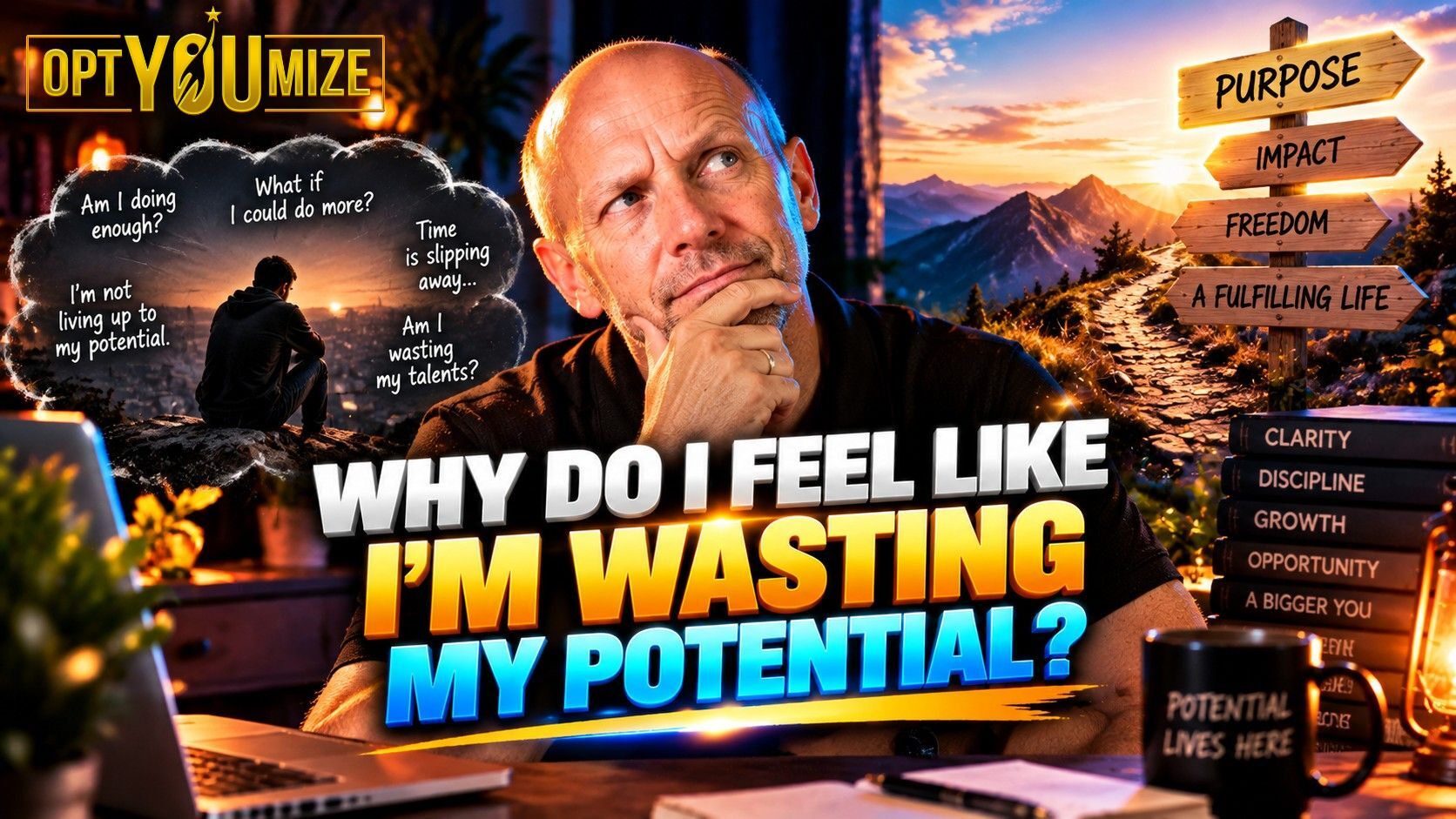
Why Do I Feel Like I'm Wasting My Potential?
~22 min | October 26, 2026
You feel like you're wasting your potential because you're measuring your real life against an imaginary version of you who made every right call and paid no price. That person never existed, so you can't catch them. In this solo episode, Brett Ingram explains the psychology behind the feeling, why the hustle script and the comfort script both make it worse, and how to treat potential as a direction you're already walking instead of a debt you owe.
What You'll Learn in This Episode
- Why "wasting my potential" is a comparison to a fantasy self who never made a tradeoff, never got tired, and never paid a bill
- Self-discrepancy theory: how the gap between your actual, ideal, and ought selves produces sadness and guilt at the same time
- Why the hustle script ("grind harder") and the comfort script ("you're enough, let it go") both treat the feeling as a verdict
- What Daniel Pink's regret research says about chances not taken
- Potential as a debt versus potential as a direction, and why more output does not always produce more of you
- The Honest Yardstick: a ten-minute practice to turn the guilt into one honest, doable step
- How to tell a true nudge from the inner critic, and how coasting differs from shame
Episode Timestamps
(Estimated from the script. Replace with real times from the final cut.)
[00:00]The person in your head[00:50]Introduction[02:00]Why capable people feel this most[03:15]What "wasting my potential" actually feels like[05:30]Not "feeling behind," and not your old wins[07:00]The three selves: actual, ideal, and ought[10:30]The fantasy self who never pays a price[12:30]The hustle script vs. the comfort script[15:00]Potential is a direction, not a debt[18:00]The Honest Yardstick: a ten-minute practice[21:00]"But what if I really am coasting?"[22:30]Closing: who are you comparing yourself to?
Episode Summary
There's a version of you that lives rent-free in your head. He's a little further along. She made the braver choice back when it mattered. They started the thing, finished the degree, built the business, wrote the book, and they did it without ever getting tired or scared and without a single bill coming due. Late at night, or right after someone asks what you're working on these days, you measure your actual life against that person, you come up short, and a quiet verdict lands: I'm wasting my potential. Brett Ingram opens the episode by asking whether that feeling is a status report on your life at all, or a comparison to someone who was never real.
He starts by getting precise about the feeling. It isn't a crisis; it's a low hum under an otherwise fine life, and it tends to be strongest in capable people whose lives have come together. It shows up on the LinkedIn scroll, when a younger person does the thing you always meant to do, or in a rare quiet hour that feels vaguely guilty instead of peaceful. Brett separates it from two cousins. Feeling behind is a comparison to a timeline and the people in your lane. Struggling to celebrate wins is about the past. Wasting your potential faces forward: it compares the you that exists with a possible you.
The explanation comes from psychologist E. Tory Higgins's self-discrepancy theory. We carry an actual self, an ideal self built from hopes and dreams, and an ought self built from duty and other people's expectations. A gap between actual and ideal tends to produce dejection: disappointment and a wistful deflation. A gap between actual and ought tends to produce agitation: anxiety, guilt, and restlessness. Brett's reading is that "wasting my potential" is both gaps firing at once, grief and guilt braided together and aimed at a single target. Then comes the hinge of the episode. Both of those selves are imaginary, and the fantasy self pays no costs. He gets the big career, the close family, the health, and the time, and says yes to everything while sacrificing nothing. Measuring a real life with real limits against a composite who has none means you rigged the game and then blamed yourself for losing it.
When you admit the feeling out loud, the world hands you one of two scripts. The hustle script says you are wasting it, so wake up earlier, monetize the hobby, and extract your potential before it rots. It never questions the impossible standard; it just whips you toward it, and the fantasy self levels up while you run. The comfort script says you're enough and potential is toxic pressure. Dropping an impossible standard is healthy, but swallowed whole it can become a cozy place to hide. Daniel Pink's regret research is the counterweight: across thousands of people, regrets of inaction outnumber regrets of action by roughly two to one, and the gap tends to widen with age. Both scripts treat the feeling as a verdict. Brett argues it's a signal, and signals are meant to be read, not obeyed or ignored.
The reframe is the heart of the episode. Most of us treat potential like a debt: a fixed amount of talent we were handed at birth and now owe, with guilt compounding every day we don't cash it in. Brett offers another way to hold the word. Potential is a direction you can move, a vector you're already traveling along rather than a ceiling you're falling short of. As he puts it, more of it does not always produce more of you. Your potential isn't how much you could produce if you optimized every hour; it's how fully and honestly you can become yourself in the direction of what you value. That is the kind of work that actually fits your life is built around, and it also dissolves the "too late" story, because capacity isn't a carton of milk with an expiration date.
To make it practical, Brett gives you the Honest Yardstick, a ten-minute exercise with a piece of paper. Step one: finish the sentence "I feel like I'm wasting my potential because I'm not ______," and keep going until you've described the specific person on the other side of the gap. Step two: make them pay. Write down what that person would have had to trade to become real, and ask whether you'd want their whole life, invoices included, or just the highlight. Most people discover they wanted one piece lifted out of context. Step three: turn the verdict into a vector. Ask what the feeling is actually pointing toward and what one honest step, small and doable this month, moves you that way. "I need to have written a book" is a verdict; "I could write for twenty minutes on Sunday mornings" is a vector.
He closes by taking the obvious objection seriously: what if I'm really coasting? His heuristic is that coasting feels like boredom, a flatness and a sense of unused capacity, and the answer is to move in a direction. The potential-guilt most people carry feels like shame, which says you're not enough and produces paralysis rather than movement. A true signal pulls you toward something; shame makes you want to hide. So this isn't about lowering the bar; it's about putting it where a human being can reach it. The question he leaves you with: when you say you're wasting your potential, who exactly are you comparing yourself to, and would you really want their whole life, or just the parts without the price?
Resources Mentioned
- "Self-Discrepancy: A Theory Relating Self and Affect" — E. Tory Higgins, Psychological Review (1987) — the actual, ideal, and ought self framework
- The Power of Regret — Daniel H. Pink (2022) — the research on regrets of inaction and "boldness regrets"
- Good Will Hunting (1997) — the "hidden genius wasting a gift" archetype, used as a cultural touchstone
- The Honest Yardstick — Brett's ten-minute, three-step practice from the episode
Frequently Asked Questions
Why do I feel like I'm wasting my potential? Usually because you're comparing your real life, with real limits and tradeoffs, to an imagined version of you who made every right call and paid no costs. That person can't exist, so you always fall short. The feeling is better read as a signal than a verdict.
What is self-discrepancy theory? It's a psychological model from E. Tory Higgins that says we carry an actual self, an ideal self, and an ought self. A gap between actual and ideal tends to produce sadness and disappointment, and a gap between actual and ought tends to produce anxiety and guilt. Brett applies it to explain why "wasted potential" feels like grief and guilt at once.
How do I know if I'm wasting my potential or just being hard on myself? Check the tone of the voice. A true nudge is specific, forward-looking, and calm, and it points at a path. The inner critic issues global verdicts about your worth. Coasting tends to feel like boredom, while the guilt of unrealized potential usually feels like shame.
Why do I feel like I should be doing more with my life? Often the "ought self" is speaking: a version of you built from duty and other people's expectations. When your actual life doesn't match it, the result is guilt and restlessness. Naming who that ought self is, and what their life would cost, usually loosens its grip.
Is it too late to live up to my potential? The idea that potential has a deadline is almost always the fantasy self talking. Capacity isn't a carton of milk with an expiration date, and people start, change, and come alive at every age. The useful question is what honest step is available from where you are.
How do I stop feeling guilty about not reaching my full potential? Stop treating potential as a debt you owe and start treating it as a direction you move. Use the Honest Yardstick: finish the sentence to describe the person you're comparing yourself to, price out what their life would have cost, then pick one small step this month toward what's left.
Do the hustle and comfort approaches work? Neither fully. The hustle script whips you toward a finish line that keeps moving, and the comfort script can become a place to hide from a real nudge. Both treat the feeling as a verdict instead of a signal to read.
Keep Exploring
If this episode resonated, these are worth your time:
- Why Can't I Celebrate My Own Wins? — the other side of the same ache: the past you can't feel
- Why Do You Feel Behind in Your Career? — when the comparison is to other people's timelines
- What Is Self-Compassion, and Is It Just Letting Yourself Off the Hook? — how to quiet the inner critic without going numb
Enjoyed This Episode?
The best way to support optYOUmize is to subscribe and leave a review — it takes about two minutes and makes a real difference in helping more people find the show.
Apple Podcasts · Spotify · Amazon Music · YouTube