
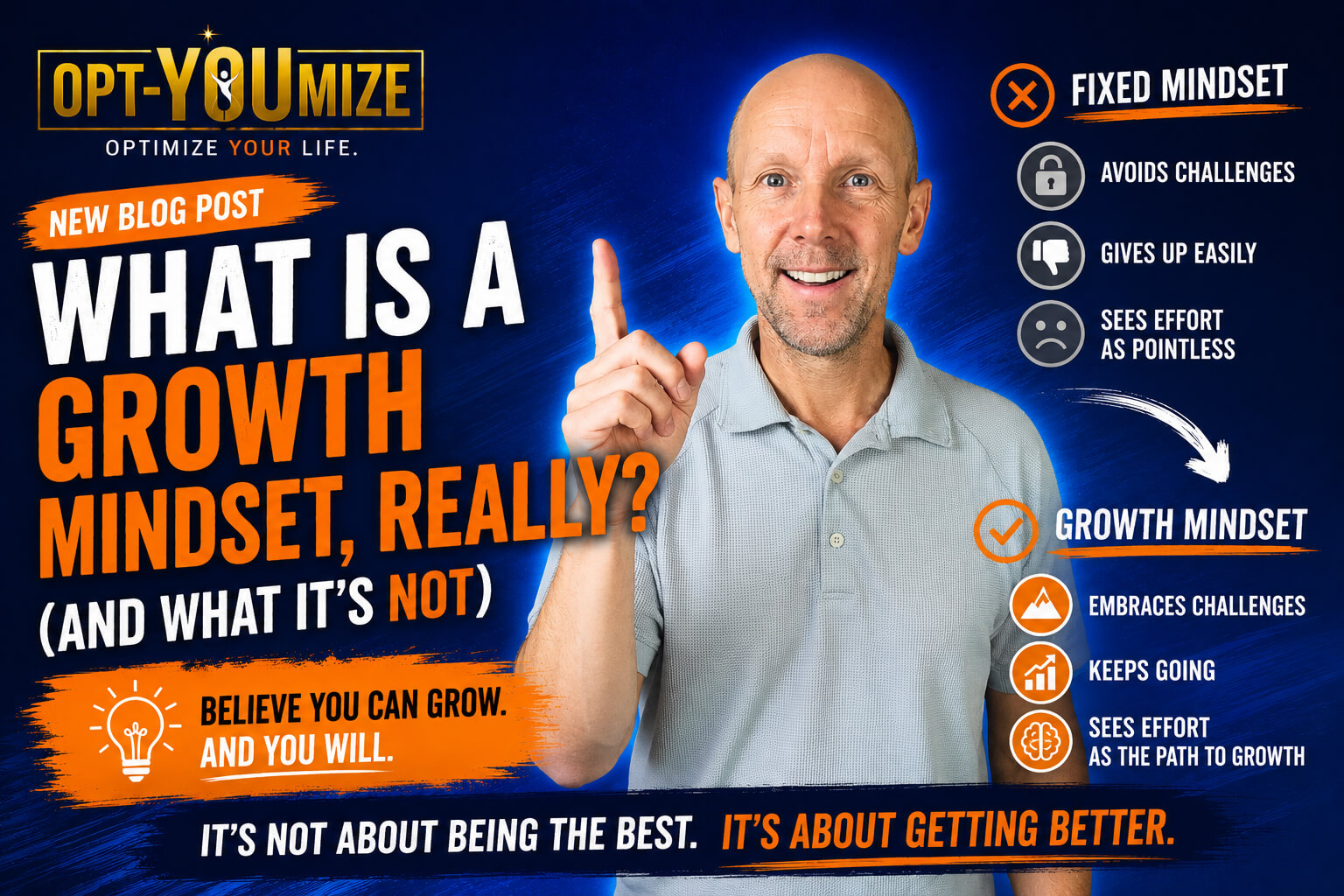
A growth mindset is the belief that your abilities — intelligence, skill, talent — can be developed through effort, good strategy, and feedback, rather than being fixed traits you either have or don't. That's the actual definition, from the research it came from. It is not the same as positive thinking, "believing in yourself," or telling yourself you can do anything if you try hard enough.
That distinction matters more than it sounds like it should, because somewhere along the way, "growth mindset" got flattened into a motivational poster. It became a synonym for optimism — a thing you're supposed to have, like good posture, that will presumably make your career, your relationships, and your workouts go better if you just adopt the right attitude.
The actual research is more interesting than that, more limited than the slogan suggests, and more useful once you separate the two.
The Simple Answer: What a Growth Mindset Actually Is
A growth mindset is a belief about where ability comes from. People with a strong growth mindset tend to believe that capability is built through practice, learning from mistakes, and adjusting strategy. People with a strong fixed mindset tend to believe that capability is something you're born with — you're either a "math person" or you're not, a "people person" or you're not, naturally talented or not.
The difference shows up most clearly in how each person responds to difficulty. Someone operating from a fixed mindset tends to read struggle as evidence: this is hard, therefore I'm not good at it, therefore I should probably stop before everyone notices. Someone operating from a growth mindset tends to read struggle as information: this is hard, which means I'm at the edge of what I currently know how to do — useful to know.
Same situation. Completely different internal story. And the story shapes what happens next — whether you keep going, ask for help, change your approach, or quietly back away.
What a Growth Mindset Is Not
Here's where most popular treatments of this idea go sideways.
It's not "you can do anything you set your mind to." A growth mindset doesn't claim that effort guarantees outcomes, or that everyone has equal potential in every domain. It claims something narrower and more honest: that effort and strategy can move your current ability, whatever your starting point. That's a meaningfully smaller claim — and a much more defensible one.
It's not relentless positivity. You can have an accurate, even unflattering, view of where you currently stand and still have a growth mindset — because the mindset is about whether that current state is seen as fixed or as a starting point. In fact, an inflated sense of where you already are can get in the way of growth, because there's nothing left to develop.
It's not a personality type. Most people aren't purely one or the other. You might have a strong growth mindset about your career and a rigid fixed mindset about, say, your ability to have hard conversations, or your athletic ability, or your capacity to learn a language as an adult. Mindset is domain-specific and often inconsistent — which is actually good news, because it means the parts that are fixed aren't a verdict on the whole person.
If you've ever felt like self-improvement advice promises a transformation it doesn't deliver, this is often why — the advice treats mindset as a switch you flip once, rather than something that varies by domain and has to be practiced where it actually matters. We've written about that pattern in why self-improvement advice often backfires, and the mindset conversation runs into the same problem: the framing oversells what a single shift in belief can do.
Where the Idea Came From
The term comes from psychologist Carol Dweck's decades of research on how people respond to challenge and failure, originally studied in children and later extended to adults across school, work, and relationships. The core finding was straightforward: when people believe ability is malleable, they tend to engage differently with difficulty — more willing to try unfamiliar approaches, more resilient after setbacks, less likely to interpret a single failure as a permanent statement about who they are.
That part of the research has held up well. What's gotten more complicated — and more honest — is the question of how much this belief actually changes outcomes, and under what conditions.
Does It Actually Work? What the Research Says
This is the part most popular coverage skips, and it's worth sitting with, because the nuance is more useful than the hype.
A large, pre-registered national study published in Nature tested a short online growth mindset exercise with a representative sample of U.S. high school students. The results were real but specific: the intervention improved grades for lower-achieving students, and increased enrollment in advanced math courses — but mainly in schools where the surrounding peer environment supported that message. In other words, a belief about your own potential interacts with the environment you're in. Mindset alone, dropped into a context that contradicts it, has limited power. (Yeager et al., 2019, Nature)
A broader OECD analysis across international education data found something similar: a growth mindset correlates with achievement, persistence, curiosity, and lower anxiety about challenging subjects — but those associations are weaker and less consistent for students who are already struggling the most, which is exactly the group the popular version of the idea promises the most for. (OECD, Mindsets, Attitudes and Learning)
And a more critical review, published through the National Institutes of Health, lays out what's been learned from the controversies and failed replications in this field — including the point that effect sizes in many studies are modest, and that "growth mindset" interventions are not a substitute for the actual conditions that support learning: good instruction, safety to fail, and real opportunities to practice. (NIH/PMC, What Can Be Learned from Growth Mindset Controversies?)
None of this means the idea is wrong. It means it's smaller and more conditional than the version that gets repeated in keynote speeches. A growth mindset is one input into how you handle difficulty — not a override switch for talent, circumstance, resources, or the actual difficulty of the thing you're attempting.
The Deeper Answer: Why This Distinction Matters
If growth mindset is "just believe in yourself," then failing to improve becomes a referendum on your belief — which is its own kind of fixed-mindset trap, just one level up. I tried to have a growth mindset and it didn't work, so maybe I really am stuck.
But if a growth mindset is a way of relating to difficulty — treating it as information rather than a verdict — then it's not something you either have or don't. It's something you practice, in specific moments, usually the moments that feel the least convenient: right after you've made a visible mistake, right when you've been told no, right when something you used to be good at suddenly feels hard again.
This is closer to what Growth & Self-Becoming is actually about at optYOUmize — not a personality upgrade, but an honest, ongoing relationship with the parts of yourself that are still developing. That kind of growth is slower than the slogan version. It's also the only version that survives an actual hard week.
How to Build a Growth Mindset That Holds Up
A few practices that reflect what the research actually supports — not a checklist, but places to start.
Notice what you make a setback mean
The moment right after something goes wrong is where mindset actually lives. Not in how you feel about yourself in general, but in the specific sentence that runs through your head when a project gets rejected, a conversation goes badly, or you're slower at something than you expected to be. Is the sentence about the outcome ("that approach didn't work — what would I try differently?") or about you ("of course it didn't work, this is who I am")? You can't always control the first reaction, but you can get better at noticing it, which is the first step to not believing it automatically. If this kind of looping self-talk is a regular pattern for you, what rumination actually is and how to interrupt it is worth a look — the mechanics overlap a lot with fixed-mindset thinking.
Separate effort from strategy
"Just try harder" is not growth-mindset advice — it's a misreading of it. The research distinguishes between effort and strategy: working harder at an approach that isn't working will mostly produce a more tired version of the same result. Growth-oriented responses to difficulty usually involve a change in approach — different resources, different help, a different angle — not just more hours at the same one.
Get specific about the domain
Instead of asking "do I have a growth mindset," ask "where, specifically, do I treat my current ability as the ceiling?" For most people, it's not everywhere. It might be public speaking, or a particular relationship pattern, or a skill you tried once as a kid and decided you "weren't good at." Naming the specific domain turns an abstract identity question into something you can actually work on.
Check what you're optimizing for
Sometimes what looks like a fixed mindset is actually a clear-eyed read of priorities — you're not "stuck," you've just decided this isn't where you want to spend your developmental energy, and that's fine. Growth isn't a moral obligation to improve at everything. It's worth occasionally checking whether the goals you're measuring yourself against are ones you actually chose. We've written more about that question in what if your definition of success has never actually been yours — it's closely related, because a lot of "I should have a growth mindset about this" is really "someone else decided this should matter to me."
FAQ
What is a growth mindset in simple terms?
A growth mindset is the belief that abilities can be developed through effort, learning, and feedback — as opposed to a fixed mindset, which treats abilities as largely set from birth. It mainly shows up in how someone responds to difficulty: as information to act on, or as evidence to give up.
Is a growth mindset the same as positive thinking?
No. A growth mindset is a belief about whether ability can change, not a general attitude of optimism. You can have an honest, even difficult, assessment of your current skills and still have a growth mindset — because the mindset is about whether that current level is seen as a fixed endpoint or a starting point.
Can adults develop a growth mindset, or is it set early?
Mindset is not fixed by age, and it's also not all-or-nothing — most adults have a growth mindset in some areas of life and a fixed one in others. It tends to shift through repeated experience: noticing your response to setbacks, trying a different strategy instead of just trying harder, and getting feedback in an environment that treats mistakes as useful rather than embarrassing.
Does growth mindset research actually hold up?
The core idea — that believing ability is malleable changes how people respond to challenge — has reasonable support. But large-scale studies show the effects are real yet modest, and depend heavily on context: a growth mindset intervention works better when the surrounding environment (a classroom, a team, a family) reinforces the same message. It's a meaningful factor, not a cure-all.
What's an example of a growth mindset versus a fixed mindset?
Imagine two people get the same critical feedback on a project. One thinks, "I clearly don't have what it takes for this kind of work" and avoids similar projects going forward. The other thinks, "okay, that's useful — what specifically would I do differently next time?" and asks a follow-up question. Same feedback, same difficulty — different relationship to it. That difference, repeated over time, is what a growth mindset actually looks like in practice.
Where to Go From Here
A growth mindset isn't a belief you adopt once and then carry around like a badge. It's a habit of attention — noticing, especially in the moments right after something doesn't go well, whether you're treating the result as a verdict or as data. That habit is learnable. It's also slower and less dramatic than the version sold in keynote talks, which is probably why it doesn't get repeated as often.
If this kind of honest, patient approach to growth resonates, it's the whole premise behind the Growth & Self-Becoming guide — worth exploring if you want to go deeper.