
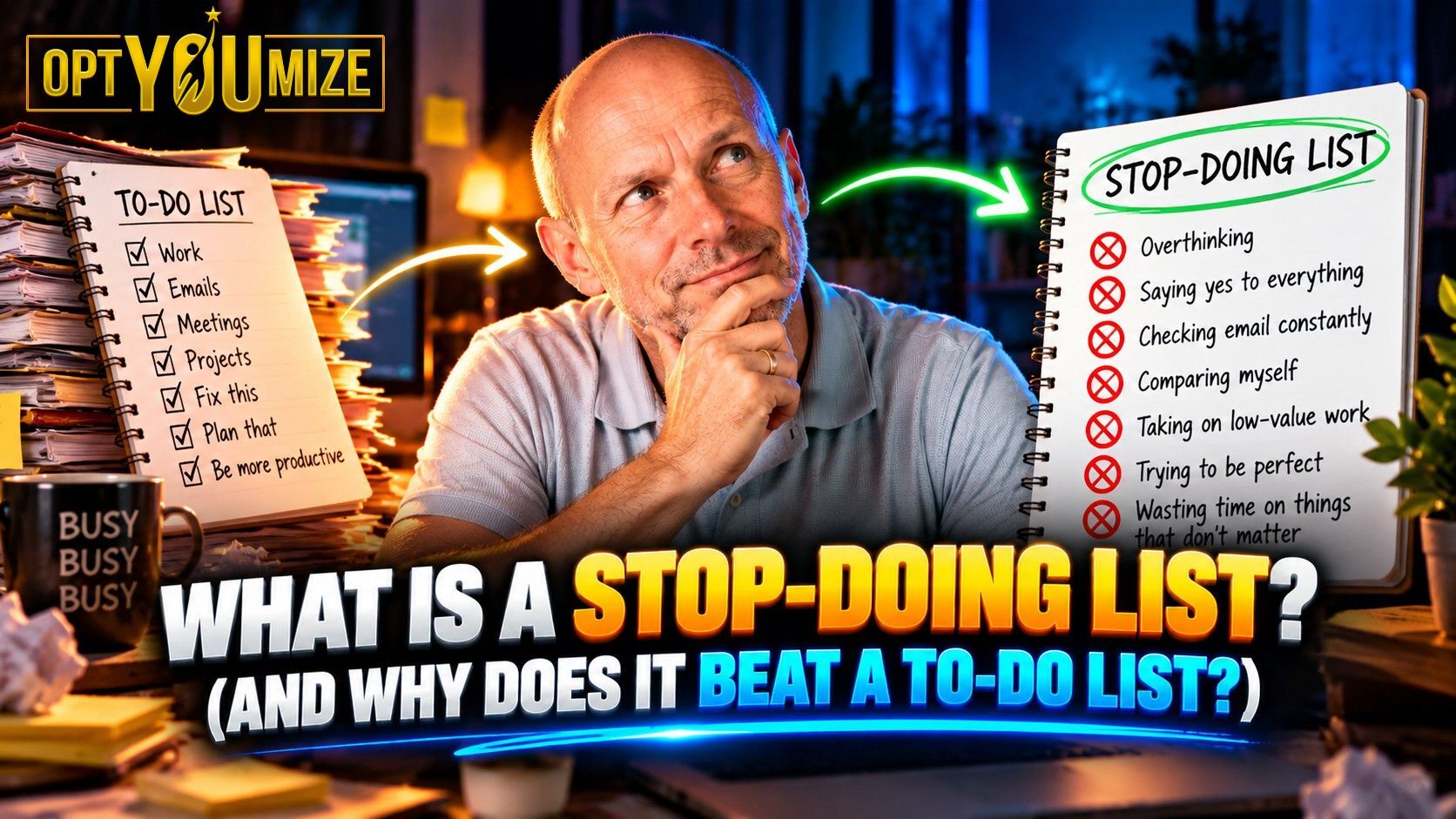
What Is a Stop-Doing List (and Why Does It Beat a To-Do List)?
By Brett Ingram | Last updated October 21, 2026 | 6 minute read
A stop-doing list is a short, deliberate list of things you will quit, decline, or hand off so the rest of your life has room to work. It beats a to-do list for a simple reason: a to-do list can only add to your load, while a stop-doing list is the one tool that actually lowers it. The idea was popularized by author Jim Collins, and a 2021 study in Nature helps explain why so few of us make one. When we try to improve something, our minds reach for "add" long before they think of "remove."
The Simple Answer
Write down what you're doing now that you'd stop if you had more time, more money, or more courage. Pick the two or three that cost the most and return the least. Make each one specific enough to be a decision, not a vibe. Then put the list where you'll see it as often as you see your to-do list.
Where Did the Stop-Doing List Come From?
In his own account on JimCollins.com, Collins traces it to a course he took at Stanford in his mid-twenties. His instructor, Rochelle Myers, looked at his carefully written yearly goals and told him he led a busy life, not a disciplined one. Then she gave him an exercise Collins later called the "20-10" assignment. Imagine two phone calls. In the first, you learn you've inherited $20 million, no strings attached. In the second, you learn you have a terminal diagnosis and about 10 years to live. What would you change? And just as important, what would you stop doing?
Collins says that question changed his direction. Later, studying companies that moved from good to great, he noticed that many of the pivotal decisions were about what to stop doing. His example is Darwin Smith at Kimberly-Clark, who sold the company's paper mills and bet on consumer brands. Collins quotes him on the nerve it takes: "If you have a cancer in your arm, you've got to have the guts to cut off your own arm."
Dramatic, yes. But notice what it isn't. It isn't a productivity hack. It's a decision about what deserves your finite time.
Why Do We Keep Adding Instead of Subtracting?
Here's the part I find genuinely useful. In a 2021 paper titled "People systematically overlook subtractive changes", researchers Gabrielle Adams, Benjamin Converse, Andrew Hales and Leidy Klotz ran a series of experiments showing that people default to adding components rather than removing them, even when removing is simpler or better.
According to the University of Virginia's write-up of the research, one task asked participants to stabilize a structure built from Lego bricks, and about 60 percent of the control group added bricks instead of taking away the one thing that was causing the problem. When participants were reminded that removing pieces was free, more of them subtracted. The researchers also found that people with a distracting task running in the background reached for addition even more. And in a real organization they studied, stakeholders offered eight additive suggestions for every subtractive one.
The authors suggest this habit may help explain overloaded schedules and institutional red tape. That's their hypothesis, not a proven cause. But it matches what most of us see in our own calendars: nobody's week got too full because they were too good at removing things.
So if you've ever read a "morning routine" article and thought "great, another thing," you're not lazy. You're running the default software.
How Is a Stop-Doing List Different from a To-Do List?
| To-do list | Stop-doing list | |
|---|---|---|
| Direction | Adds to your load | Lowers your load |
| Question it asks | "What else should I do?" | "What am I doing that I shouldn't be?" |
| Natural length | Grows on its own | Stays short on purpose |
| What "done" feels like | Relief, briefly, until tomorrow | Space that stays open |
| Hard part | Getting it all done | Deciding, then disappointing someone |
That comparison is my own framing, not a finding from either source.
How Do You Make a Stop-Doing List?
You can do this in about 20 minutes. These steps are my adaptation of Collins's idea, not a formal method from the research.
- Run your own 20-10 question. If money and time were no longer the constraint, or if you had ten good years to work with, what would you quit first? Write down whatever shows up without arguing with it.
- Check each item against what matters. Collins suggests three circles: what you're deeply passionate about, what you're suited for, and what makes economic sense. He argues that if more than half of what you do falls outside those circles, a stop-doing list may be your most important tool. I'd add a fourth circle for the optYOUmize crowd: what you'd be proud of in ten years.
- Sort into three buckets. Things to quit outright, things to decline from now on, and things to hand off or shrink.
- Pick two or three. Not twelve. A stop-doing list with fifteen items is just a to-do list wearing a disguise.
- Write the exit. "Stop attending the Monday status meeting; send a two-line update instead." Specific beats noble.
- Plan for the awkward part. Quitting things disappoints someone, sometimes you. If saying no is the sticking point, our post on why it's so hard to say no will help.
What Might Go on a Stop-Doing List?
| Type | Example | The exit |
|---|---|---|
| Commitments | A committee you joined three years ago and no longer care about | Give notice, name a successor, leave on a date |
| Habits | Checking email first thing, every morning | Phone stays in another room until after breakfast |
| Standards | Hand-making what you could buy or share | Decide where "good enough" is, in advance |
| Obligations you invented | Replying to every message within the hour | Set one or two check-in times and say so |
Examples are illustrative, not from the research.
Not sure where to start looking? A life audit is a good way to surface the candidates, and the 80/20 rule applied to your whole life can help you spot which activities give back the least.
Will a Stop-Doing List Actually Work?
Honest answer: it works if you actually use it, and there's no study I know of that proves a stop-doing list, specifically, improves outcomes. What the research does support is the underlying point that we under-use subtraction. The authors of the Nature paper write that overlooking it may mean people are missing opportunities to make their lives more fulfilling. That's an invitation, not a guarantee.
A few cautions. Don't quit things in a fit of irritation on a Tuesday. Don't drop obligations that other people truly depend on without a handoff. And don't turn the list into one more thing to perform perfectly. If it ever starts feeling like homework, subtract the list.
Frequently Asked Questions
What is a stop-doing list?
A stop-doing list is a short list of activities, commitments, or habits you decide to quit, decline, or delegate. Where a to-do list adds tasks, a stop-doing list removes them so your time and energy go to what matters most.
Who came up with the stop-doing list?
Author Jim Collins popularized it. He credits a Stanford instructor, Rochelle Myers, with the exercise that shaped his thinking, and he later saw the same pattern in the good-to-great companies he studied.
Why is it so hard to stop doing things?
Partly because of how our minds work. A 2021 Nature study found that people tend to look for ways to add before they consider removing, even when removing is the better move. Quitting also carries social costs, which makes it feel riskier than adding.
How many items should be on a stop-doing list?
Fewer than you think. Two or three well-chosen items you will actually act on are worth more than a long list you admire. You can always add another once you've cleared the first ones.
Where This Leaves You
A well-designed life isn't the one with the most in it. It's the one where what's in it was chosen. Try the 20-10 question this week, find your two or three, and write the exits down. If you'd like more tools for building a life on purpose instead of by accumulation, explore our Life Architecture pillar.