
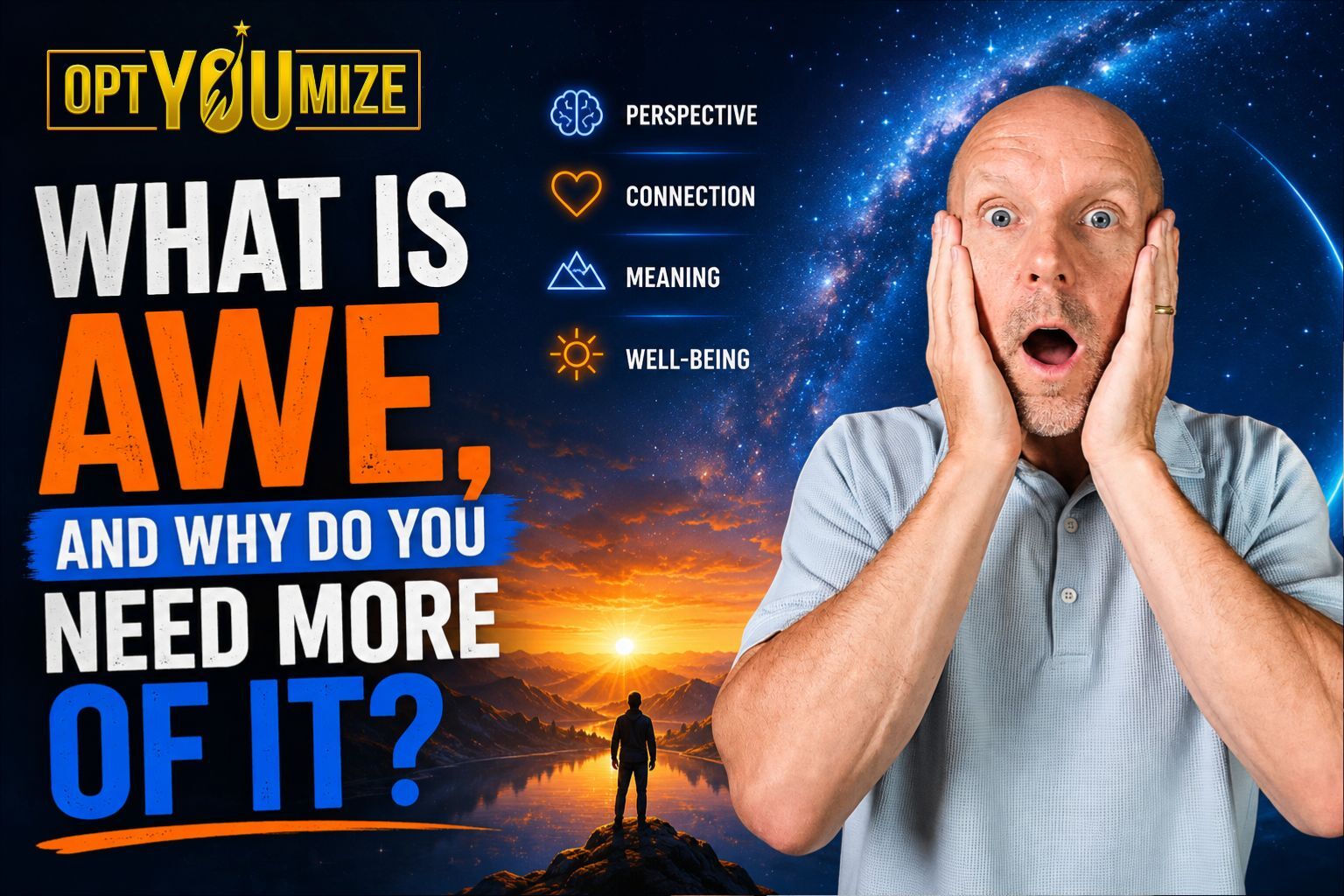
What Is Awe, and Why Do You Need More of It?
By Brett Ingram | Last updated September 1, 2026 | 8-9 minute read
Here's the direct answer: awe is the emotion you feel when you encounter something so vast, impressive, or unexpected that your current way of understanding the world doesn't quite fit it anymore - and you have to stretch a little to take it in. Psychologists define it as having two ingredients: a sense of vastness (in size, scope, skill, or meaning) and a need for "accommodation," meaning your mental model of how things work has to expand to make room for what you just experienced. It matters because unlike a lot of the emotions we chase - excitement, pride, even happiness - awe reliably makes people feel smaller in a good way, more connected to others, and less anxious about the clock. Most adults simply stop scheduling any opportunity to feel it.
You've felt it before, even if you never had a name for it. Standing at the rim of a canyon. Watching a total eclipse go dark in the middle of the afternoon, surrounded by strangers who all gasped at the same moment. Hearing a piece of music that seems too complex for one person to have written. That specific full-body "whoa" is awe, and it turns out to be one of the more useful emotions available to us - not because it feels nice, but because of what it quietly does to your brain while it's happening.
What Does "Awe" Actually Mean, Psychologically?
Dacher Keltner, the UC Berkeley psychologist who has spent much of his career studying this emotion, describes awe as the feeling we get in the presence of vast things we don't immediately understand. The key word is vast - not just "big," but bigger than your current frame of reference. That's why awe shows up in wildly different contexts: nature, live music, a moral act of courage, a math proof, a newborn's hand wrapped around your finger. What they share isn't subject matter. It's scale relative to you.
The Greater Good Science Center's research summary on the topic notes that awe experiences are remarkably common across cultures and history, and appear to carry measurable health and social benefits - in some studies, more consistently than other positive emotions like joy or contentment. That's a strange thing to say about an emotion most people can't remember scheduling on purpose since childhood.
The Simple Answer: What Does Awe Actually Do for You?
Three things, backed by research rather than vibes:
It makes you feel like you have more time. A study out of Stanford's Graduate School of Business, led by researcher Melanie Rudd along with Jennifer Aaker and Kathleen Vohs, found that people who experienced awe reported feeling like they had more available time than people who felt other positive emotions like happiness or surprise. The effect showed up across several experiments and appeared to work by pulling people into the present moment - which, not coincidentally, is the exact opposite of the rushed, blurry feeling most of us associate with a bad week.
It lowers stress and lifts mood, measurably. Researchers at UC San Francisco and UC Berkeley, in a study published in the journal Emotion, had older adults take a weekly fifteen-minute walk for eight weeks - half the group were simply asked to look for things that inspired a sense of wonder along the way. By the end of the study, the "awe walk" group reported more positive emotion and less distress in daily life than the control group, and even their selfies changed - their smiles got measurably bigger over the eight weeks, and the photos shifted from close-ups of their own faces to wider shots that included more of the world around them.
It nudges you toward other people. The same Stanford research found that people who'd just experienced awe were more willing to volunteer their time to help someone else. Awe seems to shrink the sense of "me" just enough to make room for "us" - which tracks with why so many people describe feeling closer to strangers during a shared awe-inducing moment, like a solar eclipse or a stadium going quiet for a moment of silence.
The Deeper Answer: Why Awe Feels Different From Other Positive Emotions
Most emotions we pursue on purpose are self-focused. Pride is about your accomplishment. Comfort is about your ease. Even happiness, in its more common form, is largely about you getting what you wanted. Awe runs the opposite direction - it works by making your usual sense of self feel temporarily, pleasantly smaller. Researchers sometimes call this the "small self" effect, and it's part of why awe is so reliably linked to feeling more connected rather than more accomplished.
There's a line from the 1997 film Contact that captures this better than most psychology papers: after seeing something vast and inexplicable, Jodie Foster's character can only manage, "They should have sent a poet." That's the awe response in a sentence - the sense that your existing vocabulary, your existing sense of scale, isn't quite built for what's in front of you. You don't need a wormhole to get there, though. A genuinely dark sky full of stars will usually do it.
Why Modern Life Quietly Edits Awe Out
Awe requires two things most calendars don't protect: unstructured attention and exposure to things bigger than your to-do list. Most days offer neither. You commute the same route, sit under the same fluorescent lights, and scroll a screen that's specifically engineered to keep your attention at eye level rather than pointed up and out. None of that is dramatic or a crisis - it's just quietly efficient at squeezing out the conditions awe needs to show up.
This is closely related to what we've written about before as languishing - that flat, colorless feeling of not being depressed, just muted. Awe is one of the more direct antidotes to it, precisely because languishing is a narrowing of attention and awe is, almost by definition, a widening of it.
A Simple Way to Build More Awe Into an Ordinary Week
You don't need a canyon. The UCSF/Berkeley research used an ordinary neighborhood walk, and it worked. Here's a version anyone can try, no travel required.
| Step | What to do | Why it matters |
|---|---|---|
| 1. Pick a familiar route | A regular walk - block, trail, parking lot, doesn't matter | Removes the excuse of needing somewhere exotic |
| 2. Widen your gaze on purpose | Look up, look far, look for scale - trees, sky, architecture, distance | Mirrors what researchers call "vastness cues" |
| 3. Leave your phone in your pocket | Fifteen minutes, camera included | Awe needs undivided attention, not documentation |
| 4. Ask one question | "What here is bigger, older, or more complex than I usually notice?" | Turns passive walking into active noticing |
| 5. Do it weekly, not daily | Once a week is enough to build the habit | Matches the study's actual protocol - consistency beats intensity |
If your instinct is that a week already spoken for has no room for this, it's worth revisiting the idea of time affluence - the research consistently shows that a small amount of deliberately protected time does more for how rich your life feels than an equivalent amount of unprotected time ever does. Fifteen minutes of an actual awe walk outweighs an extra fifteen minutes of scrolling, almost every time.
Why This Connects to How You Experience Time
If you've ever wondered why time seems to speed up as you get older, awe is part of the answer, and part of the fix. Novel, vivid experiences lay down richer memories, which is part of why childhood summers felt endless and adult ones evaporate - childhood is simply denser with genuinely new things. Awe works the same way in miniature. A fifteen-minute walk spent actually noticing something vast doesn't just feel good in the moment; the Stanford research suggests it can make that stretch of time feel more expansive in memory, too. In a life that otherwise runs on autopilot, that's not a small thing.
Frequently Asked Questions
What is the definition of awe in psychology?
Psychologists define awe as the emotional response to something vast - in size, scope, skill, or meaning - that requires you to expand your existing understanding of the world to make sense of it. It combines a sense of smallness with a sense of connection, rather than fear or discomfort.
What are the benefits of awe?
Research links awe to lower stress and more positive daily emotion, a greater sense of having enough time, increased willingness to help others, and a temporarily smaller, less self-focused sense of self that tends to leave people feeling more connected rather than diminished.
What is an "awe walk," and does it actually work?
An awe walk is an ordinary walk taken with the specific intention of noticing vast or wonder-inducing things along the route. In a UCSF and UC Berkeley study, older adults who took weekly fifteen-minute awe walks for eight weeks reported more positive emotion and less distress than a control group by the end of the study.
Do you need to travel somewhere impressive to feel awe?
No. While grand landscapes are a reliable source of it, research on awe walks found meaningful effects from ordinary neighborhood routes. Awe is more about the quality of attention - looking for scale and novelty - than the scale of the destination.
Where This Leaves You
You don't need a canyon, a telescope, or a total eclipse to access this. You need about fifteen minutes, a route you already know, and a genuine willingness to look up instead of down. Awe isn't a productivity hack or another item for the self-improvement list - it's closer to a reminder that your life is happening inside something larger than your inbox. That's really the whole premise behind Mind & Inner Life at optYOUmize: the quality of your inner world shapes everything else, and sometimes the most useful thing you can do for it is simply notice something bigger than yourself on purpose.