
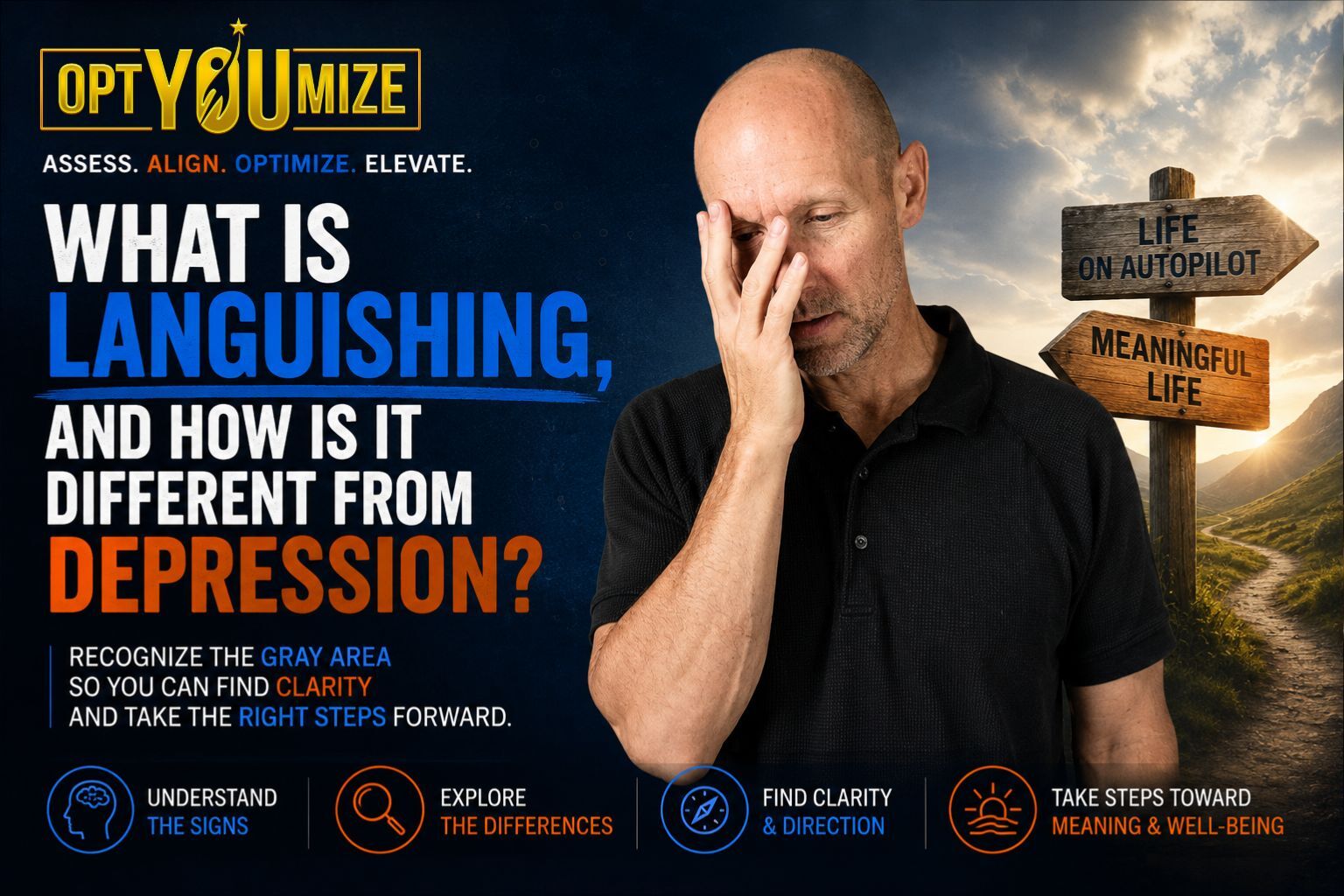
What Is Languishing, and How Is It Different From Depression?
By Brett Ingram | Last updated August 22, 2026 | 8-9 minute read
Here's the direct answer: languishing is a real, studied mental health state - not depression, and not just a mood. Psychologist Corey Keyes coined the term in a 2002 paper describing mental health as a full continuum rather than a simple presence-or-absence-of-illness switch. On one end sits flourishing: feeling good and functioning well. On the other end sits depression and other diagnosable conditions. Languishing sits in a third place entirely - not diagnosable, not dramatic, but a measurable dip in the positive feelings and sense of purpose that make life feel worth showing up for. If you're functioning fine on paper but everything feels a little muted, there's a real name for that, and it isn't "you're just being dramatic" or "you're secretly depressed and don't know it."
The Simple Answer: Languishing Is the Absence of Feeling Good, Not the Presence of Feeling Bad
The American Psychological Association defines languishing as a condition marked by ennui, apathy, listlessness, and a loss of interest in life. Notice what's missing from that list: sadness, hopelessness, worthlessness - the core markers clinicians look for in depression. Languishing isn't the presence of a negative state so much as the absence of a positive one. You're not in pain. You're just not particularly anywhere.
That distinction matters more than it sounds like it should, because it explains why languishing is so easy to miss in yourself. Depression tends to announce itself - it's loud, heavy, hard to ignore for long. Languishing is quiet. It doesn't interrupt your day. It just drains the color out of it, one ordinary Tuesday at a time, until you notice you can't remember the last time something felt genuinely good.
Where Did This Term Actually Come From?
Languishing isn't a piece of internet pop psychology - it comes from real research. In his 2002 paper "The Mental Health Continuum: From Languishing to Flourishing in Life," sociologist Corey Keyes argued that mental health shouldn't be measured on a single line running from "mentally ill" to "not mentally ill." Instead, he proposed two separate dimensions: the presence or absence of mental illness, and the presence or absence of mental health - meaning positive emotion, engagement, and a sense that your life has direction. Cross those two dimensions and you get people who are mentally ill but still find moments of meaning, and people with no diagnosable illness who are, by his measure, barely getting by. Using national data from the Midlife in the United States study, Keyes found a meaningful share of adults with no depressive episode who still scored low enough on positive functioning to be classified as languishing - proof that "not depressed" and "doing well" are not the same claim.
Languishing vs. Depression: What Actually Separates Them
These two get confused constantly, partly because both can involve low motivation and a flat affect. But they diverge in some important, practical ways.
| Languishing | Depression | |
|---|---|---|
| Core experience | Emptiness, flatness, "meh" - absence of positive feeling | Persistent sadness, hopelessness, or numbness - presence of negative feeling |
| Clinical status | Not a diagnosis - a subclinical dip in wellbeing | A diagnosable clinical condition with defined criteria |
| Daily functioning | Usually intact - work and relationships still happen, just without much spark | Often impaired - getting through basic tasks can feel genuinely hard |
| What tends to help | Small deliberate shifts in engagement, purpose, and connection | Often requires clinical treatment - therapy, medication, or both |
| Risk if ignored | Can be an early signal that, left unaddressed, may deepen over time | Can worsen without appropriate care and support |
One important caveat worth naming plainly: languishing and depression aren't mutually exclusive, and languishing is not a substitute diagnosis for something more serious. If low mood is accompanied by hopelessness, changes in sleep or appetite, or thoughts of self-harm, that's outside the scope of "languishing" and worth talking to a professional about directly.
Why Does It Suddenly Feel Like Everyone's Talking About This?
Part of it is timing. Languishing had been sitting in academic journals for nearly two decades before it broke into everyday conversation - it just took a widely shared moment of naming to make people realize the word applied to them. But the underlying condition it describes doesn't seem to be going anywhere. Gallup's State of the Global Workplace 2026 report found that global employee engagement fell to 20% in 2025 - its lowest level since 2020 - with daily stress remaining elevated across the workforce. None of that is a languishing diagnosis. But a workplace culture running on low engagement and high background stress is close to a manufacturing plant for the exact flatness Keyes described in 2002, long before anyone had a word for the specific ache of being fine and uninspired at the same time.
The Deeper Answer: Languishing Is a Signal, Not Just a Symptom
Here's the part that's easy to miss when languishing gets flattened into a trendy label: Keyes never framed it as a life sentence. He framed it as information. Mental health, in his model, moves - people shift between flourishing, moderate health, and languishing depending on how life is going, not because one state is permanent. Treated that way, languishing functions less like a diagnosis and more like a low-fuel light. It's not telling you the car is broken. It's telling you to stop ignoring the gauge.
What tends to trigger it isn't usually one dramatic event. It's more often a slow accumulation - work that stopped feeling like it mattered, relationships running on autopilot, days that are full but not full of anything you'd choose again. There's a scene in American Beauty where Lester Burnham says, "I feel like I've been in a coma for about twenty years, and I'm just now waking up." That's an exaggerated, cinematic version of languishing - the sense of having been present for your own life without quite being in it. Most people's version is smaller and less cinematic: a Sunday that felt like nothing, a promotion that didn't move the needle the way it was supposed to, a friendship that quietly went from monthly to occasional to a text you keep meaning to answer.
This is also where languishing overlaps with a habit covered in why you can't stop overthinking: a flat inner life often gets filled with low-grade mental noise, because an unoccupied mind doesn't stay unoccupied - it just finds smaller, less useful things to circle.
How to Tell If You're Languishing
A few honest questions tend to surface it faster than trying to name the feeling directly:
Can you point to the last time something felt genuinely good? Not fine, not "nice I guess" - actually good. If you have to think hard to answer that, that's worth paying attention to.
Are you going through motions that used to have meaning? Work, hobbies, relationships that once felt like yours but now feel like items on a list.
Would you describe your baseline mood as "flat" more than "bad"? Languishing tends to read as neutral-to-numb rather than distressed. If the honest word is "empty" or "meh" rather than "sad," that's a meaningful distinction.
Is anyone actually asking you how you're doing, and are you telling them the truth? Languishing is easy to hide precisely because "fine" is technically accurate. It's just not the whole answer.
What Actually Helps
Look for small pockets of real engagement, not big fixes. Keyes's framework ties flourishing to specific, buildable ingredients - positive emotion, a sense of purpose, quality connection, and feeling like you're contributing to something. None of those require overhauling your life. They require finding places to reintroduce them in small doses.
Name what actually mattered before it went flat. Languishing often follows a slow drift away from things that used to feel purposeful, not a sudden loss of them. Retracing that drift - honestly, not nostalgically - is closer to a diagnostic tool than most people expect. This is close to the territory covered in what a life audit actually is and how to run one: sometimes the fix starts with an honest look at where the time and attention have actually been going.
Check whether "busy" has replaced "engaged." It's entirely possible to have a packed calendar and still be languishing - busyness and meaning are not the same currency, a distinction explored in are you actually growing, or just staying busy. A full schedule can be one of the best places to hide from noticing you're languishing at all.
Rebuild one real connection before trying to fix everything. Isolation and languishing tend to travel together. A single honest conversation - not a group hang, not small talk - tends to move the needle faster than most self-improvement efforts attempted alone.
Treat it as worth addressing, not something to power through. Languishing doesn't require a crisis to justify attention. Waiting until it's bad enough to force a change is one of the more common ways people let a flat stretch turn into something heavier.
Frequently Asked Questions
Is languishing a real diagnosis?
No. It's a researched psychological concept, not a clinical diagnosis in the DSM. It describes a measurable dip in positive emotion and functioning that falls short of a mental illness but also falls short of genuine wellbeing - a real state, just not one a clinician would formally diagnose.
Can you be languishing and depressed at the same time?
Not by Keyes's original framework - his model defines them as distinct categories based on whether someone also meets criteria for a diagnosable condition like major depression. In practice, though, a prolonged period of languishing can be a precursor to something more serious, which is part of why it's worth taking seriously rather than dismissing as "just a phase."
What's the fastest way to tell if I'm languishing versus just tired?
Tiredness usually responds to rest. Languishing usually doesn't - you can sleep well, take a vacation, and still come back feeling just as flat. If rest alone hasn't touched the feeling, that's a signal it's more than fatigue.
Does languishing go away on its own?
Sometimes, if life circumstances shift. But Keyes's research suggests it more often responds to deliberate changes in engagement, purpose, and connection than to time passing on its own. Waiting it out tends to be a slower and less reliable path than actively addressing it.
Where This Goes From Here
You don't need a crisis to justify taking a flat stretch of life seriously. Languishing is exactly the kind of thing easy to talk yourself out of - nothing's technically wrong, so why make a fuss? But "nothing's wrong" and "things are good" are different sentences, and the gap between them is worth closing. Understanding which one you're actually living in is a quiet but real part of what Mind & Inner Life is about - paying enough attention to your own inner state to notice when "fine" has quietly become the ceiling instead of the floor, and doing something about it before it has to get worse to get your attention.