
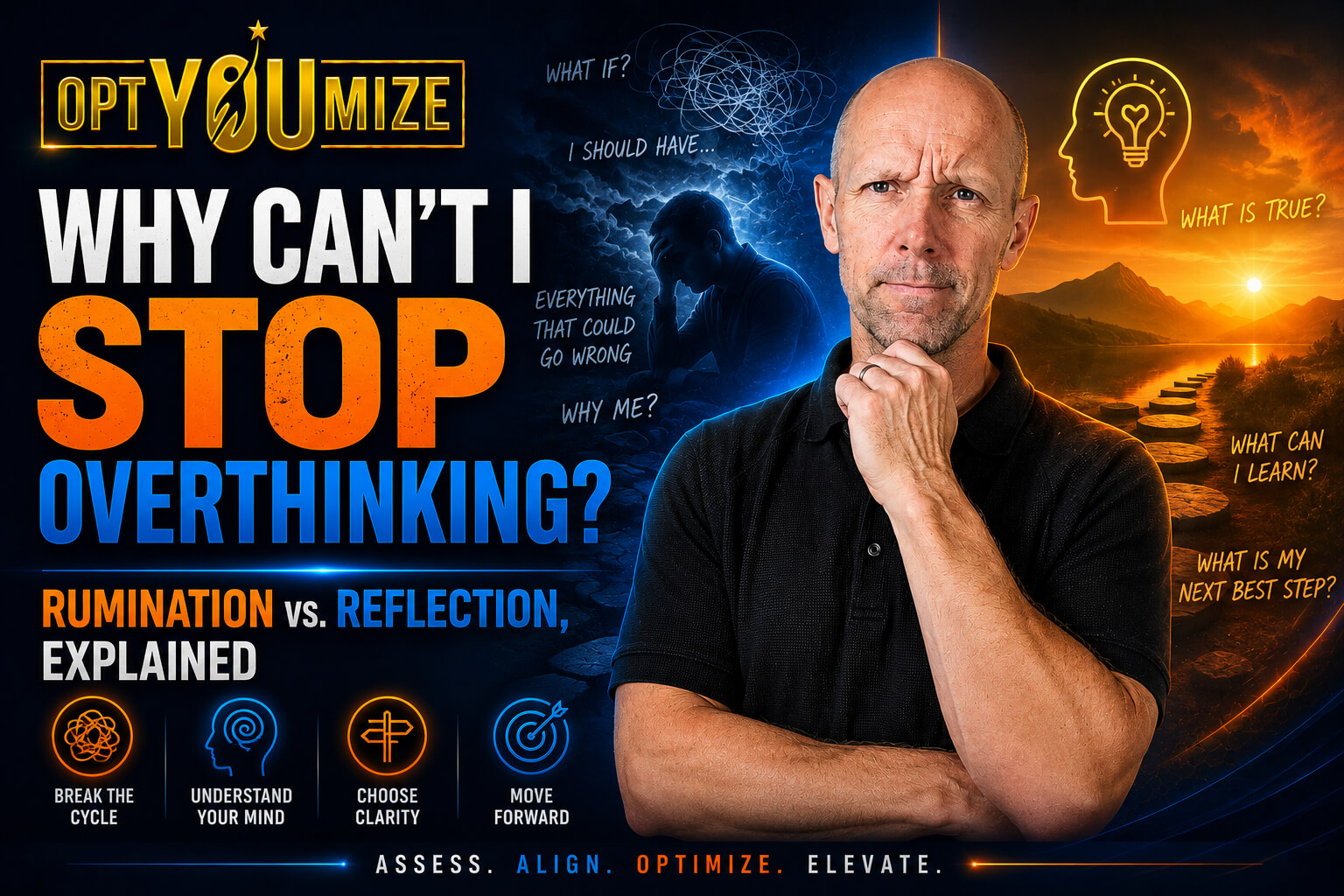
Why Can't I Stop Overthinking? Rumination vs. Reflection, Explained
By Brett Ingram | Last updated July 30, 2026 | 8-9 minute read
Here's the direct answer: you probably can stop, but not by trying to think your way out of it, because "thinking your way out of it" is usually the exact behavior keeping the loop alive. Psychologists draw a real, measurable line between two things people lump together as "overthinking." One is reflection - turning a problem over to actually understand it, which tends to resolve and then let go. The other is brooding - a passive, repetitive circling that feels like problem-solving but mostly just replays the problem. Most people who say they "can't stop overthinking" have drifted from the first into the second without noticing the handoff.
The Simple Answer: You're Not Overthinking. You're Doing One of Two Different Things.
"Overthinking" isn't a clinical term, and that's part of the problem - it flattens two different mental processes into one word. The American Psychiatric Association describes the more troublesome of the two, rumination, as repetitive thinking or dwelling on negative feelings and distress, along with their causes and consequences - thinking that keeps circling instead of moving toward resolution. That's different from sitting with a problem long enough to actually work it out. Both can look identical from the outside: someone staring at the ceiling at midnight. What's happening internally is not the same.
What Rumination Actually Is
The clearest research on this comes from psychologist Susan Nolen-Hoeksema, who spent much of her career studying what she called Response Styles Theory - essentially, what people do with their minds when something's bothering them. Her original finding, later refined by Treynor, Gonzalez, and Nolen-Hoeksema's 2003 psychometric study, was that rumination isn't one uniform habit. It splits into two distinct components with two very different outcomes.
Brooding is passive and comparative - thoughts like "why do I always react this way" or "why do I have problems other people don't have." It's moody pondering, measuring your situation against some standard you haven't hit, without doing anything to close the gap.
Reflection is purposeful - analyzing a situation to actually understand it, the way you might go over a decision to figure out what you'd do differently next time. In the 2003 study, reflection was linked to less depression over time. Brooding was linked to more of it, both immediately and months later. Same starting behavior - turning inward, thinking about a problem - with opposite trajectories.
Reflection vs. Brooding: The Distinction That Actually Matters
| Brooding | Reflection | |
|---|---|---|
| Core motion | Passive comparison to an unmet standard | Active analysis aimed at understanding |
| Typical thought | "Why do I always do this?" | "What actually happened, and what would I change?" |
| Relationship to time | Stuck - the same ground, revisited on a loop | Moving - each pass adds something, then it ends |
| Effect on mood over time | Associated with more depression, concurrently and later | Associated with less depression over time |
| How it ends | Doesn't, on its own - usually needs a deliberate interruption | Reaches a conclusion, even a partial one, and releases |
Groundhog Day, But at 11 p.m.
There's a reason Groundhog Day is the movie people reach for when they describe rumination, even if they've never used that word. Phil Connors doesn't get to leave February 2nd until something in how he approaches the day actually changes - repetition alone doesn't do it. He tries the same failed pitch to Rita a dozen different ways before anything shifts. That's brooding in a nutshell: replaying the day expecting the replay itself to produce a different outcome. It doesn't, until he stops circling and starts genuinely changing something about how he's showing up. Reflection is closer to the version of Phil who finally learns ice sculpture and piano - repetition that's actually building toward something, rather than just repeating.
Most people have their own smaller version of this. A conversation that seemed fine in the moment gets replayed on the drive home, then again in the shower, then again at 11 p.m. - not because new information keeps showing up, but because the loop itself has become the thing you're doing instead of whatever you were supposed to be doing. Nothing about pass four of the replay tells you anything pass one didn't.
Why Rumination Feels Productive, Even Though It Usually Isn't
This is the part that keeps people stuck. Rumination doesn't feel like avoidance - it feels like effort. Dr. Jacqueline Olds, a psychiatrist at Massachusetts General Hospital, put it plainly in a Harvard Health article on the topic: "Rumination is like getting stuck in a conversation with yourself." People keep doing it because they believe they'll eventually gain insight into whatever's bothering them. Sometimes that's true. More often, as Olds notes, the brain is tricking you into believing you're solving something, when thinking about a problem endlessly usually doesn't solve it - it just proves exhausting and steals focus from things you'd rather be doing.
There's a physical cost to this too, not just a mental one. The same article cites research linking rumination to greater vulnerability to anxiety, depression, insomnia, and worsened stress responses in the body. Olds is specific about the sleep piece: "If you're in bed for seven-and-a-half hours and spend two-and-a-half of it ruminating and only five hours sleeping, that's a problem." If you've ever wondered why you can log a full night in bed and still wake up wrecked, the hours your mind spent circling instead of resting are part of the answer - the same territory covered in why you're tired all the time, even when you're sleeping enough.
The Deeper Answer: What Rumination Is Actually Doing for You
The simple answer is that rumination and reflection are different processes wearing the same clothes. The deeper answer is that rumination usually shows up when you feel like you have little control over the thing bothering you. The original research behind the 2003 study found that people with a lower sense of mastery over the events in their lives, and those under more chronic stress, were more likely to ruminate. The brooding wasn't random - it was what was left when someone had a problem, no clear lever to pull on it, and a mind that needed somewhere to put the discomfort.
That reframes the question. "Why can't I stop overthinking" often isn't really about thought control at all. It's closer to: "Where in this situation do I actually have no leverage, and where have I stopped looking for it?" The loop is frequently standing in for a decision or an action you haven't let yourself take yet.
There's also a social-comparison flavor to a lot of brooding that's worth naming. A good chunk of the brooding items in the 2003 study - "why do I have problems other people don't have," wishing a situation had gone differently - are really about measuring yourself against other people or an imagined better version of events. That's closely related to a habit covered in how to stop comparing yourself to others: rumination and comparison often feed the same loop, just with different material.
How to Tell If You're Ruminating Right Now
A few honest questions tend to sort it out faster than trying to analyze the thought itself:
Is this pass adding anything the last pass didn't? Reflection produces something new each time - a detail you missed, a decision about what to do differently. Brooding produces the same conclusion on repeat.
Am I working toward a decision, or just revisiting a feeling? Reflection points somewhere. Brooding just stays where it is and gets louder.
Would explaining this out loud to someone take two minutes, or twenty? If the honest version is short and the mental version keeps expanding, that's usually the brooding talking.
What Actually Helps
Set a decision deadline, not a thinking deadline. "I'll think about this until I understand it" has no natural endpoint. "I'll decide what to do about this by Thursday" does. Deadlines convert open loops into ones that have to close.
Externalize it once, on purpose. Write down the actual situation and what you'd tell a friend in it. This does in five minutes what an hour of internal replay usually fails to do, because writing forces the vague feeling into specific, finishable sentences.
Interrupt with something that occupies attention, not just time. Scrolling doesn't reliably break a rumination loop because it leaves plenty of mental bandwidth free. A genuinely absorbing task - a hard conversation, a workout, a task with real stakes - competes for the same attention the loop is using.
Notice when the loop is standing in for an action. If you've replayed the same scenario more than three times without a new conclusion, ask what you're avoiding deciding or doing. Often the rumination is more comfortable than the decision it's circling.
Watch your evenings specifically. Rumination tends to spike when you're already depleted, which is also when your capacity to catch yourself doing it is lowest - the same dynamic behind why decision fatigue wins by evening. If your loops reliably show up after 9 p.m., the fix may have less to do with willpower and more to do with not making it the hour you process anything important.
Frequently Asked Questions
Is overthinking the same as rumination?
Not exactly. "Overthinking" is the casual, catch-all term. Rumination is the specific psychological pattern - repetitive, passive dwelling on distress and its causes - that overthinking usually refers to. Reflection, the more useful cousin, gets lumped into the same word even though it behaves very differently.
Is rumination a sign of a mental health condition?
Not on its own, but it's associated with several. The American Psychiatric Association notes rumination commonly occurs alongside depression, anxiety, and obsessive-compulsive disorder, and can worsen existing conditions. Occasional rumination after a stressful event is common and not automatically a diagnosis - the frequency, duration, and whether it's interfering with daily life are what matter.
Why does rumination feel like it's helping me solve a problem?
Because your brain reads effortful thinking as productive thinking, even when it isn't. Psychiatrist Dr. Jacqueline Olds describes this as the brain "tricking you into believing you're figuring out something useful." Real problem-solving reflection tends to reach conclusions and stop. Rumination keeps generating the same material without resolution.
What's the fastest way to interrupt a rumination loop?
Distraction that genuinely occupies attention - not passive distraction like scrolling. Exercise, a real conversation, or a task with actual stakes works better than anything that leaves your mind free to keep circling in the background.
How much rumination is too much?
There's no universal number, but a useful gut check is whether the thinking is blocking out everything else or costing you sleep and function. If you can't tell anymore whether you're processing something or just stuck in it, that's usually a sign it's time for outside support rather than another solo attempt to think your way clear.
Where This Goes From Here
You don't need to eliminate this kind of thinking - reflection is genuinely useful, and some replaying is just how minds process things that mattered. What's worth changing is the automatic assumption that more circling equals more understanding. It usually doesn't. Knowing the difference between the loop that's building something and the loop that's just spinning is one of the more practical pieces of self-knowledge there is, and it's a small but real part of what Mind & Inner Life is actually about: understanding how your own mind works well enough to stop mistaking its noise for its signal.