
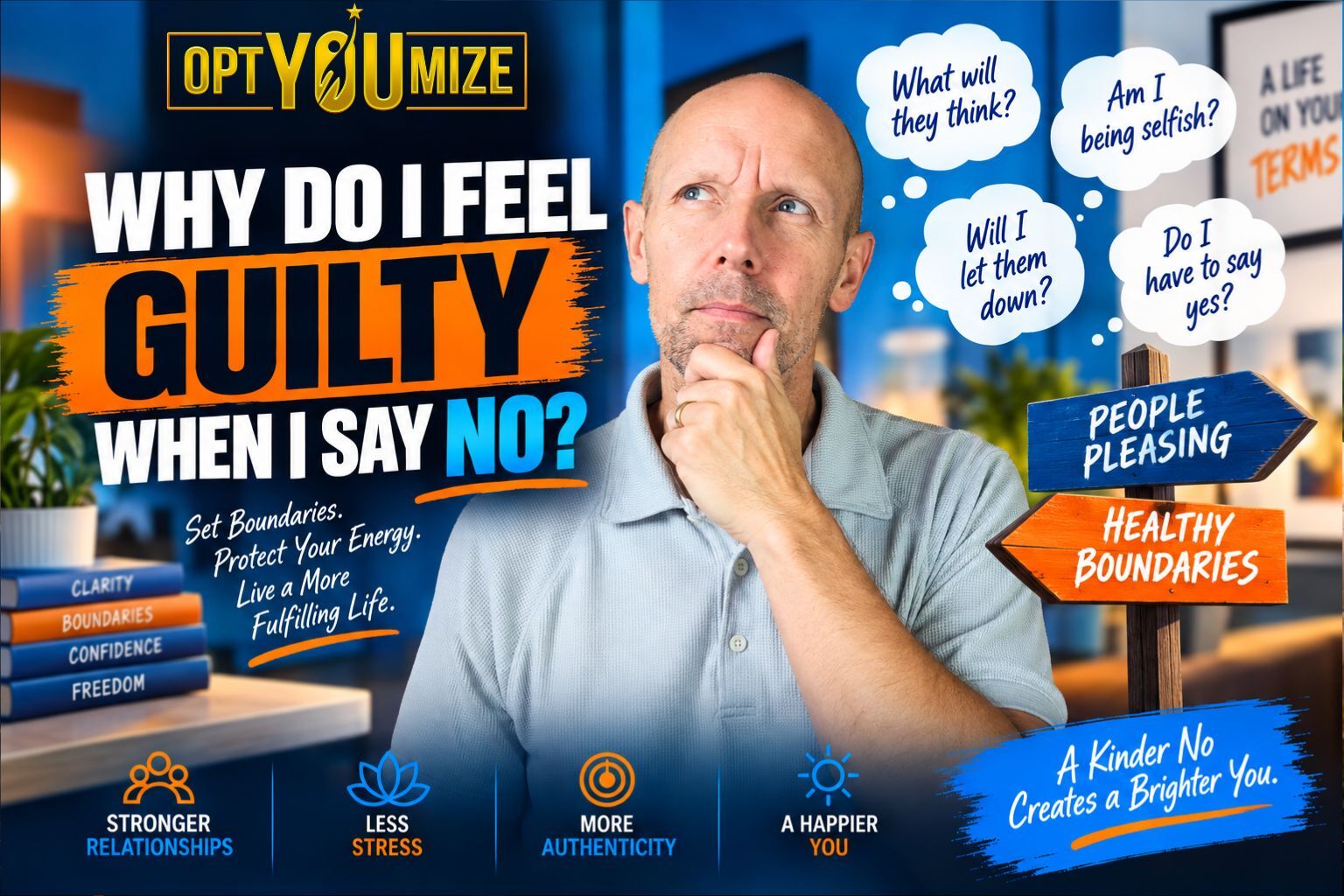
Why Do I Feel Guilty When I Say No?
~17 min | September 8, 2026
You feel guilty when you say no because your nervous system is built to protect belonging, because refusing someone to their face is genuinely uncomfortable in the moment, and because many of us were trained early that being good meant being agreeable. But guilt is not a verdict — it's information. In this episode, Brett Ingram makes the case that the goal was never to stop feeling guilty when you set a boundary. It's to read the guilt accurately: to tell the difference between guilt that's pointing at a real value you'd be betraying and guilt that's just an old alarm going off. One is the fire. The other is just smoke from the toaster.
What You'll Learn in This Episode
- Why the hard part of saying no isn't the sentence — it's the eight hours afterward
- Three reasons a completely fair "no" still produces guilt, none of which mean something is wrong with you
- Why "kill the guilt, here are five scripts" advice quietly makes you colder instead of freer
- The difference between guilt and shame — and why guilt is actually the more useful of the two
- The smoke detector test: how to tell the alarm from the fire before you evacuate the house
- Three questions for reading the guilt: whose voice is this, what am I protecting, and is there a no that keeps the relationship
- What a "warm no" sounds like — declining the ask without declining the person
- The one-no experiment for teaching your nervous system that a refusal is survivable
- When the guilt is actually right, and this framework should not be used to justify the no
Episode Timestamps
[00:00]Introduction — the no you're still carrying around[01:30]The moment before you answer, and the long tail of guilt[03:00]Reason one: the human need to belong[04:00]Reason two: refusing people is harder than we admit[05:00]Reason three: trained to be easy[06:00]Where "just kill the guilt" advice goes wrong[07:20]Guilt vs. shame — guilt is information, not a verdict[09:40]Reading the guilt: three questions to run[10:50]The warm no — no to the ask, yes to the person[12:20]The pause and the one-no experiment[14:00]When the guilt is actually right[15:00]Key takeaways: fire or smoke
Episode Summary
You said no. It was reasonable. Small, even. And somehow you've spent the last three hours carrying it around like you kicked a puppy. Brett Ingram opens this episode on that exact sensation — the low-grade static that follows a perfectly fair refusal — and points out the backwards math most of us run without noticing: I feel guilty, therefore I must have been selfish. From there we cave, over-apologize, or say yes next time before we've even thought about it.
Why does a fair no produce so much guilt? Three reasons, none of which mean anything is wrong with you. The first is wiring: Roy Baumeister and Mark Leary described a fundamental human "need to belong," and because being cast out of the group was once genuinely dangerous, your nervous system treats disappointing someone as a threat. That flinch, Brett says, is "very old software doing exactly what it was designed to do" — your brain hasn't gotten the memo that being left off a group text isn't life-threatening. The second comes from psychologist Vanessa Bohns, whose research across thousands of participants found we massively underestimate how hard it is for someone to refuse a direct request to their face. Refusing feels almost physically uncomfortable, so people agree to things they'd rather not do just to escape it — which means a lot of your yeses were never really choices. The third is conditioning: many of us were praised as kids for being easy, helpful, agreeable, "such a good kid." Brett shares his own version, running a business where seven employees brought him every problem — a terrible way to operate, but it felt good, because being needed felt like being useful.
Then comes the pushback. The internet's confident answer is that guilt is the enemy: kill it, boundaries are self-care, memorize these five scripts. Brett argues that treating guilt as pure malfunction gets something quietly wrong. If your only goal is to feel nothing when you say no, you don't become free — you become colder, treating people who need things from you as threats to be managed rather than people you're in relationship with. You win the boundary and lose the warmth. Yes Man makes the point: the Jim Carrey premise is that unlimited yes cracks your life open, but the joke of the film is that unlimited yes is its own prison — and unlimited guilt-free no isn't freedom either. It's just a wall with good branding.
The reframe the episode turns on is this: guilt is not a verdict, guilt is information. To use it, Brett draws on June Tangney's decades of research separating guilt from shame. Shame says I am bad; guilt says I did something bad. Guilt is the more adaptive of the two, because it points outward toward repair while shame collapses inward. Real guilt shows up when you've violated one of your own values. Most of the guilt that follows an honest no isn't that — it's the belonging alarm firing on reflex. It feels identical, but it's pointing at nothing. Like a smoke detector: sometimes fire, sometimes you left the toast in too long, and your job is to check which before you evacuate the house.
To check, Brett offers three questions he calls reading the guilt. Whose voice is this in? Real values sound like you; old conditioning sounds like someone else. What am I protecting by saying no? Sometimes a no guards your health, your family's time, a commitment you already made — sometimes it just guards you from mild discomfort. Both can be valid, but you should know which you're doing. Is there a no that keeps the relationship? This is the one people skip, and it's where the difference between connection and performance in relationships gets real. He illustrates it with a story from Stephen Covey's The 7 Habits of Highly Effective People: Covey's wife, asked to chair a committee, declines cleanly and warmly — thanking them for the honor, saying she won't participate this year, asking to be kept updated. No wishy-washy "check back with me," no wound left behind. No to the ask, yes to the person.
The practice has two parts. A pause: when a request lands and you feel the drop, buy the smallest amount of time — "let me check and get back to you" — and run the three questions in that gap. You're not committing to no; you're refusing to say yes on reflex. And an experiment: sometime this week, say one honest no you'd normally guilt yourself out of, then watch what actually happens. Bohns' research predicts the catastrophe you're bracing for almost never arrives. Most of the time the other person says "no problem" and moves on, and you're left holding all that dread you rented for nothing.
Brett closes with a caveat. Sometimes the guilt is right — sometimes a no is avoidance dressed up as a boundary, correctly telling you that you pulled away from someone you wanted to show up for. This is a machine for telling the difference, not for justifying every no. "This is a lens," he says. "It's not a law." The question he leaves listeners with isn't how to stop feeling guilty. It's better than that: the next time the guilt shows up after a no, is this the fire, or is this just the smoke? Learn to tell the difference and you get to keep two things most people think you have to choose between — your boundaries and your warmth.
Resources Mentioned
- Roy Baumeister & Mark Leary — "The Need to Belong" — the foundational social psychology paper on belonging as a fundamental human motivation — https://roybaumeister.com/1995/10/15/the-need-to-belong-desire-for-interpersonal-attachments-as-a-fundamental-human-motivation/
- Vanessa Bohns (Cornell) — research on the difficulty of saying no — studies showing we underestimate how hard it is to refuse a direct request — https://www.vanessabohns.com/research
- June Tangney — research on guilt vs. shame — decades of work distinguishing "I did something bad" from "I am bad" — https://www.apa.org/news/podcasts/speaking-of-psychology/guilt-shame
- The 7 Habits of Highly Effective People by Stephen Covey — source of the story about a clean, warm no to a committee request
- Yes Man (2008) — Jim Carrey film referenced for the fantasy that unlimited yes opens your life up
Frequently Asked Questions
Why do I feel guilty when I say no, even when saying no was completely fair? Three things stack on top of each other. Humans have a fundamental need to belong, so your nervous system reads "I might disappoint someone" as a genuine threat. Refusing a direct request is genuinely uncomfortable in the moment — more than we admit. And many of us were rewarded early in life for being easy and agreeable. The guilt isn't evidence you did something wrong. It's those three systems doing exactly what they were built to do.
Is it selfish to say no? Not by itself. A no is only selfish if it violates a value you actually hold or a commitment you actually made. Most of the nos people agonize over don't do that — they simply decline something you didn't have room for. A yes you resent isn't a gift anyway; it's a bill you hand the other person later.
What's the difference between guilt and shame? Guilt says "I did something bad." Shame says "I am bad." One is about a specific act, the other is about your character. Psychologist June Tangney's research found guilt is the more adaptive of the two, because it points outward toward the other person and toward repair, while shame collapses inward on the self. Confusing the two is what turns a small no into a referendum on who you are.
How do I know if the guilt I feel after saying no is worth listening to? Ask whether it's pointing at a value you actually betrayed. Real guilt shows up when you blew off a friend who genuinely needed you or broke a real promise — it's pointing at something specific. Reflex guilt shows up after any refusal at all and points at nothing. It's the smoke detector: sometimes fire, sometimes toast. Your job is to check which before you act on it.
What are the three questions for reading the guilt? One: whose voice is this in — a real obligation you'd stand behind in daylight, or a rule you absorbed a long time ago? Two: what am I protecting by saying no — something genuine like your health or your family's time, or just yourself from mild discomfort? Three: is there a no that keeps the relationship — a way to decline the ask while still honoring the person?
What does a "warm no" actually sound like? It declines the request and honors the person in the same breath: "I can't take this on, and I really want to hear how it goes." Or, "I can't do a call this month, but send me the specific question and I'll give you a real answer by text." The key is that it's clean — no vague "check back with me in a week" that forces you to say no twice and leaves them waiting.
How do I stop feeling guilty for saying no to family? The goal isn't to stop feeling it — it's to stop automatically obeying it. Family requests carry the heaviest conditioning, so the guilt will be loudest there. Use the pause: "let me check and get back to you," then run the three questions before you answer. Start with a small, low-stakes no and watch what actually happens, because the reaction you're bracing for usually doesn't arrive.
Can guilt after a boundary ever mean I actually did something wrong? Yes, and the episode is explicit about this. Sometimes a no is avoidance, fear, or self-protection dressed up as a boundary, and the guilt is correctly telling you that you pulled away from someone you wanted to show up for. This framework is for telling the difference, not for justifying every refusal.
Keep Exploring
If this episode resonated, these are worth your time:
- Relationships & Connection — the pillar this episode belongs to, on the difference between connection and performance in the relationships that matter most → https://www.optyoumize.com/relationships-connection
- Mind & Inner Life — the inner narrative that turns a small "no" into a verdict on your character → https://www.optyoumize.com/mind-inner-life
- Why Can't I Stop Replaying That Conversation in My Head? — the same long-tail rumination this episode describes, examined on its own terms
- Why Am I Kinder to Strangers Than the People I Love? — another look at how the instinct to be easy shapes your closest relationships
Enjoyed This Episode?
The best way to support optYOUmize is to subscribe and leave a review — it takes about two minutes and makes a real difference in helping more people find the show.
Apple Podcasts · Spotify · Amazon Music · YouTube